
Understanding Massachusetts Property Line and Fence Rules
Learn how Massachusetts law regulates fences, boundary lines, neighbor disputes, and spite fences before you build or remove a fence.
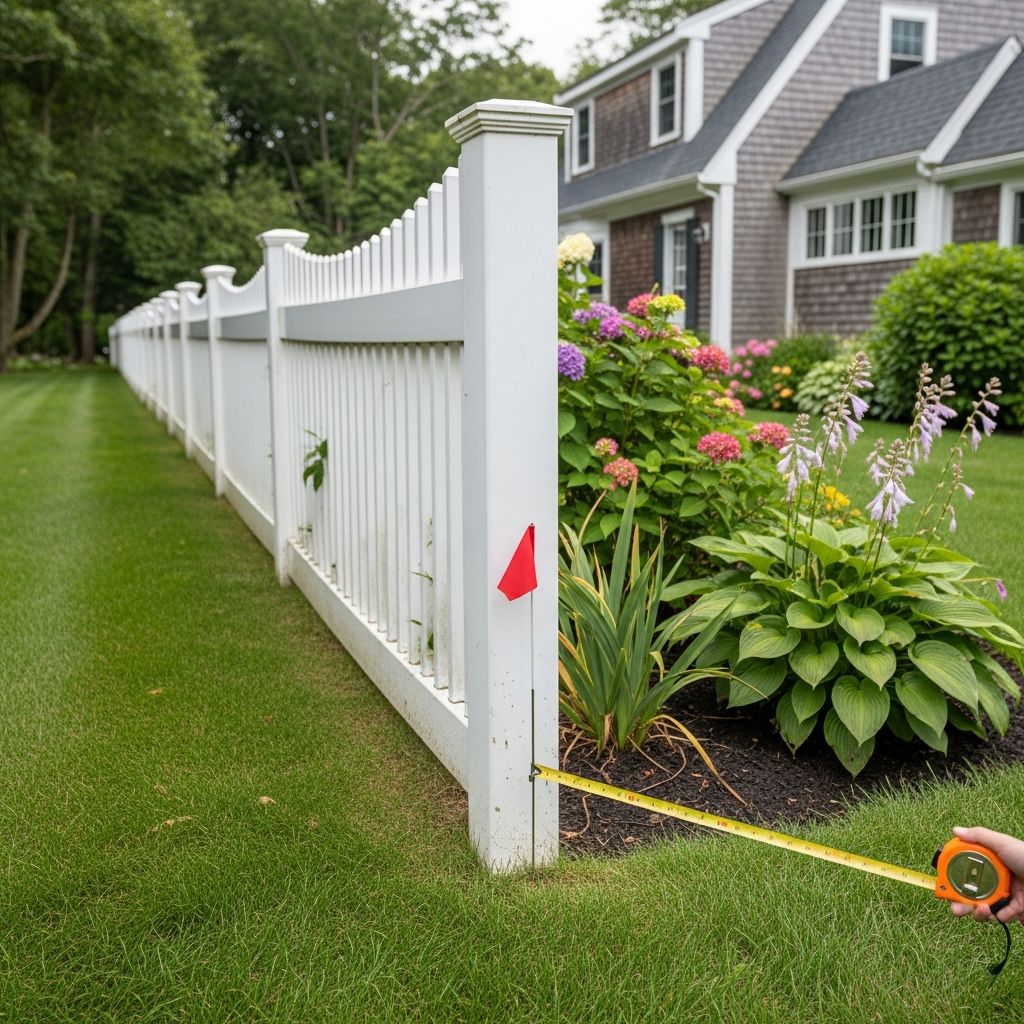
Massachusetts property owners often discover that fences and boundary lines raise legal questions as soon as a new fence is installed, an old one falls down, or a neighbor objects. This guide explains the core rules under Massachusetts law and local regulations so you can plan, build, maintain, or dispute a fence with confidence.
1. Why Property Lines Matter Before You Build
Every fence decision starts with understanding where your land ends and your neighbor’s begins. Property lines are legal boundaries described in your deed and often shown on a survey or plot plan. Accurate boundaries help you avoid encroachment, potential lawsuits, and costly fence relocation.
1.1 How to Confirm Your Property Boundary
To avoid disputes, consider the following steps before installing or moving a fence:
- Review your deed and plot plan for metes-and-bounds descriptions or survey markers.
- Check prior surveys that may have been done during a previous sale, subdivision, or construction permit.
- Hire a licensed land surveyor if the location is unclear, the lot is irregular, or a neighbor contests the boundary.
- Compare records from your municipality’s assessor or registry of deeds to confirm consistency.
Local building departments and assessors often have plot plans on file, but these are not a substitute for a formal boundary survey in a contested situation.
1.2 Encroachment and Adverse Possession Risks
If a fence has been over the line for many years, it can affect ownership rights. Under the Massachusetts doctrine of adverse possession, a person who openly, continuously, and adversely uses another’s land for at least 20 years may be able to claim legal title to that portion of the property. This sometimes arises when a fence is built incorrectly and both neighbors treat it as the true boundary for decades.
Because adverse possession claims are complex and fact-specific, property owners facing such an issue should consult an attorney experienced in Massachusetts real estate law.
2. What Counts as a Legal Fence in Massachusetts?
Massachusetts has statewide rules for what is considered a “legal and sufficient” boundary fence, mainly in Chapter 49 of the General Laws.
2.1 Minimum Requirements for a Legal Fence
Under Massachusetts law, a fence is generally recognized as legal if it meets all of the following criteria:
- At least 4 feet high from the ground.
- In good repair and reasonably sturdy.
- Constructed of typical boundary materials such as rails, timber, boards, iron, or stone, or other structures that local officials (“fence viewers”) consider equivalent.
These standards apply mainly to boundary or partition fences between neighboring properties, not necessarily decorative interior yard features.
2.2 Typical Height Limits and Local Variations
State law defines what is sufficient for a boundary fence but does not set universal maximum heights for every property. Cities and towns usually set specific height limits and permit thresholds in zoning or general bylaws. Common patterns include:
- Backyard fences commonly limited to around 6 feet in many communities.
- Front yard fences often limited to about 3.5–4 feet to preserve visibility.
- Corner lots and intersections frequently subject to special rules so that fences, walls, or hedges near street corners do not block drivers’ sight lines.
- Permit requirements triggered when fences exceed a certain height, such as 6 or 7 feet, depending on the municipality.
Always check your local zoning office, building department, or online ordinances because local rules can be stricter than state law and may set specific height, setback, and design restrictions.
3. Shared Boundary Fences: Ownership and Responsibility
When a fence sits directly on the property line between two parcels, Massachusetts generally treats it as a partition fence. Both adjoining owners share rights and responsibilities, unless they have agreed otherwise in writing.
3.1 What Is a Partition Fence?
Under Massachusetts General Laws Chapter 49, partition fences are those on the dividing line between lands of different owners. Key implications include:
- Shared ownership of the fence structure itself.
- Shared maintenance obligations unless an agreement or deed provision assigns responsibility differently.
- Shared cost of construction, repair, and necessary replacement, typically split equally between neighbors.
Chapter 49 also addresses situations where one owner fails to maintain a required partition fence and allows the other to seek contribution through formal procedures involving local fence viewers.
3.2 Private Agreements About Fence Costs
Neighbors can adjust the default rule by mutual agreement. Common approaches include:
- One owner paying the full cost in exchange for design control or written recognition of sole maintenance responsibility.
- Written agreements recorded in the land records, clarifying how repairs and replacements will be handled.
- Allocation of a specific portion (for example, the rear 50 feet) to one owner for upkeep.
To avoid future misunderstandings, any such agreement should be written, signed, and preferably recorded with the county registry of deeds.
4. Spite Fences and Nuisance Claims
Massachusetts has a specific statute targeting fences built primarily to irritate or harm neighbors, often called spite fences. These structures can be treated as a private nuisance and may be subject to court-ordered removal or damages.
4.1 Legal Definition of a Spite Fence
Under Massachusetts General Laws Chapter 49, Section 21, a fence or similar structure is considered a private nuisance if it meets all of the following elements:
- Height unnecessarily exceeds 6 feet.
- Maliciously erected or maintained, meaning the primary purpose is to annoy or harm the adjoining owner or occupant.
- Located near the boundary and affects the neighboring property.
The law focuses on intent and unnecessary height. A tall fence necessary for safety, privacy, or other legitimate reasons is not automatically illegal simply because a neighbor dislikes it.
4.2 Remedies for Spite Fences
A neighbor harmed by a spite fence may file a civil action in court, seeking:
- Damages for the nuisance (such as loss of property value or enjoyment).
- Injunctive relief ordering the fence lowered, altered, or removed.
Court decisions are highly fact-dependent and will consider the fence’s purpose, design, context, and local zoning rules.
5. Local Regulations, Permits, and Special Districts
Massachusetts state law sets baseline standards, but local governments often add more detailed rules for fence height, placement, and appearance. Failure to comply can lead to stop-work orders, fines, or orders to adjust or remove the fence.
5.1 Typical Local Rules to Check
Before installing or changing a fence, review your town or city’s requirements for:
- Maximum heights for front, side, and rear yard fences.
- Setbacks, including how close a fence can be to the street, sidewalk, or property line.
- Corner-lot visibility regulations limiting fence height in a visibility triangle near intersections.
- Material and design restrictions in certain zoning districts or historic areas.
- Permit thresholds based on fence height or location (for example, permits required for fences above 6–7 feet).
5.2 Historic Districts and Conservation Areas
Properties located in a local historic district, scenic road overlay, or conservation area may be subject to additional review from commissions or boards before a fence can be installed or changed. These bodies may regulate:
- Fence style and material compatibility with historic character.
- Impact on protected natural resources or open space.
Owners in such areas should contact the local historic district commission or conservation commission early in the planning process.
6. Practical Issues: Maintenance, Damage, and Removal
Once installed, fences must be properly maintained to avoid legal and safety problems. Disagreements often arise over who must pay for repairs, how much must be done, or whether a fence may be removed.
6.1 Ongoing Maintenance Obligations
For partition fences located on the boundary line, both owners are normally responsible for keeping the structure in legal and safe condition. State law provides procedures for compelling an uncooperative neighbor to share costs when a partition fence is required but neglected.
For fences entirely on one owner’s side of the line, that owner usually bears full maintenance responsibility; however, local bylaws and private agreements can affect this general rule.
6.2 Can You Remove or Replace a Neighbor’s Fence?
Removing a fence that belongs wholly or partly to someone else can expose you to liability for property damage or trespass. Best practices include:
- Confirming exact ownership and fence location through survey and deed review.
- Documenting the fence’s condition, including photographs and repair estimates.
- Sending written notice and attempting to reach an agreement about repair, relocation, or removal.
- Seeking legal advice or using local “fence viewers” or mediation if negotiations fail.
Never unilaterally demolish or substantially alter a fence that may be a shared partition fence without professional legal guidance.
7. Property Lines, Easements, and Access Rights
Some fence conflicts arise because of existing easements and access rights rather than simple line-placement errors. An easement allows another person (such as a neighbor or utility company) to use a portion of your land for a specific purpose, like access to a landlocked parcel or placement of utility lines.
7.1 Common Types of Easements
In Massachusetts, you may encounter:
- Driveway or access easements allowing one owner to cross another’s land to reach a public road.
- Utility easements for power, water, sewer, or cable lines.
- Prescriptive easements, acquired through long-term use similar to adverse possession but relating to use, not ownership.
Fences built across or too close to an easement corridor may need to be moved if they unreasonably interfere with the easement holder’s rights.
8. Neighbor Relations and Dispute-Resolution Tips
While Massachusetts law provides formal remedies, many fence problems are best resolved through communication rather than litigation.
8.1 Preventing Fence Disputes
Before building or altering a fence, consider these preventive measures:
- Discuss plans with your neighbor and share sketches or plot plans.
- Obtain a professional survey when there is any doubt about the boundary.
- Confirm local height, setback, and permit requirements in writing from your municipality.
- Put cost-sharing or maintenance agreements into a written document signed by both parties.
8.2 Using Fence Viewers and Mediation
Massachusetts maintains the traditional office of fence viewers, local officials who can inspect fences, determine sufficiency, and help resolve certain boundary-fence disputes under Chapter 49. In addition, many communities offer or refer parties to mediation programs that may help neighbors reach a mutually acceptable solution without going to court.
9. Quick Reference Table: Key Massachusetts Fence Concepts
| Issue | General Massachusetts Rule | Where to Check Details |
|---|---|---|
| Minimum legal boundary fence | At least 4 feet high, in good repair, made of common boundary materials or equivalents. | M.G.L. c. 49, §4; local bylaws. |
| Typical maximum residential height | Often about 6 feet in backyards; lower in front yards. | Local zoning and general bylaws. |
| Partition (shared) fence | Fence located on the boundary; costs and maintenance usually shared. | M.G.L. c. 49; private agreements; deeds. |
| Spite fence | Unnecessarily exceeds 6 ft and maliciously built to annoy neighbor; treated as a nuisance. | M.G.L. c. 49, §21; court decisions. |
| Adverse possession | 20+ years of open, notorious, exclusive, and adverse use may create ownership claim. | M.G.L. c. 260, §21; case law; legal counsel. |
Frequently Asked Questions (FAQs)
Q1: Do I need my neighbor’s permission to build a fence in Massachusetts?
State law does not always require your neighbor’s consent to build a fence entirely on your own land, but if the fence is on the boundary line (a partition fence) or you expect to share costs, you should obtain their agreement in writing. Local permitting rules may still apply.
Q2: How close to the property line can I put my fence?
Massachusetts state law allows boundary fences at the property line, but many professionals recommend installing slightly inside your line to allow maintenance access and reduce boundary disputes. Local zoning ordinances may also impose setbacks from streets or sidewalks, so always check with your municipality.
Q3: Who owns the fence between two houses?
If the fence is built directly on the property line, Massachusetts generally treats it as a partition fence that belongs to both neighbors, with shared responsibilities for upkeep unless a written agreement or deed provision says otherwise.
Q4: Can I force my neighbor to pay for half of a new fence?
If a legal partition fence along a common boundary is necessary under Chapter 49, each owner can typically be required to contribute to construction and maintenance, and fence viewers or a court can help resolve disputes. However, if you propose a fence that exceeds what the law or local practice requires, you may not be able to compel your neighbor to share the cost.
Q5: What can I do if my neighbor’s fence blocks my view or sunlight?
Massachusetts law does not generally guarantee a right to a view, but if the fence unnecessarily exceeds 6 feet and is maliciously built to annoy you, it may qualify as a spite fence and a private nuisance under M.G.L. c. 49, §21. A lawyer can advise whether your situation meets that standard and whether you might seek damages or an order to alter the fence.
References
- Massachusetts law about neighbors and trees (including fences) — Mass.gov. 2024-01-08. https://www.mass.gov/info-details/massachusetts-law-about-neighbors-and-trees
- Massachusetts General Laws, Chapter 49: Fences, Fence Viewers, Pounds and Field Drivers — Massachusetts Legislature. 2023-07-01. https://malegislature.gov/Laws/GeneralLaws/PartI/TitleVII/Chapter49
- General Fence Guidelines — Town of North Attleborough, MA. 2022-04-15. https://www.nattleboro.com/813/General-Fence-Guidelines
- Can I Build a Fence on My Property Line and How High? — Town of Acton, MA. 2021-09-10. https://www.acton-ma.gov/FAQ.aspx?QID=82
- Property Boundaries and Easements: Avoiding Legal Pitfalls When Buying a Home in Massachusetts — Ligris + Associates PC. 2025-07-01. https://www.ligris.com/2025/07/property-boundaries-and-easements-avoiding-legal-pitfalls-when-buying-a-home-in-massachusetts/
- Fence Disputes: Five Things Every Massachusetts Property Owner Should Know — The Sherwin Law Firm. 2020-03-05. https://sherwinlawfirm.com/fence-disputes/
- Massachusetts Property Fencing Laws for Home Owners — Townsquare Media (WOKQ). 2023-05-11. https://wokq.com/who-legally-owns-the-fence-between-two-houses-in-massachusetts/
Similar Articles








Read full bio of Sneha Tete


