
Maine Service Dogs and Assistance Animals Guide
Comprehensive guide to Maine's regulations on service dogs, emotional support animals, public access, housing rights, and owner responsibilities.
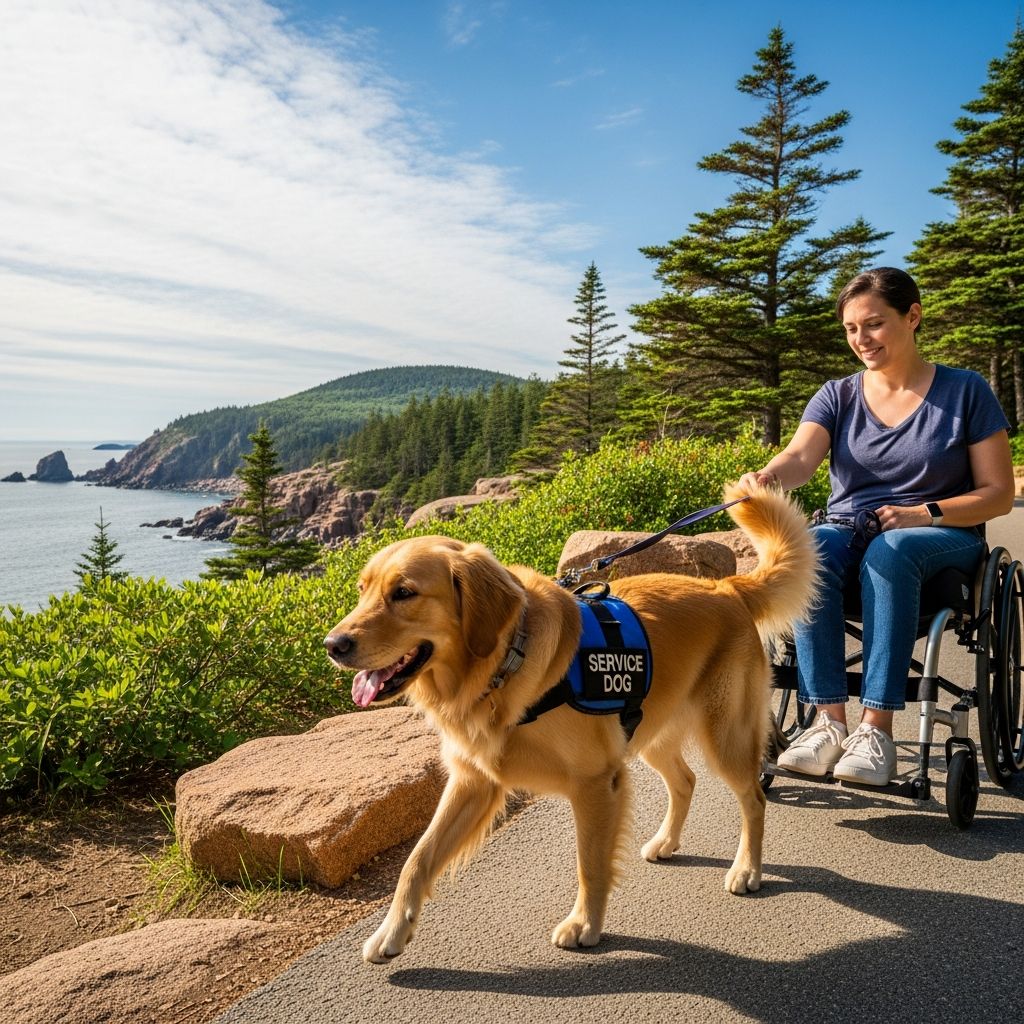
Maine law provides robust protections for individuals with disabilities who rely on service dogs and assistance animals, ensuring access to public spaces and housing without discrimination. These regulations align with federal standards like the Americans with Disabilities Act (ADA) while incorporating state-specific provisions under the Maine Human Rights Act and White Cane Law.
Defining Service Animals Under Maine Regulations
In Maine, a
service animal
is narrowly defined as a dog individually trained to perform specific tasks or work that directly mitigates a person’s disability, which may be physical, sensory, psychiatric, intellectual, or mental. This definition, found in the Maine Human Rights Act (Me. Rev. Stat. tit. 5, § 4553(9-E)), applies primarily to public accommodations and excludes other species, whether trained or not. Federal ADA rules similarly limit service animals to dogs (and occasionally miniature horses) trained for disability-related tasks (28 C.F.R. § 36.104).Distinct from pets, service animals must demonstrate task-training, such as guiding the visually impaired, alerting to seizures, or interrupting harmful behaviors in psychiatric conditions. Emotional support animals (ESAs), which provide comfort through presence alone, do not qualify as service animals under these laws and lack public access rights.
Public Access Protections for Service Dogs
Service dogs must be permitted in all places open to the public, including retail stores, restaurants, hotels, theaters, medical facilities, and government buildings. Maine’s Human Rights Act lists 14 specific public accommodation types (Me. Rev. Stat. tit. 5, § 4553(8)), while the White Cane Law extends coverage to public transportation and invited public venues (Me. Rev. Stat. tit. 17 § 1312(3)). Businesses cannot impose pet fees, require proof of training, or deny entry based on breed, size, or appearance.
- No extra charges: Public venues may not levy special fees for service animals, though owners are liable for any damage caused (Me. Rev. Stat. tit. 5, § 4592(8)).
- Verification questions: Staff may only ask two questions: (1) Is the dog a service animal required for a disability? (2) What tasks does it perform? No demonstrations or documentation are required.
- Service dogs in training (SDITs): Maine’s White Cane Law grants access to SDITs when handled by professional trainers (Me. Rev. Stat. tit. 17 § 1312(4)).
Exclusion is permitted only if the animal poses a direct safety threat, is uncontrollable, or lacks house training, but the handler must still be allowed entry without the animal.
Housing Rights for Assistance Animals
Maine’s fair housing laws under the Human Rights Act prohibit discrimination against tenants needing assistance animals, defined more broadly to include service animals and ESAs that alleviate disability symptoms (Me. Rev. Stat. tit. 5, § 4582-A). Landlords must make reasonable accommodations, waiving no-pet policies and fees, even for multiple animals or non-dog species.
Requests require reliable documentation from a healthcare provider verifying the disability and need, but no specific training certification for ESAs. Landlords are protected from liability for injuries or damages caused by assistance animals (14 Me. Rev. Stat. § 6030-G).
| Aspect | Service Animals (Public) | Assistance Animals (Housing) |
|---|---|---|
| Species | Dogs only (mini horses federal) | Any reasonable animal |
| Training Required | Task-specific training | Service: yes; ESA: no |
| Access Rights | Public places | Housing units |
| Fees | Prohibited | Prohibited (damage liable) |
Workplace Policies for Service Animals
State agencies like the Maine Attorney General’s Office permit service animals as reasonable accommodations under review by EEO coordinators. Animals must be licensed, vaccinated, trained by reputable organizations, and exhibit calm behavior in testing scenarios.
- Licensed by municipal clerk or vet agent.
- Current on vaccinations.
- Evaluated for temperament around people, children, noises.
- Controlled via leash, crate, or voice; no aggression or disruption.
- Ideally identifiable by vest.
Handlers bear full responsibility for care; violations lead to removal. Private employers follow ADA guidelines for accommodations.
Misrepresentation Penalties and Licensing Benefits
Maine’s Model White Cane Law criminalizes falsely claiming an animal as a service or assistance animal (17 Me. Rev. Stat. § 1314-A), a civil violation with fines. Service dogs owned by disabled individuals are exempt from licensing fees (7 Me. Rev. Stat. § 3923-A).
Key Differences: Service Animals vs. Emotional Support Animals
Service animals access public spaces via task-training proofs, while
assistance animals
(including ESAs) are housing-only, relying on provider letters for emotional or therapeutic benefits without training mandates. ESAs do not enter workplaces or stores as they are not task-trained.Frequently Asked Questions
Can my emotional support cat live in Maine rental housing?
Yes, as an assistance animal with proper disability documentation, overriding no-pet rules.
What if my service dog barks in a store?
Control it promptly; persistent disruption allows exclusion, but you enter without it.
Do landlords need proof of service dog training?
No for housing; credible assurance or provider note suffices.
Are miniature horses service animals in Maine?
Federal ADA allows; state aligns for public access.
Can businesses require service dog vests?
No; identification is optional.
What about service animals in schools or hospitals?
Protected as public accommodations; case-by-case for safety.
Responsibilities of Handlers and Businesses
Owners must ensure hygiene, control, and cleanup. Businesses train staff on rights inquiries only. Disputes route through the Maine Human Rights Commission.
This framework empowers disabled Mainers while safeguarding public safety. For personalized advice, consult the Maine Human Rights Commission or legal experts.
References
- Office of the Maine Attorney General: Service Animal Policy — Maine.gov. Accessed 2026. https://www.maine.gov/ag/about/service_animal_policy.html
- Maine Laws on Service Dogs and Emotional Support Animals — Nolo. Accessed 2026. https://www.nolo.com/legal-encyclopedia/maine-laws-on-service-dogs-and-emotional-support-animals.html
- Service Animals | Maine State Legislature — Maine Legislature. Accessed 2026. https://legislature.maine.gov/lawlibrary/what-is-maines-law-on-service-animals/9491
- Assistance Animals in Housing — Maine Human Rights Commission. Accessed 2026. http://www.maine.gov/mhrc/laws-guidance/housing/assistance-animals
- Table of State Service Animal Laws — Michigan State University College of Law. Accessed 2026. https://www.animallaw.info/topic/table-state-assistance-animal-laws
Similar Articles








Read full bio of medha deb


