
The Movement to Transform Los Angeles County’s Incarceration System
Discover how grassroots community organizers are actively dismantling the nation's largest jail network.
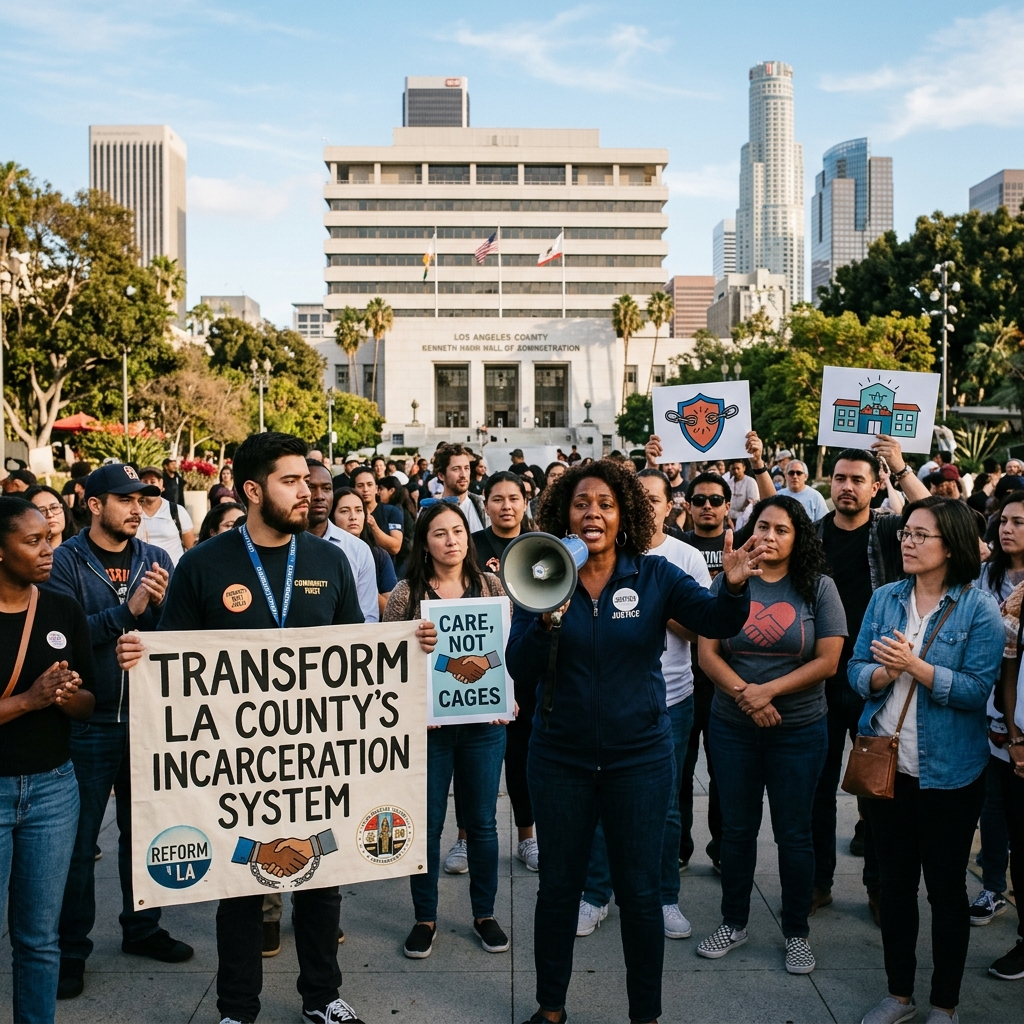
Los Angeles County is home to the largest and most expensive jail system in the United States, a sprawling network of concrete and steel that has historically confined tens of thousands of individuals on any given day. For decades, this massive carceral apparatus operated with relative impunity, despite chronic reports of inhumane conditions, severe overcrowding, and mounting civil rights violations. However, a profound and historic shift is currently underway. Driven by an unyielding coalition of grassroots organizers, civil rights advocates, and directly impacted community members, a powerful movement has emerged to dismantle this punishment-centric model.
At the heart of this sweeping transformation is a radical yet highly pragmatic demand: drastically shrink the jail population, close the most notorious and outdated facilities, and reinvest billions of taxpayer dollars into community-based care. This evolving paradigm, encapsulated by the rallying cry of “Care First, Jails Last,” represents a fundamental reimagining of public safety in the twenty-first century. It directly challenges the deeply entrenched assumption that mass incarceration effectively prevents crime or adequately addresses social crises. Instead, advocates argue that locking people in cages exacerbates the very issues that lead to criminalization in the first place, such as extreme poverty, untreated mental illness, severe substance use disorders, and chronic homelessness.
Through relentless community organizing, rigorous policy advocacy, and public mobilization, local activists are fighting not just to free people from cages, but to rebuild the essential social safety net that was dismantled by decades of aggressive, tough-on-crime legislation.
A System in Crisis: Inside the Nation’s Largest Jail Network
To understand the urgency of the movement, one must examine the staggering scale and the grim realities of the Los Angeles County jail system. Facilities such as the Men’s Central Jail (MCJ) and the Twin Towers Correctional Facility have long been the epicenters of this crisis. Built in 1963, Men’s Central Jail features an antiquated, linear design that severely restricts visibility, exacerbating violence and making adequate supervision practically impossible. The facility has been the subject of numerous federal investigations, lawsuits, and federal oversight agreements due to systemic civil rights abuses and a deeply entrenched culture of excessive force.
Beyond the structural decay of the buildings, the human toll is devastating. The Los Angeles County jail system effectively functions as the largest mental health institution in the country . Because community-based clinical resources are heavily underfunded, law enforcement has become the default first responder to public health crises. Consequently, a vast portion of the incarcerated population is managing acute psychological distress. It is estimated that roughly half of the overall jail population in Los Angeles requires dedicated mental health treatment.
The consequences of utilizing jails as makeshift asylums are frequently fatal. The system has seen a tragic surge in in-custody deaths, with 2021 marking one of the deadliest years in recent history, and subsequent years continuing to reflect deeply alarming mortality rates . Overcrowding, medical negligence, and the inherent trauma of incarceration create a volatile environment where vulnerable individuals deteriorate rapidly. Activists argue that no amount of internal reform can adequately fix a system fundamentally incapable of providing genuine therapeutic care.
The Economics of Mass Incarceration versus Community Investment
The push to decarcerate Los Angeles is not only a moral imperative but also a stark economic necessity. The financial burden of maintaining this colossal jail system is astronomical, commanding nearly a billion dollars annually from the county’s public safety budget. This massive expenditure drains vital resources away from proactive community investments, perpetuating a cycle of poverty and criminalization.
Research initiatives, such as the widely acclaimed “Million Dollar Hoods” project led by researchers at UCLA, have meticulously mapped the fiscal impact of the Los Angeles jail system . Their data vividly illustrates that the county’s incarceration budget is heavily committed to policing and jailing residents from a concentrated number of low-income, predominantly Black and Latino neighborhoods. Areas like Lancaster, Palmdale, and South Central Los Angeles see tens of millions of dollars siphoned out of their local economies to fund the detention of their residents, often for low-level, non-violent offenses related to poverty or substance dependency.
When comparing the cost of confinement to the cost of care, the argument for systemic overhaul becomes undeniable. The financial contrast is striking:
| Intervention Type | Primary Outcome Focus | Relative Cost Efficiency |
|---|---|---|
| County Jail Incarceration | Containment, isolation, and punitive measures | Highest annual cost per individual |
| Community-Based Clinical Treatment | Rehabilitation, therapy, and mental health stabilization | Moderate annual cost; yields long-term savings |
| Supportive Housing Programs | Long-term stability and homelessness prevention | Lowest long-term cost; dramatically reduces recidivism |
Diverting individuals into supportive housing and comprehensive treatment programs is significantly more cost-effective than keeping them confined in a maximum-security cell. By reallocating funds from the sheriff’s department to community health agencies, advocates aim to simultaneously lower the tax burden and improve public safety outcomes.
The “Care First, Jails Last” Paradigm
The defining legislative victory for grassroots organizers arrived with the formal adoption of the “Care First, Jails Last” framework by the Los Angeles County Board of Supervisors in 2020. This framework was the culmination of an intensive, year-long collaborative process led by the Alternatives to Incarceration (ATI) Work Group, which included county officials, healthcare professionals, and system-impacted community leaders.
The ATI Work Group produced a comprehensive roadmap containing 114 specific recommendations designed to scale up community-based care and significantly reduce the jail population. The core philosophy dictates that incarceration should be an absolute last resort, utilized only when all other restorative and therapeutic interventions have been exhausted. A central pillar of this mandate is the explicit, historic commitment to depopulate and permanently close Men’s Central Jail without constructing a replacement facility .
Further embedding this philosophy into the county’s financial DNA was the passage of Measure J in November 2020. Approved by a decisive majority of Los Angeles voters, the ballot measure structurally mandated that 10 percent of the county’s locally generated, unrestricted revenues be permanently allocated to direct community investment and alternatives to incarceration. Though it faced subsequent legal hurdles, the spirit of Measure J birthed the Care First Community Investment (CFCI) spending plan, ensuring that hundreds of millions of dollars are directed toward youth development, affordable housing, and restorative justice programs.
Grassroots Advocacy: How Communities Are Forcing Systemic Change
None of these bureaucratic milestones would have materialized without the relentless pressure exerted by grassroots advocacy groups. The movement to free people from L.A. jails is distinctly decentralized and led predominantly by those who have survived the carceral system themselves. Coalitions of local organizations have spent years organizing town halls, orchestrating large-scale protests, and utilizing public comment periods to force jail conditions into the political spotlight.
The strategy of these activists is multifaceted. They engage in rigorous policy analysis, presenting county supervisors with meticulously researched alternative budgets. They mobilize rapid-response networks to support individuals navigating the pretrial system, often raising community bail funds to secure the release of medically vulnerable people. Furthermore, they center the narratives of incarcerated people, ensuring that the human cost of the jail system is never abstracted into mere statistics.
A notable achievement of this grassroots organizing was the successful push for independent civilian oversight of the Sheriff’s Department. Activists recognized that true decarceration requires dismantling the political power and lack of transparency traditionally enjoyed by law enforcement agencies. By securing subpoena power for the Civilian Oversight Commission, organizers created critical mechanisms for accountability, paving the way for deeper structural reforms.
Alternatives to Incarceration: Rebuilding the Social Safety Net
The ultimate success of the “Care First” model relies entirely on the robust expansion of the social safety net. Decarceration cannot happen in a vacuum; there must be a viable, welcoming infrastructure ready to receive individuals transitioning out of the justice system. The cornerstone of this infrastructure is the Los Angeles County Office of Diversion and Reentry (ODR).
Since its inception, ODR has proven to be a highly effective model for systemic diversion. The office focuses on identifying individuals in custody with serious mental health and substance use disorders and redirecting them into permanent supportive housing equipped with intensive, wrap-around clinical services. ODR’s programs boast remarkable success rates, demonstrating that when individuals are provided with stable housing and compassionate care, recidivism drops precipitously.
However, activists point out that the current scale of these programs remains insufficient. There is a persistent bottleneck: the county lacks the requisite number of community mental health beds and supportive housing units to absorb the thousands of people who are legally and clinically eligible for release. Therefore, the ongoing fight is heavily focused on real estate, zoning, and health infrastructure—demanding that the county urgently acquire and staff properties to serve as community care centers.
The Road Ahead: Bureaucracy, Pushback, and Political Will
Despite the historic commitments made by the Board of Supervisors, the road to closing Men’s Central Jail and fully realizing the Care First vision is fraught with immense challenges. Bureaucratic inertia remains a formidable obstacle. While the Jail Closure Implementation Team (JCIT) was established to orchestrate the decommissioning of the facility , timelines have repeatedly slipped. Activists continuously express frustration over a perceived lack of urgency from county leadership.
Moreover, the movement faces aggressive political pushback from law enforcement unions and tough-on-crime political action committees. These entities frequently leverage fear-based narratives, falsely equating decarceration policies with increases in violent crime, despite empirical data indicating that community investment yields safer neighborhoods. Consequently, the struggle is not merely administrative but deeply ideological. Grassroots organizers remain vigilant, attending every public meeting and continuing to hold elected officials strictly accountable to their promises. The battle to close the jails is far from over, but the blueprint for a more humane Los Angeles is now firmly in place.
Frequently Asked Questions (FAQ)
- What is the Men’s Central Jail (MCJ)?
Men’s Central Jail is a massive, antiquated detention facility located in downtown Los Angeles. Opened in the early 1960s, it is notorious for severe overcrowding, architectural deficiencies, and a documented history of human rights violations. Activists and county officials alike have targeted it for closure. - What does the phrase “Care First, Jails Last” actually mean?
It is a systemic policy framework adopted by Los Angeles County. It prioritizes using community-based mental health care, substance abuse treatment, and supportive housing as the primary responses to public health and poverty-driven issues, utilizing jail incarceration only as an absolute last resort. - How large is the Los Angeles County jail system?
It is the largest jail system in the United States. While the specific daily population fluctuates based on arrest rates and policy changes, it routinely incarcerates tens of thousands of individuals, many of whom are held pretrial because they cannot afford cash bail. - What is the Office of Diversion and Reentry (ODR)?
The ODR is a dedicated county department tasked with safely removing vulnerable populations—particularly those with severe mental illness—from the jail system and placing them into permanent supportive housing with clinical oversight.
References
- Care First L.A.: Tracking Jail Decarceration — Vera Institute of Justice. 2021-05-25. https://www.vera.org/care-first-la-tracking-jail-decarceration
- An Uncertain Future for Jail Reform in Los Angeles — RAND Corporation. 2020-07-21. https://www.rand.org/pubs/commentary/2020/07/an-uncertain-future-for-jail-reform-in-los-angeles.html
- Report 2020-102 Recommendation 2 Responses — California State Auditor. 2021-08-01. https://www.auditor.ca.gov/reports/2020-102/recommendation-responses/
- Million Dollar Hoods: Mapping the Fiscal and Human Cost of Mass Incarceration — University of California, Los Angeles (UCLA). 2019-01-09. https://milliondollarhoods.amdigital.co.uk/
- Jail Closure Implementation Team (JCIT) — Los Angeles County Chief Executive Office. 2024-12-01. https://ceo.lacounty.gov/jcit/
Similar Articles








Read full bio of medha deb




