
LLC vs LP: Optimal Business Structure Guide
Discover key differences between LLCs and LPs to select the ideal structure for liability protection, management, and growth.
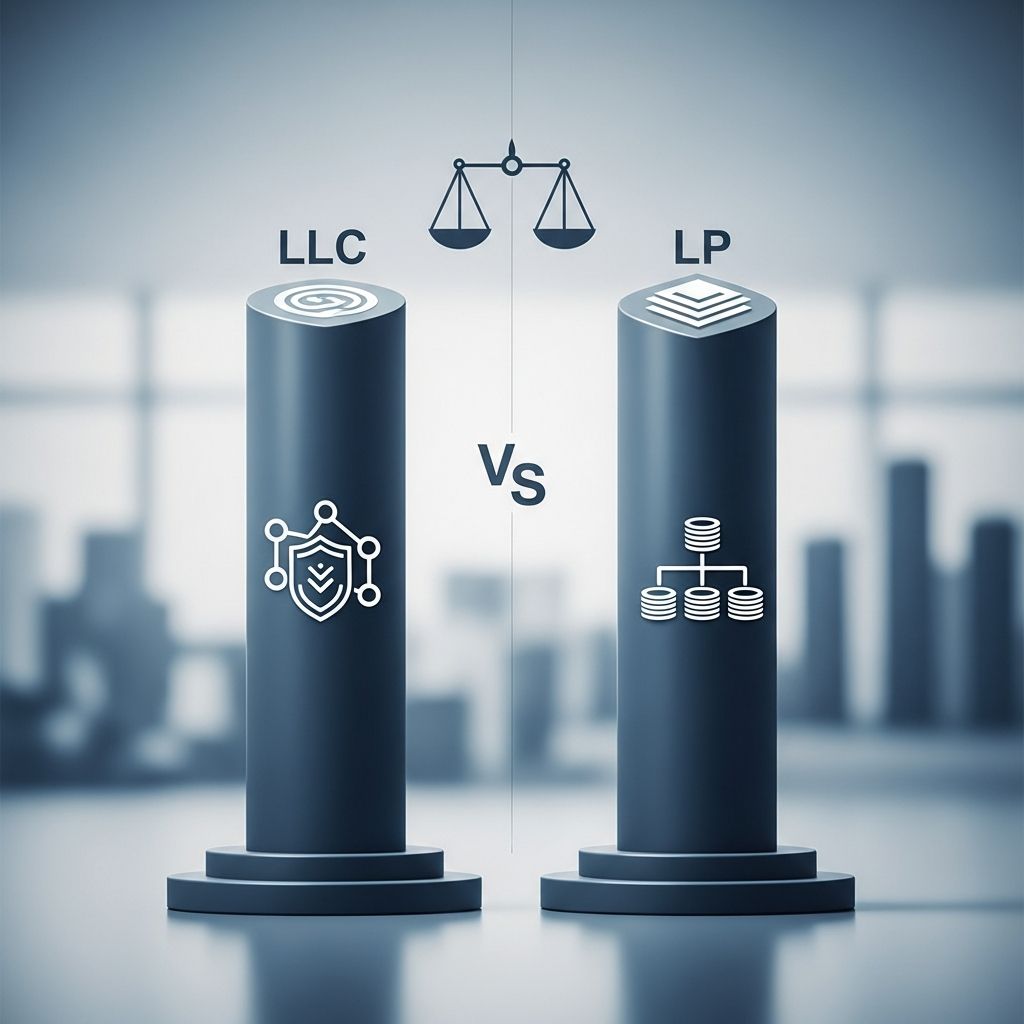
Selecting between a
Limited Liability Company (LLC)
and aLimited Partnership (LP)
shapes your business’s liability exposure, tax obligations, management dynamics, and long-term viability. LLCs provide uniform limited liability and adaptable operations for active owners, while LPs suit ventures with passive investors and distinct management roles.Understanding Limited Liability Companies (LLCs)
A Limited Liability Company merges partnership simplicity with corporate safeguards, shielding members’ personal assets from business debts and lawsuits. Formed under state law, LLCs require filing Articles of Organization, detailing the entity name, purpose, address, and registered agent. Fees range from $50 to $500 depending on the state, with no minimum capital requirement.
LLCs support single-member or multi-member ownership, including individuals, corporations, or other entities. An operating agreement—though not always mandatory—outlines profit distribution, voting rights, and dissolution procedures, fostering customized governance.
- Member-Managed: All owners handle daily decisions, ideal for collaborative teams.
- Manager-Managed: Designated managers (members or outsiders) oversee operations, suiting investor-heavy setups.
This duality enables scalability from solopreneurs to expanding firms.
Exploring Limited Partnerships (LPs)
Limited Partnerships demand at least one general partner with full management authority and unlimited personal liability, alongside one or more limited partners whose risk caps at their investment. LPs file a Certificate of Limited Partnership with the state, publicly signaling the structure via ‘LP’ or ‘L.P.’ in the name.
General partners direct operations and bear responsibility for obligations, while limited partners provide funding without control to preserve liability limits. A partnership agreement details contributions, profit shares, and exit terms. LPs thrive in real estate, venture capital, and films where passive capital is key.
Unlike LLCs, LPs enforce rigid roles: limited partners risk full liability if they engage in management.
Critical Comparisons: LLC vs LP
Key divergences influence suitability. The table below summarizes core aspects:
| Aspect | LLC | LP |
|---|---|---|
| Liability Protection | Limited for all members | Unlimited for general partners; limited for limited partners |
| Management | Flexible (member or manager-managed) | General partners only; limited partners passive |
| Taxation | Pass-through default; elect corp status | Pass-through partnership taxation |
| Formation | Articles of Organization | Certificate of Limited Partnership |
| Continuity | Perpetual existence | May dissolve on general partner exit |
| Ownership | No residency limits; unlimited members | At least 1 GP + 1 LP; no ownership caps |
Liability Protection Breakdown
LLCs uniformly protect all members’ personal assets, barring personal guarantees or misconduct. LPs expose general partners fully, akin to sole proprietors, while shielding limited partners—provided they abstain from decisions. This disparity favors LLCs for risk-averse teams but fits LPs for controlled-risk investments.
Tax Treatment Nuances
Both default to pass-through taxation, avoiding double taxation: income flows to personal returns via Schedule K-1. LLCs uniquely elect C-corp, S-corp, or sole proprietorship status for optimization. LPs remain partnership-taxed, with self-employment taxes on general partners’ shares.
Management and Decision-Making
LLCs adapt to needs, empowering all or select managers. LPs centralize power with general partners, deterring limited partner involvement to safeguard protections. This rigidity aids clear hierarchies but hampers collaborative ventures.
Formation and Compliance Demands
LLCs simplify setup with minimal filings and optional agreements. LPs mandate detailed certificates and agreements, plus annual reports in many states. Both register with state secretaries, but LLCs often cost less and demand less upkeep.
Continuity and Transferability
LLCs persist indefinitely, easing ownership transfers via membership interests. LPs risk dissolution upon general partner withdrawal unless agreements specify succession, complicating stability.
Steps to Form an LLC
- Choose Name: Ensure uniqueness and include ‘LLC’.
- Appoint Agent: Designate for legal service receipt.
- File Articles: Submit to state with fee.
- Draft Agreement: Detail internals.
- Obtain EIN: From IRS for taxes/banking.
- Register Taxes: State/local as needed.
- Secure Licenses: Industry-specific.
Processes vary by state; consult professionals.
Steps to Establish an LP
- Select Name: With ‘LP’ suffix.
- Identify Partners: Assign GP/LP roles.
- File Certificate: State submission with details.
- Create Agreement: Govern operations.
- Get EIN: IRS assignment.
- Comply Ongoing: Annual filings.
General partners often form via entities for protection.
Prime Scenarios for LLCs
- Active Small Businesses: Restaurants, consultancies needing flexibility.
- Tech Startups: Rapid changes demand adaptability.
- Professional Practices: Lawyers, accountants seeking protection.
- Solo Ventures: Single-member simplicity.
LLCs excel where all owners engage.
Ideal Use Cases for LPs
- Real Estate Investments: Passive funders, active managers.
- Venture Funds: Capital aggregation without control dilution.
- Short-Term Projects: Films, developments with defined ends.
- Family Investments: Estate planning via limited roles.
LPs shine with investor-management splits.
Conversion and Hybrid Options
States permit LLC-to-LP or vice versa conversions via filings. Manager-managed LLCs mimic LPs, offering limited liability to all. For professional fields, consider LLPs—partnerships with protections sans general partner exposure.
Frequently Asked Questions
Can an LLC have multiple classes of members?
Yes, operating agreements define voting, profit tiers for tailored structures.
Do limited partners pay self-employment taxes?
No, passive status exempts them; general partners do.
Is an LLC or LP better for real estate?
LPs for passive investors; LLCs for hands-on owners with full protection.
How do foreign owners form these?
Both welcome non-residents; use registered agents.
What if no operating/partnership agreement exists?
State defaults apply, risking disputes—always document.
Professional Guidance Recommendation
Consult attorneys and CPAs to align structures with goals, tax residency, and industry. State laws evolve; verify current rules.
References
- LLC vs. LP vs. S-Corp: A Guide for Business Owners — Evolved, LLC. 2024. https://evolvedtax.com/blog/llc-vs.-lp-vs.-s-corp-a-guide-for-business-owners
- Limited Liability Company (LLC) vs. Limited Partnership (LP) — SmartAsset. 2025-01-15. https://smartasset.com/small-business/llc-vs-lp
- LLC vs. Partnership (GP, LP, and LLP) — Wolters Kluwer. 2024-11-20. https://www.wolterskluwer.com/en/expert-insights/llc-vs-partnership
- Choose a business structure — U.S. Small Business Administration. 2026-01-05. https://www.sba.gov/business-guide/launch-your-business/choose-business-structure
Similar Articles








Read full bio of medha deb


