Introduction: The Unspoken Crisis at the Border
Every year, tens of thousands of vulnerable individuals embark on treacherous and life-threatening journeys to the United States in search of safety. Fleeing political persecution, ethnic violence, extortion, and severe human rights abuses, these asylum seekers arrive at the U.S. border hoping to find refuge. However, upon arrival, many encounter an invisible yet impenetrable barrier that has nothing to do with physical walls or border enforcement protocols: a profound and systemic failure of language access . For migrants whose primary tongue is not English or Spanish, but rather an indigenous or lesser-diffusion language, the inability to communicate effectively can mean the difference between sanctuary and a wrongful deportation back to danger.
The fundamental premise of the United States asylum system is that every individual who sets foot on American soil or presents themselves at a legal port of entry has the right to request protection. Yet, this right is effectively nullified when an individual cannot understand the instructions given to them, cannot articulate their credible fear to an asylum officer, or cannot navigate the complex digital platforms mandated by border authorities. This linguistic disenfranchisement disproportionately affects indigenous people from regions in Central America, South America, and parts of Africa, who often find themselves trapped in an administrative void, stripped of their due process rights simply because the system lacks the resources—or the will—to hear their voices.
The Constitutional and Statutory Foundation of Language Rights
The requirement to provide adequate language services is not a modern administrative courtesy; it is deeply embedded in the civil rights framework of the United States. Under Title VI of the Civil Rights Act of 1964, any program or activity receiving federal financial assistance is strictly prohibited from discriminating on the basis of race, color, or national origin. The courts and federal guidelines have long established that a failure to provide meaningful access to individuals with Limited English Proficiency (LEP) constitutes a form of national origin discrimination.
Furthermore, this principle was solidified in August 2000, when Executive Order 13166, titled “Improving Access to Services for Persons with Limited English Proficiency,” was signed. This mandate requires federal agencies, including the Department of Homeland Security (DHS) and the Department of Justice (DOJ), to examine the services they provide, identify needs for language assistance, and implement robust systems to ensure that LEP persons can meaningfully access those services without placing an undue burden on the agency’s mission .
In response, the DOJ and the U.S. Customs and Border Protection (CBP) have developed Language Access Plans over the years, theoretically designed to facilitate communication . These plans stipulate the use of translated documents, bilingual staff, and contracted telephonic interpreters. However, as advocacy groups and legal scholars consistently point out, a severe disconnect exists between these written directives and the operational reality on the ground at immigration detention centers and border crossings. The theoretical protections fail spectacularly when confronted with the vast linguistic diversity of the modern migrant population.
Digital Exclusion: The Shortcomings of the CBP One Application
In a bid to modernize border processing and manage the unprecedented flow of migrants, the federal government introduced the CBP One mobile application. Asylum seekers are now generally required to use this smartphone application to schedule an appointment at a legal port of entry before they can present their claims. While touted as a solution to streamline processing and reduce chaotic border crossings, the CBP One app has inadvertently created a massive technological and linguistic bottleneck.
The core of the issue lies in the app’s limited language offerings. As of recent operational reports, the CBP One application is fully functional only in English, Spanish, and Haitian Creole, with very limited features available in Russian and Portuguese . This exclusionary design leaves thousands of asylum seekers who speak none of these languages completely locked out of the primary lawful pathway to seek protection.
- Accessibility Hurdle: Individuals must navigate complex menus, read legal disclaimers, and follow rigid scheduling procedures in a language they do not understand.
- Technological Literacy: The assumption that all migrants have access to a reliable smartphone, stable internet connection, and the digital literacy required to use facial recognition software ignores the extreme poverty and trauma many face.
- The Exception Clause Loophole: While regulations state that individuals can bypass the app if they prove it was impossible to use due to a “language barrier, illiteracy, or significant technical failure,” border agents frequently place the burden of proof on the migrant. In practice, establishing this exemption requires the very communication skills the migrant lacks, resulting in cyclical denials.
For an indigenous language speaker, standing at the physical border but digitally locked out, the CBP One app is not a tool of facilitation—it is a digital wall that severely undermines their right to seek international protection.
The Complex Reality of Indigenous Dialects
The demographic profile of individuals seeking asylum at the U.S. Southern border has shifted dramatically over the past decade. It is no longer accurate to assume that migrants arriving from Mexico or the “Northern Triangle” (Guatemala, Honduras, El Salvador) natively speak Spanish. A significant and growing percentage of these individuals belong to indigenous communities and speak pre-Columbian languages.
When border authorities fail to identify an indigenous language speaker, they often default to communicating in Spanish. For many indigenous migrants, Spanish is a second or even third language, spoken with limited proficiency. Under the immense stress of apprehension and detention, communicating complex legal concepts or recounting traumatic experiences of persecution in a non-native tongue is nearly impossible. This leads to crucial misunderstandings, inconsistent testimonies, and ultimately, the rejection of valid asylum claims.
Commonly Encountered Indigenous Languages at the Border
| Language Family | Primary Region of Origin | Examples of Dialects | Interpretation Challenges |
|---|---|---|---|
| Mayan | Guatemala, Southern Mexico | K’iche’, Mam, Q’anjob’al, Ixil | Severe shortage of certified interpreters; distinct regional variations within the same dialect make cross-communication difficult. |
| Oto-Manguean | Central & Southern Mexico | Mixtec, Zapotec, Triqui | Many dialects are purely oral with no standardized written form, complicating the translation of legal documents. |
| Chibchan | Honduras, Nicaragua, Colombia | Miskito, Kuna | Lack of telephonic interpretation services on-demand; reliance on delayed relay translation. |
To bridge this gap, immigration courts and CBP occasionally rely on “relay interpretation.” In this flawed process, an interpreter translates the indigenous language into Spanish, and a second interpreter translates the Spanish into English for the asylum officer or judge. Every layer of translation increases the risk of critical nuances being lost, cultural context being stripped away, and factual errors being introduced into the official legal record .
Cascading Failures: Due Process, Detention, and Deportation
The consequences of these systemic language failures are devastating and immediate. The first stage of the asylum process is the “credible fear interview,” a high-stakes screening where an individual must articulate a significant possibility of persecution or torture if returned to their home country. This interview demands precision, emotional recall, and legal clarity.
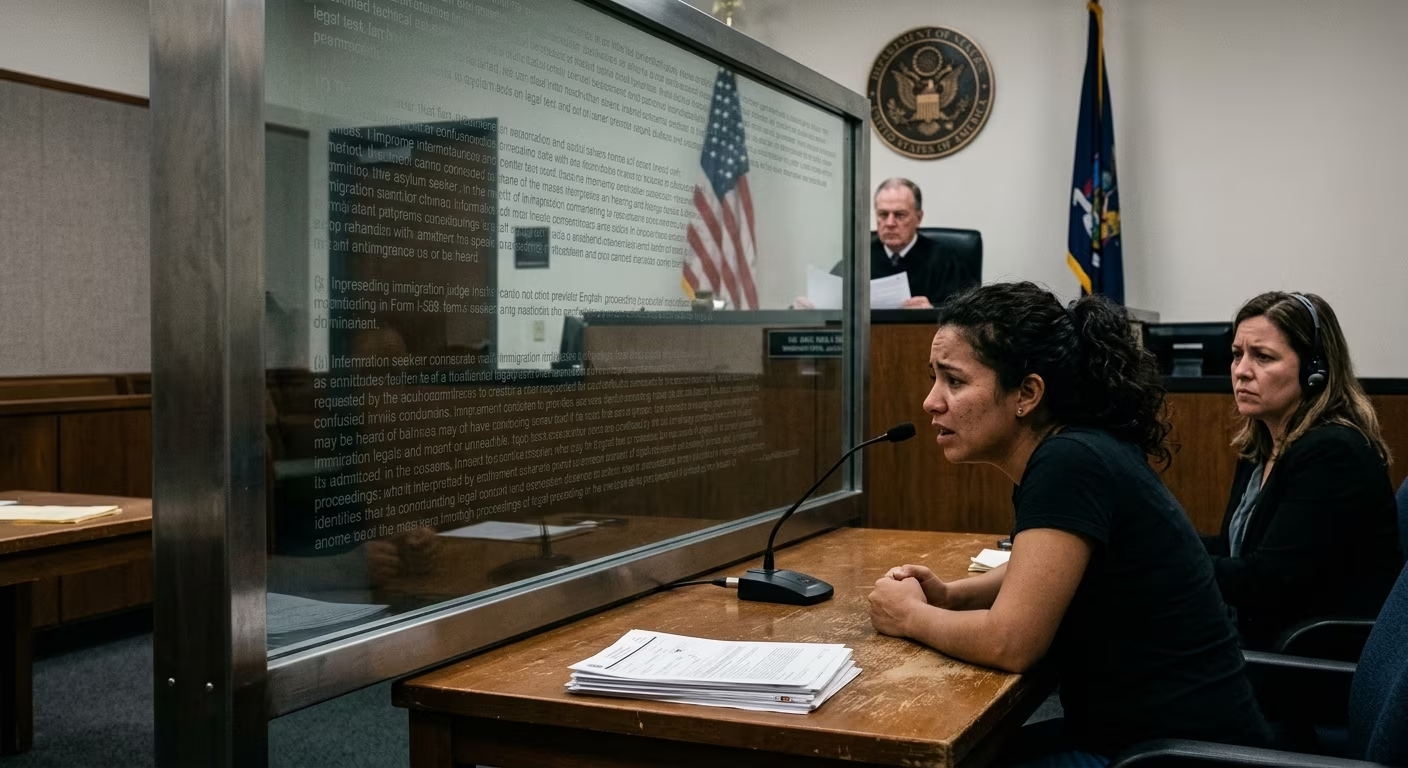
Without an adequate interpreter, an indigenous asylum seeker may struggle to comprehend the questions being asked. An officer might ask if they fear returning home, and due to a mistranslation, the migrant’s confusion is logged as a lack of fear. Once an officer determines there is no credible fear, the individual is placed in expedited removal proceedings. Because the migrant does not understand the paperwork they are handed—which is invariably printed in English or Spanish—they unknowingly sign away their right to an appeal before an immigration judge.
Beyond the legal proceedings, language barriers exacerbate the trauma of detention. Non-English and non-Spanish speakers in detention facilities are isolated from the general population, unable to access medical care effectively, read commissary instructions, or communicate with guards. In extreme cases documented by human rights organizations, language barriers have even resulted in the tragic separation of indigenous parents from their children, as border officials mistakenly concluded, due to communication failures, that the adults were not the biological guardians.
The Path Forward: Legal Challenges and Advocacy
Faced with federal inertia, a coalition of civil rights organizations, legal advocates, and grassroots organizers are actively challenging these discriminatory practices. Groups recognize that holding the government accountable to its own constitutional and statutory mandates is the only way to safeguard the rights of Limited English Proficiency individuals.
Recent advocacy efforts have focused on filing civil rights complaints with the DHS Office for Civil Rights and Civil Liberties (CRCL), highlighting the discriminatory impact of the CBP One app and the chronic absence of interpreters. Legal petitions are demanding formal rulemakings to legally bind the United States Citizenship and Immigration Services (USCIS) and CBP to provide competent, professional interpreters at every stage of the affirmative and defensive asylum processes.
Furthermore, advocates are pushing for the proactive recruitment of indigenous language interpreters, the implementation of comprehensive language identification protocols at the point of initial apprehension, and an immediate halt to the use of technological mandates like CBP One when they result in the categorical exclusion of language minorities. Until these structural reforms are realized, the U.S. government remains in violation of its fundamental promise to offer a fair and accessible harbor to those fleeing persecution.
Frequently Asked Questions (FAQ)
What does Limited English Proficiency (LEP) mean in the context of asylum?
Limited English Proficiency (LEP) refers to individuals who do not speak English as their primary language and who have a limited ability to read, speak, write, or understand English. In the immigration context, ensuring LEP individuals have language access (such as translators and translated documents) is a civil rights requirement to ensure they receive fair due process under the law.
Why are indigenous language speakers particularly vulnerable at the U.S. border?
Indigenous language speakers often originate from marginalized communities with limited access to formal education or bilingual resources. When they arrive at the border, federal agencies frequently misidentify them as Spanish speakers. Because there is a severe shortage of professional interpreters for languages like Mam, K’iche’, and Mixtec, these individuals cannot accurately convey their fear of persecution, leading to wrongful deportations.
How does the CBP One App restrict asylum access for certain migrants?
The CBP One application is currently required by the government to schedule appointments at ports of entry to seek asylum. However, the app is only available in a few languages (primarily English, Spanish, and Haitian Creole). Asylum seekers who speak indigenous languages, African dialects, or other rare languages cannot navigate the app, effectively barring them from the legal asylum process.
What legal obligations does the U.S. government have to provide interpreters?
The obligation is rooted in Title VI of the Civil Rights Act of 1964, which prohibits discrimination based on national origin in federally funded programs. Additionally, Executive Order 13166 mandates federal agencies to provide meaningful access to LEP individuals. Both the Department of Justice and the Department of Homeland Security have internal Language Access Plans designed to fulfill these legal duties, though enforcement remains inconsistent.
Conclusion
The United States prides itself on a legal system rooted in fairness, equality, and the right to be heard. Yet, for thousands of asylum seekers speaking indigenous and lesser-diffusion languages, the promise of due process is silenced by an impenetrable linguistic barrier. From the digital exclusion imposed by the CBP One app to the severe lack of trained interpreters during high-stakes credible fear interviews, the government’s language access failures inflict catastrophic harm on vulnerable populations. Meaningful access to the asylum system must not be a privilege reserved for those who speak the right language; it is a fundamental human right that must be vigorously defended and structurally guaranteed.
References
- CBP Language Access Plan — U.S. Customs and Border Protection. 2026-05-21. https://www.cbp.gov/document/guidance/cbp-language-access-plan
- Executive Order 13166: Improving Access to Services for Persons with Limited English Proficiency — U.S. Department of Justice. 2000-08-16. https://www.justice.gov/crt/executive-order-13166
- Language Access Program — United States Department of Justice. https://www.justice.gov/crt/language-access-program
- Improving Language Access in the U.S. Asylum System — Center for American Progress. 2023-05-25. https://www.americanprogress.org/article/improving-language-access-in-the-u-s-asylum-system/