
The Limits of Clemency: Presidential Pardons and Executive Accountability
Exploring the constitutional boundaries of the presidential pardon power and its impact on the rule of law.
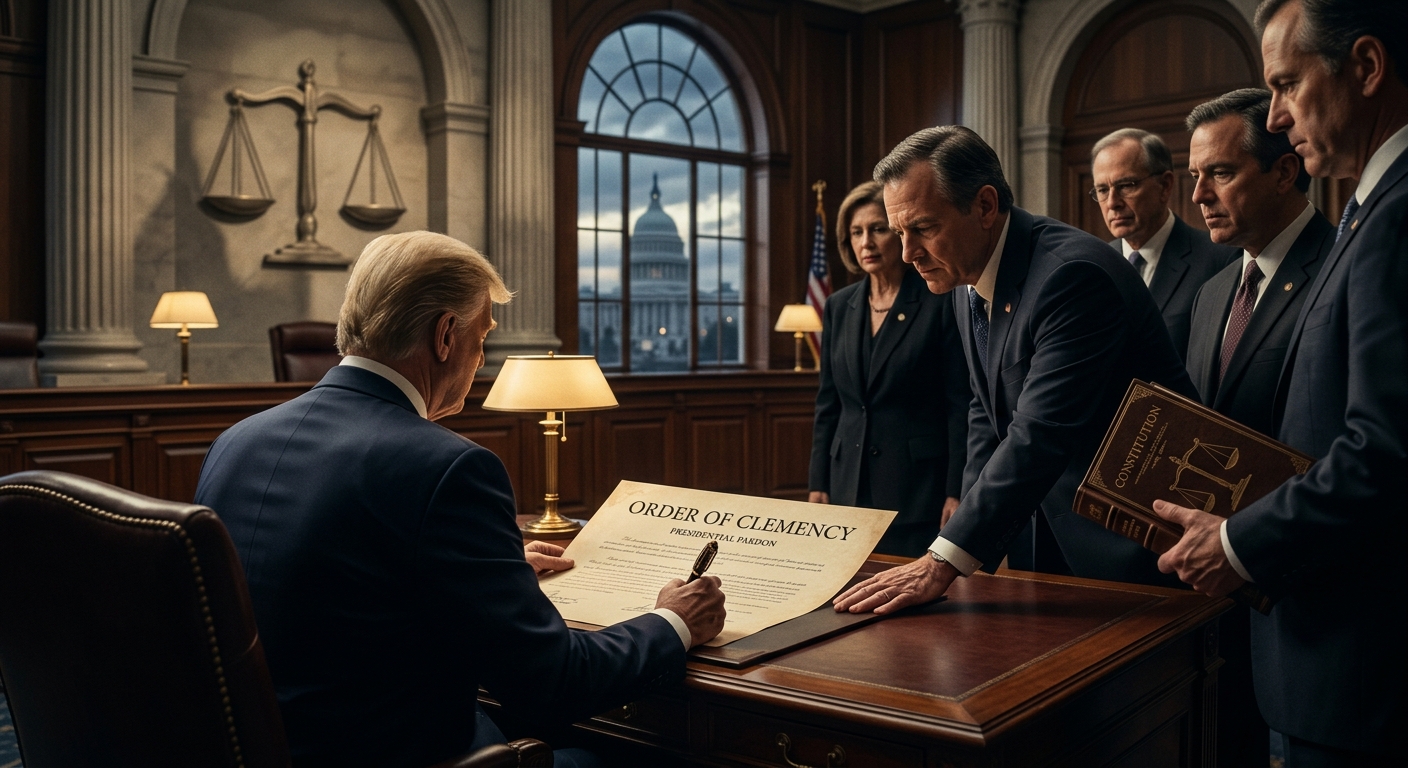
The architecture of the United States government relies on a delicate and intricate system of checks and balances. Each branch is designed to counteract the potential excesses of the others, ensuring that no single entity wields absolute power. Yet, embedded within this framework is a mechanism of almost unparalleled unilateral authority: the presidential pardon power. Originally conceived as a tool for mercy and a constitutional safety valve, executive clemency has increasingly become a subject of intense legal and ethical debate. When exercised to protect political allies or shield government officials from accountability for severe legal infractions—such as constitutional violations or human rights abuses—the pardon power transforms from an act of grace into a potential instrument of executive overreach. This article explores the depths, controversies, and limits of the presidential pardon, examining how an instrument of forgiveness can sometimes undermine the very fabric of democratic accountability.
The Constitutional Foundation of Clemency
The legal foundation for the presidential pardon is found in Article II, Section 2, Clause 1 of the U.S. Constitution, which states that the President ”shall have Power to grant Reprieves and Pardons for Offences against the United States, except in Cases of Impeachment.” This sweeping language affords the chief executive broad discretion to forgive federal crimes. However, it explicitly restricts the power to federal offenses; a president cannot pardon individuals for civil liabilities or state-level crimes. Those seeking relief for state convictions must appeal to the respective state governor or state clemency board .
During the Constitutional Convention of 1787, the Framers vigorously debated the inclusion of this power. Proponents like Alexander Hamilton argued in Federalist No. 74 that in times of severe crisis, such as a domestic rebellion, a well-timed offer of pardon could quickly restore domestic tranquility. The Framers ultimately vested this power solely in the executive, believing that a single individual could act with the necessary speed and decisiveness that a fractured legislative body could not. Consequently, there is almost nothing that Congress or the judiciary can do to overturn a legally issued pardon, making it one of the few truly unchecked powers within the American constitutional system .
Beyond Simple Forgiveness: The Mechanics and Forms of Clemency
The term ”clemency” operates as an umbrella classification for several distinct types of executive action. While the public colloquially refers to all these acts as ”pardons,” the executive branch recognizes various mechanisms, each carrying unique legal and practical implications:
- Full Pardon: This is an expression of the President’s forgiveness and typically restores fundamental civil rights, such as the right to vote, serve on a jury, and possess firearms, which are often systematically stripped following a felony conviction. It does not technically signify innocence, but it effectively mitigates the severe collateral consequences of a criminal record.
- Commutation of Sentence: Unlike a full pardon, a commutation does not erase the conviction or restore lost civil rights; it simply reduces the severity or duration of a sentence currently being served. Presidents frequently use this mechanism to address disproportionately harsh prison terms.
- Remission: This specific action absolves an individual from paying court-ordered fines, penalties, or forfeitures associated with their conviction, though it leaves the underlying guilty verdict entirely intact.
- Reprieve: A reprieve is a temporary postponement of a punishment. It is most commonly utilized to delay the execution of a death sentence while further legal avenues are explored or mental health evaluations are conducted.
- Amnesty: Amnesty is broadly applied to a class of individuals rather than a single person. Historical examples include George Washington granting amnesty to participants in the Whiskey Rebellion, and Jimmy Carter granting it to those who evaded the military draft during the Vietnam War .
- Conditional Pardon: The President may also attach specific requirements to a pardon or commutation. This means the recipient must abide by certain terms or risk having the grant of clemency swiftly revoked .
The Legal and Moral Ambiguity of Preemptive Pardons
Perhaps the most legally fascinating and ethically fraught application of executive clemency is the ”preemptive pardon.” A preemptive pardon is issued before an individual has been formally charged, tried, or convicted of a crime. The constitutionality of this practice was largely settled by the Supreme Court in the 1866 case Ex parte Garland, wherein the Court ruled that the pardon power ”may be exercised at any time after [an offense’s] commission, either before legal proceedings are taken or during their pendency, or after conviction and judgment” .
The most consequential modern example of a preemptive pardon occurred in 1974, when President Gerald Ford fully pardoned his predecessor, Richard Nixon, for any crimes he may have committed against the United States during the Watergate scandal. Ford reasoned that a prolonged, sensational trial of a former president would irreparably damage the country’s social fabric and prevent the nation from healing. While history has somewhat softened its judgment of Ford’s decision, the immediate political backlash was severe. The primary danger of the preemptive pardon is that it permanently aborts the investigative and judicial process. When a trial is circumvented, the full scope of the facts may never be entered into the public record, denying the public the transparency and truth that the justice system is designed to provide.
Shielding the Executive Branch: National Security and Human Rights
The debate over executive clemency takes on a substantially darker hue when the pardon power is wielded—or threatened to be wielded—to protect executive branch officials who authorized or executed legally dubious policies. In the realm of national security, intelligence gathering, and foreign policy, the executive branch often operates behind a thick veil of classification. When whistleblowers, journalists, or oversight committees expose potential crimes—such as unauthorized domestic surveillance, extraordinary rendition, or state-sanctioned torture—the prospect of a preemptive pardon becomes a deeply destabilizing force.
If a president can issue blanket pardons to cabinet members, intelligence officers, or military personnel who blatantly broke federal and international laws under the guise of protecting national security, it creates a perilous cycle of impunity. For instance, if an administration theoretically implements brutal, illegal interrogation tactics, the perpetrators might willingly execute those orders if they are quietly assured that a presidential pardon will shield them from future prosecution. This dynamic effectively nullifies congressional statutes, such as the federal Anti-Torture Act, and allows the executive branch to operate as a law unto itself, fully insulated from judicial scrutiny.
Advocacy groups and legal scholars argue that pardoning government officials for human rights violations contradicts the very essence of a democratic republic. The pardon power was designed to act as a safeguard against a rigid or unjust judicial system, not as a get-out-of-jail-free card for those who abuse state power. When high-ranking officials are absolved of accountability for systemic abuses, the victims of those abuses are denied justice, and the mechanisms of democratic oversight are rendered impotent. Such actions transform a constitutional instrument of mercy into an impenetrable shield for state-sanctioned violence and executive overreach.
The Consequences of Unchecked Executive Clemency
The unrestricted use of the pardon power carries profound consequences for the rule of law. A fundamental tenet of the American legal system is that no citizen, regardless of their office, wealth, or political pedigree, is above the law. When a president routinely uses the pardon power to insulate political cronies, family members, or administration officials who broke the law on their behalf, it breeds profound civic cynicism. It validates the widespread perception that there is a two-tiered justice system: one forgiving system for the well-connected political elite, and one highly punitive system for everyone else.
Furthermore, these unilateral executive actions yield severe international ramifications. The United States frequently positions itself as a global arbiter of human rights, urging other nations to adhere to international law, prosecute war criminals, and maintain transparent, independent justice systems. When the American executive intentionally bypasses its own judicial system to protect human rights violators or corrupt officials, it severely undermines the country’s moral authority on the global stage. Adversaries can easily point to these politically motivated pardons as evidence of hypocrisy, making it substantially more difficult for American diplomats to advocate for the rule of law abroad.
Evaluating Proposals for Pardon Reform
Given the controversies surrounding recent administrations spanning multiple decades, there is a growing, bipartisan appetite for pardon reform. Because the pardon power is explicitly enshrined in Article II of the Constitution, statutory attempts by Congress to limit it would almost certainly be struck down by the courts as unconstitutional. Therefore, creating binding, permanent limits on the President’s clemency power would require the arduous process of passing a constitutional amendment.
Several reform proposals have gained traction among legal scholars and reform advocates. One prominent suggestion is an amendment explicitly forbidding presidents from pardoning themselves—a legally unsettled question that currently hangs over the executive branch like a constitutional Sword of Damocles . Other proposals suggest requiring the consent of the Senate, or at least a majority vote in both houses of Congress, for any pardon involving a member of the president’s administration, a family member, or an individual involved in a crime directly connected to the president’s political campaigns.
On a bureaucratic level, some advocates push for removing the Office of the Pardon Attorney from the Department of Justice and establishing it as an independent, bipartisan commission. While such a commission could not legally bind the president under the current constitutional framework, it could mandate a high standard of transparency, requiring the president to publicly justify any clemency grants that deviate from the commission’s formal, vetted recommendations.
Table: Understanding Executive Clemency
To better understand the nuances of the president’s power, the following table breaks down the various forms of executive clemency:
| Type of Clemency | Definition | Typical Application |
|---|---|---|
| Full Pardon | Forgiveness of a crime that restores lost civil rights. | Granted to individuals who have demonstrated rehabilitation after serving a sentence. |
| Commutation | A reduction of a criminal sentence’s severity or duration. | Used to correct disproportionately harsh sentences for current inmates. |
| Amnesty | A broad pardon issued to a group or class of people. | Often applied post-conflict to draft evaders or non-violent political dissidents. |
| Reprieve | A temporary delay of an imposed punishment. | Utilized most often to pause capital punishment for further legal review. |
Conclusion
The presidential pardon remains one of the most compelling and paradoxical features of the United States Constitution. It is a desperately necessary tool for injecting mercy into a rigid criminal justice system, capable of righting historical wrongs and offering second chances to the truly rehabilitated. However, its near-absolute nature makes it uniquely vulnerable to exploitation. When leveraged to thwart legitimate investigations, shield corrupt officials, or excuse horrific human rights abuses under the banner of national security, the pardon power threatens the foundational democratic principle that no one is above the law. As the nation continues to grapple with the evolving boundaries of executive authority, the debate over how to balance the absolute necessity of mercy with the strict imperative of accountability will undoubtedly persist.
Frequently Asked Questions (FAQs)
Q: Can a U.S. President pardon state-level convictions?
A: No. The constitutional pardon power only applies to federal offenses against the United States. State crimes fall under the exclusive jurisdiction of state governors or respective state clemency boards.
Q: What exactly is a preemptive pardon?
A: A preemptive pardon is a grant of clemency issued before an individual has been formally indicted, tried, or convicted. While it prevents federal prosecution for the specified acts, it remains highly controversial due to its ability to bypass judicial fact-finding and public trials.
Q: Does receiving a pardon mean the person is officially innocent?
A: No. A pardon is an expression of forgiveness and mercy, not an exoneration or a declaration of innocence. In fact, accepting a pardon has historically been interpreted by some legal scholars as an implicit admission of guilt, although it legally restores certain civil rights stripped by a felony conviction.
Q: Has the Supreme Court ruled on whether a President can pardon themselves?
A: As of now, the Supreme Court has never issued a definitive ruling on the constitutionality of presidential self-pardons. Legal scholars and constitutional experts are sharply divided on the issue, making it one of the most prominent unsettled questions in American constitutional law.
References
- Office of the Pardon Attorney | Frequently Asked Questions — U.S. Department of Justice. 2026-04-29. https://www.justice.gov/pardon/frequently-asked-questions
- ArtII.S2.C1.3.5 Scope of Pardon Power — Constitution Annotated, Congress.gov. 2024. https://constitution.congress.gov/browse/essay/artII-S2-C1-3-5/ALDE_00013318/
- Presidential pardons: Settled Law, unsettled issues, and a downside for Trump — The Brookings Institution. 2021-01-17. https://www.brookings.edu/articles/presidential-pardons-settled-law-unsettled-issues-and-a-downside-for-trump/
- The President’s Conditional Pardon Power — Harvard Law Review. 2021-06-10. https://harvardlawreview.org/print/vol-134/the-presidents-conditional-pardon-power/
Similar Articles








Read full bio of medha deb


