
Traveling with Large Cash Amounts: Legal Rules
Navigate the laws on carrying substantial cash while traveling domestically or internationally without facing penalties or seizures.
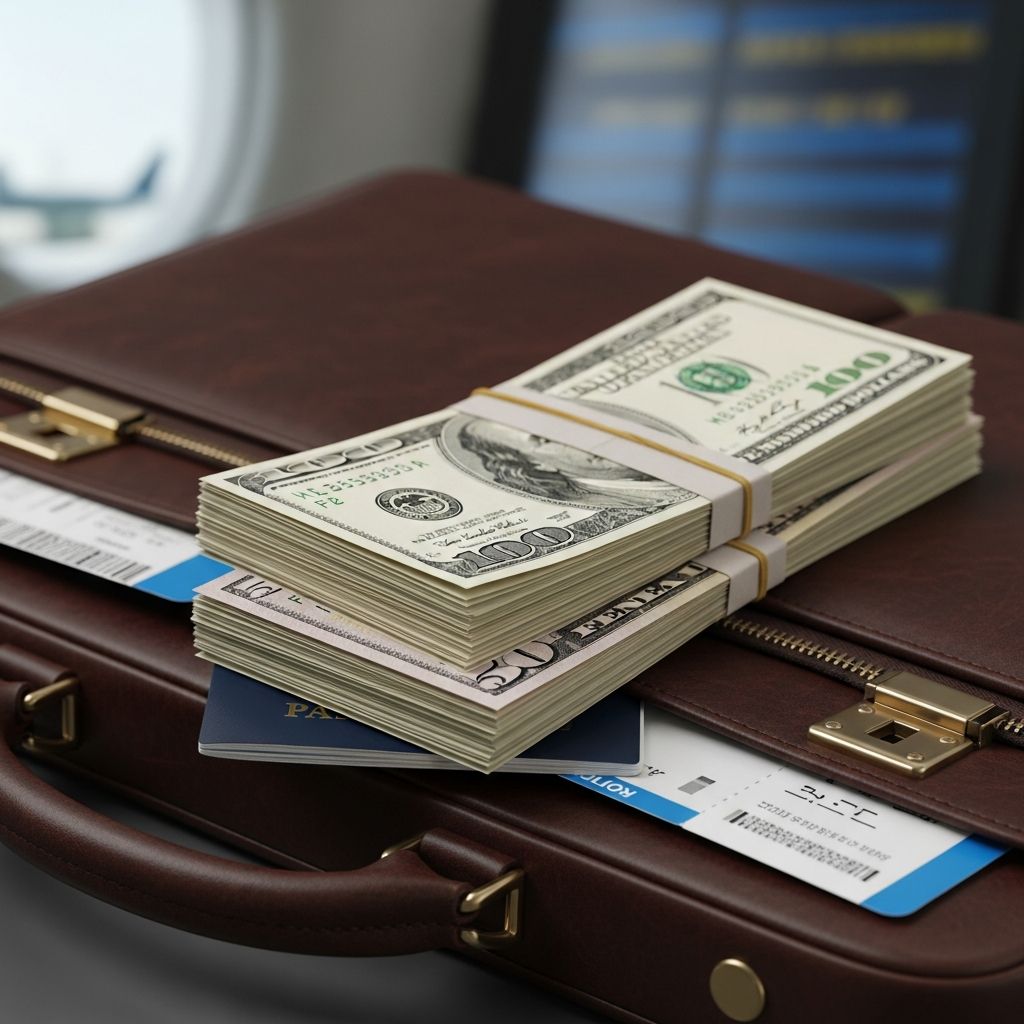
Carrying significant sums of money during travel raises common concerns about legality, security checks, and potential complications at airports. While no federal laws prohibit transporting unlimited cash on domestic U.S. flights, international journeys trigger specific reporting obligations enforced by U.S. Customs and Border Protection (CBP). This guide details the regulations, declaration processes, group travel considerations, risks of non-compliance, and practical alternatives to minimize issues.
Core Principles of Cash Transport on Flights
The fundamental rule across U.S. transportation systems is that cash itself poses no inherent security threat, distinguishing it from prohibited items like weapons or liquids. Travelers enjoy the freedom to carry any amount on domestic routes without mandatory disclosures. However, exceeding certain thresholds on international trips mandates transparency to authorities.
This framework stems from anti-money laundering efforts, aiming to monitor large cash movements that could fund illicit activities. Understanding these distinctions ensures compliant and stress-free travel.
Domestic Flight Regulations: Unlimited but Scrutinized
On flights within the United States, no statutory cap restricts cash amounts. Passengers can board with thousands or even millions in their luggage or carry-on without prior notification to the Transportation Security Administration (TSA).
- TSA focuses on aviation safety, not financial tracking; cash screenings are rare unless bundled suspiciously or accompanied by other red flags.
- Officers may conduct secondary inspections or involve law enforcement if large stacks appear during routine bag checks, potentially leading to questions about the funds’ origin.
- Practical advice: Disperse cash across bags, use secure money belts, or opt for bank-issued instruments to reduce visibility.
Despite the absence of limits, visible bulk cash can invite delays or referrals, emphasizing discretion as a best practice.
International Travel: The $10,000 Declaration Threshold
Crossing U.S. borders shifts oversight to CBP, where the key benchmark is $10,000 in currency or monetary equivalents. Legally, unlimited amounts remain permissible, but totals surpassing this figure—whether entering or exiting the country—require formal reporting via FinCEN Form 105.
| Aspect | Domestic Flights | International Flights |
|---|---|---|
| Cash Limit | No limit | No limit, declare over $10,000 |
| Authority | TSA (security focus) | CBP (financial reporting) |
| Form Required | None | FinCEN 105 |
| Penalties for Non-Compliance | Possible questioning | Fines, seizure, criminal charges |
Monetary instruments qualifying for aggregation include U.S./foreign currency, traveler’s checks, money orders, cashier’s checks, and certain bearer bonds or promissory notes. Precious metals in coin form may also count if negotiable.
Group and Family Travel: Combined Totals Matter
A frequent oversight occurs with companions: the $10,000 threshold applies to the aggregate carried by a traveling party, not individuals. Families, friends, or even loosely associated groups qualify if journeying together.
- Example: Two spouses with $6,000 each total $12,000, necessitating declaration.
- Separate households maintain individual counts unless explicitly traveling as one unit.
- Friends splitting $4,000 apiece across three people hit $12,000 collectively, triggering the rule.
CBP assesses intent and association at ports of entry; preemptive group filings prevent disputes.
Step-by-Step Declaration Process
Compliance simplifies border crossings. Upon arrival or departure:
- Locate CBP officers or red declaration lines at airports.
- Complete FinCEN Form 105, detailing exact amounts, carriers, and destinations—available online or on-site.
- Submit orally or in writing; no proof of funds’ legality is typically demanded unless suspicion arises.
Processing adds minimal time for honest declarers, preserving travel momentum.
Consequences of Failing to Report Excess Cash
Non-disclosure invites severe repercussions, prioritizing civil asset forfeiture over criminal prosecution in many instances. Outcomes include:
- Immediate Seizure: Funds are confiscated without arrest; recovery demands lengthy petitions proving lawful origin.
- Fines: Up to the cash value or statutory maximums, escalating with perceived structuring (evading reports by splitting amounts).
- Criminal Prosecution: If linked to crimes like drug trafficking, penalties include imprisonment.
- Trusted Traveler Revocation: Global Entry or SENTRI privileges end upon violation.
These measures deter evasion while protecting legitimate travelers who disclose promptly.
Global Variations: Beyond U.S. Borders
Destination countries impose independent rules, often mirroring or exceeding U.S. standards. Many require declarations above €10,000 or local equivalents upon entry.
- EU nations: No uniform intra-bloc limit, but border checks demand reporting for anti-terrorism.
- India: RBI mandates declarations over INR 2 lakhs for inflows.
- Universal Tip: Research via official customs sites pre-trip; penalties mirror U.S. severity.
U.S. outbound declarations ensure compliance on return, closing dual-jurisdiction loops.
Safer Alternatives to Bulk Cash
While legal, hauling cash amplifies theft, loss, or counterfeit risks. Modern options mitigate these:
- Cards: No-foreign-fee credit/debit cards access accounts seamlessly.
- Forex/Prepaid Cards: Load equivalents, ideal for volatile exchange rates.
- Traveler’s Checks/Money Orders:
- Digital Transfers: Apps like Remitly or wires for on-demand funds.
Insured replacements, though less common.
Blend methods: Minimal cash for incidentals, digital for bulk needs.
Practical Strategies for Compliant Cash Carriage
Enhance security and reduce scrutiny:
- Document source via bank statements or receipts.
- Use nondescript packaging; avoid vacuum-sealed bundles signaling evasion.
- Carry in carry-ons for accessibility, not checked bags prone to loss.
- Consult attorneys for ultra-high amounts (>$100K).
Preparation transforms potential pitfalls into seamless experiences.
Frequently Asked Questions (FAQs)
Is there a cash limit on domestic U.S. flights?
No legal limit applies; carry any amount, though large sums may prompt TSA questions.
What counts toward the $10,000 international threshold?
Cash, traveler’s checks, money orders, and negotiable instruments in U.S. or foreign currencies.
Do groups need to declare if individuals are under $10,000?
Yes, combined totals over $10,000 require reporting for families or traveling companions.
Can TSA confiscate my cash?
TSA cannot seize for amount alone but may refer to law enforcement if suspicious.
What happens if I forget to declare internationally?
Cash seizure, fines, or criminal charges possible; recovery is challenging.
Are credit cards subject to these rules?
No, only physical cash and equivalents; account balances are exempt.
How do EU cash rules differ?
No EU-wide intra-travel limit, but declarations often needed at external borders.
References
- 7 Rules for Carrying Cash on International Flights — Tata Neu. 2023. https://www.tataneu.com/pages/travel/flights/7-rules-for-carrying-cash-on-international-flights
- How to Travel Internationally With More Than $10,000 in Cash — MyBankTracker. 2023. https://www.mybanktracker.com/money-tips/money/travel-internationally-10000-cash-300806
- Traveling with Cash: How Much Can You Carry When Traveling with Family or Friends — National Security Law Firm. 2024. https://www.nationalsecuritylawfirm.com/traveling-with-cash-how-much-can-you-carry-when-traveling-with-family-or-friends/
- Flying With Cash? How Much You Can Legally Bring and How to Declare It — Remitly. 2024. https://www.remitly.com/blog/travel/how-much-cash-can-you-carry-on-a-plane/
- Can TSA Seize Cash at the Airport for Civil Asset Forfeiture? — Criminal Defense Attorney Tampa. 2023. https://criminaldefenseattorneytampa.com/asset-seizure-asset-forfeiture/airport/can-tsa-seize-cash/
- How much currency/monetary instruments can I bring into the United States? — U.S. Customs and Border Protection (CBP). 2025-01-01. https://www.help.cbp.gov/s/article/Article-1393?language=en_US
- Rules for taking cash in / out of the EU — European Union. 2024. https://europa.eu/youreurope/citizens/travel/carry/carrying-cash/index_en.htm
Similar Articles








Read full bio of medha deb


