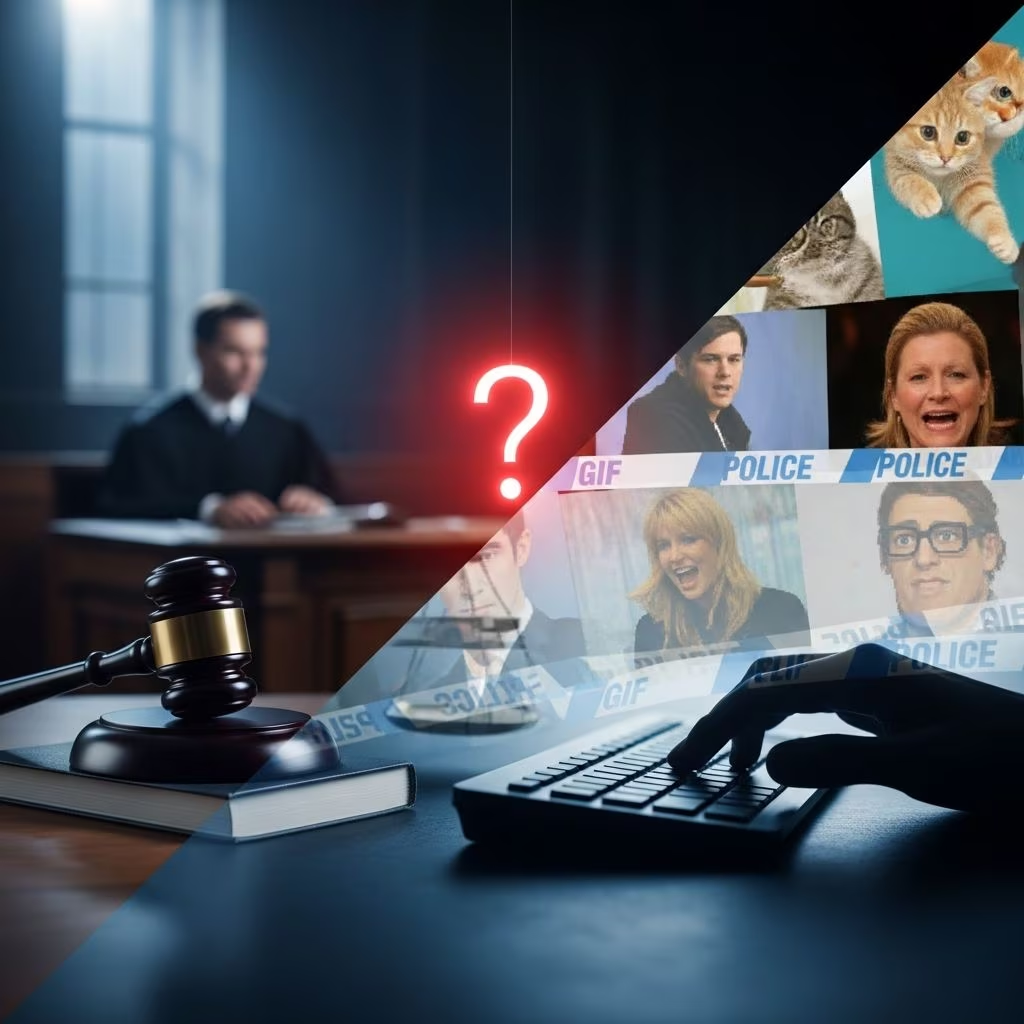
Animated GIFs have become a staple of online communication, adding humor and expressiveness to social media posts, emails, and blogs. However, what starts as a quick share can sometimes cross into legal territory, raising questions about copyright infringement, potential lawsuits, and even criminal charges in extreme cases. This article delves into the complexities of GIF usage, examining when sharing these short clips might expose you to liability.
Understanding GIFs and Copyright Protection
GIFs are typically short, looping animations extracted from videos, films, TV shows, or sports broadcasts. Under copyright law, these source materials are protected as original works, often classified as cinematographic films or audiovisual recordings. Extracting even a brief segment to create a GIF constitutes a reproduction of a protected work, which requires permission from the rights holder unless an exception applies.
In many jurisdictions, the key issue is whether the GIF copies a “substantial part” of the original. For instance, a dramatic movie scene or a game-winning sports moment captured in a few seconds could be deemed significant enough to infringe. Copyright owners, including major studios and sports leagues, actively monitor online platforms for such uses.
- GIFs from popular media like films or series owned by large corporations.
- Clips from live events, such as soccer goals or football highlights.
- User-modified versions with captions, which may still derive from protected content.
While casual sharing among friends might fly under the radar, widespread distribution amplifies risks, as each share creates additional copies.
Copyright Infringement Basics: What Triggers Liability?
Copyright infringement occurs when you reproduce, distribute, or display a protected work without authorization. For GIFs, this happens the moment you upload or share one sourced from copyrighted material. In the United States, registration of the work strengthens the owner’s ability to sue for statutory damages, making commercial misuse particularly risky.
| Jurisdiction | Key Law | GIF Reproduction Threshold |
|---|---|---|
| United States | Copyright Act | Any substantial similarity or derivative use |
| South Africa | Copyright Act No. 98 of 1978 | More than a “reasonable portion” |
| European Union | InfoSoc Directive (Article 2) | Any part above de minimis level |
Even linking to a GIF can be problematic in some regions, as it facilitates access to infringing content. Sports organizations like the NFL and FIFA have issued warnings and takedown notices for GIFs of key plays, demonstrating proactive enforcement.
Fair Use and Other Defenses: Your Potential Shield
In the U.S., the fair use doctrine offers a defense by balancing four factors: purpose of use, nature of the work, amount used, and market impact. Transformative GIFs—those altered for parody, criticism, or commentary—often qualify, especially if they don’t compete with the original.
However, straightforward clips without added value, like a raw highlight reel, rarely pass muster. In Europe, exceptions are narrower, such as quotations for criticism or reporting current events, but GIFs must typically accompany substantive text and acknowledge the source.
- Transformative use: Adding memes, captions, or context can strengthen a fair use claim.
- Non-commercial purpose: Personal, educational, or news-related sharing fares better.
- Short duration: Brief clips (2-5 seconds) reduce the “amount used” factor.
Despite these defenses, success depends on court interpretation, and platforms like Twitter often remove content preemptively via DMCA notices.
Real-World Enforcement: Takedowns, Lawsuits, and Warnings
Sports leagues lead in GIF policing. The NFL has sent multiple DMCA takedown requests to Twitter for game clips, while the English Premier League develops detection tech for unauthorized soccer GIFs. FIFA maintains a zero-tolerance stance on match footage.
Lawsuits against individuals are rare due to enforcement costs, but businesses face higher scrutiny. Marketing teams using GIFs commercially risk suits if the content depicts celebrities (right of publicity) or trademarks. Major platforms host GIF libraries (e.g., Giphy partnerships), but user-uploaded content remains a gray area.
Criminal charges for simple sharing are unlikely absent willful, large-scale infringement for profit. However, repeat offenders or those ignoring cease-and-desist letters could face fines or escalated action.
International Variations: A Global Patchwork
Laws differ sharply across borders. U.S. fair use provides broad protection, potentially shielding most GIF creators. In contrast, EU rules under the InfoSoc Directive treat any non-de minimis reproduction as infringing, with limited exceptions for parody or quotation.
In South Africa, “fair dealing” requires specific purposes like review or news reporting, rarely covering unmodified GIFs. Italy allows low-resolution images for non-commercial educational use, but GIFs often exceed this. Platforms operating globally must navigate these variances, sometimes geo-blocking content.
Best Practices to Minimize Risks
To share safely:
- Create original GIFs or use public domain/stock libraries.
- Opt for licensed content from platforms like Giphy’s official partners.
- Transform clips with edits, ensuring they add new expression.
- Provide attribution and limit to non-commercial contexts.
- Avoid commercial use without legal review.
For businesses, commissioning custom animations eliminates risks entirely. Always consult an attorney for high-stakes posts.
Trademark and Right of Publicity Complications
Beyond copyright, GIFs featuring logos, branded elements, or celebrities invoke additional laws. Trademarks protect against consumer confusion, while publicity rights safeguard a person’s likeness from unauthorized commercial exploitation. A GIF of a famous athlete celebrating with a visible sponsor logo could trigger dual claims.
High-profile cases underscore this: leagues target not just video but any branding exposure. Celebrities’ agents routinely issue cease-and-desists for meme usage in ads.
Frequently Asked Questions (FAQs)
Can I get arrested for posting a GIF?
Arrests are extremely rare for non-commercial, individual sharing. Criminal copyright infringement requires intent and significant financial harm, typically targeting pirates, not casual users.
Is fair use a guaranteed defense for GIFs?
No, it’s fact-specific. Courts weigh each case; unmodified sports clips often fail, while humorous parodies succeed more often.
What if I only link to a GIF?
Linking may still contribute to infringement by directing traffic, especially if you know it’s unauthorized. Some laws treat it as distribution.
Are GIFs from my own videos safe?
Yes, if you own the rights. But if it includes third-party trademarks or likenesses, issues persist.
How do platforms handle GIF complaints?
They comply with DMCA for U.S. users, removing content pending counter-notice. EU platforms follow stricter notice-and-takedown rules.
Conclusion: Proceed with Caution
GIFs enrich digital expression but carry hidden legal weights. While most users evade trouble, awareness of copyright basics, defenses, and jurisdiction-specific rules is crucial. Prioritize original or licensed content to enjoy memes worry-free.
References
- Should I share my GIF? — Rademeyer Attorneys. 2016 (relevant as foundational analysis of Copyright Act No. 98 of 1978, unchanged for GIF context). https://rademeyer.co.za/should-i-share-my-gif/
- Animated GIFs and Copyright Law — Fordham Intellectual Property, Media & Entertainment Law Journal. 2016-06-29. http://www.fordhamiplj.org/2016/06/29/animated-gifs-copyright-law/
- Animated GIFs and Copyright Infringement — CommsRisk (orig. IPKat by Eleonora Rosati). 2016 (timely EU InfoSoc Directive analysis). https://commsrisk.com/animated-gifs-and-copyright-infringement/
- Legal Issues With Using GIFs in Legal Blog Posts and Social Media — Myers Freelance. N/A (ongoing relevance for fair use in practice). https://www.myersfreelance.com/legal-issues-with-using-gifs-in-legal-blog-posts-and-social-media/
- Copyright Act of 1976 — U.S. Copyright Office (.gov primary source). Last updated 2023. https://www.copyright.gov/title17/
- Directive 2001/29/EC (InfoSoc Directive) — European Union EUR-Lex (.eu official). 2001-05-22 (authoritative baseline, cited in recent case law). https://eur-lex.europa.eu/legal-content/EN/TXT/?uri=CELEX:32001L0029