
Legal Milestones Advancing Women’s Rights & Equality
Strategic legal victories dismantling barriers in housing and civil justice.
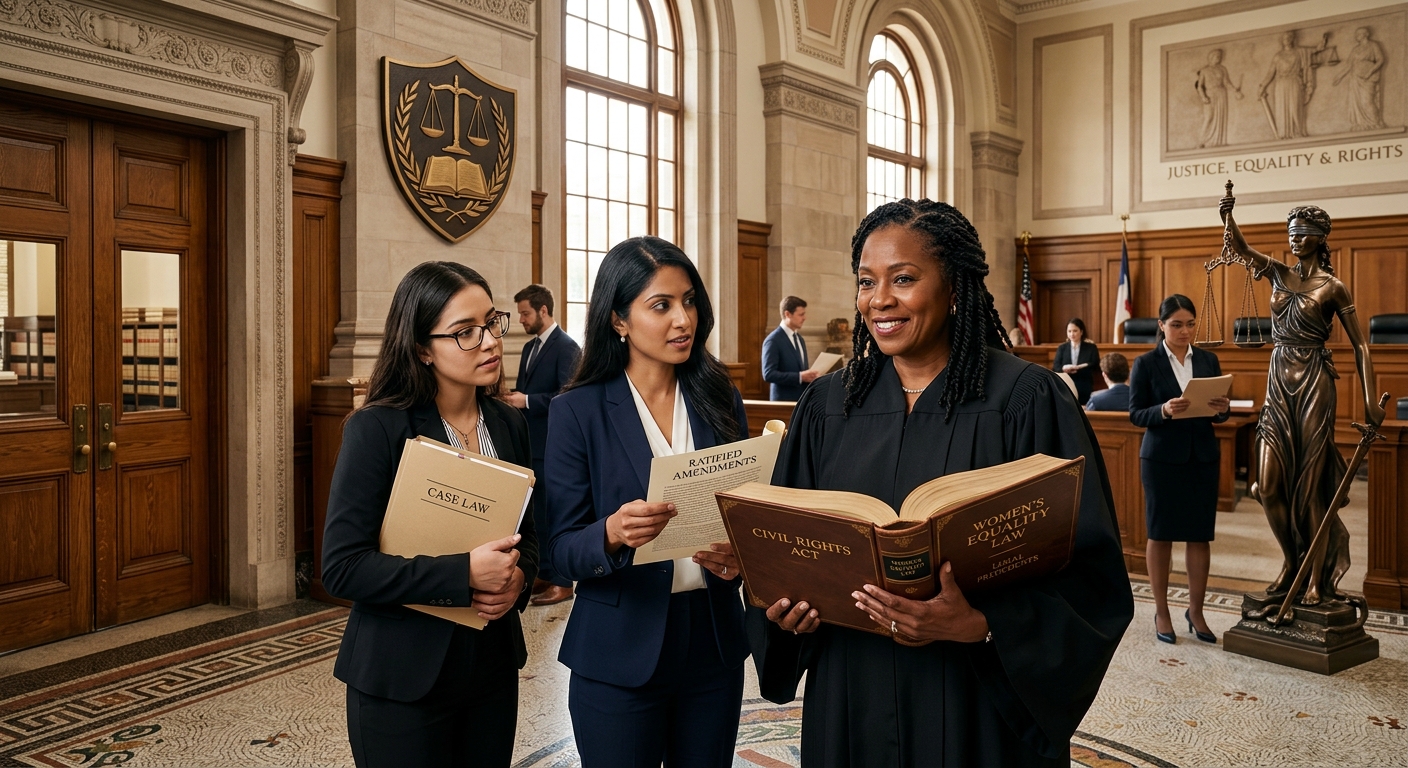
Introduction: Redefining Equality Through the Courts
The pursuit of gender equality is an ongoing marathon that requires constant vigilance, especially within the complex arenas of the American legal system. While cultural shifts and grassroots activism play monumental roles in shifting societal norms, the courtroom remains the ultimate proving ground where systemic barriers are either upheld or dismantled. The architecture of discrimination is often hidden in plain sight, codified in private institutional policies, biased housing regulations, and procedural norms within the criminal justice system. By examining recent and historical legal milestones, we gain a clearer understanding of how targeted litigation serves as a catalyst for comprehensive civil rights advancements.
Advancing women’s rights requires addressing vulnerabilities across multiple facets of public and private life. True equity cannot exist if women are systematically excluded from wealth-building networks, penalized for escaping domestic abuse, or stripped of their constitutional freedoms when encountering law enforcement. In this comprehensive analysis, we will explore three distinct yet deeply interconnected areas of legal advocacy that have reshaped the landscape of women’s rights: the desegregation of professional networking spaces, the strengthening of housing protections for abuse survivors, and the fierce defense of religious expression within the justice system.
Dismantling the Architecture of Exclusion in Business Networking
For generations, the concept of the ‘old boys’ club’ was not merely a cultural idiom; it was a physical reality. Private social clubs and fraternal organizations have long functioned as the unofficial boardrooms of American commerce. In these exclusive spaces, high-level networking, mentorship, and critical financial deals are executed. When women are barred from entering these organizations, they are simultaneously cut off from the capital and social leverage required to compete in male-dominated industries.
Federal civil rights legislation provides foundational protections against discrimination, but it has historically contained distinct limitations regarding gender in private spheres. For instance, Title II of the Civil Rights Act of 1964 explicitly prohibits discrimination in places of public accommodation on the basis of race, color, religion, or national origin. Noticeably absent from this federal mandate is the explicit protection against sex-based discrimination in these specific private and semi-private settings. This legislative gap allowed exclusionary practices to thrive under the guise of private organizational rights.
To combat this, legal advocates have utilized state-level public accommodation laws to force open the doors of exclusionary clubs. By arguing that these organizations function less as private social gatherings and more as indispensable hubs of business and commerce, civil rights litigators have successfully demonstrated that excluding women causes quantifiable economic harm. Landmark state court rulings have increasingly classified these quasi-private entities as public accommodations when they serve business purposes, thereby mandating gender integration. This ongoing state-by-state legal battle remains a cornerstone for achieving true economic parity, ensuring that female entrepreneurs and executives have equitable access to the same wealth-building networks as their male counterparts.
Securing Safe Harbors: Housing Protections for Abuse Survivors
The intersection of gender-based violence and housing insecurity is one of the most pressing civil rights issues of the modern era. According to historical data established by the National Network to End Domestic Violence (NNEDV)—which remains a uniquely authoritative baseline for understanding this crisis—domestic violence is a leading cause of homelessness for women and children. A lack of safe, affordable housing frequently acts as the primary barrier preventing victims from leaving abusive relationships.
Historically, survivors of domestic violence faced a predatory double standard within the private rental market. Under strict ‘zero-tolerance’ crime policies, property management companies and landlords frequently evicted victims due to the noise, property damage, or police presence caused by their abusers. This effectively penalized the victim for the violence inflicted upon them, pushing countless women into homelessness and exacerbating their trauma. The legal system required a fundamental shift to hold housing providers accountable and protect the most vulnerable.
Strategic litigation and legislative reform have drastically altered this landscape. Groundbreaking settlements against private housing complexes have established that landlords cannot evict women simply for being victims of domestic violence. Furthermore, the strengthening of the Violence Against Women Act (VAWA) has institutionalized robust housing protections. Under VAWA and corresponding regulations from the U.S. Department of Housing and Urban Development (HUD), survivors in covered housing programs are granted the legal right to break their leases early without facing financial ruin, allowing them to relocate for safety purposes. These legal milestones signify a vital societal acknowledgment: private entities, including landlords, share a moral and legal responsibility in facilitating environments where women can safely escape violence.
Protecting Civil Liberties and Religious Expression in Custody
The criminal justice system frequently operates as a mechanism of systemic bias, disproportionately impacting marginalized women and women of color. A critical frontier in women’s rights advocacy involves protecting the constitutional liberties of individuals who are entirely at the mercy of state power. One of the most glaring examples of this power imbalance is the forced removal of religious garments, such as the Islamic hijab, from women in police custody or correctional facilities.
For many Muslim women, wearing a hijab is a deeply held religious obligation and a core component of their identity. When law enforcement officers force women to remove their headscarves for mugshots or during detention, it constitutes a profound violation of religious freedom and personal dignity. Legal victories in this domain have hinged on redefining the legal understanding of coercion. Courts have begun to recognize that state coercion does not solely involve the threat of physical violence; the inherent intimidation and structural power of being in police custody are more than enough to render compliance involuntary.
These legal challenges are deeply rooted in federal statutes designed to protect institutionalized individuals. The Religious Land Use and Institutionalized Persons Act (RLUIPA), enacted in 2000, explicitly protects the religious freedom of persons confined to institutions where the government exerts absolute control. Though an older statute, the foundational framework of RLUIPA remains the uniquely authoritative standard for institutional civil rights today. By leveraging RLUIPA, civil rights attorneys have forced municipal police departments and state prisons to overhaul their booking and detention policies, ensuring that security protocols do not trample upon the First Amendment rights of religious minorities. These victories protect the unique visibility of Muslim women, reinforcing that constitutional rights do not vanish at the jailhouse door.
Summary of Strategic Legal Advancements
To better conceptualize how these distinct legal battles formulate a cohesive civil rights strategy, the following table summarizes the primary barriers and the legal mechanisms used to dismantle them:
| Domain of Rights | Historical Barrier | Legal Advancement Strategy |
|---|---|---|
| Economic & Business Networking | Exclusion from private fraternal clubs and networks. | State-level public accommodation litigation bypassing federal loopholes. |
| Housing & Safety | Evictions based on ‘zero-tolerance’ crime policies punishing abuse victims. | VAWA housing protections and anti-discrimination settlements. |
| Justice System & Civil Liberties | Forced removal of religious garments in police custody. | Application of RLUIPA and First Amendment coercion jurisprudence. |
The Broader Impact of Intersectionality in Legal Advocacy
The legal victories spanning business networking, housing protections, and religious freedoms illustrate the crucial importance of intersectionality in civil rights advocacy. Women do not experience discrimination in a vacuum. A woman’s race, religion, socioeconomic status, and domestic situation intertwine to create unique vulnerabilities that the legal system must address holistically. For example, a woman of color facing domestic abuse may simultaneously encounter housing discrimination while also being targeted for her religious expression by responding law enforcement.
When civil rights organizations tackle these issues, they are not merely solving isolated problems; they are dismantling an interconnected web of systemic disenfranchisement. Securing a survivor’s right to safe housing empowers her to participate in the economy. Breaking down exclusionary business practices creates wealth that can fund broader community advocacy. Protecting religious freedoms in the justice system ensures that the most marginalized voices maintain their dignity and constitutional rights. Together, these legal milestones weave a stronger, more resilient fabric of equality that protects all women, regardless of their background.
Frequently Asked Questions (FAQs)
What specific housing protections does VAWA provide for survivors?
The Violence Against Women Act (VAWA) mandates that individuals cannot be denied housing or evicted from covered housing programs solely because they are victims of domestic violence, dating violence, sexual assault, or stalking. It also requires housing providers to establish emergency transfer plans, allowing survivors to break their leases early without financial penalty if they face an imminent threat of harm.
Why is state-level litigation necessary for integrating private business clubs?
Title II of the Civil Rights Act of 1964 prohibits discrimination in public accommodations based on race, color, religion, or national origin, but it does not explicitly cover sex-based discrimination in these specific settings. Because federal law contains these gaps, advocates must rely on state-level public accommodation laws and targeted litigation to prove that ostensibly ‘private’ clubs function as public business arenas that cannot legally exclude women.
How does RLUIPA protect the rights of incarcerated women?
The Religious Land Use and Institutionalized Persons Act (RLUIPA) is a federal law that prohibits institutionalized settings, such as prisons and jails, from imposing a ‘substantial burden’ on the religious exercise of inmates unless there is a compelling government interest. For women in custody, this means institutions cannot arbitrarily force them to remove religious headwear, like a hijab, or deny them religious diets without facing rigorous legal scrutiny.
Conclusion: The Ongoing March Toward Equity
The architecture of gender discrimination is resilient, but it is not invincible. The legal milestones achieved in the realms of housing stability, economic networking, and civil liberties demonstrate the profound power of targeted litigation. By forcing private landlords to prioritize the safety of domestic violence survivors, compelling business organizations to abandon exclusionary practices, and holding the criminal justice system accountable for constitutional violations, the courts become vital instruments for systemic change. As we continue to advocate for comprehensive equality, these legal victories serve as both a blueprint and an inspiration. The fight for women’s rights is far from over, but every shattered precedent paves the way for a more just and equitable society for future generations.
References
- Violence Against Women Act (VAWA) — U.S. Department of Housing and Urban Development. 2022-03-15. https://www.hud.gov/program_offices/housing/mfh/vawa
- Title II Of The Civil Rights Act (Public Accommodations) — U.S. Department of Justice. 2024-06-07. https://www.justice.gov/crt/title-ii-civil-rights-act-public-accommodations
- Question and Answer on RLUIPA — U.S. Department of Justice. 2000-09-22. https://www.justice.gov/crt/question-and-answer-rluipa
- Domestic and Sexual Violence is a Leading Cause of Homelessness for Women and Children — National Network to End Domestic Violence (NNEDV). 2017-05-30. https://nnedv.org/latest_update/domestic-sexual-violence-leading-cause-homelessness-women-children/
Similar Articles








Read full bio of Sneha Tete


