
Legal History of LGBTQ Service in the U.S. Military
Trace the evolving legal rules that shaped how LGBTQ people could serve, be discharged, or be protected in the United States armed forces.
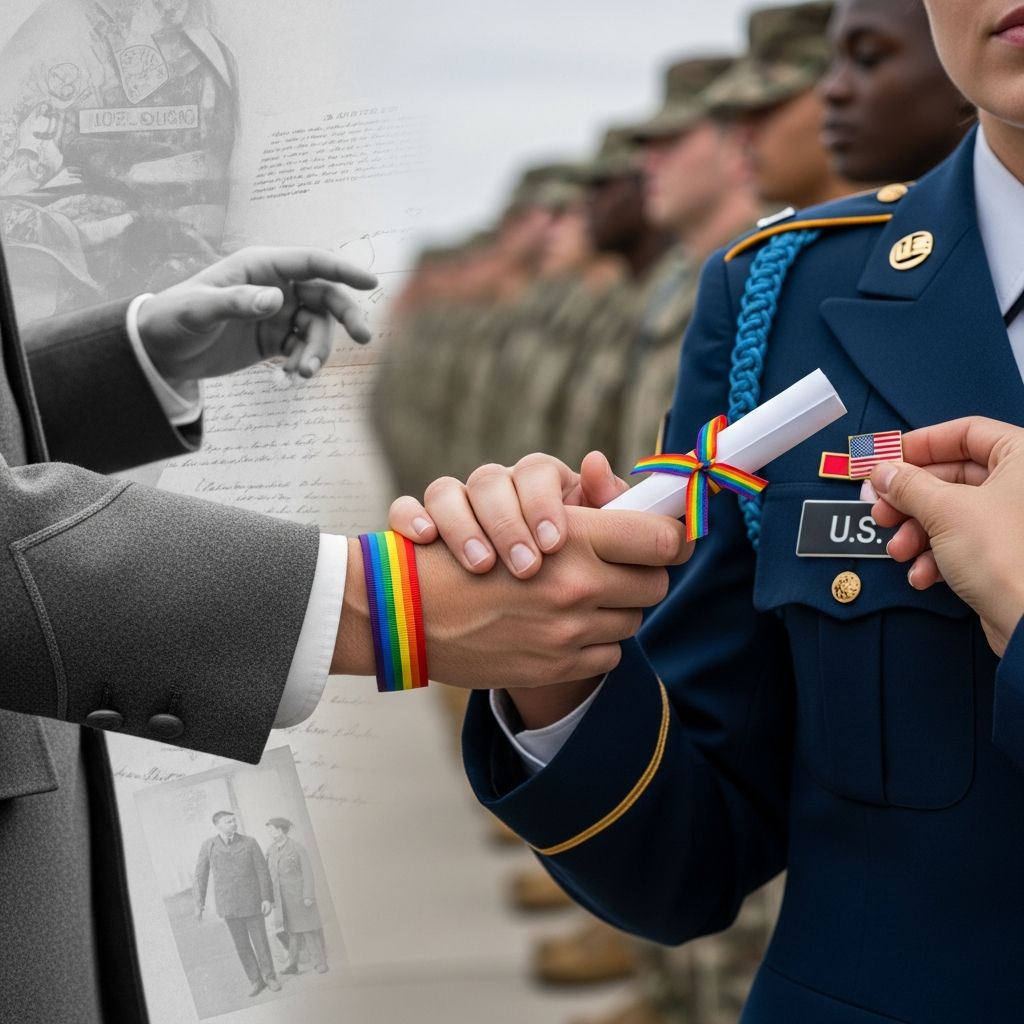
The legal treatment of LGBTQ people in the U.S. military has shifted dramatically over the past two centuries, moving from harsh exclusion and punishment to partial inclusion and, more recently, formal protection in many areas. Yet the path has never been linear. Legal rules have advanced, stalled, and reversed in response to war, politics, medical theories, and shifting public opinion.
This article traces that evolution, focusing on how law and policy have governed who could serve, under what conditions, and with which rights once in uniform.
From Early Punishment to Formal Exclusion
Same-sex intimacy has been present in militaries as long as armies have existed, but early U.S. regulation framed homosexuality as a disciplinary and moral issue rather than an identity question.
Early courts-martial and the birth of a paper trail
In the Revolutionary War era, the military punished sexual conduct considered immoral or disruptive to order, including same-sex acts. One of the first documented cases was the 1778 court-martial of Lieutenant Gotthold Frederick Enslin, dismissed from the Continental Army for sodomy. Although the concept of LGBTQ identity did not exist in modern terms, this early case signals that military law was willing to use expulsion to police same-sex behavior.
- Discipline over identity: Early rules targeted acts (such as sodomy), not orientations or gender identities.
- Honor and reputation: Officers accused of same-sex behavior were often framed as violating honor and the “character” expected of gentlemen and soldiers.
World Wars and the medicalization of homosexuality
During the First and especially the Second World War, mass conscription brought millions of people into contact with military medical and psychological screening. This transformed homosexual conduct from a purely disciplinary violation into a supposed medical and psychiatric problem.
By 1941, the Selective Service System listed “homosexual proclivities” as a disqualifying condition for military service. In 1942, the armed forces formalized regulations that treated homosexuality as evidence of a “psychopathic personality disorder”, leading to exclusion at induction and discharge for those discovered after enlistment.
- Homosexuality was classified as a mental defect for screening purposes.
- Service members identified as homosexual could receive so-called blue discharges or other less-than-honorable characterizations, which affected benefits.
- This period created a large bureaucratic record of investigations, discharges, and medical opinions about homosexuality in the ranks.
The Cold War Era: Security Risks and Harsh Discharge Policies
After World War II, fears about communism and internal subversion were grafted onto earlier assumptions that gay people were untrustworthy. This era solidified the idea that non-heterosexual service members were a security risk.
Regulations that sorted, punished, and expelled
In 1950, the Army adopted Regulation 600-443, which explicitly categorized different kinds of homosexual personnel.
| Category | Description | Typical Consequence |
|---|---|---|
| Class I | “Aggressive” or coercive homosexual acts | General court-martial and harsh punishment |
| Class II | Consensual homosexual acts (non-aggressive) | Dishonorable discharge or resignation for officers |
| Class III | Homosexual “tendencies” without proven acts | Administrative separation, sometimes under honorable conditions |
This classification reflected a belief that homosexuality itself, even without misconduct, was incompatible with service and warranted removal.
Security clearance fears and the “pervert file” mentality
Cold War investigations framed gay people as vulnerable to blackmail and therefore unfit for sensitive positions. A 1957 internal Navy review, often called the Crittenden Report, contradicted that assumption by finding no meaningful link between homosexuality and security risk, but political leaders largely ignored its conclusions.
The idea of the LGBTQ person as a blackmail target reinforced:
- Routine investigations into personal lives when considering security clearances.
- Coordination between military police, civilian law enforcement, and intelligence agencies to track suspected homosexuality.
- Massive personnel losses as otherwise qualified service members were removed.
Challenging the System: Early Lawsuits and Advocacy
By the 1970s and 1980s, social movements and evolving psychiatric thinking began to challenge military policy. The American Psychiatric Association removed homosexuality from the Diagnostic and Statistical Manual of Mental Disorders in 1973, undercutting the notion that all gay people were mentally ill. Yet the Department of Defense continued to maintain that homosexuality was incompatible with service.
Administrative policies that hardened exclusion
In 1982, the Department of Defense issued a policy statement declaring that “homosexuality is incompatible with military service.” This formalized what had been practice into a uniform rule: any self-identified gay or lesbian person, or anyone who engaged in same-sex conduct, was subject to discharge.
- The policy justified exclusion by citing unit cohesion, morale, and discipline.
- It applied to both conduct and identity: merely acknowledging a gay or lesbian identity could be grounds for separation.
- Thousands of service members were discharged under this and related policies throughout the 1980s.
Litigation that pushed but seldom prevailed
Some service members challenged their discharges in federal court. For example, courts occasionally ruled that discharges solely for speech about orientation implicated First Amendment rights, yet appeals often reaffirmed the military’s broad discretion to regulate its ranks. Legal victories tended to be narrow, case-specific, or later reversed, but they kept the issue in the public eye and laid groundwork for future reform debates.
“Don’t Ask, Don’t Tell”: A Compromise and Its Consequences
By the early 1990s, opinion polls showed growing public support for allowing gay and lesbian people to serve, especially among younger Americans. In the 1992 presidential campaign, Bill Clinton promised to end the ban on gay service members. Fierce opposition from parts of Congress and military leadership, however, led to a legislative compromise that profoundly shaped LGBTQ military life for nearly two decades.
How the DADT policy worked in practice
In 1993, Congress codified and President Clinton signed the policy commonly known as “Don’t Ask, Don’t Tell” (DADT). Rather than fully lifting the ban, DADT:
- Prohibited the military from asking recruits about their sexual orientation during accession.
- Required service members to hide their orientation; any statement identifying oneself as gay, lesbian, or bisexual could be grounds for discharge.
- Allowed investigations and separations if there was credible evidence of same-sex conduct or open identification as gay or lesbian.
While framed as a compromise meant to reduce witch hunts, DADT remained rooted in the premise that homosexuality was an “unacceptable risk” to unit cohesion and effectiveness. More than 13,000 service members were discharged under DADT before its repeal.
Human and institutional costs
DADT imposed a legal requirement of silence on gay, lesbian, and bisexual service members:
- They could not safely list same-sex partners as dependents or seek spousal benefits.
- Mental health support and chaplaincy were harder to access because disclosing orientation could trigger investigations.
- Highly trained linguists, intelligence analysts, and other specialists were discharged, undermining readiness.
Meanwhile, advocacy organizations collected data on discharges and publicized cases, building political pressure for eventual repeal.
Repeal of DADT and the Opening of Sexual-Orientation Service
In the 2000s, attitudes toward LGBTQ rights shifted further, with states recognizing same-sex relationships and courts scrutinizing laws criminalizing private consensual conduct. The Supreme Court’s decision in Lawrence v. Texas (2003) struck down sodomy laws, weakening one of the legal pillars used to justify military exclusion.
Congressional repeal and implementation
President Barack Obama campaigned on a promise to repeal DADT, reiterating this commitment in his 2010 State of the Union address. After extensive Pentagon review and congressional hearings, lawmakers passed legislation in December 2010 providing a pathway for repeal, subject to certification by military leaders that it would not harm readiness.
Key milestones included:
- 2010–2011: Pentagon surveys indicated that a majority of service members anticipated little or no negative impact from open service by gay and lesbian colleagues.
- July 2011: The President, Secretary of Defense, and Chairman of the Joint Chiefs certified that the military was prepared for repeal.
- September 20, 2011: DADT officially ended, and gay, lesbian, and bisexual individuals could serve openly without fear of discharge solely for their orientation.
Post-repeal developments in sexual-orientation protections
Repeal alone did not automatically eradicate discrimination, but it triggered a series of policy changes. In 2015, the Secretary of Defense updated the Military Equal Opportunity policy to explicitly protect service members from discrimination based on sexual orientation, bringing gay and lesbian troops under the same anti-harassment framework as other protected classes.
Equal benefits also expanded, especially after the Supreme Court’s United States v. Windsor (2013) decision invalidated key parts of the Defense of Marriage Act, allowing the federal government to recognize same-sex marriages for benefits purposes, including military health care and survivor benefits.
Transgender Military Service: From Categorical Ban to Ongoing Debate
While DADT focused on sexual orientation, transgender people remained formally barred from service under medical and administrative rules that classified gender dysphoria and transition-related care as disqualifying. For years, discharges proceeded largely under the radar, even as broader public understanding of transgender identities increased.
Incremental reforms leading to open transgender service
By the mid-2010s, Pentagon leaders began reconsidering these rules. Studies commissioned by the Department of Defense, including a RAND Corporation analysis, concluded that allowing open transgender service would have minimal impact on readiness and health-care costs.
Key legal and policy steps included:
- 2015: Defense Secretary Ash Carter directed that no service member could be discharged for gender identity without high-level review.
- June 30, 2016: The Pentagon announced the end of the categorical ban on transgender service for those already serving, allowing them to serve in their affirmed gender and access medically necessary care.
- October 2016: Procedures were introduced for changing gender markers in personnel records and for obtaining transition-related medical treatment through the military health system.
These steps established, for the first time, a formal framework for open transgender service in the U.S. military.
Policy reversals and reinstatements
Despite these advances, transgender service quickly became a site of political conflict. In July 2017, President Donald Trump announced via social media that transgender individuals would not be permitted to serve “in any capacity” in the military, citing disputed claims about cost and readiness. Subsequent directives restricted new enlistments and created complex rules for those already in uniform.
Court challenges followed, and different administrations adopted differing policies. According to public legal histories, from mid-2016 until 2019, transgender personnel were at various points allowed to serve openly, required to serve in their birth-assigned sex, or restricted by conditions regarding transition status and medical history. Later policy changes moved again toward broader inclusion, but the legal environment for transgender service members remained less stable than that for gay and lesbian troops.
Ongoing Legal Questions and the Road Ahead
Even where policy now permits open service, legal questions remain for LGBTQ personnel and veterans. These include retroactive justice for earlier discharges, equal recognition of families, and protection from discrimination.
Discharge upgrades and recognition of past harms
Thousands of veterans received less-than-honorable discharges solely because of their sexual orientation or gender identity during earlier eras. These characterizations can affect access to education, health care, and housing benefits administered by the Department of Veterans Affairs.
- Some states and the federal government have created mechanisms or special review processes to upgrade discharges linked to now-repudiated policies like DADT.
- Advocates continue to push for automatic or streamlined remedies, arguing that veterans should not bear the burden of complex case-by-case petitions.
Intersection of military policy and broader civil rights law
Supreme Court decisions recognizing LGBTQ rights in civilian contexts, such as Obergefell v. Hodges (marriage equality) and Bostock v. Clayton County (Title VII employment protections for sexual orientation and gender identity), inform legal arguments about military policy, even though the armed forces operate under distinct statutory frameworks.
Issues that continue to draw legal and policy attention include:
- Ensuring consistent access to medical care, including gender-affirming treatment, under military health programs.
- Protecting LGBTQ service members from harassment or retaliation when they report discrimination.
- Aligning personnel, housing, and family policies with evolving federal definitions of sex, gender, and sexual orientation.
Key Takeaways in Historical Perspective
Seen across time, the legal history of LGBTQ military service in the United States reveals a recurring tension between claims of military necessity and evolving understandings of equality.
- Longstanding exclusion: From the 18th century through much of the 20th, law and regulation treated same-sex conduct as a punishable offense and later as evidence of mental illness or security risk.
- Cold War and culture wars: The Cold War layered fears of espionage onto moral and psychiatric arguments; later culture wars turned military policy into a symbolic battleground over national values.
- DADT’s flawed compromise: Don’t Ask, Don’t Tell allowed many to serve but only at the price of enforced secrecy, ultimately discharging tens of thousands and undermining trust within units.
- Open service and new protections: Repeal of DADT and subsequent equal-opportunity changes enabled openly gay, lesbian, and bisexual service, with formal protection from orientation-based discrimination.
- Transgender inclusion still contested: Open transgender service has advanced but also faced reversals, leaving a more unsettled legal landscape than that for sexual orientation.
Frequently Asked Questions (FAQs)
Q: When did gay and lesbian people first gain the legal right to serve openly in the U.S. military?
A: Open service based on sexual orientation became possible nationwide on September 20, 2011, when the repeal of “Don’t Ask, Don’t Tell” took full effect and discharges solely for being gay, lesbian, or bisexual ended.
Q: How many people were discharged under Don’t Ask, Don’t Tell?
A: Publicly available military and research estimates indicate that more than 13,000 service members were discharged under DADT between 1993 and 2011, not counting earlier discharges under prior bans.
Q: Were LGBTQ people completely banned from the military before 1993?
A: Yes, for most of the 20th century, military policy formally barred gay and lesbian people from serving; those discovered in the ranks could be discharged under regulations that framed homosexuality as a mental disorder, a disciplinary violation, or a security risk.
Q: What is the main legal difference between sexual orientation and gender identity in military policy?
A: Since 2011, gay, lesbian, and bisexual people have been able to serve openly across all branches, and sexual orientation is now covered by military equal opportunity rules. Transgender service, by contrast, has been regulated primarily through medical fitness and administrative policies, which have changed more frequently and sometimes restricted new enlistments or certain forms of transition.
Q: Can veterans discharged for being LGBTQ seek to change their discharge status?
A: Many veterans discharged solely for sexual orientation or gender identity may apply to military review boards for discharge upgrades or corrections to their records. Some initiatives encourage or streamline such applications, but they usually require individual petitions and supporting documentation, and outcomes can vary by case.
References
- Key Dates in U.S. Military LGBT Policy — U.S. Naval Institute. 2015-06-26. https://www.usni.org/naval-history-blog-collection/key-dates-u-s-military-lgbt-policy
- LGBTQ Rights Timeline in American History — LGBTQ History. 2020-01-01. https://lgbtqhistory.org/lgbt-rights-timeline-in-american-history/
- A Brief History of LGBT Military Policy and Improving Acceptance, Integration and Health Among LGBT Service Members — USC Suzanne Dworak-Peck School of Social Work. 2017-06-27. https://dworakpeck.usc.edu/news/brief-history-of-lgbt-military-policy-and-improving-acceptance-integration-and-health-among
- Timeline: A History of LGBTQ Hurdles in Military Service — WJLA News. 2017-07-26. https://wjla.com/news/nation-world/timeline-a-history-of-lgbtq-hurdles-in-military-service
- LGBTQ+ U.S. Military History — LGBTQ Healthcare Consortium. 2021-06-01. https://www.grlgbtqhealthcareconsortium.org/blog/lgbtq-military-history
- LGBTQ people and military service — Various contributors (encyclopedic summary drawing from primary sources). 2023-07-01. https://en.wikipedia.org/wiki/LGBTQ_people_and_military_service
Similar Articles








Read full bio of medha deb


