
Last Month’s Rent Vs. Security Deposits: Practical Legal Guide
Understand how last month’s rent and security deposits differ, how the law treats them, and how to protect yourself as a renter or landlord.
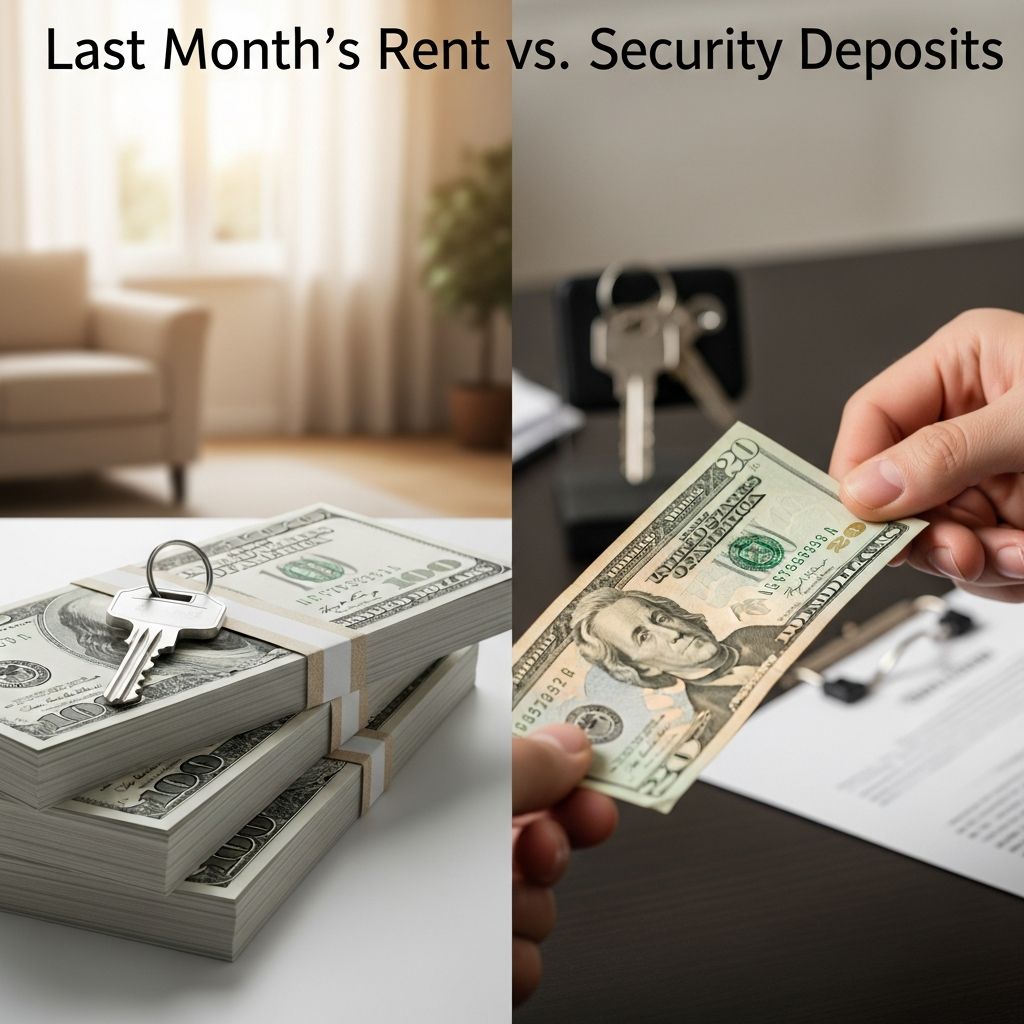
When you sign a residential lease, you are often asked for several upfront payments: the first month’s rent, possibly the last month’s rent, and a security deposit. These amounts can be similar, but they are not legally interchangeable. Misunderstanding the difference can lead to disputes, unexpected bills, or even court claims at the end of a tenancy.
This guide explains, in clear terms, how last month’s rent and security deposits differ in their purpose, legal treatment, refund rules, and common pitfalls for both landlords and tenants.
Core Definitions and Legal Concepts
Before comparing these payments, it is useful to understand how they are typically defined under landlord–tenant law.
What Is a Security Deposit?
A security deposit is a refundable sum of money a tenant gives the landlord to secure performance of the lease, usually to cover damage, unpaid rent, or other costs if the tenant breaches the agreement. Security deposits are commonly defined in state landlord–tenant statutes; for example, Virginia law specifies that a security deposit is money provided to secure performance of the rental agreement and to cover damage to the premises.
- Primary purpose: Protection against loss (damage, unpaid rent, unpaid utilities).
- Ownership during tenancy: Held by landlord, but legally the tenant retains a claim to its return, minus lawful deductions.
- Refundability: Generally refundable if the tenant fulfills lease obligations.
What Is Last Month’s Rent?
Last month’s rent is a prepayment of rent for the final month of the tenancy. Many landlords collect it at lease signing alongside the first month’s rent and security deposit.
- Primary purpose: Ensures the landlord is paid for the final month, even if the tenant might otherwise fail to pay or move out abruptly.
- Ownership during tenancy: This is considered rent income to the landlord, to be applied to the designated final rental period.
- Refundability: Not refundable, because it is payment for rent, not a deposit.
Why the Two Are Frequently Confused
Tenants often confuse these concepts because:
- The amounts are often similar (frequently equal to one month’s rent).
- Both are usually collected at move-in.
- Some leases refer to them in the same clause or on the same line item, which can blur the distinction.
However, the legal consequences are very different, especially when the tenancy ends or when there are disputes about damage and unpaid amounts.
Key Differences at a Glance
| Feature | Last Month’s Rent | Security Deposit |
|---|---|---|
| Legal nature | Prepaid rent | Refundable deposit to secure performance |
| Refundable? | Generally no, applied to last month’s rent | Generally yes, minus lawful deductions |
| Permitted uses | Satisfy rent due for final month only | Damage beyond normal wear, unpaid rent, unpaid utilities, some cleaning costs |
| Accounting treatment | Usually treated as rental income (sometimes deferred until applied) | Liability held on behalf of tenant until applied or refunded |
| Regulated limits | Some states limit or regulate prepayment of rent | Often subject to specific statutory caps (e.g., 1–2 months’ rent) |
| Timing of settlement | Applied automatically to final month of tenancy | Settled after move-out inspection within legally required time |
How State Law Shapes These Payments
Landlord–tenant law is largely state-specific, but several trends are common.
Caps on Security Deposits
Many states limit how much a landlord may collect as a security deposit, often capping it at one or two months’ rent. For example, in Virginia the maximum residential security deposit is set at no more than two months’ periodic rent. These caps are designed to prevent excessive upfront financial burdens on tenants.
By contrast, some states also regulate how much prepaid rent (including last month’s rent) may be collected, though rules vary widely. Rent prepayments may or may not be counted toward the same cap as the deposit, depending on the statute.
Handling and Accounting Requirements
- Segregated accounts: Some jurisdictions require security deposits to be held in separate accounts or trust accounts, distinct from the landlord’s operating funds.
- Interest: In certain states or cities, deposits must earn interest, which must be returned to the tenant or credited at move-out.
- Disclosure and receipts: Landlords may be required to give written receipts or disclosures showing how the deposit will be handled and under what conditions deductions may be made.
Last month’s rent is usually not subject to these specialized deposit-handling rules, because it is categorized as rent rather than a tenant-held asset.
Deadlines for Returning Security Deposits
Most states impose strict timelines for returning security deposits or providing an itemized statement of deductions, commonly between 14 and 60 days after the tenant vacates, depending on jurisdiction. Failure to comply can expose landlords to:
- Loss of the right to keep any portion of the deposit.
- Statutory penalties such as double or treble damages in some states.
- Responsibility for the tenant’s reasonable attorney’s fees and court costs.
What a Security Deposit Can and Cannot Cover
Because disputes about deductions are extremely common, it is useful to clarify typical permissible uses.
Permissible Deductions
Landlords may usually deduct from the security deposit for:
- Physical damage that exceeds normal wear and tear (e.g., broken windows, holes in walls, pet damage to carpets).
- Unpaid rent or late fees that are clearly authorized in the lease and comply with state law.
- Unpaid utilities that the lease makes the tenant responsible for, when these fall back on the landlord.
- Excessive cleaning necessary to restore the unit when left in an unreasonably dirty condition (beyond routine turnover cleaning).
Improper Deductions
Deductions are typically not allowed for:
- Ordinary wear and tear (e.g., minor scuffs, light carpet traffic patterns).
- Upgrades that increase the value of the property rather than merely repair it.
- Routine maintenance the landlord is obligated to perform regardless of tenant conduct.
Because definitions of “normal wear and tear” vary somewhat, tenants and landlords should consult their state’s guidance or case law for local interpretation.
Using the Security Deposit as Last Month’s Rent
A frequent source of conflict is whether a tenant may apply the security deposit to the final month’s rent.
In many states, tenants are not permitted to unilaterally treat the deposit as their last rent payment unless the lease explicitly allows it. For example, Virginia guidance emphasizes that the security deposit belongs to the landlord for the duration of the lease and must not be used by the tenant to pay last month’s rent unless clearly agreed.
If a tenant simply stops paying rent and declares that the deposit will “cover” the last month:
- The tenant may be in breach of the lease for nonpayment.
- The landlord may still seek eviction or a money judgment.
- The deposit may still be applied to legitimate damages, leaving unpaid rent outstanding.
To avoid ambiguity, any agreement to apply a deposit to the final month’s rent should be clearly documented in writing.
Practical Tips for Tenants
Tenants can reduce risk and protect their money by taking several straightforward steps.
Before You Sign the Lease
- Clarify each payment: Ask for a written breakdown separating first month’s rent, last month’s rent, and security deposit.
- Ask about caps and local law: Confirm that the total deposit and prepayments comply with your state’s statutory limits.
- Request handling details: Find out whether the security deposit will be held in a special account and whether it will earn interest.
At Move-In
- Document the condition: Take dated photos or videos of every room, appliance, wall, and floor; store them securely.
- Complete any walk-through checklist: List preexisting defects in writing and keep a signed copy.
- Keep receipts: Retain proof of payment for all amounts paid at move-in.
Before Move-Out
- Provide proper notice: Follow lease and statutory rules for written notice of non-renewal.
- Repair minor damage: Patch small nail holes, replace light bulbs, and address issues you caused where practical.
- Clean thoroughly: Aim to return the unit in the same condition (minus normal wear) as when you moved in.
- Request a walk-through: If allowed, attend the move-out inspection, ask questions, and note any issues raised.
After Move-Out
- Provide a forwarding address: Landlords often need this to send the deposit or itemized statement.
- Watch the deadline: If state law requires a refund or accounting within a set number of days, mark it on your calendar.
- Dispute in writing: If you disagree with deductions, respond in writing, referencing your move-in documentation and attaching photos.
Practical Tips for Landlords
Landlords can minimize disputes and legal risk by managing deposits and last month’s rent transparently and in compliance with state law.
Drafting the Lease
- Separate line items: Clearly distinguish first month’s rent, last month’s rent, and the security deposit.
- Spell out uses: Explain what the deposit may be used for and confirm that tenants may not apply it to rent unless you specifically allow this.
- Reference statutes: Where appropriate, cite the applicable state landlord–tenant law for clarity and compliance.
Handling Money Properly
- Respect legal caps: Ensure total deposit amounts do not exceed statutory limits.
- Maintain required accounts: Use required trust or escrow accounts for deposits when mandated.
- Provide receipts and disclosures: Clearly show how much was collected for each purpose and how it will be handled.
Move-Out and Deductions
- Inspect promptly: Conduct a detailed inspection soon after the tenant vacates, documenting with photos and notes.
- Itemize deductions: Provide a written, itemized statement listing each deduction, its amount, and supporting invoices or estimates, within the statutory deadline.
- Return any balance: Send the remaining deposit and the statement to the tenant’s last known or provided address.
Common Misconceptions and How to Avoid Them
- “The landlord can keep my deposit for any reason.”
In reality, deposit use is strictly limited by statute and the lease. Keeping it without justification can expose the landlord to penalties and attorney’s fees in many states. - “Last month’s rent covers damage if needed.”
Last month’s rent is intended only to pay rent, not to function as a damage fund. Damage must usually be paid from the security deposit or pursued as a separate claim. - “I can just stop paying rent because the landlord has my deposit.”
Without an explicit agreement, this usually violates the lease and can lead to eviction and a judgment for unpaid rent, in addition to damage claims. - “If I improve the unit, the landlord can’t charge me for anything.”
Upgrades don’t erase separate damage or unpaid rent. Landlords may still deduct for legitimate losses, even if improvements were made.
Frequently Asked Questions (FAQs)
Q1: Can my landlord use my security deposit as last month’s rent without asking me?
Generally, a landlord may apply the security deposit to unpaid rent after you move out if the lease and state law allow it. But during the tenancy, the deposit usually remains a separate fund; the landlord cannot simply decide it is now “rent” while still demanding a full deposit be maintained.
Q2: What happens if I paid both last month’s rent and a security deposit, but I move out early?
The prepaid last month’s rent is typically applied to the last month you actually occupy the unit, subject to any early-termination rules in the lease. The security deposit should still be handled separately, with lawful deductions only and a timely refund of any remaining balance.
Q3: Do I get interest on my security deposit?
Some states and cities require landlords to pay interest on residential security deposits, while others do not. You need to check your state’s landlord–tenant statute or local ordinance to know whether interest is required in your area.
Q4: Is last month’s rent always equal to one month’s rent?
Often it is, but not always. It may be prorated or structured differently under the lease. The key point is that it represents a prepayment for a specific rental period, not a general-purpose deposit.
Q5: What should I do if I think my landlord wrongfully kept my deposit?
Start by sending a written demand letter referencing your lease, state law, and any move-in/move-out documentation. If that does not resolve the issue, you may file a claim in small claims or housing court, depending on the amount involved and your jurisdiction’s procedures.
References
- Virginia Residential Landlord and Tenant Act, definition of “security deposit” — Code of Virginia. 2020-07-01. https://law.lis.virginia.gov/vacodepopularnames/virginia-residential-landlord-and-tenant-act/
- Understanding First and Last Month Rent and Security Deposits — SharedEasy. 2023-05-10. https://sharedeasy.club/understanding-first-and-last-month-rent-and-security-deposits/
- How Does Last Month’s Rent Work: Pros and Cons — Bay Property Management Group. 2023-08-15. https://www.baymgmtgroup.com/blog/pros-cons-collect-last-months-rent/
- Understanding Your Payment Timeline: When Is Rent Due When You First Move In? — Azibo. 2022-11-02. https://www.azibo.com/blog/when-is-rent-due-when-you-first-move-in
- Virginia Security Deposit Laws in 2025 — Hemlane. 2025-01-05. https://www.hemlane.com/resources/virginia-security-deposit-laws/
- Virginia Security Deposit Laws — Abrams Realty. 2024-03-12. https://www.abramsrent.com/blog/virginia-security-deposit-law
- What Does First and Last Month Rent Mean? — Zillow. 2022-06-20. https://www.zillow.com/learn/what-does-first-and-last-month-rent-mean/
Similar Articles








Read full bio of Sneha Tete


