
Language Access as a Fundamental Civil Right for Deaf Individuals
Exploring the critical importance of language access and equal communication rights.
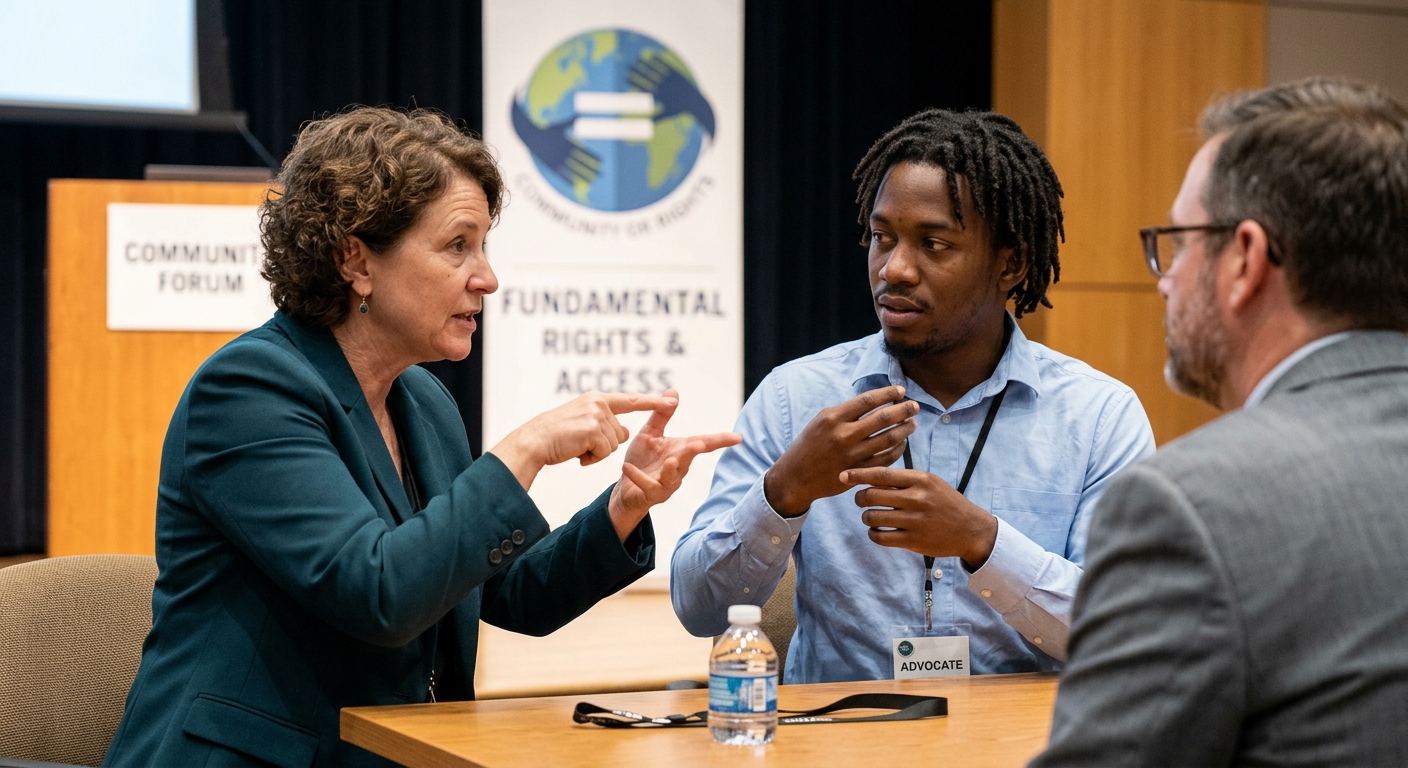
The Vital Distinction Between Speech and Language
Human connection, cognitive development, and societal participation are entirely dependent on communication. However, for Deaf, deafblind, and hard-of-hearing individuals, this fundamental human right is frequently compromised. This compromise does not stem from physiological differences in hearing, but rather from systemic, societal failures to provide robust language access. To understand why language access is a profound civil right, one must first recognize the critical difference between speech and language.
Speech is an articulated physical motor function—the ability to produce audible vocal sounds. Language, in contrast, is a vast and intricate cognitive framework that allows human beings to process complex thoughts, express nuanced emotions, understand abstract concepts, and connect with the world around them. Confusing these two distinct concepts often leads to the dangerous presumption that if a child cannot speak audibly, they cannot acquire language. This misconception fuels a cycle of exclusion, making language access an urgent matter of civil rights, educational equity, and neurodevelopmental health.
The Devastating Impact of Language Deprivation
The most immediate and severe consequence of failing to provide language access is the onset of language deprivation. Language deprivation occurs when a child, particularly during the critical developmental window from birth to age five, is not exposed to an accessible, comprehensive first language. Because approximately 90% to 95% of deaf children are born to hearing parents who may have no prior experience with deafness or sign language, the default approach is frequently a “wait-and-see” methodology focused heavily on auditory technologies and speech therapy.
While this approach aims to integrate the child into a hearing world, it frequently leaves them without a reliable linguistic foundation during their most formative neurodevelopmental years. A foundational 2017 clinical study published in the Maternal and Child Health Journal details the severe consequences of this gap, outlining a phenomenon known as “Language Deprivation Syndrome” . The study highlights that because language acquisition has a strict, time-sensitive neurobiological window, missing this phase can lead to permanent structural brain changes. The consequences are lifelong and devastating, resulting in severe cognitive delays, hindered executive functioning, profound mental health difficulties, and heavily compromised health literacy. Language deprivation is not a natural byproduct of being deaf; it is a preventable consequence of societal and medical systems failing to provide accessible early language environments, such as those rich in American Sign Language (ASL).
Legal Frameworks Protecting Communication Rights
In the United States, language access is not considered a luxury or an optional accommodation—it is an established civil right protected by rigorous federal legislation. The core philosophy of these legal frameworks is that individuals with disabilities must have an equal opportunity to participate in and benefit from all civic, educational, and commercial activities.
The Americans with Disabilities Act (ADA) and Effective Communication
The Americans with Disabilities Act (ADA) stands as the foremost civil rights law protecting individuals with disabilities from discrimination. Specifically, Title II (covering state and local government services) and Title III (covering public accommodations and commercial facilities) of the ADA mandate the provision of “effective communication.” The U.S. Department of Justice explicitly outlines that covered entities must ensure their communications with people with vision, hearing, or speech disabilities are as equally effective as their communications with people without disabilities .
To achieve effective communication, the ADA requires entities to provide appropriate auxiliary aids and services where necessary. These aids and services are highly contextual and can range from qualified sign language interpreters and real-time computer-aided transcription services (CART) to accessible electronic technologies and written materials. The critical element of the ADA’s mandate is that the accommodation must match the individual’s normal method of communication. For example, a hospital cannot force a Deaf patient whose primary language is ASL to rely on lip-reading or written notes during a complex medical consultation, as these methods do not ensure equivalent comprehension and active participation.
The Individuals with Disabilities Education Act (IDEA)
While the ADA governs public spaces and general services, the Individuals with Disabilities Education Act (IDEA) is the primary federal law ensuring educational equity. IDEA mandates that all eligible children with disabilities be provided a “Free Appropriate Public Education” (FAPE) in the “Least Restrictive Environment” (LRE) . Under IDEA, deafness is specifically categorized as an impairment in processing linguistic information through hearing that adversely affects a child’s educational performance.
Under IDEA, Individualized Education Programs (IEPs) must consider the child’s specific language and communication needs. For a Deaf child, this means the educational system must provide environments that foster continuous, interactive, and direct communication with peers and educators. Unfortunately, the interpretation of the “Least Restrictive Environment” is often misapplied. Placing a Deaf child in a mainstream classroom with an interpreter is sometimes viewed as the least restrictive option. However, if that child is socially isolated and unable to directly interact with peers or the teacher, the environment is fundamentally restrictive. A truly inclusive environment is one where language flows freely and without barriers.
Bridging the Gap: The Crucial Role of Bilingualism
For decades, a pervasive myth has dominated both medical and educational circles: the belief that exposing a deaf child to sign language will hinder their ability to learn spoken language or utilize auditory technologies like cochlear implants. This misconception has forced many families into a false dichotomy, feeling they must choose between signed and spoken language.
Modern pediatric and linguistic research thoroughly debunks this myth. According to guidance supported by the American Academy of Pediatrics, providing early access to a fully accessible visual language like ASL does not harm spoken language development; in fact, it acts as a crucial linguistic foundation that can support all subsequent learning, including literacy and spoken language . Embracing a bilingual approach—providing simultaneous access to ASL and spoken/written English—acts as an insurance policy against language deprivation. It guarantees that the child will successfully acquire a robust first language during the critical developmental window, empowering them to navigate both the Deaf and hearing worlds effectively.
Systemic Barriers and the Fight for Language Justice
Despite the robust legal protections outlined in the ADA and IDEA, practical reality often falls drastically short of legal ideals. Systemic barriers persist across various sectors, demonstrating that having a right on paper does not automatically equate to experiencing that right in daily life.
- Healthcare Disparities: Medical facilities frequently rely on Video Relay Interpreting (VRI) rather than providing on-site, qualified sign language interpreters. While VRI can be useful in specific emergencies, it is notoriously prone to technical failures, poor internet connections, and restricted screen visibility. This can lead to disastrous misunderstandings during critical healthcare moments, severely compromising patient consent and safety.
- Educational Shortfalls: Many public school districts face acute shortages of qualified educational interpreters and specialized teachers of the deaf. Furthermore, mainstreamed Deaf students often experience extreme social isolation, as they may be the only signing individual in their entire school, completely cutting them off from peer-to-peer incidental learning.
- Employment Discrimination: Deaf adults continuously face barriers in the hiring process and workplace mobility. Employers often misunderstand the costs and logistics of providing reasonable accommodations, viewing them as undue burdens rather than legally required mechanisms for achieving an equitable workplace.
Contrasting Perspectives: Medical vs. Social Models
Understanding the root of these systemic issues requires examining how society views deafness. The table below contrasts the two dominant paradigms that influence policy and language access.
| Feature | The Medical Model of Deafness | The Social Model of Deafness |
|---|---|---|
| Core Philosophy | Views deafness as a biological deficit or physical impairment that needs to be “fixed” or cured. | Views deafness as a human variation. The “disability” arises from society’s failure to accommodate. |
| Primary Focus | Auditory interventions, speech therapy, and making the individual conform to hearing norms. | Language accessibility, systemic equity, cultural identity, and inclusive environmental design. |
| Language Approach | Often discourages sign language to prioritize verbal speech and auditory processing. | Promotes early ASL acquisition and bilingualism as a fundamental human right. |
Building a Culture of True Accessibility
Achieving true language justice requires moving beyond mere compliance with minimum legal standards. It demands a cultural shift that recognizes American Sign Language and other auxiliary aids not as burdens, but as essential tools for human connection. Policymakers must invest in robust early intervention programs that provide hearing parents with immediate, unrestricted access to ASL education. Furthermore, federal and state agencies must strictly enforce the ADA, imposing substantial penalties on healthcare providers, law enforcement agencies, and commercial entities that fail to provide effective communication.
Ultimately, language access is the gateway to all other civil rights. Without the ability to understand and be understood, an individual cannot advocate for themselves, participate in democratic processes, or access the justice system. By prioritizing bilingual-bicultural education, enforcing the effective communication mandate, and elevating Deaf voices in policy-making, society can dismantle the barriers of language deprivation and ensure that every individual is granted their fundamental right to connect with the world.
Frequently Asked Questions
What exactly is Language Deprivation Syndrome?
Language Deprivation Syndrome is a neurodevelopmental condition observed in deaf or hard-of-hearing children who are not given access to a comprehensible first language (such as sign language) during their critical developmental years (birth to age five). It can cause irreversible cognitive, emotional, and social delays.
Does the ADA require businesses to hire sign language interpreters?
The Americans with Disabilities Act requires covered entities to provide “effective communication.” While this does not mean an interpreter is required for every minor interaction (like buying a coffee), it is legally mandated for complex, lengthy, or critical communications, such as medical appointments, legal consultations, and educational lectures.
Will learning ASL prevent a child from learning to speak?
No. Extensive pediatric and linguistic research shows that learning American Sign Language does not delay or hinder spoken language development. In fact, establishing a strong foundation in a visual language provides a cognitive framework that can significantly assist in learning spoken and written languages.
How does IDEA protect the rights of Deaf students?
The Individuals with Disabilities Education Act (IDEA) requires public schools to provide a Free Appropriate Public Education (FAPE) tailored to a child’s unique needs via an Individualized Education Program (IEP). For Deaf students, this includes ensuring appropriate language access, specialized instruction, and a learning environment where they can communicate directly with teachers and peers.
References
- What You Don’t Know Can Hurt You: The Risk of Language Deprivation by Impairing Sign Language Development in Deaf Children — Maternal and Child Health Journal / Wyatte C. Hall. 2017-02-09. (Note: Retained as a uniquely authoritative, canonical foundation for language deprivation syndrome). https://www.ncbi.nlm.nih.gov/pmc/articles/PMC5392137/
- ADA Requirements: Effective Communication — U.S. Department of Justice / Civil Rights Division. 2020-02-28. https://www.ada.gov/resources/effective-communication/
- Sec. 300.8 (c) (3) – Individuals with Disabilities Education Act — U.S. Department of Education. 2017-05-02. https://sites.ed.gov/idea/regs/b/a/300.8/c/3
- Embracing Bilingualism for Children Who Are Deaf and Hard of Hearing — Pediatrics / American Academy of Pediatrics. 2026-01-06. https://publications.aap.org/pediatrics/article/153/1/e2023064402/196324/Embracing-Bilingualism-for-Children-Who-Are-Deaf
Similar Articles








Read full bio of medha deb


