
Landlord 1099-NEC Filing Rules: Essential Guide For 2026
Essential guide for landlords: When to issue 1099-NEC forms to contractors, key deadlines, exceptions, and strategies to avoid IRS penalties.
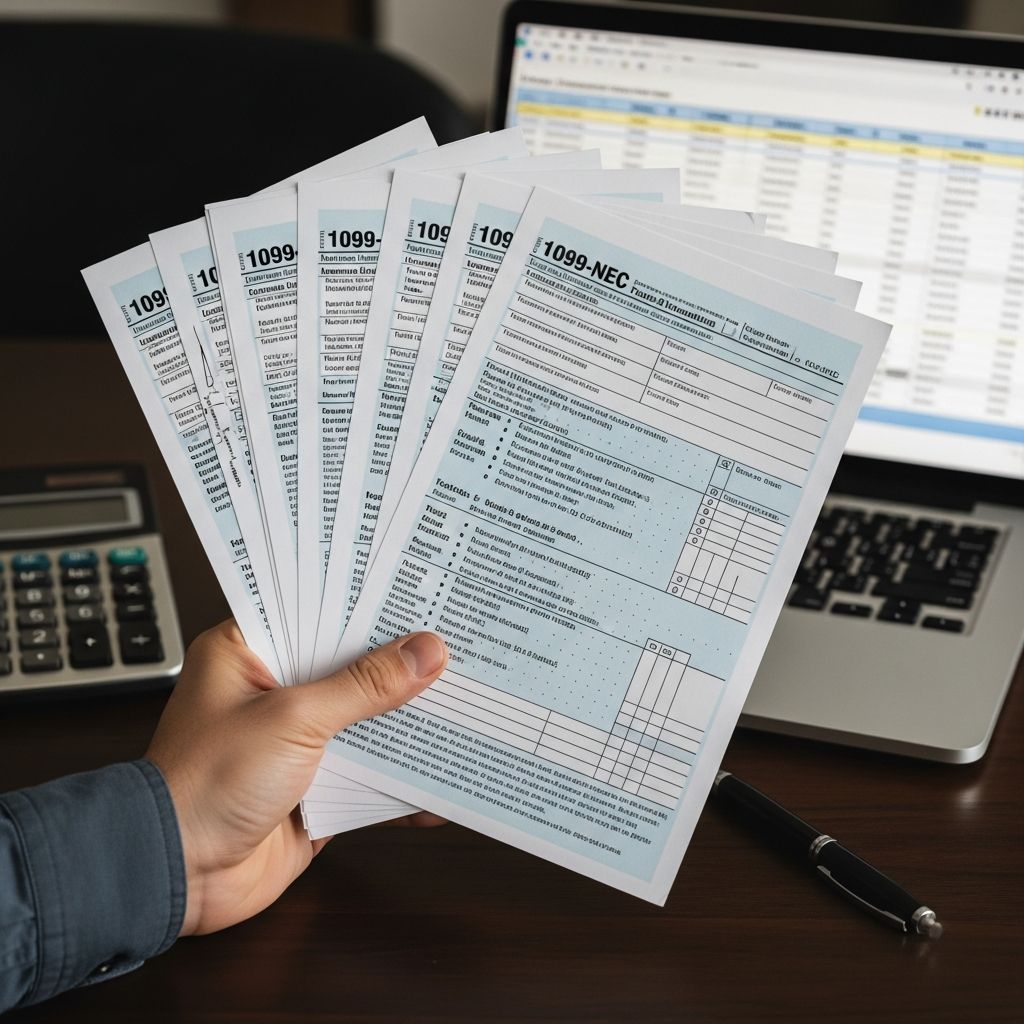
Landlords frequently hire independent contractors for maintenance, repairs, and property management, creating specific IRS reporting obligations through Form 1099-NEC. This form documents non-employee compensation exceeding $600 annually to unincorporated service providers, ensuring accurate income tracking for tax purposes.
Understanding Form 1099-NEC Obligations for Property Owners
Form 1099-NEC serves as the primary tool for reporting payments to independent contractors, replacing the prior use of Form 1099-MISC for this purpose. Property owners must issue this form whenever cumulative payments to a single non-corporate recipient reach or exceed $600 in a calendar year for services like plumbing, electrical work, landscaping, or management services. This requirement applies regardless of whether the work spans multiple projects; it’s the total annual payout that triggers filing.
The IRS mandates this reporting to verify that contractors declare their earnings properly, preventing underreporting of self-employment income. For landlords, compliance not only avoids penalties but also supports deductibility of these expenses on Schedule E of Form 1040, where rental real estate activities are detailed. Failure to file can result in fines starting at $60 per form, escalating to $310 for intentional disregard.
Who Qualifies as a Reportable Independent Contractor?
Not every vendor requires a 1099-NEC. Corporations, including C-corps and most S-corps, are exempt from this reporting, streamlining processes for payments to incorporated plumbers or electricians. However, attorneys receive special treatment: even incorporated law firms must receive 1099-NEC for legal services.
- Single-member LLCs: Treated as sole proprietorships, requiring 1099-NEC unless they elect corporate status.
- Multi-member LLCs: Generally treated as partnerships, necessitating forms.
- Exempt payments: Include credit card transactions (reported by the processor), reimbursed expenses under accountable plans, and wages to employees (use W-2 instead).
Always secure a Form W-9 from vendors before payment to determine their tax classification and obtain taxpayer identification numbers (TINs). This document is crucial for accurate filing and TIN matching with the IRS.
Rental Income Reporting: Beyond Contractor Payments
While 1099-NEC focuses on outflows to contractors, landlords must meticulously report inflows on Schedule E (Form 1040). All rental receipts qualify as income, including monthly rents, security deposits retained for damages or unpaid rent, tenant-paid utilities if structured as rent reductions, and lease termination fees.
Cash-basis accounting applies to most landlords: report income when received, not when due. A tenant’s early December payment counts for that tax year, even if it covers January. Property management companies issue Form 1099-MISC to owners for collected rents, while payment platforms like PayPal send Form 1099-K for high-volume transactions.
| Income Type | Reportable? | Form/Schedule |
|---|---|---|
| Monthly Rent | Yes | Schedule E |
| Refundable Security Deposit | No, until retained | Schedule E (if kept) |
| Tenant Utilities (Direct Pay) | Possibly, if rent credit | Schedule E |
| Lease Break Fee | Yes | Schedule E |
Maintain comprehensive records: bank statements, leases, receipts, and payment confirmations to substantiate entries during audits.
Critical Deadlines and Electronic Filing Mandates
For 2026 tax year reporting (filed in 2027), adhere to these timelines:
- January 31, 2027: Furnish 1099-NEC copies to recipients and file with IRS (no extensions for recipient copies).
- January 31, 2027 (electronic): IRS deadline for 10+ forms.
- February 28, 2027 (paper): IRS filing if fewer than 10 forms.
A pivotal change: Any filer issuing 10 or more information returns (across 1099 types) must file electronically via the IRS IRIS system. This lowered threshold from 250 captures many small-scale landlords. Obtain a Transmitter Control Code (TCC) by mid-November 2026, as approval takes up to 45 days. Electronic submission is free and minimizes errors.
Penalties, Abatements, and Compliance Strategies
IRS penalties for late or non-filed 1099s range from $60-$310 per form, with higher amounts for intentional failures. Aggregate penalties can quickly accumulate for multi-contractor properties.
Mitigation options include:
- First-Time Abate (FTA): Available for clean compliance histories; request via IRS letter or phone.
- Reasonable Cause: Explain delays due to disasters, illness, or unavoidable system issues with supporting documentation.
- Immediate Action: File as soon as possible post-deadline to reduce penalties.
Proactive steps: Use property management software for automated tracking, collect W-9s upfront, and batch payments to stay under thresholds where possible without compromising property needs.
Tax Benefits and Deductions Tied to Proper Reporting
Accurate 1099 filing unlocks deductions for contractor expenses on Schedule E, offsetting rental income. Common write-offs include repairs (immediately deductible), insurance, property taxes, mortgage interest (reported via Form 1098 for $600+), and depreciation.
The Qualified Business Income (QBI) deduction under IRC §199A allows up to 20% off qualified rental income, now permanent with higher thresholds. Real estate professionals may bypass passive loss limitations, deducting expenses against other income.
California landlords note state non-conformity on certain federal deductions like bonus depreciation, requiring Form 3885 adjustments.
Record-Keeping Essentials for Audit Protection
Retain records for at least three years (seven recommended): invoices, canceled checks, mileage logs, leases, and 1099 copies. Digital tools like Landlord Studio or TenantCloud automate this, generating Schedule E-ready reports.
Distinguish repairs (deductible now) from improvements (depreciated over 27.5 years for residential property). IRS Publication 527 provides detailed guidance.
Frequently Asked Questions
Do I need to issue 1099-NEC to a corporate plumber?
No, payments to corporations are generally exempt, but verify via W-9 and confirm non-attorney status.
What if I pay a contractor $599?
No 1099-NEC required, as the threshold is $600 cumulative.
Does Venmo rent payments trigger 1099-K?
Yes, platforms issue 1099-K for business transactions over thresholds; report on Schedule E.
Can I deduct unreported contractor payments?
Yes, but lack of 1099 increases audit risk; always file for substantiation.
What about multi-property owners?
Aggregate all 1099s across properties for the 10-form electronic threshold.
References
- What Rental Income Reporting Is Required for Tax Purposes? A Comprehensive Guide for Property Owners — Iconic Property Management. 2026. https://iconicpm.com/glossary/what-rental-income-reporting-is-required-for-tax-purposes-a-comprehensive-guide-for-property-owners/
- The Complete 1099 Tax Form Guide for Landlords in 2026 — TenantCloud. 2026. https://www.tenantcloud.com/blog/the-complete-1099-tax-form-guide
- How to Report Rental Income on Your Tax Return — Landlord Studio. 2026-01-08. https://www.landlordstudio.com/blog/how-to-report-rental-income-on-your-tax-return
- California Landlord Tax Deductions 2026 | Rental Property Write-Offs — Steven D. Silverstein. 2026. https://www.stevendssilverstein.com/resources/california-landlord-tax-deductions
- How Rental Income Is Taxed in 2026: Complete Guide for Real Estate Investors — Amerisave. 2026. https://www.amerisave.com/learn/how-rental-income-is-taxed-in-complete-guide-for-real-estate-investors
- Instructions for Form 1098 (12/2026) — Internal Revenue Service. 2026-12. https://www.irs.gov/instructions/i1098
- Rental Personal Income Types — California Franchise Tax Board. 2026. https://www.ftb.ca.gov/file/personal/income-types/rental.html
Similar Articles








Read full bio of Sneha Tete


