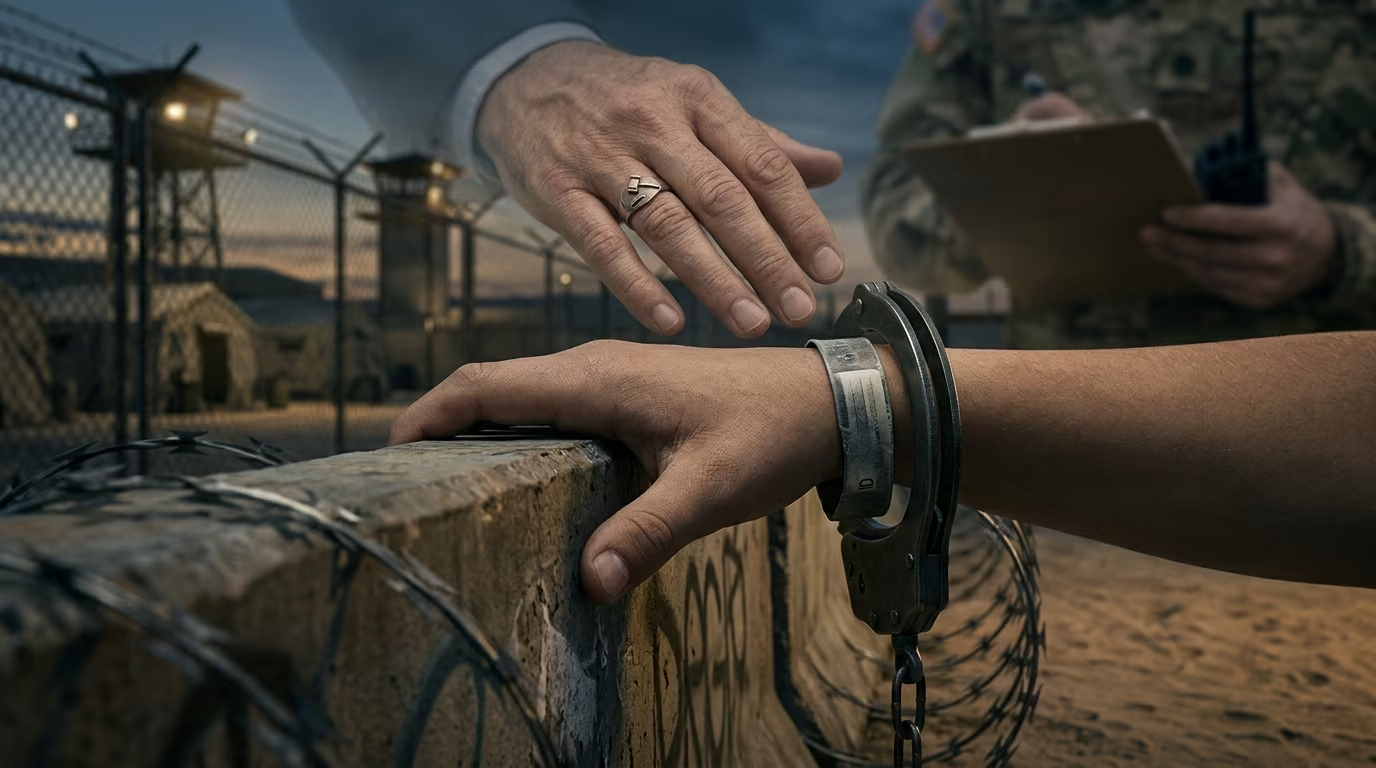
The Intersection of Youth and Armed Conflict
The involvement of youth in armed conflict represents one of the most profound legal and moral dilemmas in modern international relations. Across the globe, minors are frequently drawn into hostilities, sometimes forcibly conscripted by state or non-state armed groups, and at other times motivated by socio-economic desperation or ideological indoctrination. When these young individuals are captured by opposing forces, particularly in the context of asymmetric warfare and global counterterrorism operations, their status becomes highly contested. Are they combatants deserving of military detention, or are they victims of exploitation who require rehabilitation and psychological care?
Historically, the lines between combatant and civilian have blurred, but the distinction between an adult soldier and a child participant has increasingly become a focal point of international human rights advocacy. The treatment of juveniles apprehended in conflict zones tests the resilience of global treaties designed to shield the most vulnerable populations from the brutalities of war. As nations navigate complex security threats, the tension between immediate tactical imperatives and long-term human rights obligations often leads to controversial detention practices that attract intense scrutiny from the global community.
Defining the International Legal Framework
The foundation of international protections for minors in conflict zones is built upon a robust architecture of treaties and conventions. Chief among these is the Optional Protocol to the Convention on the Rights of the Child on the involvement of children in armed conflict (OPAC), a landmark agreement adopted by the United Nations. The overarching principle of this protocol is the recognition that individuals under the age of eighteen who participate in armed conflict should primarily be treated as victims of exploitation rather than willful perpetrators of violence.
Under OPAC and associated international humanitarian laws, ratifying states commit to preventing the recruitment of minors and ensuring that those who have been involved in hostilities receive appropriate assistance for their physical and psychological recovery. This framework emphasizes demobilization and social reintegration over punitive measures. Furthermore, the Geneva Conventions and their Additional Protocols provide baseline protections for all persons captured during armed conflict, but special provisions explicitly mandate that captured children be held in quarters separate from adults and be provided with age-appropriate care.
Despite these clear legal parameters, the enforcement of such standards relies heavily on state compliance. When military forces operate extraterritorially, the application of domestic juvenile justice standards often falls by the wayside, creating a legal vacuum where international protocols are nominally acknowledged but practically ignored on the ground.
The Counterterrorism Paradigm Shift
The geopolitical landscape underwent a seismic shift in the early 21st century, fundamentally altering how captured combatants, including minors, were classified and treated. The advent of global counterterrorism operations led to the apprehension of thousands of individuals in sweeping battlefield operations across the Middle East, Central Asia, and other regions. Within these dragnets, numerous juveniles were detained.
To navigate the complexities of asymmetric warfare against non-state actors, some nations introduced novel legal classifications such as “unprivileged enemy belligerents.” By utilizing this terminology, detaining powers sought to bypass the traditional protections afforded to prisoners of war under the Geneva Conventions, as well as the specialized protections designated for child soldiers. Consequently, juveniles captured in overseas operations were frequently processed through military frameworks designed for adult terrorists, rather than through civilian or juvenile justice channels.
This paradigm shift severely compromised the human rights of detained youth. The prioritization of intelligence gathering and national security overrode the legal imperative to assess the age, vulnerability, and victimhood status of the detainees. As a result, minors were subjected to prolonged periods of uncertainty, lacking access to legal representation, family contact, or independent judicial review.
Conditions in Extraterritorial Military Detention
The reality of extraterritorial military detention facilities presents a stark contrast to established international juvenile justice standards. Facilities historically operating in conflict zones or isolated military bases have been characterized by harsh environmental conditions and stringent security measures. When minors are thrust into these adult-centric environments, the psychological and physical impacts are profound and lasting.
Reports and investigations into various overseas military prisons have highlighted deeply concerning practices. Juveniles have frequently been subjected to extended periods of isolation, aggressive interrogation techniques, and a pervasive lack of sensory or intellectual stimulation. In traditional legal systems, juvenile justice is predicated on the Beijing Rules (the United Nations Standard Minimum Rules for the Administration of Juvenile Justice), which mandate that any deprivation of liberty for a minor must be a measure of last resort and for the shortest appropriate period.
In military detention contexts, however, minors have sometimes been held for years without charge. They are often interrogated not as vulnerable victims coerced into conflict, but as hardened insurgents. The absence of specialized psychological support exacerbates the trauma of war, while the lack of educational and vocational programs severely stunts their developmental progress. The profound mismatch between the needs of a developing adolescent and the rigid, punitive nature of a military prison underscores a critical failure in the application of human rights law.
Comparison: Juvenile Justice vs. Military Detention
To fully understand the divergence between international standards and battlefield realities, it is helpful to compare the core components of traditional juvenile justice with the documented practices of military detention facilities.
| Operational Aspect | International Juvenile Justice Standards | Extraterritorial Military Detention |
|---|---|---|
| Primary Objective | Rehabilitation, education, and social reintegration. | Intelligence gathering, incapacitation, and security. |
| Legal Representation | Immediate access to independent counsel and guardians. | Often delayed for years; reliance on military tribunals. |
| Interrogation Protocol | Age-appropriate questioning with a trusted adult present. | Adversarial, high-pressure tactics designed for adults. |
| Confinement Conditions | Strict separation from adult populations; focus on care. | Frequent co-location with adults; use of isolation. |
The Mechanisms of International Oversight
The enforcement of human rights treaties relies on continuous international oversight and the willingness of the global community to hold powerful states accountable. The United Nations Committee on the Rights of the Child (CRC) plays a pivotal role in this process. States that have ratified the Optional Protocol are required to submit regular reports detailing their compliance and the practical steps they have taken to implement the treaty’s provisions.
During the review process, state delegations are often subjected to rigorous questioning—a constructive yet intense dialogue aimed at uncovering the realities behind official policies. Committees scrutinize the capture, transfer, and detention protocols of military forces operating abroad. They rely not only on the self-reporting of governments but also heavily on shadow reports provided by international non-governmental organizations, human rights advocates, and independent monitors.
This oversight mechanism frequently generates diplomatic friction. When a committee highlights systemic failures—such as the detention of children in facilities like Bagram or Guantanamo without due process—it creates a public record of non-compliance that can pressure governments to enact policy reforms. While UN committees lack direct punitive enforcement powers, their legal interpretations and public censures carry significant moral weight, often providing the necessary leverage for domestic courts and legislators to demand changes in military detention operations.
Prioritizing Rehabilitation and Reintegration
Moving forward, aligning counterterrorism operations with international human rights obligations requires a fundamental philosophical shift: recognizing that children involved in armed conflict are victims first. The international community has developed comprehensive frameworks, such as the Paris Principles, to guide the Disarmament, Demobilization, and Reintegration (DDR) of child soldiers. These guidelines stress that treating former youth combatants strictly as security threats undermines long-term peacebuilding efforts.
Effective reintegration demands specialized psychosocial support tailored to address complex post-traumatic stress and the profound moral injury sustained during conflict. It requires educational interventions that bridge the gaps caused by years of violence or confinement. Furthermore, transitioning juveniles out of military detention and into civilian rehabilitative care requires secure, internationally monitored pathways that guarantee the safety of the minor while addressing the legitimate security concerns of the state.
Legal reforms are also urgently needed. States must establish strict operational guidelines that prohibit the prolonged military detention of anyone under the age of eighteen, regardless of where they are captured. Establishing a minimum age for criminal prosecution in military tribunals and ensuring immediate access to independent legal advocates are crucial steps in preventing the human rights abuses of the past.
Frequently Asked Questions
What exactly defines a “child soldier” under international law?
Under international law, particularly the Paris Principles and the Optional Protocol to the Convention on the Rights of the Child, a child associated with an armed force or armed group is defined as any person below 18 years of age who has been recruited or used by an armed force or group in any capacity. This includes not only active combatants but also those used as cooks, porters, messengers, spies, or for sexual purposes. The defining metric is age, explicitly separating them from adult combatants and emphasizing their inherent vulnerability.
Are nations legally bound to rehabilitate child combatants captured in war?
Yes. Nations that have ratified the Optional Protocol on the involvement of children in armed conflict (OPAC) are legally obligated to provide all appropriate assistance for the physical and psychological recovery and social reintegration of children who have been involved in hostilities. Treating them merely as enemy combatants or terrorists violates the spirit and the letter of these international commitments, which stipulate that their rehabilitation must be a primary objective.
How do international bodies enforce human rights treaties against powerful militaries?
International bodies, such as the UN Committee on the Rights of the Child, do not possess independent police forces or immediate coercive powers. Instead, they enforce treaties through systematic reviews, mandatory state reporting, and public accountability. By issuing concluding observations that document violations, they create international diplomatic pressure. This often empowers domestic legal advocates, influences foreign aid and allied cooperation, and ultimately forces internal policy changes within the offending state’s military and legal frameworks.
Conclusion
The detention of juveniles in extraterritorial military facilities stands as one of the most glaring contradictions between global human rights ideals and the pragmatic, often brutal realities of modern warfare. While national security remains a paramount concern for any sovereign state, it cannot serve as a blanket justification for eroding the fundamental protections owed to children. Realigning military practices with international law requires transparency, rigorous independent oversight, and a steadfast commitment to the principle that youth drawn into the theater of war are victims in need of rescue, not adversaries slated for retribution. Only through prioritized rehabilitation can the cycle of violence be broken.
References
- Optional Protocol to the Convention on the Rights of the Child on the involvement of children in armed conflict — Office of the United Nations High Commissioner for Human Rights (OHCHR). 2000-05-25. https://www.ohchr.org/en/instruments-mechanisms/instruments/optional-protocol-convention-rights-child-involvement-children
- Children recruited by armed forces or armed groups — UNICEF. 2023-05-18. https://www.unicef.org/protection/children-recruited-by-armed-forces
- Child soldiers and international humanitarian law — International Committee of the Red Cross (ICRC). 2022-12-01. https://www.icrc.org/en/document/child-soldiers-and-international-humanitarian-law
- The Paris Principles: Principles and Guidelines on Children Associated with Armed Forces or Armed Groups — UNICEF. 2007-02-01. https://www.unicef.org/documents/paris-principles-guidelines-children-associated-armed-forces-or-armed-groups