
Jury Nullification: Power, Limits, And Key Insights
Explore how jury nullification works, why it is controversial, and what it means for defendants, lawyers, and the justice system.
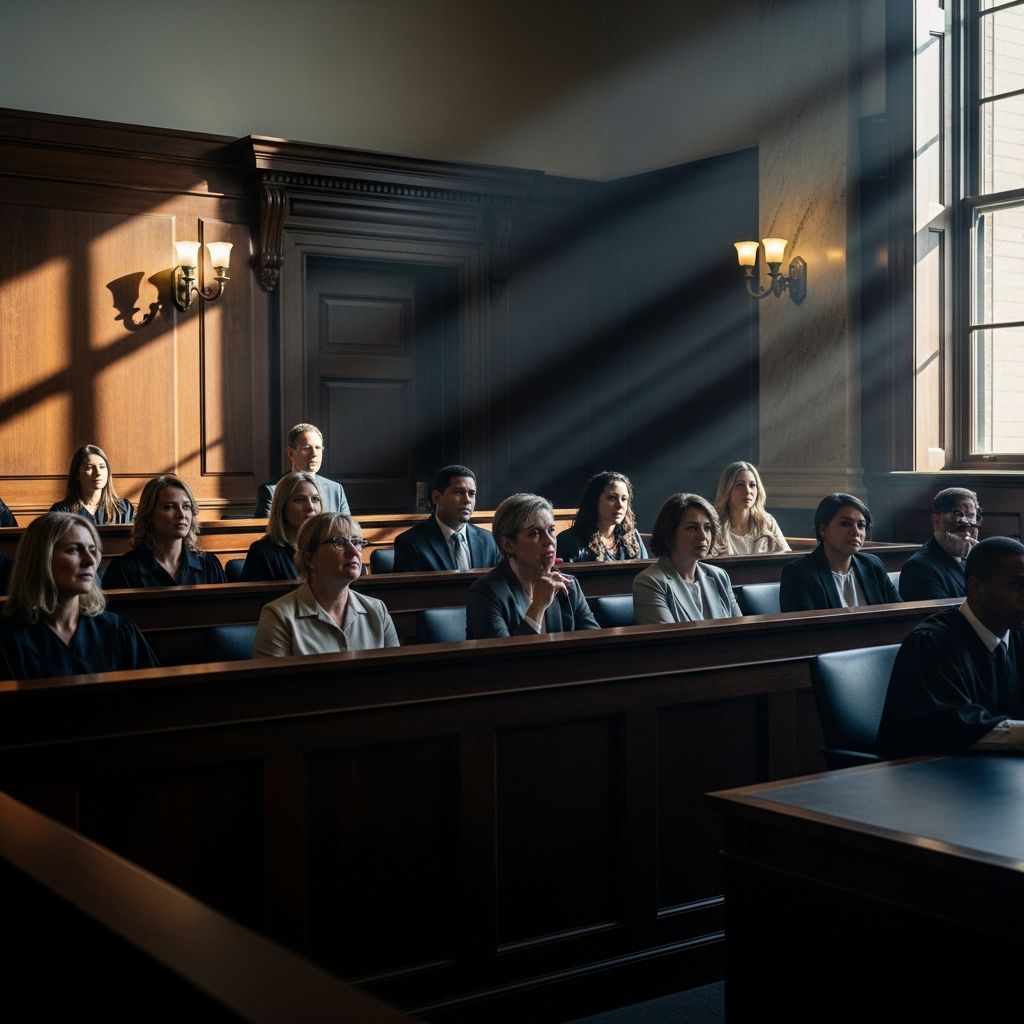
Jury nullification is one of the most debated features of jury trials in criminal cases. It represents a point where legal rules and community conscience can collide, allowing ordinary citizens to effectively veto the application of a law in a specific case.
Although courts expect jurors to follow the law as the judge explains it, juries still retain the practical ability to acquit a defendant even when the evidence supports guilt beyond a reasonable doubt. This tension makes jury nullification both a potential safeguard for individual liberty and a possible threat to the rule of law.
What Is Jury Nullification?
Jury nullification occurs when a criminal jury returns a verdict of not guilty despite believing that the prosecution has proven the defendant violated the law. The jury, in effect, refuses to apply the law because it views the law itself, or its application in that case, as unjust.
- Key idea: The jury accepts that the defendant did what the law forbids but chooses not to convict.
- Result: An acquittal that ends the case and cannot be appealed due to protections against double jeopardy in many systems.
- Reason: Jurors act on conscience, fairness, or community standards rather than strict legal instructions.
Court decisions and legal scholarship recognize that juries possess this power as a consequence of the system’s design, even though judges rarely acknowledge it to jurors and often discourage any suggestion that they may disregard the law.
How Jury Nullification Differs from Other Outcomes
Jury nullification is easy to confuse with other trial outcomes, especially when the jury does not convict. The table below highlights key differences.
| Outcome | What Happens? | Reason for Result | Can the Case Be Retried? |
|---|---|---|---|
| Ordinary acquittal | Jury returns not guilty | Jurors conclude the prosecution failed to prove guilt beyond a reasonable doubt | Generally no, due to double jeopardy rules in many jurisdictions |
| Jury nullification | Jury returns not guilty | Jurors think the law is wrong, too harsh, or misapplied, even though they believe the defendant did the act | Also generally no; an acquittal is final |
| Hung jury | Jurors cannot agree on a verdict | Persistent disagreement about the facts or the law; no unanimous verdict where required | Yes, the prosecution may retry the case after a mistrial |
Why Juries Sometimes Choose to Nullify
Juries turn to nullification for many reasons, often tied to broader social or moral concerns rather than technical legal questions.
Common Motivations
- Belief that the law is unjust
Jurors may view the statute as immoral, discriminatory, outdated, or incompatible with community values. - Disagreement with the punishment
Even if the law seems valid, mandatory minimum sentences or other severe penalties can strike jurors as disproportionate to the offense. - Perception of unfair enforcement
Jurors may suspect that the law is applied selectively to certain groups or that the prosecution is overreaching in the specific case. - Sympathy for the defendant
Jurors might see the defendant as acting under hardship, coercion, or in a way that, while technically illegal, appears morally understandable. - Broader protest
In rare instances, nullification can function as a form of community protest against government policies, criminalization choices, or law enforcement practices.
Historical Context
Legal scholars and historians have documented episodes of jury nullification in different eras, including colonial sedition cases, prosecutions under fugitive slave laws, and trials involving unpopular speech or political dissent. At times, nullification has been praised for resisting oppressive laws; at other times, it has been criticized for enabling racial bias or favoritism.
Is Jury Nullification a Right or Just a Power?
One of the central debates is whether jury nullification is a right jurors may deliberately exercise or simply a power that exists because no one can overturn an acquittal.
- Practical power: Once acquitted, a defendant typically cannot be retried for the same offense, so there is no mechanism to reverse a nullifying verdict.
- Limited recognition: Most courts refuse to instruct juries that they may disregard the law and may remove or admonish jurors who openly state an intention to do so.
- Judicial stance: Appellate courts often describe nullification as a regrettable but unavoidable byproduct of the jury system rather than an endorsed feature.
Academic commentary often distinguishes between the jury’s de facto ability to nullify and any claim that the law affirmatively grants them a right to do so. This distinction explains why lawyers must be extremely cautious about discussing nullification in court.
How Jury Nullification Works in Practice
Nullification rarely appears openly on the record. Instead, it tends to emerge quietly during jury deliberations.
Inside the Jury Room
- Jurors hear the evidence and legal instructions during the trial.
- During deliberations, some jurors may express moral or fairness concerns about applying the law.
- If enough jurors are persuaded, they may agree to vote not guilty even while acknowledging that the evidence technically supports guilt.
- The verdict form simply reflects an acquittal; courts do not ask jurors to explain their reasoning.
Because deliberations are secret and jurors are generally prohibited from being questioned about their mental processes in reaching a verdict, it can be difficult to prove in any particular case that nullification occurred.
The Role of Lawyers and Judges
The legal system closely controls what can be said about nullification during a trial:
- Defense attorneys usually may not argue directly that the jury should ignore the law, though they can emphasize fairness, proportionality, and context.
- Prosecutors emphasize that jurors must follow the law and the judge’s instructions.
- Judges typically instruct jurors that they must apply the law whether they agree with it or not, and they may exclude potential jurors who state that they refuse to follow the law.
Arguments in Favor of Jury Nullification
Supporters view nullification as a vital democratic safety valve built into the criminal justice system.
- Protection against unjust laws
Juries can shield individuals from laws that criminalize morally acceptable behavior or that target vulnerable groups. - Community participation
Nullification allows ordinary citizens to influence how criminal law is applied in practice, not just how it is written. - Check on government power
By refusing to convict in certain cases, juries can push back against aggressive prosecution policies, harsh sentencing regimes, or political prosecutions. - Signal for reform
Patterns of acquittals in particular types of cases may signal to lawmakers that the public rejects a given law or penalty structure.
Arguments Against Jury Nullification
Critics argue that widespread or uncontrolled nullification undermines predictability and fairness in the legal system.
- Risk of bias and discrimination
Nullification can be used to protect favored defendants or to refuse justice to unpopular victims, reinforcing prejudice rather than equality before the law. - Inconsistency
Different juries may treat similar cases very differently based on their personal beliefs, leading to unequal outcomes. - Undermining the rule of law
Allowing juries to ignore statutes threatens the idea that democratically enacted laws bind everyone, not just those who agree with them. - Lack of transparency
Because deliberations are secret, nullification offers no written reasoned opinion, making it difficult to review or correct misuse.
Some scholars argue that although juries must retain the raw power to nullify for structural reasons, courts are justified in refusing to encourage or formally authorize its use.
Practical Implications for Defendants and Counsel
For defendants and lawyers, jury nullification is both a possible benefit and a sensitive topic.
For Defendants
- Potential lifeline: In cases where the law is harsh or unpopular, an acquittal despite strong evidence may reflect a form of nullification.
- Unpredictability: Defendants cannot rely on nullification; most juries follow the law as instructed.
- No appeal by prosecution: If a jury acquits, the state generally cannot appeal the verdict or try the defendant again for the same offense.
For Defense Lawyers
- Ethical constraints: Counsel must honor court rules and may be barred from urging jurors to violate their oath.
- Strategic framing: Lawyers often present the human context, proportionality concerns, and mitigating circumstances, inviting jurors to view the case through a moral lens without explicitly calling for nullification.
For Prosecutors and Judges
- Prosecutors: May exercise discretion in charging and plea bargaining to avoid cases likely to provoke jury backlash.
- Judges: Carefully draft jury instructions and monitor argument to maintain the appearance and reality of legal compliance.
Ethical and Policy Debates
Scholars, judges, and policymakers continue to debate how openly the legal system should acknowledge jury nullification.
- Transparency vs. control: Some argue jurors should be told explicitly about their ability to acquit based on conscience; others fear that such instructions would invite lawlessness or bias.
- Civic education: Discussions of nullification increasingly appear in law journals, public-interest advocacy, and academic research, even as courtrooms remain restrictive.
- Reform proposals: Suggestions range from modest changes in jury instructions to broader structural reforms that would reduce the pressure on jurors to nullify (for example, by revising mandatory sentencing laws).
Key Takeaways for Everyday Jurors
For individuals called to serve on a jury, several foundational points are useful to understand:
- You will be instructed to follow the law exactly as the judge explains it, even if you disagree with it.
- The prosecution must prove guilt beyond a reasonable doubt; if you have such a doubt, you must vote not guilty.
- Your deliberations are confidential, and you cannot be punished for your final vote on the verdict.
- While the jury has the raw power to acquit despite evidence, using that power raises serious questions about fairness, equality, and your role as a juror.
Frequently Asked Questions (FAQs)
Q1: Is jury nullification legal?
Jury nullification is possible rather than officially endorsed. Courts acknowledge that juries have the power to acquit for any reason, but judges generally instruct jurors that they must follow the law and may prohibit lawyers from openly arguing for nullification.
Q2: Can a juror be punished for voting to acquit?
In many systems that use juries, jurors cannot be punished for their verdict, and an acquittal cannot be overturned or reviewed, even if observers suspect nullification. However, jurors can be removed during selection or deliberations if they state that they will not follow the law at all.
Q3: How often does jury nullification happen?
There is no precise statistic because deliberations are secret and verdicts do not explain jurors’ reasoning. Researchers infer possible nullification from patterns of acquittals in certain types of cases, but direct evidence is limited.
Q4: Can the prosecutor retry a case after jury nullification?
If the jury returns a not-guilty verdict, the prosecution is generally barred from retrying the defendant for the same offense because of constitutional safeguards against double jeopardy in many jurisdictions.
Q5: Should jurors use nullification if they disagree with a law?
Whether jurors should nullify is a matter of moral and civic judgment. Some view it as a necessary tool against unjust laws; others worry it enables bias and undermines uniform application of the law. Legal authorities typically tell jurors to follow the law as instructed, leaving questions of reform to legislatures and courts.
References
- Jury Nullification — Cornell Legal Information Institute (LII). 2021-05-01. https://www.law.cornell.edu/wex/jury_nullification
- Jury Nullification — Office of Justice Programs, National Criminal Justice Reference Service Abstract. 1997-01-01. https://www.ojp.gov/ncjrs/virtual-library/abstracts/considering-jury-nullification-when-may-and-should-jury-reject-law
- What Is a Hung Jury and How Is It Different From Jury Nullification? — Lustberg Law Offices, LLC. 2023-09-15. https://www.lustberglaw.com/blog/what-is-jury-nullification/
- Jury Nullification — Famous Trials, University of Missouri–Kansas City School of Law. 2016-06-01. https://www.famous-trials.com/zenger/99-nullification
- Jury Nullification: Legal and Psychological Perspectives — Vidmar, Neil & Hans, Valerie P. University of Pennsylvania Law Review. 2007-01-01. https://repository.upenn.edu/bitstreams/8d5f2197-9002-463c-ace7-0234b95cfb0/download
Similar Articles








Read full bio of Sneha Tete




