
Joint Tenants vs. Tenants in Common: Estate Planning Guide
Understand how joint tenancy with right of survivorship differs from tenancy in common so you can choose the best way to co-own property.
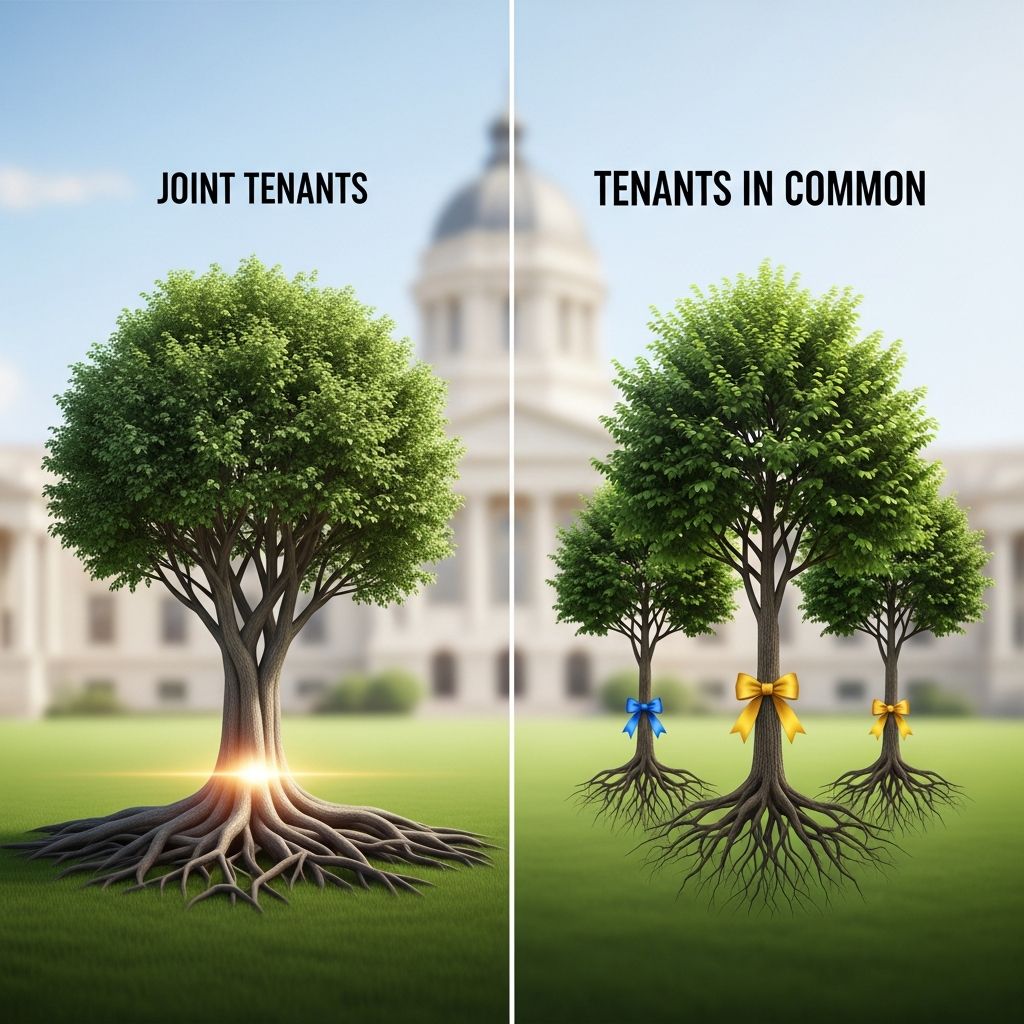
When more than one person owns the same home, bank account, or investment, the way the ownership is structured can dramatically change what happens when one of them dies. Two of the most common forms of co-ownership in U.S. law are joint tenancy with right of survivorship and tenancy in common. Choosing between these is not just a paperwork decision; it directly affects probate, taxes, control, and your broader estate plan.
This guide explains what each type of ownership means, how they differ, and how they fit into an overall estate planning strategy. It is general information, not legal advice; property and estate rules vary by state, so always confirm with a qualified attorney in your jurisdiction.
Core Concepts: How Co-Ownership Works
Property law recognizes several ways two or more people can own the same asset at the same time. The key question is: when one owner dies, who gets that person’s share and how does it transfer?
- With a right of survivorship, the surviving co-owner(s) automatically inherit the deceased owner’s share, usually outside of probate.
- Without a right of survivorship, the deceased owner’s share passes under their will or, if there is no will, under state intestacy law.
Joint tenancy typically includes a right of survivorship, while tenancy in common does not.
What Is Joint Tenancy With Right of Survivorship?
Joint tenancy is a form of co-ownership where each owner holds an undivided interest in the entire property and enjoys a built-in right of survivorship. This means every joint tenant has the right to use and possess the whole property, not just a physical slice.
Key Legal Features of Joint Tenancy
In most states, joint tenancy is traditionally created and maintained only if four classic requirements—often called the “four unities”—are met.
- Unity of time: All joint tenants acquire their interests at the same time.
- Unity of title: All receive their interests under the same legal instrument (such as the same deed or account contract).
- Unity of interest: Each co-owner holds an equal share.
- Unity of possession: Each has an equal right to possess and use 100% of the property.
If these requirements are not satisfied under state law, the ownership may default to tenancy in common instead of joint tenancy.
Right of Survivorship Explained
The defining feature of joint tenancy is the automatic transfer of the deceased owner’s share to the surviving joint tenant or tenants.
- The property typically does not go through probate for that asset.
- The deceased’s will usually does not control where that specific joint asset goes.
- Once the survivor becomes sole owner, they are not legally required to share it with other heirs (such as siblings or children) unless they choose to.
This can be highly efficient administratively but may conflict with expectations about “fair” distribution among family members.
Common Uses of Joint Tenancy
Joint tenancy with right of survivorship is widely used for:
- Homes owned by spouses or partners.
- Bank or brokerage accounts held jointly with a spouse, partner, or sometimes an adult child.
- Vacation property or a second home where owners want an easy transfer on death, including across state lines.
Some states also recognize a special form of spousal ownership called tenancy by the entirety, which is similar to joint tenancy but only for married couples and often offers extra creditor protections.
What Is Tenancy in Common?
Tenancy in common is another major form of co-ownership, but it works very differently from joint tenancy when someone dies.
Each co-owner, called a tenant in common, holds an individual share of the property. Those shares do not have to be equal; one person might own 10%, another 90%, or any other allocation the parties agree on.
Characteristics of Tenancy in Common
- Separate shares: Each owner has an identifiable, fractional interest (even though the property itself is not physically divided).
- No right of survivorship: When one tenant in common dies, their interest passes to their heirs or beneficiaries, not automatically to the other co-owners.
- Flexible ownership percentages: Useful for unrelated co-investors or where people contribute different amounts to a purchase.
- Default rule: If a deed to multiple people is ambiguous, many states presume tenancy in common unless joint tenancy is clearly expressed.
Estate Planning Consequences of Tenancy in Common
Because there is no right of survivorship, a tenant in common’s share becomes part of their probate or non-probate estate when they die, depending on whether they use a will or trust.
- If there is a will, that document determines who receives the ownership interest.
- If there is no will, state intestacy law determines who inherits, such as a spouse, children, or other relatives.
- The surviving co-owners do not automatically obtain the deceased’s share, though they may inherit it if the estate plan or law gives it to them.
Side-by-Side Comparison
The table below summarizes the most important distinctions between joint tenancy with right of survivorship and tenancy in common.
| Feature | Joint Tenancy with Right of Survivorship | Tenancy in Common |
|---|---|---|
| Ownership shares | Always equal among co-owners. | Can be equal or unequal (e.g., 30% / 70%). |
| Right of survivorship | Yes – survivor(s) automatically receive deceased’s share. | No – deceased’s share passes under will or intestacy. |
| Probate impact | Often avoids probate for that asset. | Typically passes through probate unless held in a trust or otherwise planned around. |
| Control via will | Limited – will usually cannot override survivorship for that asset. | High – owner can leave their share to anyone via will or trust. |
| Adding or removing owners | Changes may break the four unities and convert ownership to tenancy in common under state law. | Shares can often be transferred independently, subject to any agreement among owners. |
Advantages and Disadvantages for Estate Planning
Benefits of Joint Tenancy With Right of Survivorship
- Probate avoidance: Assets pass directly to the surviving owner, often faster and at lower administrative cost than a court-supervised probate process.
- Simplicity: Transferring real property or an account may require only proof of death (for example, a death certificate) to update the title or account registration.
- Predictability for the survivor: The surviving joint tenant knows they will take full ownership, which can be especially important for a spouse who depends on the home or account for support.
Drawbacks of Joint Tenancy
- Potentially unfair to other heirs: If one child is named joint owner of a major account, that child becomes the sole owner at death and is not legally required to share with other siblings, even if the parent “intended” a more equal distribution.
- Loss of control: Once someone is a joint tenant, you generally cannot unilaterally dictate what happens to that full asset at your death; survivorship benefits the other joint tenant, not necessarily your preferred beneficiaries.
- Creditor and divorce exposure: A joint owner’s creditors or ex-spouse may have access to some or all of the jointly owned asset, depending on state law.
Benefits of Tenancy in Common
- Flexible inheritance planning: Each owner can direct their share to specific beneficiaries (children, charities, trusts) in a will or revocable trust.
- Custom ownership shares: Ideal where people contribute different amounts to a purchase or have different risk appetites.
- Compatible with complex plans: Works well in blended families or business arrangements where you do not want automatic survivorship.
Drawbacks of Tenancy in Common
- Probate exposure: Unless the interest is titled in a trust or uses other planning tools, it often must go through probate on death, which can be time-consuming and costly.
- Potential co-owner conflicts: Heirs who inherit a share may have different goals for the property than the surviving co-owners, sometimes leading to partition lawsuits.
- Administrative complexity: Multiple owners across generations can make decisions about sale, renovation, or refinancing harder to coordinate.
How States Require You to Create Joint Tenancy
States generally require clear language to create joint tenancy with right of survivorship. If the deed or account paperwork is unclear, many courts default to tenancy in common.
- Real estate deeds often must say something like “as joint tenants with right of survivorship and not as tenants in common” to ensure survivorship rights.
- Account registrations may use abbreviations such as “JTWROS” (joint tenants with right of survivorship) to indicate survivorship rights.
- Some states, like New York, clearly distinguish between joint tenancy, tenancy by the entirety (for spouses), and tenants in common, with only certain forms carrying survivorship.
Because wording and legal consequences are technical, it is prudent to have a deed or account agreement prepared or reviewed by an attorney who practices in your state.
Changing or Breaking a Joint Tenancy
In many jurisdictions, a joint tenant can sometimes break the joint tenancy and convert it into a tenancy in common by transferring or “severing” their interest. The process and consequences depend heavily on state law and the type of asset.
- Conveyance to a third party by one joint tenant may destroy the four unities, converting the arrangement into tenancy in common as to that share.
- Mutual agreement among all joint tenants can often restructure the ownership.
- Court actions, such as partition lawsuits, can also result in sale or division of jointly held real estate.
For financial accounts, institutions often have their own forms to remove or add joint owners, which can change survivorship rights going forward.
Practical Estate Planning Tips
When deciding between joint tenancy and tenancy in common, it helps to step back and look at your entire estate plan, not just one property or account.
- Clarify your primary goal: Is it speed and simplicity for a surviving spouse, or long-term fairness among multiple heirs?
- Make sure your will or trust aligns with how key assets are titled; a will cannot usually redirect a joint tenancy asset that passes by survivorship.
- Be cautious when naming one child as a joint owner of a major account or home if you want equality among children; consider using a trust or clear beneficiary designations instead.
- Review state-specific rules on joint tenancy, tenancy by the entirety, creditor rights, and taxes, because these vary significantly.
- Revisit co-ownership arrangements after major life events such as marriage, divorce, the birth of a child, or the death of a co-owner.
Frequently Asked Questions (FAQs)
Does joint tenancy always include the right of survivorship?
In U.S. property law, joint tenancy is generally defined by the presence of a right of survivorship—surviving joint tenants automatically acquire the deceased tenant’s interest. Some states also allow forms of joint ownership without survivorship, so you must check the exact wording on the deed or account.
Can I override joint tenancy with my will?
Typically, no. A valid joint tenancy with right of survivorship passes outside the will; the survivorship feature controls who receives the asset upon death, not your testamentary instructions. To change who receives it, you must usually alter the ownership form or beneficiaries during life.
Is tenancy in common better for blended families?
Often yes. Because each owner’s share under a tenancy in common can be left to selected beneficiaries, it provides more flexibility for blended families where spouses may want to protect children from prior relationships, often through coordinated wills or trusts.
Does joint tenancy avoid all taxes?
No. Avoiding probate is not the same as avoiding estate or inheritance taxes. Federal and state tax treatment of jointly owned property can be complex and may depend on who contributed funds and how the ownership was created, so tax advice from a professional is important.
How do I know which co-ownership form I have now?
Review your deed (for real estate) or your account agreement or statement (for financial accounts). Look for language such as “joint tenants with right of survivorship,” “tenants in common,” or abbreviations like “JTWROS.” If the wording is unclear, consult a real estate or estate planning attorney in your state.
References
- Right of Survivorship for Joint Tenants — LawDepot. 2024-01-15. https://www.lawdepot.com/us/right-of-survivorship/
- Owning Property With a Right of Survivorship in New York — Ricaforte Law Group. 2023-06-01. https://www.ricafortelaw.com/faqs/owning-property-with-a-right-of-survivorship-in-new-york.cfm
- Joint tenancy — Legal Information Institute, Cornell Law School. 2021-08-10. https://www.law.cornell.edu/wex/joint_tenancy
- Joint-Tenants with Rights of Survivorship: Should You Do It? — Dille Law, PLLC. 2022-02-18. https://dillelaw.com/joint-tenants-with-rights-of-survivorship-should-you-do-it/
- What is Joint Tenancy? — Legal Services of Eastern Missouri. 2020-05-05. https://www.lsmo.org/page/469/what-joint-tenancy
- Joint Tenancy — Iowa State Bar Association. 2019-09-12. https://www.iowabar.org/?pg=JointTenancy
- What Is Joint Tenancy and When Should I Use It? — American College of Trust and Estate Counsel (ACTEC). 2021-03-22. https://www.actec.org/resource-center/video/what-is-joint-tenancy-and-when-should-i-use-it/
Similar Articles








Read full bio of Sneha Tete


