
Is Panhandling Protected by the First Amendment?
Exploring how courts treat panhandling as speech, and when cities may still regulate or restrict begging in public spaces.
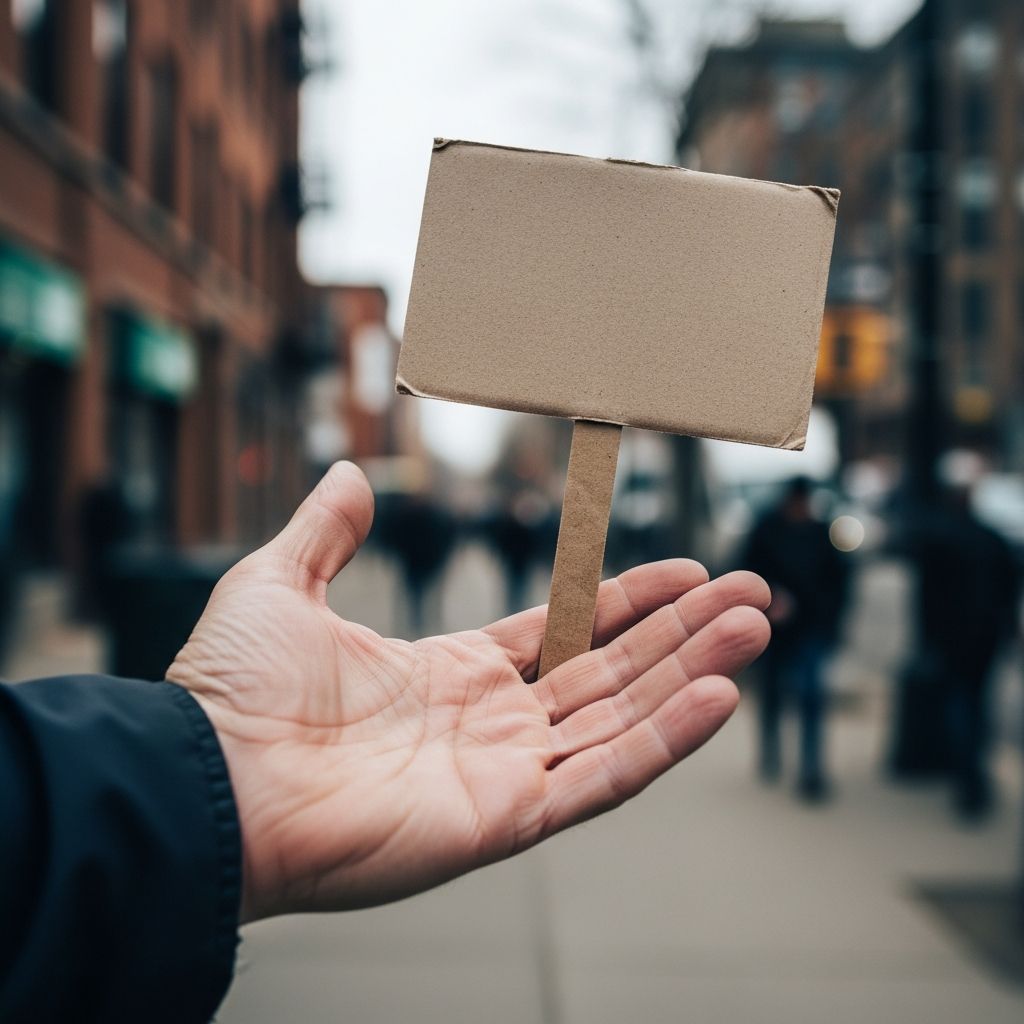
Across the United States, cities regularly pass laws trying to control or discourage panhandling—the act of asking others for money, food, or other assistance in public. At the same time, courts increasingly recognize that this conduct is a form of expression that can fall within the protection of the First Amendment. The result is an ongoing legal tug-of-war between the rights of people asking for help and the desire of governments to manage public spaces.
This article explains how courts analyze panhandling under free speech doctrine, what types of local rules have been struck down or upheld, and what practical rights and limits exist today for people who beg or solicit in public.
Defining Panhandling and Why It Matters Legally
Panhandling is generally understood as a form of solicitation—requesting donations or assistance directly from members of the public, often in streets, sidewalks, medians, or near businesses. It can include:
- Verbally asking strangers for money or food
- Holding a sign that communicates need or a request for donations
- Silently extending a hand, cup, or container to receive contributions
Courts treat these actions as expressive conduct because they communicate a message about need, poverty, or a request for help. When the government regulates that message, the First Amendment is implicated.
First Amendment Basics: Why Speech Protection Applies
The First Amendment limits how the government can restrict speech in public places such as sidewalks, streets, and parks—areas often described as traditional public forums. In those spaces, laws that regulate speech must satisfy demanding constitutional standards, especially if they depend on the content of the message.
The U.S. Supreme Court has clearly held that soliciting donations for charities is protected speech. Asking for contributions involves both communication and advocacy, and is therefore covered by the First Amendment. Although the Court has never directly ruled on one-on-one personal begging, lower federal courts have widely extended this logic to panhandling for oneself.
| Type of Activity | How Courts Typically Treat It |
|---|---|
| Charitable fundraising (for organizations) | Clearly protected speech under First Amendment doctrine |
| Personal panhandling (for oneself) | Frequently treated as protected speech by federal appeals courts |
| Aggressive or threatening conduct while begging | May be punished under assault, harassment, or similar laws; not protected when focused on physical conduct rather than message |
How Courts Have Recognized Panhandling as Free Speech
Multiple federal appeals courts—the intermediate courts directly below the U.S. Supreme Court—have explicitly recognized that begging is a form of speech entitled to constitutional protection.
- The U.S. Courts of Appeals for the 2nd, 6th and 11th Circuits have each held that soliciting money for oneself in public, including by holding a sign or verbally requesting help, is expressive activity protected by the First Amendment.
- In 2025, the Eleventh Circuit struck down two Alabama statutes that made begging illegal, holding that laws targeting begging as such violate free speech guarantees because they single out a particular kind of message for punishment.
- Other courts and commentators similarly treat panhandling as a subset of solicitation, which is typically covered by free speech doctrine when it occurs in public forums.
Civil liberties organizations have obtained rulings striking down local ordinances that required people to obtain a permit simply to ask for help. In one such case, a federal court invalidated a Louisiana city’s rule that forced panhandlers to register with the police and seek permission before requesting donations, finding that this imposed an unconstitutional burden on speech.
Content-Based vs. Content-Neutral Regulations
Courts draw a sharp line between laws that target what a person says and those that regulate how, when, or where speech occurs.
Content-Based Restrictions
A regulation is content-based if it applies because of the subject or viewpoint of the speech. Examples include laws that:
- Prohibit all requests for money but allow other conversations
- Single out people who hold signs saying “Please help” while allowing other signs
- Ban only “begging” but not other one-on-one speech in the same place
Under Supreme Court doctrine, including the decision in Reed v. Town of Gilbert, content-based laws are subject to strict scrutiny: the government must show a compelling interest and that the law is narrowly tailored, usually a difficult standard to meet. Many panhandling ordinances have failed this test because they suppress only particular messages about poverty or need.
Content-Neutral Time, Place, and Manner Rules
By contrast, a rule is considered content-neutral if it applies regardless of message and focuses instead on the time, location, or method of expression. To be valid, such a restriction must:
- Serve a significant governmental interest (such as traffic safety or pedestrian flow)
- Be narrowly tailored to address that interest
- Leave open ample alternative channels for communication
Some courts have upheld regulations that limit where people can stand in road medians or how close they may approach vehicles, when the record showed concrete safety concerns and the rules were not aimed at suppressing speech. For example, appellate courts have approved ordinances that prohibit standing on narrow or unpaved medians but allow panhandling on wider medians or sidewalks nearby, reasoning that such rules target safety rather than message content.
Common Types of Panhandling Laws
Municipalities across the country use a wide range of tools to control or limit begging in public. These laws vary considerably in both scope and constitutionality.
Typical Local Restrictions
- Location-based rules – Bans on panhandling near ATMs, bus stops, outdoor dining areas, or building entrances.
- Median and roadway rules – Prohibitions on standing in certain medians, approaching vehicles, or entering travel lanes to solicit.
- Permit or registration systems – Requirements that people obtain a permit before asking for donations, sometimes including identification, fees, or background checks.
- Aggressive panhandling ordinances – Provisions that target threatening behaviors like following people, blocking their path, or making physical contact while seeking money.
Many courts are skeptical of permit schemes that apply only to begging or impose burdensome obstacles before individuals can engage in peaceful speech. Rules that regulate conduct—such as blocking traffic, assault, or harassment—are more likely to withstand scrutiny because they do not directly target the content of speech.
When Panhandling Can Be Restricted
Even when panhandling is treated as speech, it is not immune from all regulation. Governments most often justify restrictions on three main grounds:
- Traffic and pedestrian safety – Preventing people from standing in dangerous locations, stepping into traffic, or distracting drivers.
- Preventing crime and harassment – Addressing aggressive conduct that intimidates or threatens passersby.
- Management of public spaces – Regulating crowding or obstruction near entrances, transit hubs, or narrow sidewalks.
Courts typically permit laws that focus on these concerns without discriminating against particular messages. For instance, a city can enforce general rules against blocking sidewalks or following and threatening people, whether or not money is being requested.
Several states have specific statutes aimed at “aggressive” panhandling, but in many places the same conduct is already covered by assault, harassment, or stalking laws. Because those statutes target harmful behavior rather than speech, they generally do not raise First Amendment problems.
Why Many Panhandling Ordinances Are Struck Down
Despite cities’ safety justifications, courts have invalidated a number of panhandling laws as unconstitutional. Common flaws include:
- Targeting only certain messages – Banning requests for immediate donations while allowing other kinds of interaction in the same place.
- Overbroad coverage – Prohibiting peaceful, nonthreatening begging across large areas or at all times, instead of addressing specific problems.
- Vague language – Using terms like “annoying” or “offensive” without clear definitions, making it hard for people to know what is prohibited and giving broad discretion to law enforcement.
- Burdening speech more than necessary – Imposing extensive permit requirements or effectively banning a common method of communication when less restrictive alternatives exist.
For example, the Seventh Circuit Court of Appeals invalidated a city’s ordinance that banned only oral requests for immediate money but allowed signs or requests for funds at a later time. Because the law singled out a particular way of seeking instant donations, the court concluded it was a content-based restriction inconsistent with First Amendment standards after the Supreme Court’s Reed decision.
The Supreme Court’s Silence and Ongoing Uncertainty
One central reason for legal uncertainty is that the U.S. Supreme Court has never directly decided whether individual panhandling is protected speech. Instead, it has resolved related questions—such as charitable fundraising and content-based sign regulations—leaving lower courts to apply those principles by analogy.
As a result:
- Different federal circuits sometimes reach different conclusions about similar ordinances.
- Cities continually revise their laws in response to new decisions, which then generate further litigation.
- Advocates on both sides—civil liberties groups and local governments—argue that existing doctrine favors their competing interpretations.
Scholars note that the lack of a definitive nationwide ruling has encouraged a patchwork of municipal regulations and ongoing disputes about where the line lies between legitimate management of public safety and unconstitutional suppression of speech by the poor.
Practical Takeaways for People Who Panhandle
The exact rules vary by city and state, but several general points emerge from recent case law:
- Peaceful asking for help is usually expressive activity – Holding a sign, verbally requesting assistance, or silently indicating need in public is commonly protected as speech, especially in sidewalks and parks.
- Conduct can still be regulated – Physical contact, threats, blocking paths, or stepping into traffic may be prohibited under neutral safety and criminal laws even when connected with begging.
- Location-specific restrictions may apply – Rules about medians, roadway approaches, or buffer zones near ATMs or transit stops can be lawful if they genuinely address safety and leave other places available to speak.
- Permit requirements are vulnerable to challenge – Systems that require registration or approval before one can ask for help have often been struck down as unconstitutional burdens on free speech.
Anyone facing arrest or citation for panhandling may have potential First Amendment defenses, particularly if the law targets begging specifically rather than regulating all comparable speech in the same setting.
Implications for Cities and Policy Makers
For local governments, the constitutional landscape suggests that outright bans on begging or highly targeted restrictions are legally risky. More defensible approaches generally:
- Address demonstrated safety or crime issues with evidence-based justifications
- Use content-neutral rules focused on location, distance from traffic, or obstruction of public ways
- Rely on existing assault, harassment, and disorderly conduct laws to address aggressive behavior rather than drafting broad panhandling bans
- Avoid permit schemes that function as advance censorship of individuals’ requests for help
Policy solutions that pair limited, neutral safety regulations with social services—such as housing assistance, mental health care, and outreach programs—may reduce tension between constitutional rights and public order concerns more effectively than criminal enforcement alone.
Frequently Asked Questions About Panhandling and Free Speech
Q: Is panhandling always protected by the First Amendment?
No. Many courts treat peaceful panhandling in public as protected speech, but the government can still regulate the time, place, and manner of that activity for genuine safety or order reasons, as long as it does so in a content-neutral and narrowly tailored way.
Q: Can a city completely ban begging within its limits?
Blanket bans that make begging itself a crime are frequently struck down because they single out a specific type of speech—requests for aid—for suppression. Federal appeals courts, including the Eleventh Circuit in a case involving Alabama laws, have held that such broad prohibitions violate the First Amendment.
Q: What counts as aggressive panhandling?
Aggressive panhandling typically refers to conduct that goes beyond a request for help and includes actions such as following someone after they decline to give, blocking or grabbing them, using threats, or intentionally causing fear. Regulations focused on this kind of behavior are more likely to be upheld because they target conduct, not content.
Q: Do private businesses have to allow panhandling on their property?
Generally, no. The First Amendment restricts government actors, not private owners. Businesses open to the public—like stores and restaurants—can usually prohibit solicitation on their premises, unless a specific state law or constitution provides broader speech rights on private property.
Q: If I am cited or arrested for panhandling, do I have any legal defenses?
Depending on the law used and the circumstances, you may be able to argue that the ordinance violates the First Amendment, is overly broad or vague, or improperly targets speech based on its content. Past cases, including those brought by civil liberties groups such as the ACLU, have led to invalidation of permit requirements and broad panhandling bans.
References
- Court Affirms First Amendment Rights of Panhandlers — American Civil Liberties Union. 2017-08-24. https://www.aclu.org/press-releases/court-affirms-first-amendment-rights-panhandlers
- Are Panhandling and Solicitation Protected Free Speech? — Freedom Forum Institute (Karen Hansen). 2025-04-25. https://www.freedomforum.org/panhandling-first-amendment/
- Panhandling Laws — The First Amendment Encyclopedia, Middle Tennessee State University. 2021-01-01 (approx.). https://firstamendment.mtsu.edu/article/panhandling-laws/
- Aggressive Panhandling Legislation and the Constitution — Hastings Constitutional Law Quarterly (Note). 1995-01-01. https://repository.uclawsf.edu/hastings_constitutional_law_quaterly/vol23/iss2/4/
- Panhandling Regulation After Reed v. Town of Gilbert — Columbia Law Review. 2017-05-01. https://columbialawreview.org/content/panhandling-regulation-after-reed-v-town-of-gilbert/
Similar Articles








Read full bio of Sneha Tete


