
Is It Legal to Travel With Large Amounts of Cash?
Understand the laws, declaration rules, and real-world risks of traveling with large sums of cash across borders or within a country.
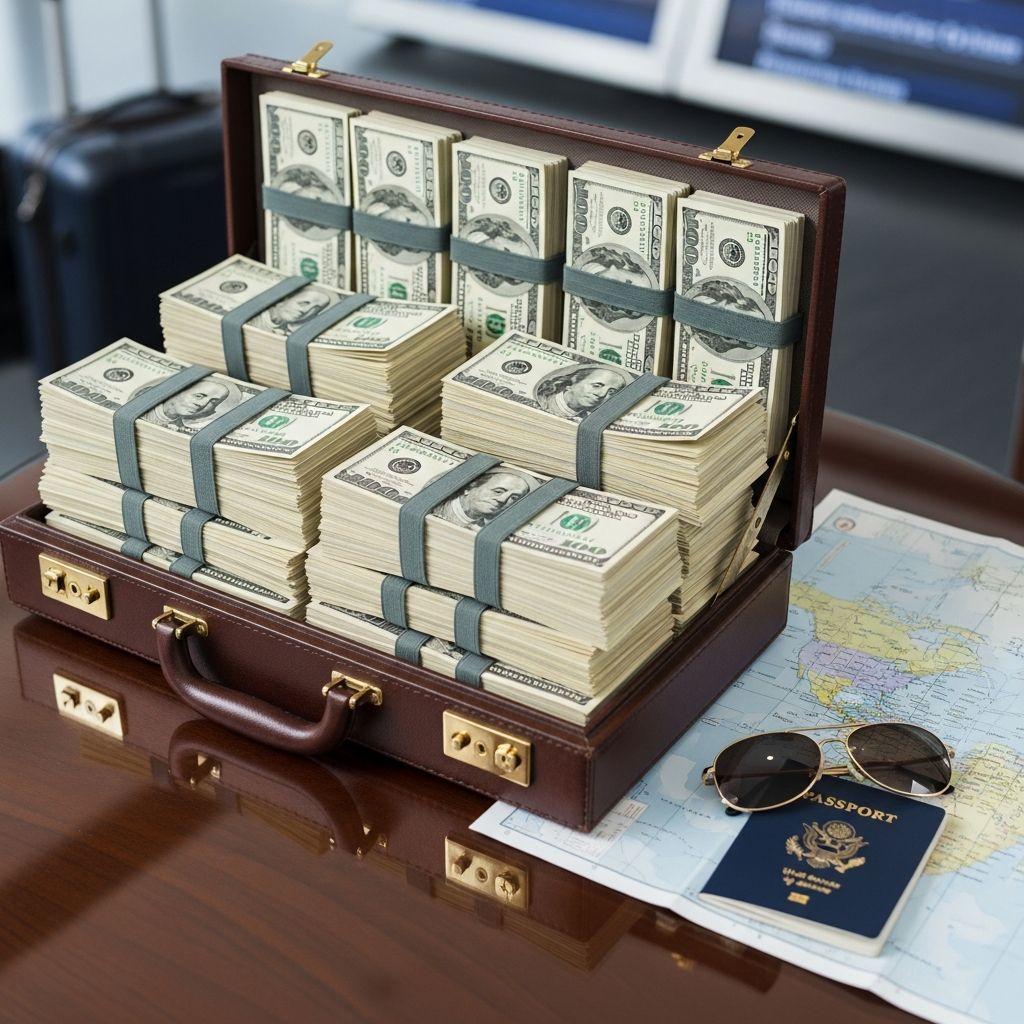
Carrying cash on a trip can feel old-fashioned in an age of cards and mobile wallets, but many people still prefer banknotes for privacy, budgeting, or destinations with limited electronic payments. The legal question is not whether you may travel with cash at all, but when the amount you are carrying triggers reporting rules, scrutiny, or possible seizure by authorities.
This guide explains how much cash you can take on a plane, what the common $10,000 threshold really means, how customs declaration rules work in the United States, European Union, Canada and elsewhere, and how to reduce both legal and personal safety risks when traveling with a lot of money.
Key Takeaways About Traveling With Cash
- Carrying cash is generally legal—domestically and internationally—if the money is legitimate and properly declared where required.
- There is usually no absolute maximum amount you can carry, but many countries require you to declare cash or monetary instruments over a set threshold (often the equivalent of €10,000 or US$10,000).
- Failure to declare can lead to seizure of the money, civil penalties, and in some cases criminal investigation, even if the money itself came from lawful sources.
- Domestic flights often have no cash reporting requirement for security agencies, but large sums may attract attention from law enforcement looking for signs of criminal proceeds.
- Using alternatives to cash—such as cards, bank transfers, or prepaid travel products—can greatly reduce your risk of theft or confiscation.
Domestic vs. International Travel With Cash
The rules differ sharply depending on whether you are staying within one country or crossing a border.
Domestic flights: security concerns, not customs rules
In the United States, there is no federal law that caps cash on domestic flights. A traveler could legally carry many thousands of dollars in a carry-on bag or on their person. The Transportation Security Administration (TSA) is focused on safety threats, not taxation or capital controls, and cash itself is not prohibited.
However, large stacks of banknotes are unusual in airport screening. This can lead to:
- Additional bag checks or questioning by security officers
- Referral to law enforcement if officers suspect money laundering, drug trafficking, or other crimes
- Potential seizure under civil asset forfeiture if police allege the money may be linked to unlawful activity, even without a criminal charge
While those outcomes are not the norm, anyone carrying an unusually large sum of cash domestically should assume they may need to explain who they are, what they do, and why they are carrying so much money.
International travel: customs reporting requirements
Once you cross a border, customs authorities gain new powers. Many countries do not limit how much cash you can bring, but require that large amounts be declared on arrival or departure.
Common features of these systems include:
- A specific threshold (often around the equivalent of US$10,000 or €10,000) above which you must report cash and certain “monetary instruments.”
- Obligations that apply both when entering and when leaving the country.
- Penalties that can include confiscation of the undeclared cash and possible fines.
| Jurisdiction | Threshold for Declaration | Legal Limit on Amount? | Key Rule |
|---|---|---|---|
| United States | More than US$10,000 in currency or monetary instruments per person or group | No statutory maximum | Any amount may be transported, but sums over US$10,000 must be reported to U.S. Customs and Border Protection (CBP) using FinCEN Form 105. |
| European Union | €10,000 or more when entering or leaving the EU | No EU-wide maximum | Travelers must declare cash at or above €10,000; national rules may also apply for movement between EU countries. |
| Canada | CAN$10,000 or more entering or leaving Canada | No maximum | Unlimited amounts allowed if you declare CAN$10,000+ to the Canada Border Services Agency (CBSA). |
Understanding the $10,000 Rule in the United States
U.S. law often uses the figure US$10,000 in financial reporting. For travelers, the key rule is that it is legal to carry any amount of money into or out of the country, but you must declare when you transport more than US$10,000 in currency or monetary instruments at once.
What must be declared to U.S. Customs?
According to U.S. Customs and Border Protection (CBP), the requirement covers not only paper currency but also a wide range of value that functions like cash.
- U.S. and foreign banknotes and coins
- Traveler’s checks
- Money orders and cashier’s checks payable to bearer
- Other negotiable instruments in bearer form that can be transferred without endorsement
When the combined total of these items exceeds US$10,000 for you, your family, or a group traveling together, you must file a report.
How to declare more than $10,000 when entering or leaving the U.S.
Travelers must complete a form called the Report of International Transportation of Currency or Monetary Instruments (FinCEN Form 105).
- You can complete the form online before travel or in paper form at a port of entry or departure.
- The form asks for identifying details, the amount and types of monetary instruments, and the purpose of carrying the money.
- The form is filed with CBP when you cross the border.
The declaration does not in itself trigger a tax charge or ban you from traveling with that money. Instead, it serves as a transparency mechanism to help enforcement agencies track potential money laundering and other illicit flows.
Group and family travel: the combined total rule
One common misconception is that each person in a group has a separate US$10,000 allowance. In reality, U.S. rules treat the threshold as applying to the combined amount carried by all travelers who are together as a family or group.
- If one person carries US$12,000, that person must declare.
- If two parents and two children carry US$4,000 each (US$16,000 total), the family must declare, even though no single person is above US$10,000.
- If separate households happen to be on the same flight but are not acting as a group, each household’s total is evaluated separately.
Attempting to evade the rule by splitting money among companions while traveling together can be treated as an intentional violation.
European Union, Canada, and Other Regions
Many jurisdictions have converged on similar reporting thresholds for large sums of cash. However, the details and definitions vary, so you should always confirm local requirements before traveling.
European Union cash controls
The EU requires anyone entering or leaving the EU with €10,000 or more in cash (or equivalent in other currencies or certain assets) to declare that amount to customs.
- The requirement applies regardless of whether you are an EU citizen or a visitor.
- There is no single EU-wide rule for cash moving between EU member countries; travelers must check national rules before their trip.
- Customs officers can detain undeclared cash and may impose penalties, depending on the member state’s laws.
Canada’s CAN$10,000 declaration rule
Canada’s system is similar in structure to the U.S. and EU systems, with a threshold of CAN$10,000 or more.
- It is not illegal to bring in or take out CAN$10,000 or more, but you must declare it to the Canada Border Services Agency (CBSA).
- The rule covers cash and other monetary instruments, such as traveler’s checks and negotiable bearer instruments.
- Failure to report can lead to seizure and a financial penalty, even if the funds are legitimate.
Legal Risks When You Do Not Declare Cash
Because large-scale criminal enterprises often move money in cash to avoid banking scrutiny, customs officers treat undeclared currency seriously. The consequences of breaking declaration rules can be severe:
- Seizure of the money: Authorities may confiscate all or part of the funds as a civil forfeiture, requiring you to pursue a claims process to recover them.
- Fines and penalties: Administrative penalties can be imposed for failing to report, even if no criminal charges are brought.
- Criminal investigation: If officers suspect the money is tied to drug trafficking, terrorism, fraud, or other crimes, they may open a criminal case.
- Travel program consequences: Travelers in trusted traveler programs (such as Global Entry in the U.S.) can lose that status if they fail to comply with customs rules.
Crucially, these outcomes can occur even when the underlying money came from lawful sources. The violation lies in the failure to declare or in misrepresenting the amount, not only in the nature of the funds.
Safety Risks of Traveling With Large Sums of Cash
Even when you follow the law, physically carrying a lot of money creates obvious practical dangers. Cash can be impossible to trace or recover once stolen or lost. Consider the following risks:
- Theft and robbery in crowded airports, bus stations, trains, or tourist areas
- Loss or misplacement of bags containing all of your travel funds
- Targeting by criminals who notice large banknotes being counted or displayed
- Lack of insurance coverage for cash losses, compared with coverage for card fraud or lost traveler’s checks
These concerns are one major reason financial institutions and consumer advisors often recommend minimizing the amount of physical cash you take abroad, relying instead on cards and digital methods where possible.
Safer Alternatives to Carrying a Lot of Cash
To reduce both the legal and personal risks of traveling with large sums, consider diversifying how you access money on the road.
- Credit cards with no or low foreign transaction fees for major expenses like hotels, flights, and restaurants
- Debit cards or ATM cards to withdraw modest amounts of local currency as needed
- Prepaid travel cards or foreign currency cards that can be loaded before departure
- International wire transfers or remittance services to send funds ahead to a trusted recipient
- Traveler’s checks in rare situations where they are still accepted, offering replacement if lost or stolen
Used correctly, these tools can maintain your financial flexibility abroad while keeping you well below reporting thresholds and minimizing the risk that one lost bag ruins your trip.
Best Practices if You Must Travel With a Large Amount of Cash
Sometimes, large cash holdings are unavoidable—for example, if you need to pay for a purchase in a place with weak banking infrastructure. In those cases, careful planning can make a major difference.
Before you travel
- Research the law in every country you will transit through or visit, including connection points where you may go through customs.
- Prepare documentation showing the origin and purpose of the funds, such as bank withdrawal slips, invoices, or contracts.
- Consult a lawyer or financial professional for large or complex transfers, particularly if the funds relate to business transactions or asset sales.
- Plan your declaration strategy: know when and where you will file the required forms and what you will say if questioned.
During your trip
- Keep cash distributed in several secure locations (e.g., money belt, hotel safe, well-concealed pockets) instead of one obvious bundle.
- Avoid displaying large wads of banknotes in public and handle cash discreetly.
- Stay alert in transportation hubs and crowded tourist areas where pickpockets operate.
- Answer customs questions truthfully and consistently with your documentation. Lying can escalate the situation quickly.
Frequently Asked Questions (FAQs)
Is it illegal to travel with more than $10,000 in cash?
No. In the U.S., you may legally transport any amount of cash or monetary instruments into or out of the country, but you must declare amounts over US$10,000 to U.S. Customs and Border Protection.
Do I have to declare cash on a domestic flight?
In the United States, there is no customs declaration requirement for cash on purely domestic flights, and there is no legal maximum on how much you can carry. However, carrying large sums may draw attention from security or law enforcement.
What happens if I do not declare cash over the threshold?
If you fail to declare cash above the legal threshold when entering or leaving a country, customs authorities can seize the money, impose fines, and potentially open a criminal investigation, even if the source of funds is lawful.
Do digital wallets or money in my bank account count toward the limit?
Reporting rules generally target physical currency and monetary instruments, not electronic balances held in bank accounts or mobile wallets. For example, the U.S. requirement concerns currency and specified negotiable instruments, not the value stored in a bank account accessed via a card.
How can I find the rules for the country I am visiting?
Check the official website of that country’s customs or border agency (often a .gov domain or similar). The European Union and Canada, for instance, maintain clear online guidance about cash declaration obligations for travelers.
References
- How much currency/monetary instruments can I bring into the United States? — U.S. Customs and Border Protection. 2023-05-18. https://www.help.cbp.gov/s/article/Article-1393
- How to Travel Internationally With More Than $10,000 in Cash — MyBankTracker. 2022-06-15. https://www.mybanktracker.com/money-tips/money/travel-internationally-10000-cash-300806
- Traveling with Cash: How Much Can You Carry When Traveling with Family or Friends? — National Security Law Firm. 2023-02-10. http://www.nationalsecuritylawfirm.com/traveling-with-cash-how-much-can-you-carry-when-traveling-with-family-or-friends/
- Flying With Cash? How Much You Can Legally Bring and How to Stay Safe — Remitly. 2023-08-01. https://blog.remitly.com/travel/how-much-cash-can-you-carry-on-a-plane/
- Rules for taking cash in / out of the EU — European Commission / Your Europe. 2024-01-09. https://europa.eu/youreurope/citizens/travel/carry/carrying-cash/index_en.htm
- Travelling with CAN$10,000 or more? — Canada Border Services Agency. 2022-11-24. https://www.cbsa-asfc.gc.ca/travel-voyage/ttd-vdd-eng.html
Similar Articles








Read full bio of Sneha Tete


