
Iowa Service Dogs and Support Animals Guide
Comprehensive guide to Iowa's rules on service dogs, emotional support animals, rights in public, housing, and penalties for misuse.
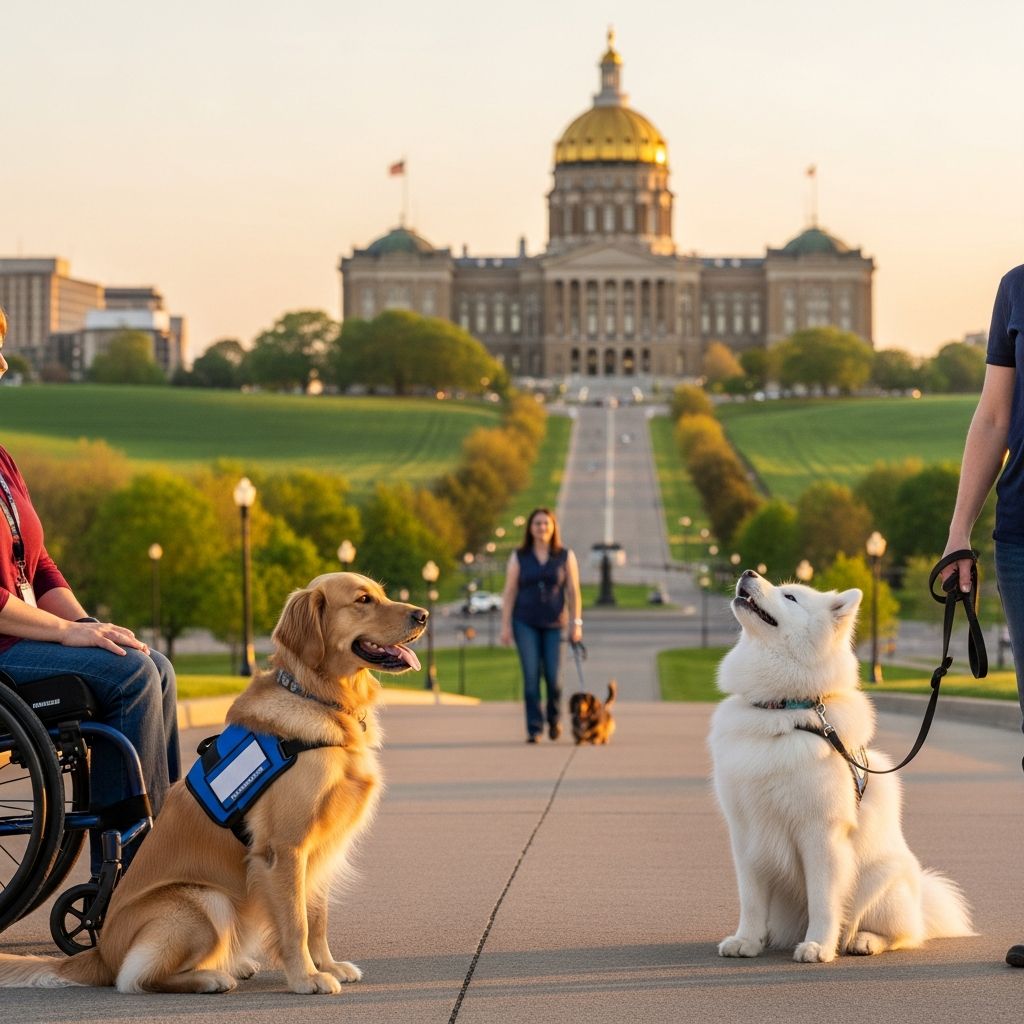
Individuals with disabilities in Iowa benefit from robust legal protections for service dogs and emotional support animals, ensuring access to public spaces, housing, and essential services. These laws blend state statutes with federal regulations like the Americans with Disabilities Act (ADA), promoting independence while setting clear boundaries on animal qualifications and handler responsibilities.
Defining Service Animals Under Iowa Regulations
Iowa aligns closely with federal standards, recognizing service animals as dogs or miniature horses individually trained to perform specific tasks mitigating a person’s disability. This excludes pets providing mere comfort, emphasizing task-oriented training such as alerting to seizures, guiding the visually impaired, or retrieving items for mobility-limited individuals.
Miniature horses qualify if they meet behavioral and training criteria comparable to dogs, though facilities assess reasonableness based on size and environment. Iowa uniquely extends protections to service-animals-in-training, allowing handlers or trainers to bring developing dogs into public areas during preparation phases.
- Key Tasks Performed: Hearing alerts, medical response, physical assistance, psychiatric support through trained behaviors.
- Exclusions: Emotional support animals (ESAs) and therapy animals do not qualify as service animals under public access rules.
Public Access Rights for Handlers
Public accommodations in Iowa, encompassing restaurants, hotels, retail stores, theaters, and government buildings, must permit entry to qualified service animals without additional fees or restrictions beyond those applied to the handler. State law (Iowa Code § 216C.11) mandates that disabled persons, their assistants, or trainers enjoy full access, provided the animal remains under control via leash, harness, or voice commands unless equipment hinders its duties.
| Public Venue Type | Iowa Coverage Examples | Federal ADA Alignment |
|---|---|---|
| Commercial Establishments | Restaurants, stores, hotels | Full access required |
| Government Facilities | Courthouses, libraries, transit | Includes state/local buildings |
| Entertainment | Theaters, stadiums | No extra charges |
Control is paramount: Animals must be housebroken and non-disruptive. Facilities may inquire only about the animal’s task performance and disability necessity, never demanding certification or vests, as no such requirements exist under law.
Housing Protections for Assistance Animals
Landlords cannot deny housing to tenants needing service or assistance animals, even under no-pet policies. Iowa’s Civil Rights Law (Iowa Code § 216.8B) defines assistance animals broadly to match the Fair Housing Act (FHA), covering both task-trained service animals and ESAs prescribed for emotional disabilities.
Tenants request reasonable accommodations via documentation if needed, such as a healthcare provider letter confirming disability-related necessity. No pet deposits apply, though damage liability rests with the tenant. Multi-family dwellings (four+ units) fall under FHA, while state law protects all rentals.
- ESA Specifics: Allowed in housing if they alleviate psychiatric symptoms, unlike public access where they lack protections.
- Handler Duties: Maintain animal control, cover damages, comply with health/safety rules.
Workplace and Employment Considerations
Under the ADA and Iowa Civil Rights Act, employers must reasonably accommodate service animals as part of disability protections. This includes office spaces, factories, and retail environments, provided the animal does not pose undue hardship or safety risks.
Requests trigger an interactive process: Employees disclose the disability-related need without detailing medical history. Employers cannot require proof of training but may verify task performance. Conflicts, like coworker allergies, demand balanced solutions without automatically excluding the animal.
Service Animals in Educational Settings
Iowa schools, including public districts, area education agencies, and accredited nonpublic institutions, comply with ADA Titles II and III. Students with disabilities gain access for trained service animals, excluding ESAs whose comfort role disqualifies them.
Staff may ask the two permitted questions: (1) Is this required due to a disability? (2) What tasks does it perform? Miniature horses require case-by-case evaluation. Disruptive behavior allows exclusion, but the student retains entry rights. Iowa law’s training animal provision aids programs developing future service dogs.
Addressing Conflicts and Exclusions
Facilities may remove service animals for valid reasons: direct threats to safety (e.g., aggression), lack of housebreaking, or uncontrollability despite handler efforts. Allergic patrons or phobia sufferers necessitate reasonable adjustments, like spatial separation, without favoring one party.
In food establishments, animals stay on floors or handler laps, never in carts or food prep areas, aligning with health codes. Handlers without animals receive equivalent service access.
Penalties for Misrepresentation and Fraud
Iowa criminalizes falsely claiming a pet as a service animal, a simple misdemeanor under Iowa Code § 216C.11(3a-3b). Intentional misrepresentation harms legitimate users by eroding trust and access. No vest or certification excuses fraud; penalties deter abuse.
Victims of denial can file complaints with the Iowa Civil Rights Commission or pursue private lawsuits for damages and attorney fees.
Frequently Asked Questions
Can emotional support animals enter Iowa restaurants?
No, ESAs lack public access rights under ADA and Iowa law, limited to housing and air travel protections.
Does my service dog need special ID in Iowa?
No, vests or certifications are unnecessary; law focuses on behavior and training proof via permitted questions.
Are miniature horses allowed everywhere dogs are?
Generally yes, if reasonable; facilities evaluate based on size and control.
What if my service animal damages property?
Handler is liable for repairs, but no extra fees or deposits required upfront.
Can schools require parents to handle service animals?
No, schools cannot mandate non-student handlers perform unrelated duties.
How do I report service animal access denial?
Contact Iowa Civil Rights Commission or U.S. DOJ for ADA violations.
Training and Handler Best Practices
Successful integration demands proactive handlers: Socialize early, maintain impeccable manners, carry waste bags, and respond swiftly to control cues. Programs accredited by organizations like those under Iowa Service Dogs enhance reliability. Regular vet care ensures health compliance.
For trainers, Iowa’s in-training status facilitates real-world exposure, building confident professionals. Communities benefit from educated public awareness campaigns countering fraud myths.
In summary, Iowa’s framework empowers disabled residents with animal partners while safeguarding public welfare through precise definitions and enforcement. Handlers thrive by knowing rights and upholding responsibilities.
References
- Iowa Laws on Service Dogs and Emotional Support Animals — Nolo. 2023. https://www.nolo.com/legal-encyclopedia/iowa-laws-on-service-dogs-and-emotional-support-animals.html
- IOWA Advocate-Stand Against Service Dog Fraud — Iowa Service Dogs. 2024. https://www.iowaservicedogs.org/advocate
- Revised Regulations on Service Animals for Districts, Area Education Agencies, and Accredited Nonpublic Schools — Iowa Department of Education. 2022-01-01. https://educate.iowa.gov/media/8176/download?inline
- CHAPTER 216C Iowa Code — Iowa Legislature. 2025. https://www.legis.iowa.gov/docs/ico/chapter/216C.pdf
- Service Animals — ADA.gov (U.S. Department of Justice). 2024-06-01. https://www.ada.gov/topics/service-animals/
- Service Animal Policy and Procedures — North Iowa Area Community College. 2023. https://www.niacc.edu/student-life/disability-services/policies-procedures/assistance-animals/service-animal-policy-and-procedures/
Similar Articles








Read full bio of medha deb


