
Intentional vs. Negligent Torts in Personal Injury Law
Understand how intent, carelessness, and legal standards shape personal injury claims and your right to compensation.
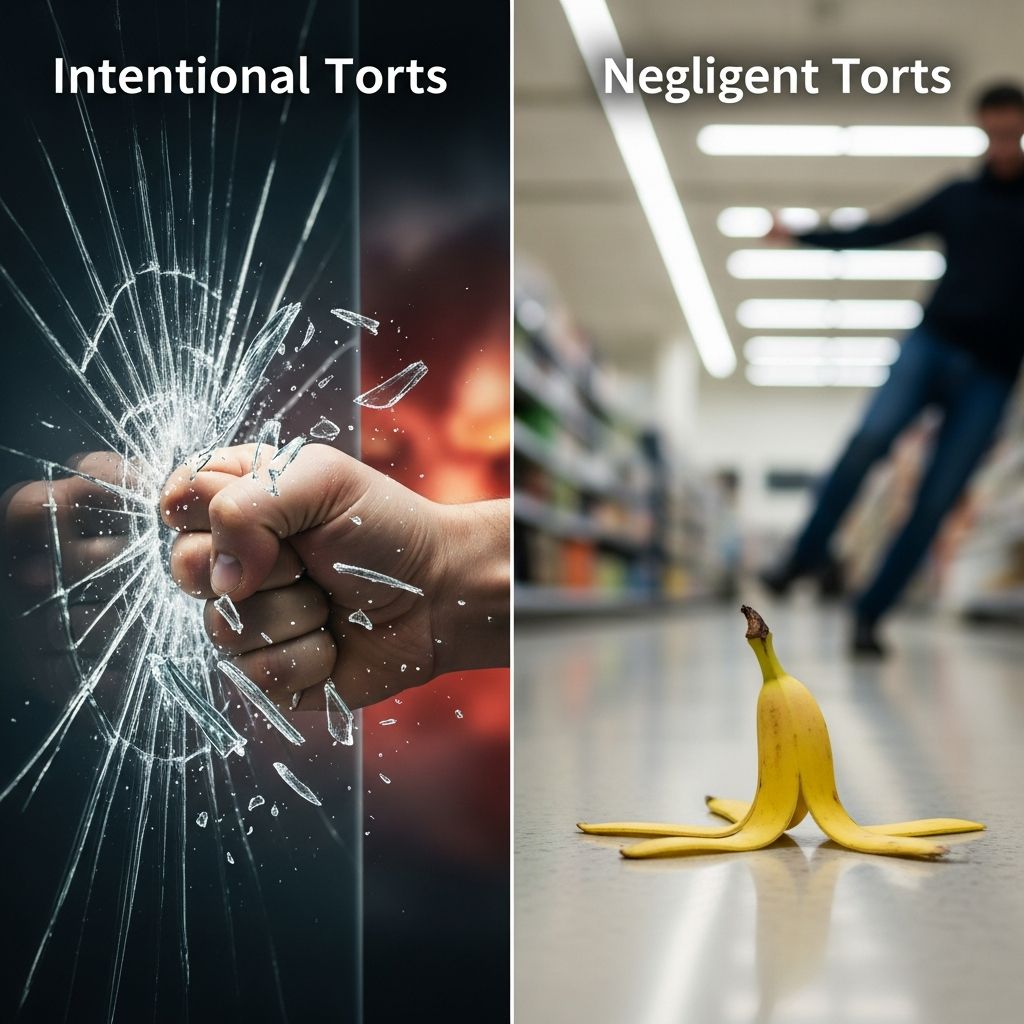
Tort law governs many everyday disputes arising from injuries, property damage, and invasions of personal rights. Two of the most important categories are intentional torts and negligent torts. Understanding how they differ is critical if you have been harmed and are considering a personal injury claim.
Both types of torts can lead to civil liability and financial compensation, but they are built on very different legal theories. The law treats deliberate harm more harshly than careless conduct, and that difference affects what you must prove, what damages you may receive, and even whether insurance will cover your loss.
Core Distinction: Intent vs. Carelessness
At the most basic level, intentional and negligent torts differ in the defendant’s state of mind when the harmful act occurred.
- Intentional tort: The wrongdoer acts on purpose, intending the conduct and knowing it will invade someone’s rights or is substantially certain to cause harm.
- Negligent tort: The wrongdoer fails to use the reasonable care the law demands, creating an unreasonable risk of harm, even though they did not mean to injure anyone.
In both situations, a victim may pursue compensation, but proving an intentional tort typically requires evidence of purposeful or knowing behavior, while negligence turns on whether the defendant met the applicable standard of care.
What Is an Intentional Tort?
An intentional tort occurs when a person deliberately engages in conduct that violates another individual’s legally protected rights. The defendant must intend the act itself, and either desire the harmful consequences or know those consequences are substantially certain to result.
Intentional torts often resemble crimes. In many cases, the same conduct can trigger both a criminal prosecution by the state and a civil lawsuit by the injured person. The civil case, however, is focused on compensating the victim rather than punishing the wrongdoer.
Common Types of Intentional Torts
- Battery – An intentional, harmful, or offensive physical contact with another person without consent, such as deliberately striking or shoving someone.
- Assault – Placing a person in reasonable fear of imminent harmful or offensive contact (for example, raising a fist to punch, even if no contact occurs).
- False imprisonment – Intentionally restraining or confining another person without legal authority or consent, such as locking someone in a room.
- Trespass to land – Entering or remaining on someone else’s property without permission, even briefly, when done deliberately.
- Conversion – Intentionally taking, using, or seriously interfering with another person’s property rights, such as stealing or intentionally destroying their belongings.
- Intentional infliction of emotional distress – Extreme and outrageous conduct carried out with the intent to cause, or reckless disregard of the risk of causing, severe emotional distress.
In each of these examples, the focus is on the actor’s deliberate choice to engage in the behavior that invades someone else’s rights.
Key Legal Elements of an Intentional Tort Claim
While the exact elements vary by cause of action and jurisdiction, most intentional tort claims require proof of:
- Intentional act – The defendant performed a voluntary, deliberate act.
- Invasion of a protected interest – The act interfered with bodily integrity, freedom of movement, property rights, or emotional security.
- Causation – The defendant’s act was a factual and legal cause of the injury suffered.
- Damages – The plaintiff experienced physical, emotional, or economic harm.
Courts often presume that people intend the natural consequences of their actions. For example, when someone intentionally hits another person, the law may infer an intent to cause at least some level of harm.
What Is a Negligent Tort?
A negligent tort arises when a person fails to exercise the level of care a reasonably prudent person would use under similar circumstances, and that failure leads to injury or damage. Negligence does not require a desire to harm; it is about carelessness or reckless disregard of foreseeable risks.
Most personal injury lawsuits—such as motor vehicle accidents, slip-and-fall incidents, and medical malpractice claims—are based on negligence rather than intentional misconduct.
Common Contexts for Negligence Claims
- Car and truck collisions – Driving while distracted, speeding, or ignoring traffic signals can breach the duty of reasonable care on the road.
- Premises liability – Property owners who fail to fix hazards, clean spills, or provide adequate warnings may be negligent if visitors are hurt.
- Medical malpractice – Healthcare professionals may be liable if their care falls below accepted professional standards and results in injury.
- Product liability (negligence-based) – Manufacturers or sellers who unreasonably fail to design, test, or warn about product risks may be negligent if consumers are harmed.
Typical Elements of a Negligence Claim
To succeed in a negligence action, a plaintiff generally must establish the following elements:
- Duty of care – The defendant owed a legal duty to use reasonable care toward the plaintiff (e.g., drivers must operate vehicles safely).
- Breach of duty – The defendant failed to act as a reasonably prudent person would under similar circumstances.
- Causation – The breach was both the factual cause (“but for” the conduct, the harm would not have occurred) and the legal or proximate cause of the injury.
- Damages – The plaintiff suffered a legally recognizable loss, such as medical bills, lost wages, pain and suffering, or property damage.
Side-by-Side Comparison: Intentional vs. Negligent Torts
The following table highlights critical differences that affect how claims are pursued and resolved:
| Feature | Intentional Torts | Negligent Torts |
|---|---|---|
| State of mind | Deliberate, purposeful conduct; intent to act and awareness of likely consequences. | Failure to use reasonable care; no intent to cause harm required. |
| Typical examples | Assault, battery, false imprisonment, trespass, conversion, intentional infliction of emotional distress. | Motor vehicle accidents, unsafe premises, professional malpractice, careless product design or warnings. |
| Burdens of proof | Must show the defendant intended the act that violated the plaintiff’s rights, often by circumstantial evidence. | Must prove duty, breach, causation, and damages by a preponderance of the evidence. |
| Potential damages | Compensatory damages plus a greater possibility of punitive damages to punish and deter. | Primarily compensatory damages; punitive damages are less common and usually require gross negligence or egregious misconduct. |
| Criminal overlap | High; many intentional torts also constitute crimes (e.g., assault, theft). | Lower; most negligence cases proceed only as civil claims. |
| Insurance coverage | Frequently excluded because policies often do not cover intentional wrongdoing. | More likely covered under auto, homeowners, business, or professional liability insurance. |
Damages and Remedies
Whether a tort is intentional or negligent, courts can award money damages to make the injured person as whole as possible. However, the type and scope of damages often differ.
Compensatory Damages
Both intentional and negligent torts may lead to compensatory damages. These are designed to reimburse the victim for losses, such as:
- Economic damages
- Medical expenses (past and future)
- Rehabilitation and therapy costs
- Lost income and diminished earning capacity
- Property repair or replacement
- Non-economic damages
- Pain and suffering
- Emotional distress
- Loss of enjoyment of life
- Loss of consortium (impact on family relationships)
Punitive Damages
Punitive damages are not aimed at compensation, but at punishing especially wrongful conduct and deterring similar behavior in the future. Courts are more likely to award punitive damages in cases involving intentional harm because the conduct is viewed as more blameworthy. In negligence cases, punitive awards are typically reserved for gross negligence or willful and wanton misconduct.
Insurance and Financial Recovery
Insurance plays a major role in personal injury litigation. It often determines whether a plaintiff can realistically collect a judgment.
- Negligence claims are more likely to be covered by liability policies, including auto, homeowners, commercial general liability, and malpractice insurance.
- Intentional torts are frequently excluded from coverage. Many policies contain explicit exclusions for intentional or expected injuries, which means the defendant may have to pay out-of-pocket if found liable.
This difference affects settlement strategy. In a negligence claim backed by insurance, there is usually a funded source of recovery. In intentional tort cases, even a favorable judgment may be difficult to collect if the defendant has limited assets.
Overlapping Conduct: When Negligence and Intent Collide
Some situations involve both negligent and intentional aspects. For instance, a bar fight might begin with a shove that escalates into serious injuries, or a driver may intentionally tailgate but negligently lose control of the vehicle.
Depending on the facts, a plaintiff may allege:
- Purely intentional misconduct (e.g., an unprovoked punch).
- Pure negligence (e.g., failing to see a pedestrian in a crosswalk).
- Alternative or overlapping claims, allowing a jury to decide which legal theory applies.
In some jurisdictions, intentional tortfeasors may face joint and several liability, meaning each one can be held responsible for the entire amount of damages, with rights of contribution between them. By contrast, negligence cases more often apportion fault and damages among multiple defendants based on their percentage of responsibility.
How Courts Evaluate Evidence of Intent and Negligence
Proving what someone “meant” to do can be challenging, so courts often rely on circumstantial evidence and reasonable inferences from behavior.
- Evidence of intent may include prior threats, text messages, social media posts, use of a weapon, or conduct showing a deliberate goal to harm.
- Evidence of negligence often centers on whether the defendant violated safety rules, industry standards, or common-sense precautions, such as traffic laws or building codes.
The same facts can support different inferences. For example, driving 30 miles per hour over the speed limit in a school zone may be characterized as negligent, grossly negligent, or even reckless, depending on the jurisdiction’s legal standards and how foreseeable the harm was.
Practical Implications for Injured People
If you have been harmed, understanding whether your claim is rooted in intentional or negligent conduct can guide your legal strategy:
- Type of evidence you need – Intentional torts often require proof of motive, threats, or deliberate acts, while negligence focuses on safety rules and reasonable behavior.
- Likelihood of punitive damages – Courts are more open to punitive awards for deliberate attacks than for momentary lapses in judgment.
- Availability of insurance coverage – Negligence claims are usually more collectible because they tap into liability insurance.
- Criminal proceedings – In cases like assault or theft, there may be parallel criminal cases. A criminal conviction can sometimes strengthen the civil claim but does not automatically guarantee compensation.
Regardless of the category, time limits (statutes of limitations) apply, and evidence can fade quickly, so prompt legal advice is important.
Frequently Asked Questions (FAQs)
Q: Can the same act be both a crime and a tort?
Yes. Many intentional torts—such as assault, battery, or theft—also qualify as crimes. The government may bring a criminal case to punish the wrongdoer, while the victim can file a civil lawsuit seeking compensation.
Q: Do I need to prove intent to win a negligence case?
No. Negligence does not require proving that the defendant wanted to cause harm. You only need to show that they failed to use reasonable care and that this failure caused your injury.
Q: Are punitive damages available in every intentional tort case?
Not necessarily. While punitive damages are more likely in intentional tort cases, courts still consider factors like the severity of the conduct, the harm caused, and applicable state law before awarding them.
Q: If an insurance company denies coverage because an act was intentional, can I still sue?
Yes. Insurance coverage is separate from liability. You may still sue the person who harmed you, but if the act is excluded from insurance, collecting the judgment may depend on the defendant’s personal assets.
Q: How long do I have to file a tort claim?
Deadlines differ by state and by type of claim. Some intentional torts have shorter limitation periods than negligence claims. Because missing the deadline can permanently bar your case, consulting a qualified attorney promptly is important.
References
- Intentional Torts vs. Negligence — Blackburn Wirth Injury Team. 2023-05-10. https://blackburnwirth.com/blog/intentional-torts-vs-negligence/
- Comparing Intentional Torts and Negligence in Personal Injury — Law Offices of Adam S. Kutner. 2022-08-16. https://www.askadamskutner.com/las-vegas-personal-injury-lawyers/comparing-intentional-torts-and-negligence-in-personal-injury/
- Differences Between Intentional and Negligence Torts — Koonz McKenney Johnson & DePaolis LLP. 2021-11-03. https://koonz.com/differences-between-intentional-and-negligence-torts/
- Comparing Intentional Torts and Negligence in Personal Injury — Stephens Law Firm. 2023-02-20. https://www.stephenslaw.com/blog/comparing-intentional-torts-and-negligence-in-personal-injury/
- The Difference Between Negligence and Intentional Tort — Casey, Devoti & Brockland, P.C. 2020-09-14. https://www.caseydevoti.com/the-difference-between-negligence-and-intentional-tort/
- Common Types of Intentional Torts — Dimopoulos Injury Law. 2022-07-01. https://www.dlgteam.com/blog/common-types-of-intentional-torts/
Similar Articles








Read full bio of Sneha Tete


