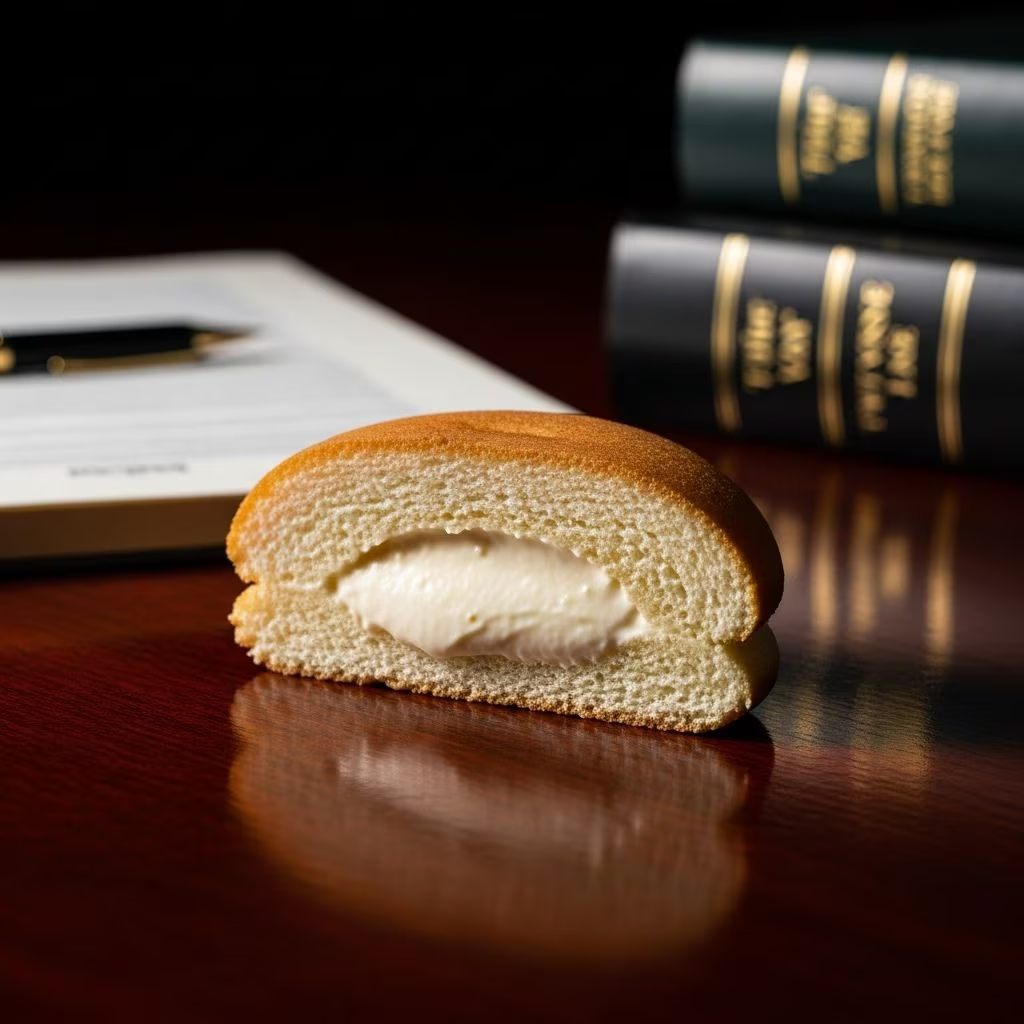
The phrase “Twinkie defense” has become shorthand in popular culture for any strange or trivial-sounding argument used to excuse serious criminal behavior. In reality, it describes a specific use of mental health evidence and the doctrine of diminished capacity in a high-profile California murder trial in the late 1970s. This article unpacks what the term actually means, why it is widely misunderstood, and how it influenced later debates about criminal responsibility.
From Headline to Legal Myth: Where the Term Came From
The label “Twinkie defense” was coined by reporters covering the 1979 trial of Dan White, the former San Francisco city supervisor who shot and killed Mayor George Moscone and Supervisor Harvey Milk in 1978. The defense did not literally argue that snack cakes made him commit murder; instead, it relied on a diminished capacity theory focused on his depression and mental state.
During the trial, a psychiatrist testified that White was suffering from serious depression and pointed to several lifestyle changes as evidence, including abandoning his normally healthy diet in favor of sugary junk food such as Twinkies. Media coverage seized on this detail, distilling a complex psychiatric argument into a catchy—and misleading—phrase that quickly entered the legal and cultural vocabulary.
Key Concepts Behind the Twinkie Defense
To understand why the phrase has endured, it helps to separate the myth from the underlying legal doctrines and evidence.
The Role of Diminished Capacity
At the time of the Dan White trial, California recognized a diminished capacity defense. Under that doctrine, evidence of mental illness or impairment could show that a defendant lacked the specific mental state—such as premeditation or malice—required for certain crimes, even if they understood what they were doing and knew it was wrong.
- Purpose: To contest whether the defendant had the precise intent needed for a higher-level offense (for example, first-degree murder) rather than to excuse the crime entirely.
- Effect: If successful, diminished capacity could reduce a charge to a lesser offense with a lower required mental state, such as voluntary manslaughter.
This is distinct from the insanity defense, which typically focuses on whether a defendant could understand the nature of their act or differentiate right from wrong at the time of the offense, as reflected in standards like the M’Naghten rule or its variants in many U.S. jurisdictions.
Symptoms vs. Causes
A central misunderstanding about the Twinkie defense is the belief that the lawyers argued junk food caused the violence. Contemporary legal accounts and later summaries note that the sugary diet was offered as a symptom of Dan White’s depression, not as the cause of the murders.
The defense theory can be summarized as:
- White was suffering from serious depression.
- His behavior had changed markedly (quitting his job, withdrawing from family, becoming disheveled, and shifting to heavy junk food consumption).
- That mental state significantly impaired his capacity for rational judgment and premeditation.
Media simplification of those facts gave rise to the impression that “Twinkies made me do it”, which has been heavily criticized by legal scholars and commentators as a distortion of what was actually argued in court.
The Dan White Trial: What Happened and Why It Matters
Understanding the legal and social impact of the Twinkie defense requires looking closely at the outcome of the Dan White case and the public reaction that followed.
| Issue | Details |
|---|---|
| Charges | Dan White was charged with the murders of San Francisco Mayor George Moscone and Supervisor Harvey Milk in 1978. |
| Defense strategy | Present evidence of depression and behavioral changes to support a diminished capacity theory, arguing he could not form the premeditated intent needed for first-degree murder. |
| Junk food evidence | White’s sudden shift to consuming large amounts of sugary snacks, including Twinkies, was described as one symptom of his depression. |
| Verdict | The jury convicted White of voluntary manslaughter, not murder, resulting in a substantially shorter prison sentence. |
| Public response | The verdict triggered intense outrage and protests in San Francisco, including the events later known as the White Night riots. |
The case quickly became a touchstone in debates about whether mental health evidence and complex psychological defenses were allowing some defendants to avoid what many considered appropriate punishment.
How the Twinkie Defense Changed California Law
The backlash to the verdict reached beyond public demonstrations and commentary. California policymakers responded by revisiting the rules that had allowed the diminished capacity argument to succeed.
From Diminished Capacity to Diminished Actuality
In the years following the Dan White trial, California voters and legislators moved to abolish the formal diminished capacity defense and replace it with what is sometimes called “diminished actuality.”
- Diminished capacity (former rule): Focused on a defendant’s overall capacity to form the required mental state.
- Diminished actuality (revised approach): Focuses more narrowly on whether the defendant actually had the required intent or mental state at the time of the crime, often limiting the impact of broader psychiatric evidence.
California also modified statutory definitions related to premeditation and malice in homicide cases, aligning them more closely with common-law concepts and reducing opportunities to use expansive mental-state defenses to significantly downgrade charges.
Shifting Attitudes Toward Mental Health Evidence
The Twinkie defense became a symbol, for many critics, of the risk that juries might be overly swayed by emotional or technical psychiatric testimony. In response, some courts and legislatures across the United States tightened rules on how expert mental health evidence can be introduced, especially when it is offered to negate specific intent instead of to support a full insanity defense.
This trend fits into a broader history of reforms aimed at standardizing insanity and mental impairment defenses after controversial verdicts, including statutory changes and model codes that clarify when psychological evidence is admissible and how juries should evaluate it.
Modern Meaning: How Lawyers and the Public Use the Term Today
Decades after the Dan White trial, “Twinkie defense” has evolved into a piece of legal slang rather than a reference to a specific doctrinal rule.
Contemporary Usage
In modern conversation and commentary, the phrase often refers to:
- Any implausible-sounding or trivial-seeming explanation for serious criminal conduct.
- A strategy that tries to link behavior to a substance, product, or minor lifestyle factor (such as sweets, caffeine, or over-the-counter medication) as part of a broader mental impairment claim.
- Cases in which defendants argue that a combination of mental illness and some external factor (like drugs, sleep deprivation, or diet) temporarily undermined their judgment or self-control.
Lawyers and judges sometimes use the term informally to critique or mock a defense they view as overly creative or disconnected from common-sense notions of responsibility.
Influence on Legal Culture and Public Perception
The Twinkie defense has also shaped broader debates about criminal accountability and the legitimacy of psychological defenses:
- Public skepticism: Many people remain wary of mental health-based defenses, fearing they allow dangerous individuals to escape punishment or receive unduly lenient sentences.
- Media framing: Headlines and commentary frequently highlight unusual aspects of a defense—such as food, medication, or technology—because they are easy to summarize and invite emotional reactions.
- Professional caution: Defense attorneys may think carefully about how to present complex psychiatric evidence so that jurors understand its relevance without perceiving it as a frivolous excuse.
Common Misconceptions About the Twinkie Defense
Because the phrase is so often repeated without context, several myths have taken root. Clarifying them can help distinguish between genuine legal principles and urban legend.
- Myth 1: The defense claimed Twinkies caused the murders.
In fact, the junk food evidence was offered as one indicator of Dan White’s underlying depression; the core argument focused on diminished capacity, not on sugar as a direct cause of violence. - Myth 2: The case created a legal right to blame snacks or sugar.
There is no formal “Twinkie defense” in any criminal code or recognized doctrine. The term is purely a media-created label, and courts treat such arguments within broader frameworks like insanity, intoxication, or mental impairment defenses. - Myth 3: Similar defenses routinely succeed.
Although some defendants have tried to link criminal behavior to unusual triggers—such as extreme caffeine consumption or over-the-counter drugs—courts most often reject these theories or treat them as part of a larger, carefully scrutinized mental health claim. - Myth 4: Mental health evidence always reduces punishment.
In many jurisdictions, findings such as “guilty but mentally ill” or similar verdicts can result in institutional confinement that may last as long as, or longer than, an ordinary prison term, particularly under reforms that require secure treatment for dangerous offenders.
Lessons for Defendants and Practitioners
The story behind the Twinkie defense offers several practical insights for anyone facing criminal charges or working in the justice system.
When Mental Health Evidence Matters
Psychiatric and psychological evidence can be crucial in criminal cases, but its impact depends heavily on the law of the relevant jurisdiction and the precise way it is presented.
- Insanity and capacity: In some cases, experts help determine whether a defendant met legal tests for insanity or competency to stand trial.
- Specific intent: Evidence of severe mental illness may be used to argue that a defendant did not actually form the specific intent required for certain charges, though many states now limit such arguments.
- Sentencing: Even when guilt is not contested, mental health history and treatment needs can strongly influence sentencing and placement in corrections or treatment settings.
Importance of Clear Communication with Juries
The Twinkie defense also illustrates how easily complex courtroom arguments can be misunderstood outside the courtroom. Lawyers and experts must be careful to explain:
- Exactly what conclusion the evidence is offered to support (for example, lack of premeditation vs. complete lack of responsibility).
- How symptoms, behaviors, and lifestyle changes fit into a recognized medical diagnosis.
- What the law allows the jury to consider, and what it does not.
Miscommunication can not only affect the verdict in a particular case but can also fuel broader backlash that leads to restrictive legal reforms.
Frequently Asked Questions (FAQs)
Q: Is the Twinkie defense an officially recognized legal defense?
A: No. “Twinkie defense” is an informal nickname created by reporters. Courts recognize doctrines like insanity, diminished responsibility, or intoxication, but there is no codified “Twinkie defense” in any criminal statute.
Q: Did Dan White’s lawyers really blame Twinkies for the killings?
A: They did not argue that Twinkies caused the murders. They used evidence of heavy junk food consumption as one symptom of White’s depression, supporting a broader diminished capacity argument aimed at reducing the degree of the homicide charge.
Q: Why did the jury convict him of voluntary manslaughter instead of murder?
A: The jury accepted that White’s mental state was impaired enough that he lacked the premeditation required for murder under then-existing California law. As a result, they returned a voluntary manslaughter verdict, which carried a shorter sentence and sparked significant public outrage.
Q: Can unusual defenses like this still work today?
A: Defendants can still present mental health and related evidence, but many jurisdictions—including California—have narrowed or abolished broad diminished capacity defenses. Modern courts generally require rigorous proof and tie any such argument to clearly defined legal standards for insanity, intent, or mitigation.
Q: What should someone do if they think mental health is relevant to their criminal case?
A: They should consult an experienced criminal defense attorney as early as possible. A qualified lawyer can arrange appropriate evaluations, explain how local law treats mental health evidence, and help decide whether raising issues like insanity, lack of intent, or mitigation is strategically appropriate.
References
- Twinkie defense — Wikipedia (summary derived; primary facts cross-checked with other sources). 2024-05-10. https://en.wikipedia.org/wiki/Twinkie_defense
- Insanity Defense — Legal Information Institute, Cornell Law School. 2020-08-15. https://www.law.cornell.edu/wex/insanity_defense
- Diminished Capacity and Diminished Responsibility — Legal Information Institute, Cornell Law School. 2019-11-01. https://www.law.cornell.edu/wex/diminished_capacity
- Guilty but Mentally Ill — National Conference of State Legislatures (NCSL). 2016-08-01. https://www.ncsl.org/civil-and-criminal-justice/guilty-but-mentally-ill
- ‘Twinkies Made Me Do It’ — Attorney at Law Magazine. 2019-10-09. https://attorneyatlawmagazine.com/the-lighter-side/legal-history/twinkies-made-me-do-it