
Inside a DUI Trial: Stages, Strategy, and What to Expect
Understand every stage of a DUI trial, from arraignment through verdict, so you can make informed decisions about your defense.
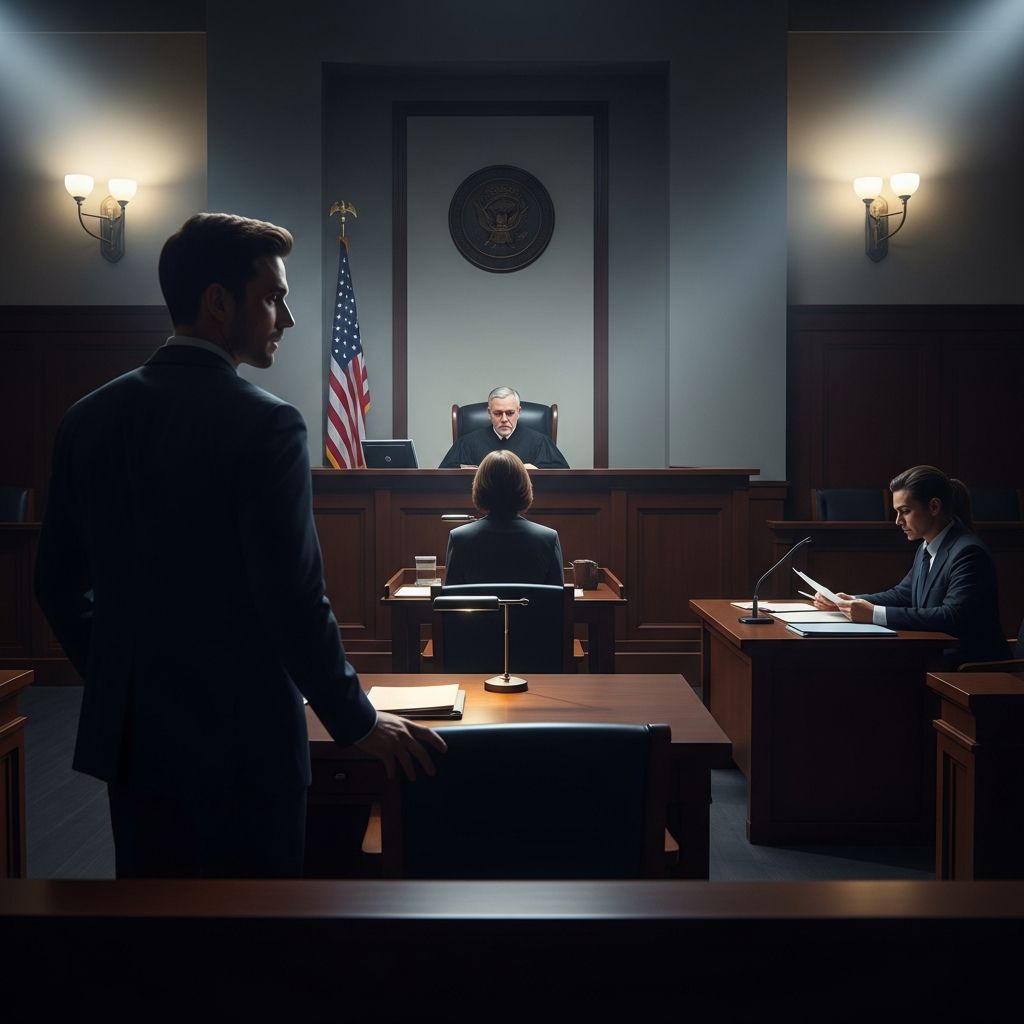
Facing a charge for driving under the influence (DUI) can be overwhelming, especially if your case may go all the way to trial. This guide walks through how a DUI case typically moves through the court system, what happens in a trial, and which strategic decisions often shape the outcome.
1. From Arrest to Courtroom: How a DUI Case Reaches Trial
Most DUI cases begin long before a jury is ever selected. Knowing the early steps helps you understand why only some cases actually proceed to trial.
1.1 The traffic stop and investigation
A DUI case usually starts when an officer stops a vehicle based on observed driving behavior or a traffic infraction (such as speeding or lane violations). Officers are trained to look for signs of impairment and then conduct a focused investigation.
- Observation of driving: weaving, drifting, unusually slow or fast speeds.
- Initial contact: smell of alcohol, slurred speech, red or watery eyes.
- Field sobriety tests (FSTs): standardized physical and cognitive tasks (such as walk-and-turn or one-leg stand) to look for impairment indicators.
- Preliminary breath test: a roadside breath test may be used to estimate blood alcohol concentration (BAC) and help determine probable cause for arrest.
If the officer believes there is probable cause, you may be arrested and transported for further chemical testing (breath, blood, or, in limited cases, urine), often under what is known as an implied consent law that requires drivers to submit to testing once lawfully arrested.
1.2 Booking, paperwork, and release
After arrest, typical steps include:
- Booking (photographs, fingerprints, and entry into a database).
- Issuance of a citation or complaint that begins the formal court case.
- Discussion of bail or release on your promise to appear in court.
The arrest paperwork and test results produced at this stage will later become central evidence if the case proceeds to trial.
2. The First Court Appearance: Arraignment
The arraignment is the first formal hearing in most DUI cases and marks the start of the court process.
2.1 What happens at arraignment
Although procedures vary by state, an arraignment usually includes:
- The judge confirming your identity and making sure you have or can obtain a lawyer.
- Reading or providing the formal charges (for example, per se DUI based on BAC, or impairment-based DUI).
- An explanation of your rights, including the right to a jury trial in many jurisdictions.
- Entry of a plea: guilty, not guilty, or, in some courts, no contest.
- Discussion of release conditions, such as bail, travel limits, or ignition interlock requirements.
- Scheduling of future dates for pretrial conferences or motions.
Most defendants who are considering trial enter a not guilty plea at arraignment. This preserves defenses, allows bargaining, and opens the door to a full review of the evidence.
3. Pretrial Phase: Where Many DUI Cases Are Resolved
Before a DUI ever reaches trial, the parties usually go through a structured pretrial phase. Many cases are resolved here by plea agreement or dismissal rather than by verdict.
3.1 Discovery and evidence review
The discovery process is the exchange of information and evidence between the prosecution and defense.
- Police reports and officer notes.
- Laboratory or breath-test machine printouts showing BAC results.
- Body cam, dash cam, or other video recordings.
- Witness statements (for example, passengers or third-party observers).
- Records of the maintenance and calibration of testing equipment.
Defense counsel uses this material to identify legal or factual weaknesses in the prosecution’s case—such as questionable traffic stops, procedural violations, or unreliable test results.
3.2 Pretrial conferences and plea negotiations
Courts commonly schedule one or more pretrial conferences where the prosecutor and defense attorney discuss potential resolutions.
Common negotiation topics include:
- Reduction of the DUI charge to a lesser offense (such as reckless driving in some states).
- Agreement on a specific sentencing range in exchange for a guilty plea.
- Dismissal of certain counts if others are resolved.
- Conditions such as alcohol education, treatment, or community service.
Many defendants choose to accept a negotiated resolution to avoid the risk and uncertainty of trial. However, if no agreement is reached—or if important legal issues must be decided—the case may continue toward trial.
3.3 Motions that shape the trial
Before trial, each side may file motions asking the judge to decide specific legal questions. Common DUI-related motions include:
- Motion to suppress evidence – arguing that evidence (such as breath test results) should be excluded because it was obtained in violation of constitutional or statutory rules (for example, an unlawful stop or improper testing procedure).
- Motion to dismiss – claiming that, even if the evidence is viewed in the light most favorable to the prosecution, the law does not support the charge.
- Evidentiary motions – seeking to limit or clarify expert testimony, chemical test evidence, or prior conviction records.
How the judge rules on these motions can significantly affect whether the prosecution proceeds to trial or reconsiders a plea offer.
4. Choosing Between Judge and Jury
In many jurisdictions, a person charged with DUI has the right to a jury trial, although some may elect a bench trial, where the judge alone decides guilt.
| Feature | Jury Trial | Bench Trial |
|---|---|---|
| Decision-maker | Group of citizens (jurors) | Judge only |
| Speed | Often slower due to jury selection and instructions | Generally faster |
| Complex legal issues | Judge explains law to jury | Judge applies law directly |
| Perception | Some defendants prefer a jury of peers | Others prefer a trained legal decision-maker |
| Strategy | May be better if facts are sympathetic or evidence is weak | May be better if the defense turns on technical legal questions |
5. Inside the DUI Trial: Step-by-Step
Once the case goes to trial, the court follows a sequence designed to ensure a fair and transparent decision.
5.1 Jury selection (voir dire)
In a jury trial, the first phase is selecting jurors. The judge and lawyers question potential jurors about their backgrounds and views to uncover bias, such as strong feelings about drunk driving or prior encounters with DUI cases.
- Jurors may be excused for cause if they cannot be fair and impartial.
- Each side also has a limited number of peremptory strikes, which can be used to remove jurors without stating a reason, within anti-discrimination rules.
Once a panel is chosen, jurors are sworn in, and the trial moves forward.
5.2 Opening statements
Both sides typically deliver opening statements summarizing what they believe the evidence will show.
- Prosecution: explains the theory of the case—for example, that the defendant drove with a BAC at or above the legal limit or while impaired by alcohol or drugs.
- Defense: highlights weaknesses or alternative explanations, such as unreliable testing, medical conditions, or improper police procedures.
These statements are not evidence; they are a roadmap to help the judge or jury follow the case.
5.3 Prosecution case-in-chief
The government presents its evidence first because it carries the burden of proof. In a DUI case, this often includes:
- Testimony from the arresting officer about driving behavior, physical signs of impairment, and performance on field sobriety tests.
- Testimony or records explaining how chemical tests were administered and how machines were calibrated.
- Laboratory or breath-test results indicating BAC.
- Video footage and audio recordings when available.
The defense has the right to cross-examine every witness, questioning credibility, memory, observation conditions, and adherence to required procedures.
5.4 Defense evidence and testimony
After the prosecution “rests,” the defense may present its own witnesses and exhibits, though it is not required to present any evidence at all because the burden remains on the prosecution.
Defense evidence might include:
- Expert witnesses who challenge the science of BAC testing, the reliability of field sobriety tests, or the effect of certain medical conditions on test results.
- Witnesses who dispute the officer’s account of driving behavior or level of impairment.
- Records or data showing problems with the specific testing device used.
The defendant may choose to testify but cannot be forced to do so. Whether to testify is a strategic decision made with counsel, balancing potential benefits against the risk of cross-examination.
5.5 Rebuttal, closing arguments, and jury instructions
After both sides have presented their main evidence:
- The prosecution may call rebuttal witnesses to respond to new issues raised by the defense.
- Each side delivers closing arguments, tying the evidence to the legal standards and urging the judge or jury to reach a particular verdict.
- In a jury trial, the judge gives jury instructions explaining the law, including the definition of DUI, the elements of the offense, and what “beyond a reasonable doubt” means.
5.6 Deliberation and verdict
In a jury trial, the jurors deliberate in private, reviewing evidence and discussing whether the prosecution has met its burden on each element of the offense.
- If the jury unanimously finds that the elements are not proven, it returns a verdict of not guilty.
- If the jury unanimously finds that the elements are proven beyond a reasonable doubt, it returns a verdict of guilty.
- If jurors cannot agree even after extended deliberation, the judge may declare a mistrial, after which the prosecution may choose to retry or dismiss the case.
In a bench trial, the judge performs the same role, weighing evidence and issuing a verdict on the record.
6. Sentencing: What Happens After a DUI Conviction
If you are convicted by verdict or plea, the case moves to sentencing. DUI penalties are heavily influenced by state law, prior offenses, and aggravating or mitigating factors.
6.1 Typical DUI sentencing factors
Courts often consider:
- Whether this is a first offense or a repeat DUI.
- The measured BAC (for example, above 0.08, 0.15, or 0.20 may trigger enhanced penalties in some states).
- Whether there was an accident, property damage, or injury.
- Presence of minors in the vehicle.
- Cooperation with law enforcement and acceptance of responsibility.
6.2 Possible penalties and conditions
Although exact penalties differ by jurisdiction, a DUI sentence may include:
- Fines and mandatory court fees.
- Jail time or, in some cases, alternative custody such as work release or electronic monitoring.
- Probation with conditions limiting alcohol use and requiring compliance checks.
- Driver’s license suspension or restriction and possible ignition interlock installation.
- Mandatory alcohol education, treatment, or participation in a specialized DUI court program for repeat offenders.
In some jurisdictions, so-called DUI courts provide closely supervised treatment and monitoring aimed at reducing repeat offenses, particularly for individuals with alcohol dependence.
7. Defense Themes Commonly Raised in DUI Trials
While each case is unique, certain defense themes appear frequently in DUI trials.
- Illegal stop or arrest: Arguing that the officer lacked reasonable suspicion to stop the vehicle or probable cause to arrest, which may lead to suppression of evidence.
- Improper testing procedures: Questioning whether officers followed required steps when giving field sobriety or chemical tests, including observation periods and machine calibration.
- Medical or physical conditions: Conditions such as inner ear disorders, injuries, or neurological issues can affect balance and coordination, potentially undermining the reliability of field sobriety tests.
- Rising BAC: Suggesting that alcohol absorbed into the bloodstream after driving, so the BAC at the time of testing was higher than at the time of driving—a concept some experts may support in appropriate cases.
- Record-keeping and calibration issues: Highlighting gaps or errors in maintenance logs for breath machines or lab equipment.
8. Practical Tips for Defendants Considering a DUI Trial
If you are deciding whether to take a DUI case to trial, strategic preparation is essential.
- Consult experienced counsel: DUI law mixes constitutional issues with technical scientific evidence; specialized knowledge can be critical.
- Gather documentation early: Save receipts, medical records, or other documents that may support your version of events.
- Be honest with your lawyer: Accurate advice depends on providing a full and truthful account.
- Understand the risks and benefits: Trials can lead to acquittal but also expose you to the full sentencing range if convicted.
- Comply with court orders: Violating pretrial conditions can affect plea negotiations, bond status, and credibility at sentencing.
Frequently Asked Questions (FAQs) About DUI Trials
Q1: Does every DUI case go to trial?
No. Many DUI cases end with plea agreements or pretrial dismissals. Only a portion proceed to trial, usually when the defense sees significant legal or factual issues or when negotiations do not produce an acceptable offer.
Q2: How long does a DUI trial usually take?
The trial itself may last from a day to several days, depending on the number of witnesses and complexity of the evidence. However, the full court process—from arrest to final resolution—can span several months or longer due to pretrial motions and scheduling.
Q3: What does ‘beyond a reasonable doubt’ mean in a DUI trial?
It is the highest standard of proof in the criminal justice system. The jurors must be firmly convinced of guilt based on the evidence and law; if they have a reasonable doubt about any element of the offense, they are instructed to vote not guilty.
Q4: Can I refuse to testify in my DUI trial?
Yes. Defendants in criminal cases have a constitutional right not to testify. The choice to testify or remain silent is made with counsel, and jurors are instructed that they may not hold a defendant’s silence against them.
Q5: If I lose at trial, can I appeal?
In many jurisdictions you have the right to appeal a DUI conviction to a higher court, usually within a strict deadline. Appeals generally focus on legal errors, such as improper admission of evidence or incorrect jury instructions, rather than simple disagreement with the jury’s factual findings.
References
- California DUI Court Process — Shouse Law Group. 2024-03-01. https://www.shouselaw.com/ca/dui/laws/court-process/
- DUI Court Process: From Hearing to Trial — National College for DUI Defense / DUI.org. 2023-07-10. https://www.dui.org/resources-and-articles/dui-court-process/
- DUI Trial Process in California — Law Offices of Arash Hashemi. 2023-05-15. https://www.hashemilaw.com/california-dui-trial-court-process/
- What Happens When a DUI Case Goes to Trial? — Nolo Press. 2022-11-30. https://www.nolo.com/legal-encyclopedia/free-books/beat-ticket-book/chapter8-8.html
- DUI Courts — Judicial Council of California. 2021-09-01. https://courts.ca.gov/programs-initiatives/collaborative-justice-courts/adult-courts/dui-courts
Similar Articles








Read full bio of Sneha Tete




