
Your Guide to Influencing State Legislation and Defending Civil Liberties
Discover how state laws shape your everyday life and learn actionable ways to protect your civil rights at the local level.
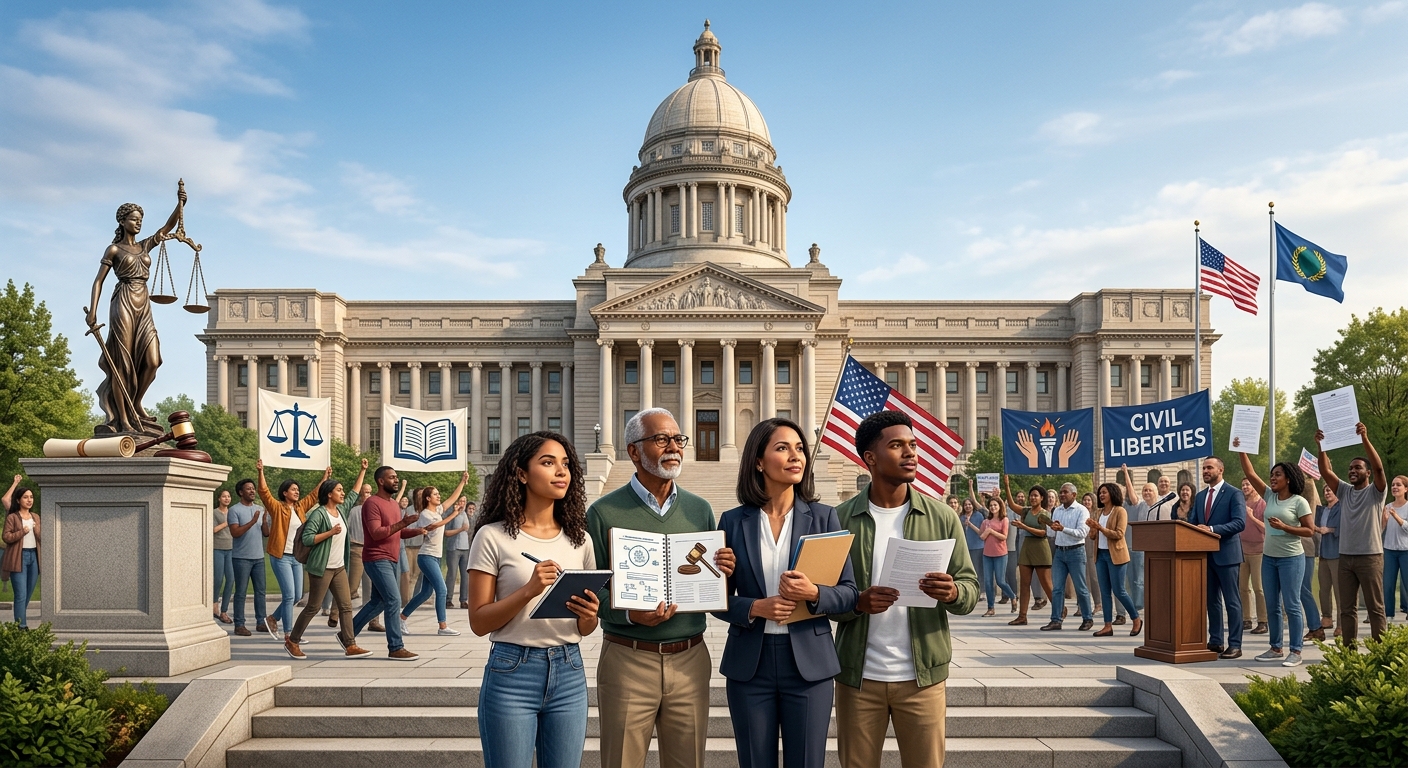
When Americans tune into the evening news, the political conversations dominating the airwaves are almost exclusively centered on the federal government. Presidential executive orders, congressional gridlock, and Supreme Court rulings capture the nation’s attention, making it incredibly easy to forget where the most consequential policy decisions are actually taking place. The reality is that the vast majority of laws impacting your everyday life—from the quality of your local schools to the fundamental protections of your civil liberties—are drafted, debated, and passed within your state legislature.
State politics rarely generate the same sensational headlines as national politics, yet they wield an astonishing amount of power over your constitutional rights. Whether it is determining how easily you can cast a ballot, deciding what medical procedures are legally accessible, or regulating the parameters of free speech in public institutions, state lawmakers are the primary architects of your community’s legal landscape. Recognizing this dynamic is the first step toward reclaiming your political agency. By understanding how state governments function, identifying the key officials who manage the electoral process, and learning how to effectively engage with your local representatives, you can transition from a passive observer of politics into an active defender of civil rights.
Understanding the Machinery of State Government
To effectively influence the policies that govern your community, you must first understand the architectural framework of state-level government. While the United States Congress serves as the federal legislative model, state legislatures operate with their own unique rules, traditions, and structures. The primary responsibility of any elected state lawmaker is to represent the distinct interests of the constituents within their specific geographic district, translating the needs of their community into actionable public policy.
In the overwhelming majority of the country, state legislatures operate under a bicameral system. This means the legislative branch is divided into two distinct chambers, typically a House of Representatives (or State Assembly) and a State Senate. In a bicameral system, a proposed bill must pass through both chambers—often undergoing significant revisions and committee reviews in each—before it can be sent to the governor’s desk to be signed into law. This dual-chamber design is intended to provide a system of checks and balances within the legislative branch itself, ensuring that proposed laws are thoroughly vetted and broadly supported.
However, there is one fascinating exception to this rule. The state of Nebraska operates the nation’s only unicameral legislature. Championed in the 1930s by U.S. Senator George Norris, Nebraska’s system consists of a single legislative chamber. Proponents of the unicameral model argue that it reduces political gridlock, increases transparency, and saves taxpayer money by eliminating the redundant processes associated with navigating two separate legislative bodies.
Full-Time, Part-Time, and Hybrid Lawmakers
Unlike the United States Congress, which functions as a full-time professional body, state legislatures are far from uniform when it comes to operational schedules and lawmaker compensation. The National Conference of State Legislatures (NCSL) broadly categorizes state legislative bodies into three distinct types: full-time, part-time, and hybrid systems. Understanding which system your state utilizes is crucial for knowing when and how to lobby your representatives.
In full-time legislatures—often found in highly populated states like California, New York, and Pennsylvania—lawmakers meet for most of the year, are paid a living wage, and are supported by extensive staffs. Because legislating is their primary career, these representatives have the capacity to introduce and analyze thousands of complex bills over a prolonged legislative session. Conversely, part-time legislatures typically convene for only a few months, or even just a few weeks, out of the year. Lawmakers in these states receive minimal compensation and almost always maintain separate, private-sector careers. Hybrid systems represent a middle ground, where lawmakers spend roughly two-thirds of a full-time equivalent job on legislative duties.
| Legislature Type | Time Commitment | Compensation & Staffing | Typical State Profile |
|---|---|---|---|
| Full-Time (Green) | 80% or more of a full-time job | High pay; extensive legislative staff | Large population (e.g., CA, NY, MI) |
| Hybrid (Gray) | Roughly 66% of a full-time job | Moderate pay; intermediate staffing | Medium population (e.g., TX, VA, CO) |
| Part-Time (Gold) | 50% or less of a full-time job | Low pay; minimal to no personal staff | Smaller population (e.g., ND, WY, NH) |
The pacing of these sessions dramatically impacts citizen advocacy. If you live in a state with a short, part-time legislative session, bills can be introduced, debated, and passed at breakneck speed. Advocates must be highly organized and ready to mobilize at a moment’s notice, as the window to testify against a bill that threatens civil liberties may only remain open for a matter of days.
Who Oversees Your Right to Vote? The Key Election Officials
Of all the civil liberties managed at the state level, perhaps none is more foundational than the right to vote. The administration of elections in the United States is highly decentralized, meaning that the rules governing how, when, and where you can cast your ballot are dictated by state law, not federal mandate. Consequently, the individuals who oversee this process wield tremendous influence over the accessibility and integrity of democracy.
In 40 out of the 50 states, the Chief Election Official is the Secretary of State. This constitutional officer is usually elected directly by the voters, though in a few states, they are appointed by the governor or the legislature. The Secretary of State is responsible for a wide array of crucial democratic functions. They maintain the state’s official voter registration database, certify the security and functionality of electronic voting machines, oversee the design and distribution of ballots, and provide the final certification of election results.
When state legislatures pass new voting laws—such as requiring specific forms of photo identification, altering the deadlines for mail-in ballots, or purging inactive voters from the registration rolls—it is the Secretary of State’s office that is tasked with implementing these directives. Because their administrative decisions can make it easier or harder for marginalized communities to vote, paying attention to the policies of your state’s chief election official is an essential component of protecting your civil liberties.
The Frontlines of Civil Liberties: How State Laws Impact You
The abstract concept of “state legislation” becomes deeply personal when you examine the specific policy areas that state lawmakers control. Federal courts may establish the baseline of constitutional rights, but state legislatures define the practical boundaries of those rights in your daily life. Currently, state capitols are the primary battlegrounds for several critical civil liberties issues.
- Voting Rights and Ballot Access: State legislatures dictate the mechanics of democracy. While some states have actively expanded voter access by implementing automatic voter registration, making Election Day a state holiday, and universalizing vote-by-mail, others have taken aggressive steps to restrict it. Legislation that limits the number of ballot drop boxes, strict signature-matching requirements, and the criminalization of providing food and water to voters waiting in line are all drafted and passed by state lawmakers.
- Reproductive Freedom and Bodily Autonomy: Following the shifting landscape of federal jurisprudence regarding reproductive rights, the authority to regulate, protect, or outright ban abortion and related reproductive healthcare has returned entirely to the states. Your zip code now largely determines your legal right to bodily autonomy, making state legislative elections the most critical factor in the fight for reproductive justice.
- Free Speech and Education: The First Amendment is frequently tested at the state level, particularly within the realm of public education. State legislatures are increasingly involved in debates over school curricula, enacting laws that restrict how educators can teach complex historical topics related to race and gender. Furthermore, state laws are being leveraged to dictate the types of books permitted in public school libraries, directly challenging the civil liberty of free expression and access to information.
- Criminal Justice Reform: The vast majority of incarcerated individuals in the United States are held in state prisons, not federal facilities. State lawmakers define mandatory minimum sentences, establish the parameters for cash bail, and decide whether individuals with past felony convictions are permitted to regain their right to vote. Reforming the justice system requires intense lobbying of state representatives.
A Citizen’s Playbook: How to Influence State Legislation
Recognizing the immense power of state government is only the beginning; the next imperative is taking actionable steps to influence that power. Many citizens feel overwhelmed by the legislative process, assuming that lobbying is reserved exclusively for high-paid professionals and massive corporations. However, because state lawmakers represent smaller constituencies than federal politicians, individual voters and grassroots coalitions can have a surprisingly profound impact on the outcome of state legislation.
The first step in your advocacy journey is identifying your elected representatives. Every citizen is represented by a State Representative (or Assemblyperson) and a State Senator. Utilize your state legislature’s official website to find their contact information, understand their committee assignments, and review their voting records. Knowing which committees they sit on is particularly valuable, as most bills live or die during the committee review phase.
Once you know who represents you, you must actively track key legislation. State websites provide public databases where you can read the exact text of proposed bills, track their progress through the legislative chambers, and see when public hearings are scheduled. Partnering with reputable civil rights organizations, local advocacy groups, and non-profits is also an excellent strategy, as these entities often provide email alerts and simplified summaries of complex legal jargon.
When a bill threatening civil liberties is introduced, public testimony becomes a powerful tool. State legislatures routinely hold committee hearings where members of the public are invited to speak on the record about proposed laws. Drafting a concise, compelling argument and delivering it in person (or via written submission) puts a human face on abstract policy. It forces lawmakers to directly confront the individuals whose lives will be impacted by their votes.
Finally, the ultimate mechanism for influencing state legislation is consistent participation at the ballot box. While presidential elections draw massive turnout, state legislative races—often held during midterm or off-year elections—suffer from chronic voter apathy. In many state-level districts, elections are decided by a margin of just a few hundred votes. By researching down-ballot candidates, organizing voter registration drives in your community, and holding elected officials accountable to their campaign promises, you ensure that the legislature remains responsive to the will of the people.
Frequently Asked Questions (FAQs)
What exactly is a legislative session?
A legislative session is the official period during which a state’s legislature is convened to draft, debate, and pass laws. Depending on whether the state has a full-time or part-time legislature, this period can last anywhere from a few weeks to nearly the entire calendar year. Some governors also have the power to call “special sessions” to address urgent crises outside the normal schedule.
How does a state bill actually become a law?
While the specifics vary by state, the general process involves a lawmaker introducing a bill, which is then assigned to a relevant committee for review and public testimony. If it passes the committee, it is debated and voted on by the full chamber. If successful, it moves to the second chamber (in a bicameral system) to repeat the process. Finally, if both chambers agree on the exact text, the bill is sent to the state governor, who can either sign it into law or veto it.
Can local city or county laws override state legislation?
Generally, no. Under a legal doctrine known as “preemption,” state law supersedes local municipal ordinances. If a city passes a law that directly conflicts with a mandate passed by the state legislature, the state law takes precedence. State legislatures sometimes use preemption laws specifically to block progressive policies enacted by individual cities, such as local minimum wage increases or environmental regulations.
When are state legislative elections usually held?
The vast majority of states hold their general elections for state legislative seats in November of even-numbered years, aligning with federal congressional midterm and presidential elections. However, a handful of states—such as Virginia, New Jersey, Mississippi, and Louisiana—hold their state elections in odd-numbered years, which are often referred to as “off-year” elections.
Conclusion
Safeguarding civil liberties is not an endeavor that can be outsourced entirely to federal courts or national politicians. The rules that govern the most intimate and fundamental aspects of your life are being written right now in your state capitol. By taking the time to understand the legislative machinery, tracking the officials who oversee your elections, and committing to active, informed participation in local politics, you ensure that your voice is heard. Democracy is not a spectator sport; it requires constant vigilance, education, and the willingness to stand up and play your part in the legislative process.
References
- For Many, Legislative Work Is More Than a Nine-to-Five Job — National Conference of State Legislatures. 2025-04-08. https://www.ncsl.org/about-state-legislatures/for-many-legislative-work-is-more-than-a-nine-to-five-job
- Legislative Branch — Nebraska.gov. 2016-05-18. (Used to provide historical and structural context for the nation’s only unicameral legislature). https://www.nebraska.gov/government/legislative-branch/
- NASS Emphasizes Importance of Election Integrity — National Association of Secretaries of State. 2020-09-29. https://www.nass.org/node/1915
- State Voting Laws Roundup — Brennan Center for Justice. 2025-10-21. https://www.brennancenter.org/our-work/research-reports/state-voting-laws-roundup-october-2025
Similar Articles








Read full bio of Sneha Tete


