
Indoor Heat Hazards: Employer Responsibilities
Understanding workplace heat risks indoors and legal obligations for employer compliance.
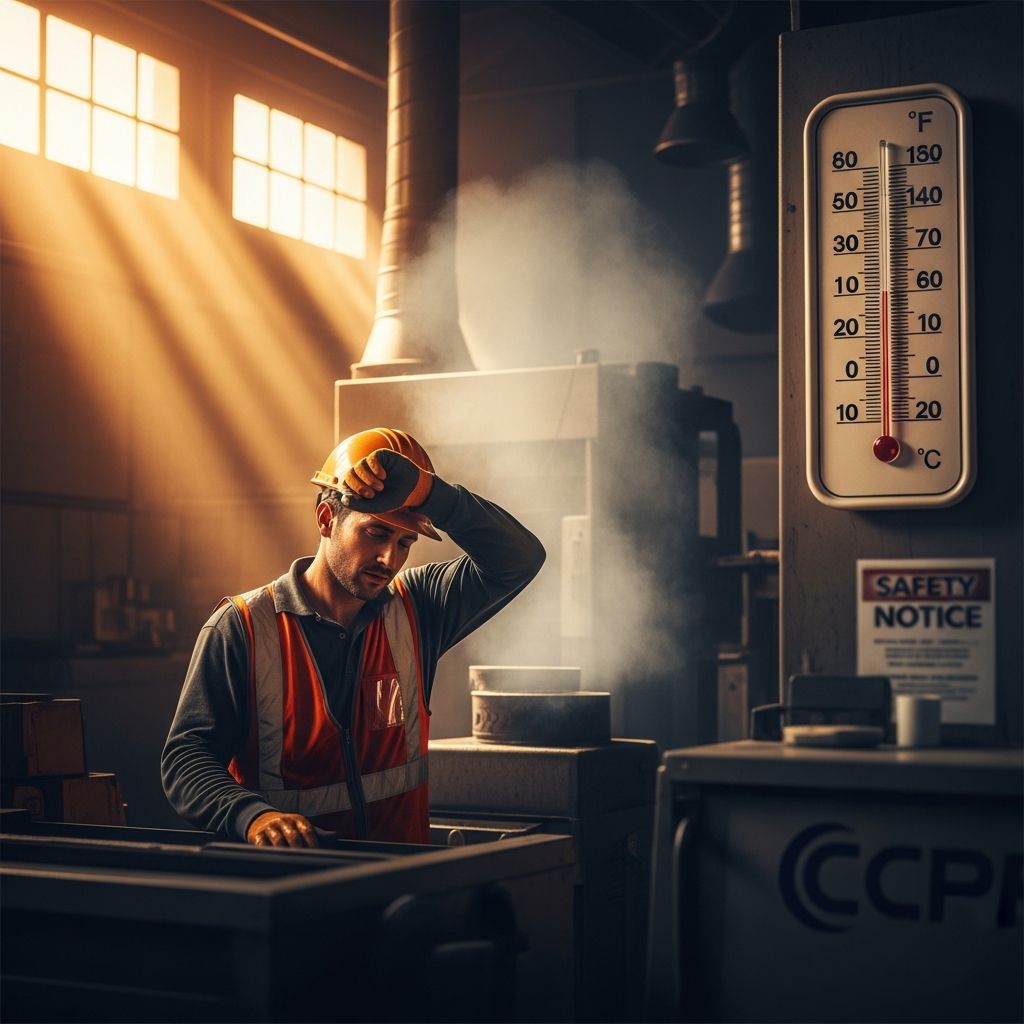
Recognizing Indoor Heat Risks: Beyond Outdoor Summer Heat
When most people think about workplace heat hazards, they typically envision construction workers laboring under the blazing sun or agricultural employees toiling in open fields. However, dangerous heat conditions exist in many indoor work environments that employers and workers often overlook. Manufacturing facilities with furnaces, bakeries with industrial ovens, kitchens, laundries, foundries, and data centers can all reach temperatures that rival or exceed outdoor summer conditions. The challenge with indoor heat hazards is that they persist year-round, making them a chronic rather than seasonal concern for affected workers.
Indoor heat hazards are particularly insidious because they lack the environmental cues that outdoor workers recognize. There is no breeze to signal cooling, no changing sky to indicate weather patterns, and no visible sun to warn of intensity. Workers in these environments may not perceive the danger until heat-related symptoms have already begun to manifest. This makes employer awareness and proactive intervention essential for worker safety.
The Legal Landscape of Heat-Related Illness Prevention
Employers face increasing legal scrutiny regarding heat-related workplace injuries. The Occupational Safety and Health Administration (OSHA) has established that employers have a general duty to provide safe working conditions. This encompasses protection from heat stress, whether occurring indoors or outdoors. Many states have gone beyond federal guidelines to establish specific heat illness prevention standards applicable to both outdoor and indoor workplaces.
California’s pioneering heat illness prevention standard, for example, applies to most indoor workplaces where temperatures reach 82°F. This recognition reflects growing legal recognition that indoor heat can be equally dangerous as outdoor exposure. Other states including Oregon and Washington have similarly incorporated heat safety requirements into their occupational safety standards. Employers operating in multiple jurisdictions must be aware that regulatory requirements vary significantly, and compliance requires understanding both federal OSHA standards and applicable state regulations.
Understanding Heat-Related Illnesses and Their Consequences
Heat-related illnesses progress along a spectrum of severity, from uncomfortable but manageable conditions to life-threatening emergencies. Heat exhaustion, characterized by heavy sweating, weakness, dizziness, and nausea, represents an intermediate stage where intervention can prevent progression to more serious conditions. Heat stroke, the most severe form, occurs when the body’s core temperature rises above 104°F and can result in organ failure, loss of consciousness, permanent disability, or death.
Beyond the immediate health consequences, heat-related illnesses create significant liability exposure for employers. Workers who suffer heat-related injuries may file workers’ compensation claims, exposing employers to increased insurance premiums and administrative costs. Additionally, workers injured due to inadequate heat protection measures may pursue negligence claims, and regulatory agencies may assess substantial fines for non-compliance with heat safety standards. This combination of health risks and financial exposure makes heat illness prevention an essential business priority.
Developing Comprehensive Heat Illness Prevention Plans
Federal guidelines and state regulations increasingly require employers to implement written Heat Illness and Injury Prevention Plans (HIIPP). These documents should be site-specific, addressing the particular heat challenges present in each workplace rather than generic templates. An effective HIIPP includes several foundational components:
- A detailed hazard assessment identifying all areas, work processes, and conditions that generate elevated temperatures
- Procedures for monitoring heat levels using appropriate measurement tools, particularly the Wet Bulb Globe Temperature (WBGT) index, which accounts for temperature, humidity, solar radiation, and air movement
- Defined trigger points and corresponding control measures based on heat index readings or WBGT values
- Requirements for mandatory rest breaks, hydration, and access to cooling areas
- Acclimatization protocols for new employees and workers returning from extended absences
- Emergency response procedures for suspected heat illness cases
- Training requirements for supervisors and employees
The plan should establish clear escalating responses as heat levels increase. At initial heat triggers, employers must ensure access to cool water (at least one quart per employee per hour), shaded outdoor break areas or air-conditioned spaces, and acclimatization programs for new workers. As heat intensifies, additional measures may include mandatory rest periods, work schedule modifications, and relocation of tasks to cooler environments.
Implementing Effective Control Measures
Engineering Controls and Environmental Modifications
The most effective approach to managing indoor heat hazards involves eliminating or reducing the heat source before workers are exposed. Engineering controls may include installing or upgrading ventilation systems, adding air conditioning capacity, implementing radiant heat barriers, or rearranging work processes to reduce exposure. For workplaces where the air temperature drops below skin temperature (approximately 35°C), cooling fans can provide relief by promoting evaporative cooling. In humid environments, dehumidification systems may be necessary to allow sweat evaporation, which is the body’s primary cooling mechanism.
Administrative Modifications and Work Schedule Adjustments
When engineering solutions are impractical or insufficient, administrative controls become critical. Adjusting work schedules to shift physically demanding tasks to cooler times of day significantly reduces heat exposure. Early morning or evening shifts may involve substantially lower temperatures than midday operations. Reducing workload intensity on particularly hot days, rotating workers between hot and cooler areas, and postponing non-urgent strenuous activities can all contribute to heat stress reduction.
Mandatory Rest and Recovery Periods
Strategic rest breaks provide essential recovery time for the body to cool. Maryland occupational safety guidelines establish specific rest requirements based on heat index levels: a minimum of 10 minutes every 2 hours when the heat index is 90-99°F, increasing to 15 minutes every hour when exceeding 100°F. These breaks must occur in designated cooling areas with adequate shade, air conditioning, or sufficient air movement to allow meaningful temperature reduction. Rest periods should be paid, as they are required for worker safety rather than optional recuperation.
Hydration, Acclimatization, and Personal Protective Measures
Water Intake and Electrolyte Management
Proper hydration forms the foundation of heat illness prevention. Workers should consume cool water continuously throughout their shift, consuming approximately one cup every 20 minutes regardless of thirst sensation. This amounts to the minimum one quart per hour recommended by OSHA. For extended work periods or particularly strenuous activity, workers should supplement water intake with beverages containing electrolytes to replace sodium and potassium lost through perspiration. Conversely, energy drinks high in sugar and caffeinated beverages that promote diuresis should be avoided, as they accelerate dehydration.
Heat Acclimatization Programming
Workers new to hot environments or those returning from extended breaks require structured acclimatization periods, typically spanning two to three weeks, to develop physiological adaptation to heat exposure. During initial days, the “20% rule” provides valuable guidance: on the first day, workers should perform no more than 20% of their normal shift duration at full intensity in the heat, with daily increases of approximately 20% until full acclimation is achieved. This gradual approach allows the body to develop improved cardiovascular stability, enhanced sweat response, and better heat distribution, significantly reducing heat illness risk.
Personal Protective Equipment and Cooling Devices
While not substitutes for primary control measures, specialized cooling devices can supplement heat protection strategies. Cooling vests designed to circulate cold fluid or contain phase-change materials can moderate core body temperature during high heat exposure. Evaporative cooling towels, when wet and applied to the neck and wrists where major blood vessels are close to the surface, provide localized cooling. Personal protective equipment such as light-colored, loose-fitting, breathable clothing allows greater evaporative cooling compared to heavy or dark garments. Workers should wear protective hats and replace damp or soiled clothing that reduces breathability.
Monitoring, Assessment, and Continuous Improvement
Effective heat illness prevention requires ongoing monitoring and adjustment based on actual workplace conditions. Temperature measurement should be conducted at representative locations throughout work zones using WBGT meters, which provide more accurate assessment of thermal stress than simple temperature readings. WBGT accounts for direct solar radiation, humidity, air movement, and convective heat, creating a comprehensive thermal index more closely correlated with human physiological responses.
Employers should establish systems for receiving real-time weather updates and heat advisories relevant to their geographic location. When forecasts indicate extreme heat conditions, advance planning allows schedule modifications or preventive work arrangement changes. Supervisors and workers should use buddy systems to monitor colleagues for early signs of heat stress, including excessive fatigue, difficulty concentrating, reduced sweating despite high temperatures, or behavioral changes.
Regular review of heat illness prevention efforts provides opportunities for refinement and improvement. Tracking heat-related near-misses and illnesses identifies patterns indicating control measure inadequacy. Worker feedback regarding the adequacy of rest areas, water availability, and cooling measures should be systematically gathered and incorporated into plan revisions. Documentation of monitoring activities, control measures, and training creates both a safety record and evidence of good faith compliance efforts.
Emergency Response and Medical Management
Despite prevention efforts, heat-related illnesses may still occur. Employers must establish emergency response protocols including clear communication procedures, immediate cooling measures, and access to emergency medical services. When heat illness is suspected, the affected worker should be moved immediately to a shaded, cool area and outer clothing removed. The worker’s skin should be wetted and air movement enhanced to promote evaporative cooling while emergency medical services are contacted.
All supervisory personnel and designated first responders should receive training in recognizing heat illness symptoms and providing appropriate initial response. This training ensures that intervention occurs before minor cases progress to medical emergencies. Documentation of all heat-related incidents and medical treatments provides essential records for regulatory compliance and identifies recurrent problems requiring additional control measures.
Training Requirements and Employee Awareness
Comprehensive training programs ensure that workers and supervisors understand heat hazards, recognition of heat illness symptoms, and appropriate protective measures. Training should address individual variation in heat tolerance, as factors including age, fitness level, body composition, medical conditions, and certain medications affect heat vulnerability. Workers should understand why acclimatization is necessary, how to recognize early warning signs of heat stress in themselves and colleagues, and how to access cooling resources during work shifts.
Supervisory training must emphasize monitoring responsibilities, appropriate work pace adjustments during heat events, and decision-making regarding work schedule modifications. Refresher training at the beginning of hot seasons and for new employees ensures sustained awareness and compliance with heat safety protocols.
Frequently Asked Questions
Q: Which indoor workplaces are most at risk for heat hazards?
A: Facilities generating significant internal heat sources pose the greatest risk, including bakeries, kitchens, foundries, manufacturing plants with furnaces, laundries with large dryers, data centers with extensive server equipment, and any industrial facility with heat-generating machinery. Even workplaces without intentional heat sources can develop dangerous conditions if ventilation is inadequate during extreme outdoor temperatures.
Q: What is the significance of the WBGT index in heat safety?
A: The Wet Bulb Globe Temperature index provides a comprehensive thermal stress measurement that incorporates temperature, humidity, solar radiation, and air movement into a single value. This metric more accurately reflects the actual heat stress experienced by workers compared to ambient temperature alone, enabling more appropriate trigger points for control measures.
Q: How long does acclimatization typically require?
A: Physiological acclimatization to hot environments generally requires two to three weeks of gradual exposure and exertion. The 20% rule provides a practical framework, with workers increasing daily exposure duration by approximately 20% until they can safely perform full work intensity in the heat.
Q: Can employers require employees to work through heat illness symptoms?
A: No. Employers have a legal obligation to remove workers showing heat illness symptoms and provide appropriate medical evaluation and treatment. Continuing work with heat-related symptoms increases injury severity risk and creates significant liability exposure for employers.
Q: What documentation should employers maintain for heat safety compliance?
A: Documentation should include the written Heat Illness Prevention Plan, records of WBGT monitoring and heat index readings, training completion records, descriptions of control measures implemented, incident reports for heat-related illnesses or near-misses, and evidence of plan reviews and updates.
References
- OSHA Heat Safety Rules for Outdoor Workers: 2025 Guide — Perry Weather. 2025. https://perryweather.com/resources/osha-heat-safety-rules/
- Heat Stress Awareness Guide — Occupational Health and Safety of Ontario (OHCOW). https://www.ohcow.on.ca/
- Heat Stress Prevention in the Workplace — AlertMedia. https://www.alertmedia.com/blog/heat-stress-prevention/
- Heat Stress Prevention Tips — Maryland Occupational Safety and Health (MOSH). https://labor.maryland.gov/labor/mosh/moshheatstress.shtml
- Heat Stress — Environmental Health and Safety, Iowa State University. https://www.ehs.iastate.edu/heat-stress
- Prevent Heat Illness at Work — WorkSafeBC. https://heathealth.info/
- Heat Stress Guide — Occupational Safety and Health Administration (OSHA). https://www.osha.gov/emergency-preparedness/guides/heat-stress
- Cal/OSHA Heat Illness Prevention Guidance and Resources — California Department of Industrial Relations. https://www.dir.ca.gov/dosh/heatillnessinfo.html
Similar Articles








Read full bio of medha deb




