
Indigenous Students’ Fight for Graduation Regalia Rights
Exploring the legal battle for Indigenous graduation rights.
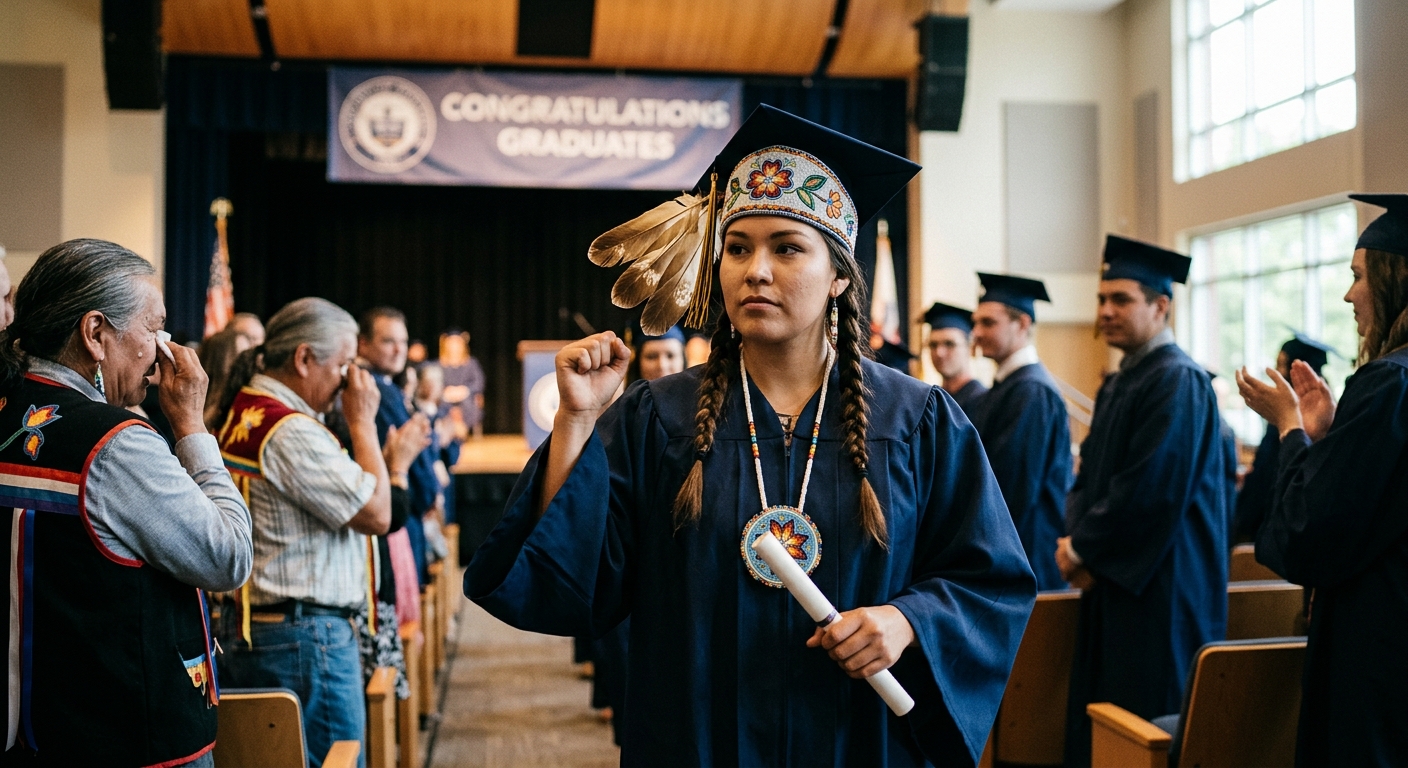
Graduation ceremonies stand as a universally recognized milestone in the educational journey of any young adult. For families across the United States, watching a student walk across the stage to receive a diploma represents the culmination of years of hard work, perseverance, and community support. It is a moment of profound celebration. However, for many Native American and Indigenous students, this joyous occasion is frequently clouded by restrictive administrative policies. Across the country, a pervasive conflict exists between traditional high school graduation dress codes—which typically demand strict uniformity through standard caps and gowns—and the deeply rooted cultural and religious traditions of Indigenous communities. For Indigenous youth, incorporating tribal regalia into their graduation attire is not a rebellious act of defying school rules, nor is it a simple fashion statement. Items such as eagle feathers, intricately beaded caps, traditional moccasins, and woven stoles are profound expressions of spiritual identity and cultural survival. Yet, year after year, some school districts refuse to allow these items, citing policies that prohibit unauthorized adornments. This ongoing clash forces Native students into an agonizing dilemma: conform to a westernized standard of uniformity and suppress their heritage, or risk disciplinary action.
The Deep Spiritual and Cultural Significance of Tribal Regalia
To understand the gravity of the graduation dress code debate, one must first recognize that tribal regalia holds a sacred place in Native American cultures. These items are intrinsically linked to religious practices, community honor, and ancestral heritage.
The Sacred Nature of Eagle Feathers
Among the most contested items at graduation ceremonies is the eagle feather. Within many of the federally recognized tribes in the United States, both bald and golden eagles are highly revered, viewed as sacred messengers between the physical world and the Creator. Eagle feathers are not simply handed out; they are earned. They are bestowed upon individuals by tribal elders or community leaders to mark significant life accomplishments, extraordinary displays of character, or the transition into adulthood. When a Native student receives an eagle feather in honor of their high school graduation, it symbolizes strength, courage, wisdom, and the collective prayers of their community. Wearing this feather during commencement is akin to carrying one’s ancestors across the stage. Denying a student the right to wear it is often compared to forbidding a Christian student from wearing a cross or a Jewish student from wearing a yarmulke.
Beadwork, Stoles, and Traditional Garments
Beyond eagle feathers, many Indigenous graduates seek to wear beadwork on their mortarboards or drape traditional stoles over their gowns. Beaded graduation caps often feature specific tribal motifs, clan symbols, or family colors, each requiring hours of meticulous, hand-crafted labor by relatives. Traditional woven stoles, ribbon skirts, and moccasins also serve to ground the student in their cultural identity during a major life transition. These garments celebrate resilience. They are visual testaments to the fact that Indigenous cultures remain vibrant and alive, despite centuries of systemic efforts to eradicate them through forced assimilation.
The Shadow of Historical Assimilation
The current disputes over graduation attire cannot be fully understood without acknowledging the painful history of educational policies aimed at Native American communities. For over a century, the United States government funded and operated Indian boarding schools, which were explicitly designed to assimilate Indigenous children into Euro-American culture. The underlying philosophy of these institutions was to erase Native identity. In these boarding schools, Native children were stripped of their traditional clothing, forced to cut their long hair, and severely punished for speaking their native languages or practicing their indigenous religions. Education was weaponized as a tool of cultural erasure. When modern school administrators enforce rigid dress codes that forbid tribal regalia, it inadvertently echoes this dark legacy. For Native families, a school policy that demands cultural suppression in exchange for academic recognition is not merely a bureaucratic inconvenience; it is a painful reminder of historical trauma. Allowing regalia, conversely, is a vital act of healing.
The Harm of Strict Conformity in Modern Dress Codes
School administrators who defend strict graduation dress codes typically argue that uniformity promotes a sense of equality and unity among the graduating class. They contend that allowing any deviations from the standard cap and gown will open a Pandora’s box, leading to a chaotic ceremony filled with distracting, secular adornments. This argument, however, rests on a flawed equivalence between cultural or religious artifacts and casual, secular accessories. When schools fail to distinguish between a commercially purchased novelty decoration and a religiously significant tribal heirloom, they marginalize their Indigenous students. The insistence on visual conformity inherently privileges the dominant culture’s norms while alienating minority students. The psychological toll on an Indigenous youth who is forced to remove an eagle feather prior to walking across the stage is profound. It sends a clear institutional message that their heritage is inappropriate for public, formal celebration. This forced conformity undermines the concept of an inclusive educational environment.
The Legal Landscape: Free Expression and Religious Liberty
When students face administrative resistance, they frequently turn to constitutional and civil rights frameworks for protection. The legal battle over tribal regalia at graduation intersects with several key areas of American law.
First Amendment Protections
The First Amendment of the U.S. Constitution guarantees the right to free speech and the free exercise of religion. Advocates for Indigenous youth argue that wearing tribal regalia constitutes both protected symbolic speech and the free exercise of religion. However, courts have historically granted school districts broad discretion in managing the specific decorum of graduation ceremonies. Because a graduation ceremony is considered a school-sponsored event, districts often claim that regulating attire is necessary to maintain order. This creates a challenging legal gray area for students trying to assert their constitutional rights in a timely manner before graduation day.
Title VI of the Civil Rights Act of 1964
Another critical legal avenue is Title VI of the Civil Rights Act of 1964, which prohibits discrimination on the basis of race, color, or national origin in any program or activity receiving federal financial assistance. Since virtually all public school districts receive federal funding, they are bound by Title VI. If a school allows some forms of secular adornment—such as honor cords, academic stoles, or floral leis—but bans tribal regalia, this disproportionate impact can be interpreted as national origin or racial discrimination. The U.S. Department of Education’s Office for Civil Rights enforces these protections, and families have increasingly used complaints to compel school districts to update discriminatory policies.
State-by-State Legislative Protections
Recognizing the limitations of relying solely on federal statutes—and the heavy burden that litigation places on individual students and their families—several state legislatures have proactively intervened. By passing explicit laws guaranteeing the right of Native American students to wear tribal regalia, these states have removed the ambiguity and subjectivity from local school administrators. These legislative victories are the result of grassroots organizing by Native American advocacy groups and tribal leaders.
| State | Relevant Legislation | Key Provisions |
|---|---|---|
| California | Assembly Bill 1248 (Education Code § 35183.1) | Allows students to wear traditional tribal regalia or recognized objects of religious/cultural significance at graduation. |
| Colorado | Senate Bill 23-202 | Requires public schools and higher education institutions to permit students to wear traditional Native American regalia. |
| Illinois | Senate Bill 1446 | Prohibits public schools from banning students from wearing items of cultural or religious significance as graduation attire. |
| Wisconsin | Wisconsin Act 222 | Affirms the right of eligible Native American students to wear traditional tribal regalia at school events. |
How School Districts Can Evolve and Foster Inclusion
Rather than waiting for state mandates or civil rights lawsuits, proactive school districts can take immediate steps to update their policies and foster a genuinely inclusive environment.
- Collaborate with Local Tribes: School boards should actively consult with local tribal leaders, cultural experts, and Native American parent advisory committees when drafting dress code policies. This ensures rules are informed by actual cultural practices.
- Update Student Handbooks: Districts should explicitly revise their student handbooks and graduation guidelines to create clear, accessible exemptions for religious and cultural items, preventing last-minute conflicts.
- Educate Staff and Faculty: Professional development is essential. Administrators must be educated on the history of Native American education and the ongoing trauma of forced assimilation.
- Differentiate Between Culture and Pop Culture: Administrators must develop the capacity to distinguish between a student requesting to wear a culturally profound eagle plume and a student requesting a secular adornment.
Empowering Students and Families: A Guide to Advocacy
For Indigenous students approaching graduation, navigating a restrictive dress code requires early preparation and self-advocacy. If a school handbook expressly forbids adornments, students should initiate a dialogue with their principal or district superintendent months in advance. Providing educational materials—such as guidance documents published by prominent Native American legal organizations like the Native American Rights Fund—can help contextualize the request and transform it from a disciplinary issue into a civil rights discussion. If a request is initially denied, families should utilize the district’s formal grievance process and appeal the decision to the school board. Connecting with tribal councils and civil rights attorneys can apply the necessary pressure to overturn discriminatory decisions.
Frequently Asked Questions (FAQs)
Why is an eagle feather considered so important for Native American graduates?
In many Native American cultures, eagles are considered deeply spiritual creatures that serve as messengers to the Creator. An eagle feather is given to an individual by a community leader or elder to honor significant life transitions, achievements, and demonstrations of maturity. Wearing it at graduation honors both the student’s hard work and the support of their ancestors and community.
Does Title VI of the Civil Rights Act guarantee the right to wear tribal regalia?
Title VI prohibits discrimination based on race, color, or national origin in federally funded programs. While it does not specifically mention graduation attire, legal experts argue that banning tribal regalia disproportionately targets Indigenous students based on their national origin, making such bans a potential violation of the Act.
Can private schools ban Native American students from wearing tribal regalia?
Because the First Amendment restricts government action, private schools generally have more leeway to enforce strict uniform policies than public schools. However, if a private school receives federal financial assistance, it is still bound by the anti-discrimination provisions of Title VI of the Civil Rights Act of 1964.
What should a student do if their school prohibits them from wearing cultural items at graduation?
Students should start advocating early. They should formally request an exemption in writing, citing the religious and cultural significance of the item. If denied, they can present state-specific laws (if applicable), appeal to the school board, and reach out to civil rights advocacy groups for legal counsel and support.
Conclusion
High school graduation is a profound rite of passage, marking the transition from childhood into the broader responsibilities of adult life. For Indigenous students, it is an achievement that carries the weight of history and the hopes of their tribal nations. By forcing these students to strip themselves of their sacred symbols, schools enforce an outdated model of assimilation. Embracing tribal regalia does not diminish the dignity of a graduation ceremony; it elevates it. When school districts modernize their policies to respect cultural expression, they uphold the highest ideals of American educational equity, ensuring that every student can cross the stage whole, honored, and seen.
References
- Resources for Students and Schools: Eagle Feathers at Graduation — Native American Rights Fund (NARF). 2026-04-14. https://narf.org/resources/graduation/
- Title VI — U.S. Department of Education (ED). 2024-09-24. https://www.ed.gov/ocr
- Tribal Regalia at Graduation Ceremonies — State of California Department of Justice. 2018. https://oag.ca.gov/nativeamerican/regalia
- SB23-202 Wearing Of Native American Traditional Regalia — Colorado General Assembly. 2023-05-04. https://leg.colorado.gov/bills/sb23-202
Similar Articles








Read full bio of Sneha Tete


