
Honoring Heritage: Indigenous Cultural Expression and School Policies
Exploring the intersection of educational policy, student rights, and Indigenous heritage at graduation ceremonies.
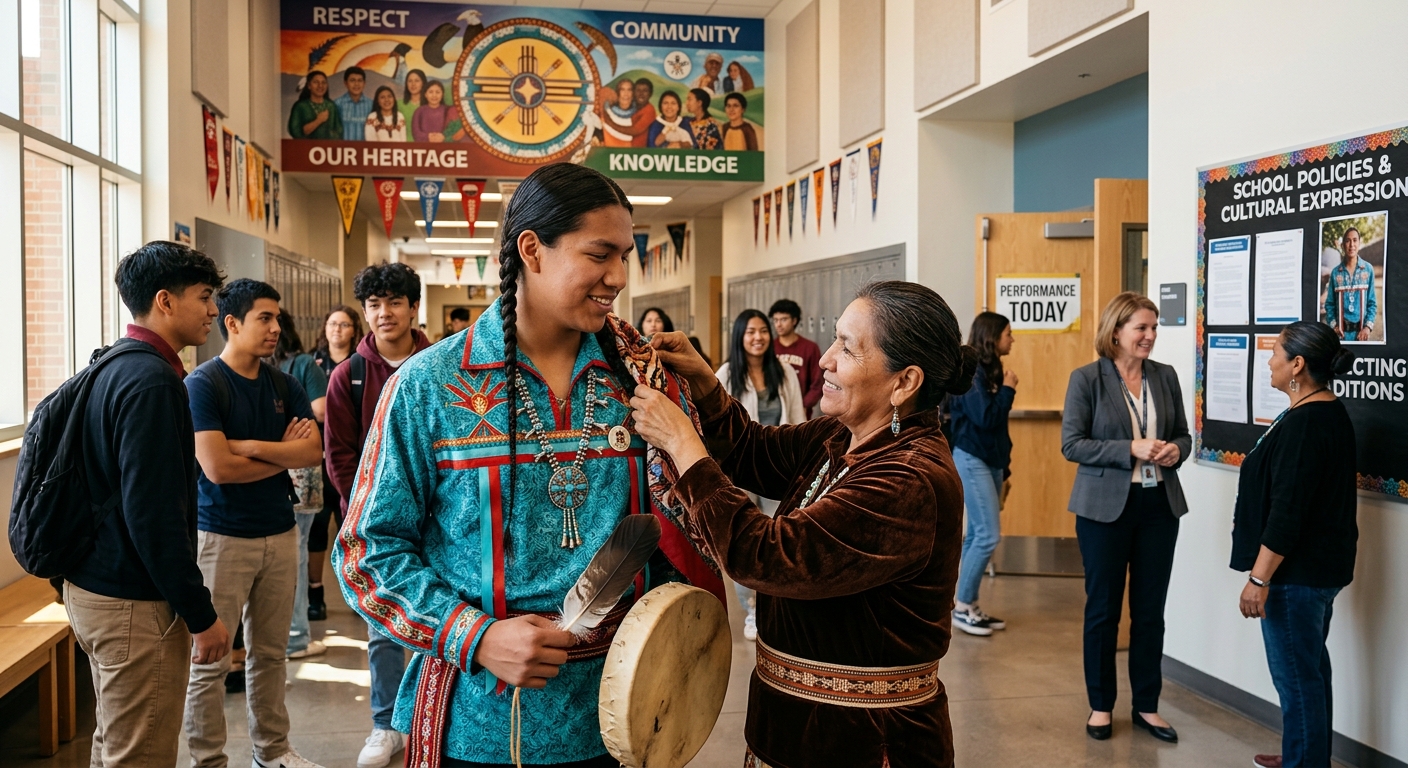
Graduation ceremonies represent a pivotal rite of passage in the American educational system. For most students, the mortarboard cap and flowing gown symbolize the culmination of years of academic dedication and the transition into young adulthood. However, for Indigenous students, this academic milestone frequently intersects with profound cultural and spiritual traditions. The act of graduating is not merely an individual triumph but a collective victory for their families, ancestors, and tribal nations. To honor this momentous occasion, many Native American students are gifted sacred items—such as eagle feathers, intricately beaded caps, woven stoles, or traditional moccasins—to wear during their commencement exercises. Unfortunately, this beautiful convergence of academic achievement and cultural heritage often clashes with rigid, traditional school dress codes, sparking intense debates over student rights, religious freedom, and institutional authority.
As communities nationwide grapple with these issues, a broader conversation has emerged regarding what inclusive education truly looks like. The insistence on uniform graduation attire, rooted in a desire for visual cohesion and institutional decorum, frequently fails to accommodate the pluralistic reality of the modern student body. By examining the cultural significance of traditional garments, the underlying legal precedents, and the shifting legislative landscape, educators and policymakers can better understand how to honor Indigenous heritage while maintaining the dignity of educational milestones.
The Deep Cultural and Spiritual Significance of Traditional Regalia
To fully grasp the stakes of this debate, one must first understand that traditional tribal regalia is not merely decorative. For Native American communities, items like eagle feathers and beadwork hold profound religious, spiritual, and historical significance. The eagle is widely revered among many Indigenous cultures as a sacred messenger to the Creator because it flies higher than any other bird. Being gifted an eagle feather is one of the highest honors an individual can receive, traditionally reserved for moments of exceptional achievement, leadership, or transition—such as graduating from high school or college.
The federal government explicitly recognizes the unique sacredness of the eagle in Indigenous religious practices. Under the Bald and Golden Eagle Protection Act (BGEPA), the possession, use, and transport of eagle parts and feathers are heavily restricted. However, federal law provides specific exemptions allowing enrolled members of federally recognized Native American tribes to obtain and possess these feathers for religious and cultural purposes. This legal framework underscores a vital point: an eagle feather is legally and culturally recognized as a sacred religious item, akin to a cross, a star of David, or an eagle scout badge, but imbued with a unique political and historical weight. When a student places a blessed eagle feather upon their mortarboard, it is an act of prayer, respect, and ancestral connection.
Similarly, beadwork, woven sashes, and traditional moccasins are deeply tied to a student’s specific tribal lineage. The colors, patterns, and techniques used in these items often tell a story of family history, tribal identity, and resilience. Denying a student the right to wear these items is often perceived not just as a violation of a dress code, but as a rejection of their identity and an affront to their community’s traditions.
Legal Landscapes Surrounding Student Expression and Dress Codes
The conflict over tribal regalia at graduation frequently centers on the tension between a school district’s desire to enforce standardized dress codes and a student’s constitutional right to free expression and religious liberty. The bedrock of student speech rights in the United States was established by the Supreme Court in the landmark 1969 case, Tinker v. Des Moines Independent Community School District.
In Tinker, the Court ruled that students do not “shed their constitutional rights to freedom of speech or expression at the schoolhouse gate”. The ruling established the famous “material and substantial disruption” standard: school officials cannot censor student expression unless they can reasonably forecast that the speech will cause a substantial disruption to the educational environment or infringe upon the rights of others.
When applying the Tinker standard to the wearing of tribal regalia, advocates argue that a single eagle feather on a cap or a beaded stole around the shoulders is entirely passive. It does not generate noise, it does not obscure the student’s face, and it does not disrupt the flow of the commencement ceremony. Despite this, many school administrators historically relied on the argument that any deviation from the uniform graduation gown causes a disruption to the “decorum” and aesthetic unity of the event. However, legal scholars and civil rights advocates continually point out that preserving aesthetic uniformity is rarely a sufficiently compelling reason to override a student’s First Amendment rights to religious and cultural expression.
Conflicts at the Crossroads: Institutional Uniformity vs. Individual Rights
The enforcement of strict dress codes at graduation has led to deeply distressing incidents for Indigenous students. In various documented cases across the country, students have been handed ultimatums moments before walking across the stage: remove the sacred item or face exclusion from the ceremony. Such ultimatums force teenagers into an impossible choice between participating in a milestone they have worked over a decade to reach and honoring the sacred traditions of their ancestors.
These confrontations are particularly painful given the historical context of Native American education in the United States. For decades, the federal government and various religious institutions operated boarding schools designed to forcefully assimilate Indigenous children. In these institutions, Native children were stripped of their traditional clothing, punished for speaking their languages, and severed from their cultural practices. When modern educational institutions demand the removal of tribal regalia in the name of “uniformity,” it inadvertently echoes this traumatic history of forced assimilation, sending a message that Indigenous identity is incompatible with academic success.
Evolving State Legislation on Tribal Regalia
Because relying on federal First Amendment litigation can be a slow, costly, and unpredictable process for students and their families, a significant wave of legislative action has emerged at the state level. Recognizing the importance of protecting Indigenous students, several states have passed specific statutes overriding strict district-level dress codes.
For example, the State of Washington enacted RCW 28A.600.500, which explicitly states that school districts and public schools “may not prohibit students who are members of a federally recognized tribe from wearing traditional tribal regalia or objects of Native American cultural significance along with or attached to a gown at graduation ceremonies”. The law further dictates that schools cannot require students to wear a cap if it is incompatible with their traditional regalia.
Other states have followed suit. California, Colorado, and New Mexico have implemented similar legislative measures to ensure that local school boards cannot arbitrarily deny Indigenous students the right to wear culturally significant items. These laws effectively shift the burden away from the student, proactively shielding them from last-minute administrative disputes.
Comparative Overview of Policy Approaches
The approaches taken by different jurisdictions can generally be categorized into three distinct frameworks, as illustrated below:
| Policy Framework | Characteristics | Impact on Students |
|---|---|---|
| Strict Uniformity | No alterations to the cap and gown are permitted. All religious and cultural adornments are banned to preserve visual cohesion. | High risk of cultural suppression. Students may face exclusion from graduation or forced removal of sacred items. |
| Case-by-Case Exemption | Students must apply for a waiver or permission from the principal or school board to wear regalia weeks in advance. | Creates bureaucratic hurdles. Decisions are subjective and can be denied based on individual administrative bias. |
| Statutory Protection | State law explicitly protects the right of Indigenous students to wear regalia, superseding local district bans. | Guarantees cultural expression. Removes anxiety for the student and prevents administrative overreach at ceremonies. |
Pathways to Inclusive Policies in School Districts
While state laws are providing necessary protections in some regions, school districts in states without such legislation must proactively update their policies. Cultivating an inclusive environment requires more than simply avoiding lawsuits; it requires a genuine commitment to celebrating the diverse identities of the student body.
- Implementing Culturally Responsive Guidelines: School boards should review their graduation dress codes months before the spring commencement season. Policies should explicitly define exemptions for religious and cultural artifacts, ensuring that the language is broad enough to cover eagle feathers, beadwork, and other tribal regalia.
- Consulting with Tribal Leaders: Districts that serve Indigenous populations should establish direct lines of communication with local tribal councils or Indigenous education committees. Collaborating with these leaders ensures that school policies respect the specific traditions and nuances of the local Native communities.
- Educating Administrators and Staff: Misunderstandings often arise from a lack of education. School staff, especially those working as marshals or coordinators at graduation, should receive training on the cultural significance of these items so they do not inadvertently disrespect a student’s sacred adornments during the event.
- Streamlining Processes: If a district maintains an approval process for graduation attire, it must be transparent, timely, and accessible. Students should not have to jump through intimidating bureaucratic hoops or face interrogation regarding the validity of their religious beliefs.
The Broader Societal Impact of Recognizing Indigenous Heritage
Ultimately, the movement to protect tribal regalia at graduation is about more than just the garments themselves. It is a fundamental affirmation of Indigenous visibility in contemporary spaces. By allowing Native American students to cross the graduation stage proudly displaying their heritage, schools foster a profound sense of belonging and psychological safety.
Research into the social-emotional well-being of minority students consistently shows that when educational institutions validate their cultural identities, students experience higher self-esteem, better academic outcomes, and a stronger connection to their communities. Furthermore, this visibility educates the broader public. When an audience witnesses a graduate wearing a meticulously beaded stole or an eagle feather, it serves as a powerful, living reminder that Indigenous cultures are not relics of the past, but vibrant, enduring, and celebrated realities of the present.
Educational institutions are uniquely positioned to be environments of healing and progress. By dismantling outdated policies that demand conformity at the expense of cultural dignity, schools can transform graduation ceremonies into true celebrations of every student’s journey, honoring the ancestors who paved the way and the communities that support them.
Frequently Asked Questions (FAQs)
Why is wearing an eagle feather so important to Indigenous graduates?
In many Native American traditions, the eagle is considered a sacred messenger that carries prayers to the Creator. Earning an eagle feather is a distinct honor that signifies bravery, academic achievement, or an important life transition. Wearing it at graduation is a way for the student to honor their family, ancestors, and the Creator while acknowledging the hard work required to reach that milestone.
Can schools legally ban tribal regalia under standard dress codes?
The legality varies heavily by state and district. While schools generally have the right to enforce dress codes, these rules can be challenged if they violate a student’s First Amendment rights to free expression and religious practice. Additionally, an increasing number of states—such as Washington, California, and Colorado—have passed specific laws explicitly forbidding public schools from banning traditional Native American regalia at graduation ceremonies.
How does the Tinker standard apply to graduation dress codes?
The Supreme Court’s 1969 decision in Tinker v. Des Moines established that schools cannot prohibit student expression unless it causes a “material and substantial disruption” to the educational environment. Advocates for Indigenous students argue that wearing an eagle feather, beaded cap, or traditional stole is a passive form of expression that in no way disrupts the functioning or decorum of a graduation ceremony, thereby placing it under First Amendment protection.
What should a student do if their school prohibits their regalia?
Students should first review their local district policies and state laws regarding cultural and religious expression. They can proactively request an accommodation from school administrators, often supplying explanations of the item’s religious significance. If denied, students frequently seek assistance from civil rights organizations, tribal leaders, or legal advocacy groups to help mediate or challenge the district’s policy before the graduation date.
References
- RCW 28A.600.500: Graduation ceremonies—Tribal regalia — Washington State Legislature. 2020-06-11. https://app.leg.wa.gov/RCW/default.aspx?cite=28A.600.500
- Bald and Golden Eagle Protection Act — U.S. Fish & Wildlife Service. 1940-06-08. https://www.fws.gov/law/bald-and-golden-eagle-protection-act
- Facts and Case Summary – Tinker v. Des Moines — United States Courts. 1969-02-24. https://www.uscourts.gov/educational-resources/educational-activities/facts-and-case-summary-tinker-v-des-moines
Similar Articles








Read full bio of medha deb


