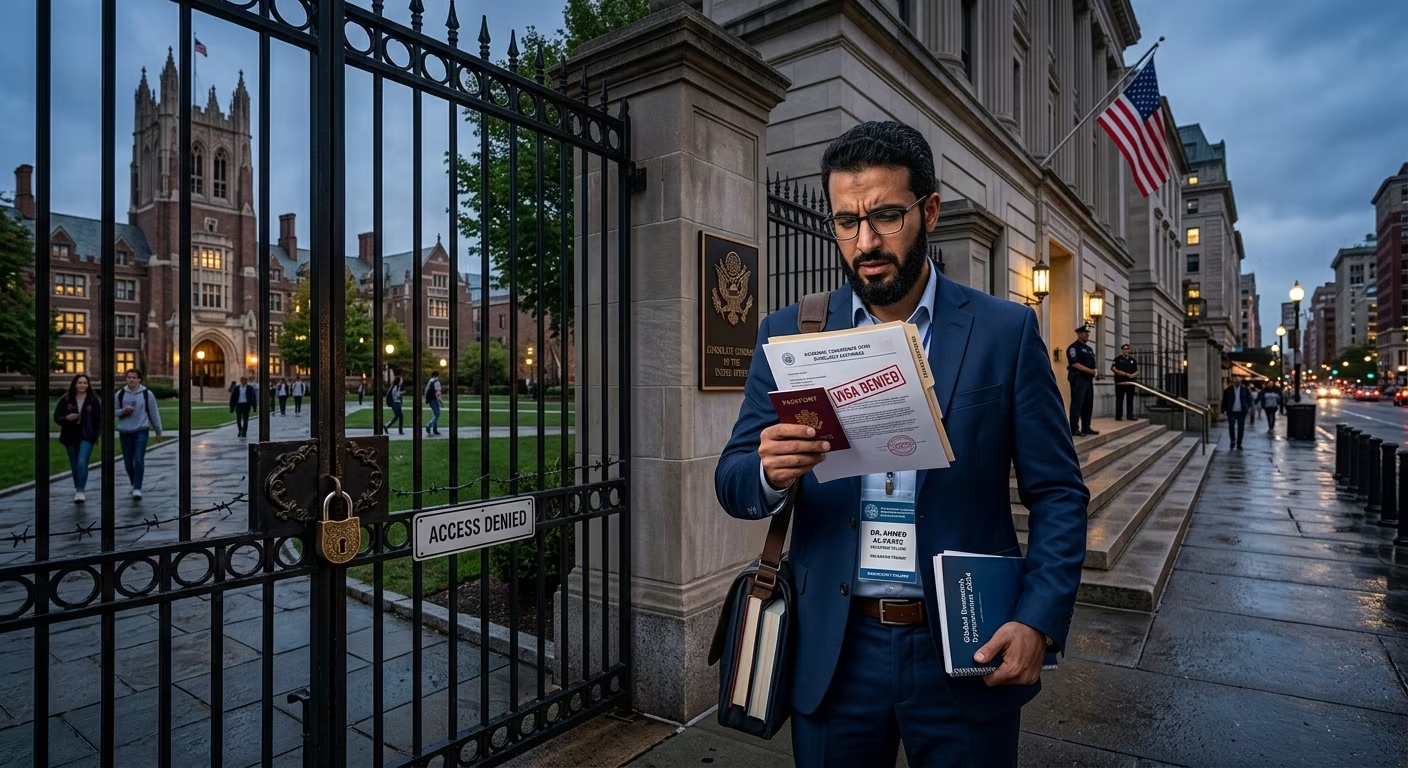
At the intersection of national security, immigration law, and constitutional rights lies a highly contested legal battleground: ideological exclusion. The concept refers to the practice of denying entry to foreign nationals based on their political beliefs, speeches, or associations. While sovereign nations unequivocally possess the authority to regulate their borders, the deployment of ideological tests to bar foreign scholars, writers, and activists from entering the United States raises profound constitutional questions. These questions do not primarily concern the rights of the excluded foreigners—who generally do not enjoy constitutional protections outside U.S. territory—but rather the First Amendment rights of American citizens.
When the government revokes or denies a visa to a prominent international thinker, it inevitably disrupts the flow of intellectual exchange. It creates a barrier between American audiences—comprising students, professors, and civic organizations—and the global marketplace of ideas. This article explores the historical roots of ideological exclusion, the legal doctrines that protect the American public’s right to receive information, and the chilling effect these immigration policies cast over academic freedom within the United States.
Historical Precedents: From the Cold War to the Modern Era
The practice of barring individuals from the United States based on their political ideologies is not a recent phenomenon. Its modern statutory roots can be traced back to the ideological anxieties of the Cold War. The McCarran-Walter Act of 1952, formally known as the Immigration and Nationality Act (INA), originally contained provisions that allowed the government to deny entry to individuals associated with communist or totalitarian organizations. For decades, this legislation was utilized to prevent numerous high-profile intellectuals, authors, and political dissidents from engaging with American audiences.
During the latter half of the 20th century, pressure from civil liberties organizations and academic institutions gradually forced Congress to roll back some of the most overtly ideological provisions of the McCarran-Walter Act. Lawmakers introduced amendments intended to prevent the exclusion of foreigners based on speech or associations that would be constitutionally protected if engaged in by a U.S. citizen within the United States. For a brief period, it appeared that the era of aggressive ideological exclusion was waning, replaced by a more open framework that prioritized the free exchange of global perspectives.
However, the legislative landscape shifted dramatically in the early 21st century. In the aftermath of the September 11 attacks, national security imperatives understandably took center stage. Congress enacted sweeping legislation aimed at securing the homeland, which inadvertently reopened the door to ideological exclusions under the guise of counterterrorism. This shift fundamentally altered how immigration enforcement interacted with academic and intellectual freedom.
The Constitutional Doctrine: The Right to Receive Information
To understand why domestic civil liberties groups care deeply about foreign visa denials, one must examine a critical, yet frequently overlooked, facet of the First Amendment: the “right to hear.” The Supreme Court has long recognized that the protection of free speech encompasses not only the right of the speaker to broadcast their views but also the right of the audience to receive information and ideas.
When the government denies a visa to a foreign scholar slated to speak at an American university, it directly infringes upon the First Amendment rights of the domestic audience that invited them. The American audience is deprived of the opportunity to engage in face-to-face debate, ask questions, and evaluate controversial ideas in real-time. In a democratic society, this restriction on the domestic populace is viewed with deep constitutional suspicion.
Kleindienst v. Mandel and the Bona Fide Standard
The defining legal framework for this tension was established in the landmark 1972 Supreme Court case, Kleindienst v. Mandel. Ernest Mandel, a Belgian Marxist economist and journalist, was invited to speak at several American universities. The U.S. Attorney General denied his visa waiver under the ideological exclusion provisions of the era. American professors sued, arguing their First Amendment rights to hear Mandel were being violated.
The Supreme Court acknowledged that the First Amendment was indeed implicated because the American professors had a protected interest in hearing Mandel’s views. However, the Court ultimately ruled in favor of the government, establishing a deferential standard. The Court held that if the Executive Branch can provide a “facially legitimate and bona fide” reason for denying a visa, the courts will not look behind that decision to weigh the competing First Amendment interests.
This standard has made it notoriously difficult to challenge visa denials in court. As long as the government cites a statutory ground for inadmissibility—even broadly defined ones relating to national security—courts are highly reluctant to intervene. Consequently, the “facially legitimate” standard has served as a powerful shield for the executive branch, allowing it to exercise wide discretion in determining who gets to participate in American academic discourse.
The Patriot Act and the Redefinition of Inadmissibility
The tension between national security and free speech was exacerbated by the passage of the USA PATRIOT Act in 2001. Section 411 of the Act significantly broadened the terrorism-related grounds for inadmissibility under the Immigration and Nationality Act. Crucially, it included provisions that allowed the government to deny entry to individuals who have used their “position of prominence within any country to endorse or espouse terrorist activity.”
While preventing actual terrorists from entering the country is an undisputed priority, civil liberties advocates warned that the “endorse or espouse” language was dangerously vague. It granted consular officers and immigration officials broad latitude to interpret provocative political speech, criticism of U.S. foreign policy, or academic commentary as an endorsement of terrorism.
Because the government is rarely required to produce detailed public evidence when denying a visa under these provisions, scholars and activists have been barred from the United States with little transparency. The lack of a clear, public explanation in such cases prevents both the excluded individual and the American host organizations from effectively challenging the decision, creating a frustrating opacity in the intersection of immigration and speech.
The Institutional Toll on American Universities
The implications of broad ideological exclusion policies are most acutely felt on university campuses. Academic freedom relies heavily on the ability of institutions to invite global experts, regardless of how unpopular or controversial their viewpoints might be. When foreign scholars face sudden visa revocations or unexplained administrative delays, the academic ecosystem suffers.
- Disruption of Conferences and Symposiums: Academic gatherings often require months or years of planning. A last-minute visa denial can derail entire conferences, depriving hundreds of attendees of key insights and research presentations.
- The Chilling Effect on Global Scholarship: International scholars, aware that controversial statements might jeopardize their ability to travel to the United States for collaboration, may engage in self-censorship. This stifles the genuine, unfiltered exchange of ideas that higher education is meant to foster.
- Erosion of Institutional Autonomy: Universities traditionally determine their own academic priorities and guest lists based on intellectual merit. When the government effectively exercises veto power over these invitations via immigration law, it encroaches upon the autonomy of academic institutions.
Furthermore, this dynamic damages the international reputation of the United States as a sanctuary for free expression and academic inquiry. When a democratic society effectively quarantines itself from contentious foreign ideologies, it signals a lack of confidence in its own citizens’ ability to critically evaluate competing ideas.
Analyzing Competing Interests
The debate over ideological exclusion forces society to weigh two compelling, yet often conflicting, sets of values. The table below outlines the core arguments from both the national security and civil liberties perspectives.
| Perspective | Core Arguments and Priorities | Legal/Policy Mechanisms |
|---|---|---|
| National Security & Sovereignty | The state has an absolute right to control its borders. Protecting the homeland from individuals who may incite violence or support hostile actors supersedes intellectual exchange. | USA PATRIOT Act; Broad Executive Discretion; “Facially Legitimate” Standard; Consular Nonreviewability. |
| First Amendment & Academic Freedom | Democracy requires an informed citizenry. U.S. citizens have a constitutional right to hear diverse global perspectives. Viewpoint discrimination by the state is inherently dangerous. | The “Right to Receive Information”; Academic Freedom Principles; Transparency Demands; Civil Litigation. |
The Role of Civil Society in Challenging Exclusions
In the face of expansive executive authority, civil society organizations, academic associations, and legal advocacy groups have assumed the critical role of challenging ideological exclusions. Groups such as the American Association of University Professors (AAUP) and various free speech organizations continuously monitor visa denials that appear to be politically motivated.
Through strategic litigation, these organizations aim to compel the government to provide specific, factual justifications for barring foreign scholars, rather than relying on blanket national security citations. They argue that if an individual truly poses a security threat, the government should be able to present evidence to that effect. If, however, the exclusion is based merely on the scholar’s political writings or criticisms of state policy, these organizations fight to have the visa reinstated, asserting that intellectual disagreement is not a valid ground for inadmissibility.
These legal battles are arduous and face significant procedural hurdles, primarily due to the doctrine of consular nonreviewability—which heavily restricts judicial review of visa decisions made by consular officers abroad. Nonetheless, by bringing these cases into the federal courts and the court of public opinion, civil society forces a public reckoning over the limits of government power regarding intellectual freedom.
Safeguarding the Marketplace of Ideas
A robust democracy does not insulate its citizens from challenging, offensive, or radical ideas; rather, it empowers them to confront and debate those ideas openly. The principle of the “marketplace of ideas” rests on the conviction that truth emerges from the collision of opposing viewpoints, not from government-enforced intellectual quarantine.
Using immigration laws as a backdoor to filter the ideas available to the American public undermines the very foundations of the First Amendment. While border security remains an undeniable necessity, it must be carefully calibrated to ensure that counterterrorism measures do not devolve into tools of ideological censorship. Ensuring that American universities, civic groups, and citizens can freely interact with global scholars—irrespective of their political leanings—is essential for preserving the intellectual vitality and democratic integrity of the United States.
Frequently Asked Questions About Visas and Free Speech
What is the doctrine of consular nonreviewability?
The doctrine of consular nonreviewability is a legal principle that generally prevents U.S. courts from reviewing the decisions of consular officers who deny visas to foreign nationals. Because of this doctrine, it is extremely difficult to challenge a visa denial in court, even when domestic organizations claim the denial violates their First Amendment rights.
Does the First Amendment protect non-citizens?
The U.S. Constitution generally does not protect foreign nationals located entirely outside the United States. However, foreign nationals who are legally present within the U.S. do enjoy substantial First Amendment protections. In the context of ideological exclusion, lawsuits are usually filed on behalf of the U.S. citizens who invited the foreigner, invoking the citizens’ right to hear the speaker.
How did the USA PATRIOT Act affect academic freedom?
The USA PATRIOT Act expanded the definitions of terrorist-related inadmissibility, including barring individuals who use a position of prominence to “endorse or espouse” terrorist activity. Critics argue this language is overly broad and has been used to deny visas to foreign scholars based on their controversial political writings or criticisms of government policy, thereby depriving American universities of diverse viewpoints.
Can a foreign speaker participate in an event without a visa?
Yes, increasingly, scholars who are denied visas participate in U.S. academic conferences via video link or teleconferencing. While this allows the exchange of ideas to occur technically, academic organizations argue that remote participation is a poor substitute for in-person collaboration, networking, and the uninhibited debate that occurs at physical academic gatherings.
References
- Kleindienst v. Mandel, 408 U.S. 753 — Supreme Court of the United States. 1972-06-29. https://supreme.justia.com/cases/federal/us/408/753/
- USA PATRIOT Act of 2001 (Pub. L. 107-56) — U.S. Government Publishing Office. 2001-10-26. https://www.govinfo.gov/app/details/PLAW-107publ56
- Immigration: Visa Denials on Ideological Grounds (RL32826) — Congressional Research Service. 2005-03-21. https://crsreports.congress.gov/product/pdf/RL/RL32826
- Academic Freedom and National Security in a Time of Crisis — American Association of University Professors (AAUP). 2003-10-01. https://www.aaup.org/report/academic-freedom-and-national-security-time-crisis