
How States Are Repealing the Death Penalty
Exploring the political and moral tides driving capital punishment abolition.
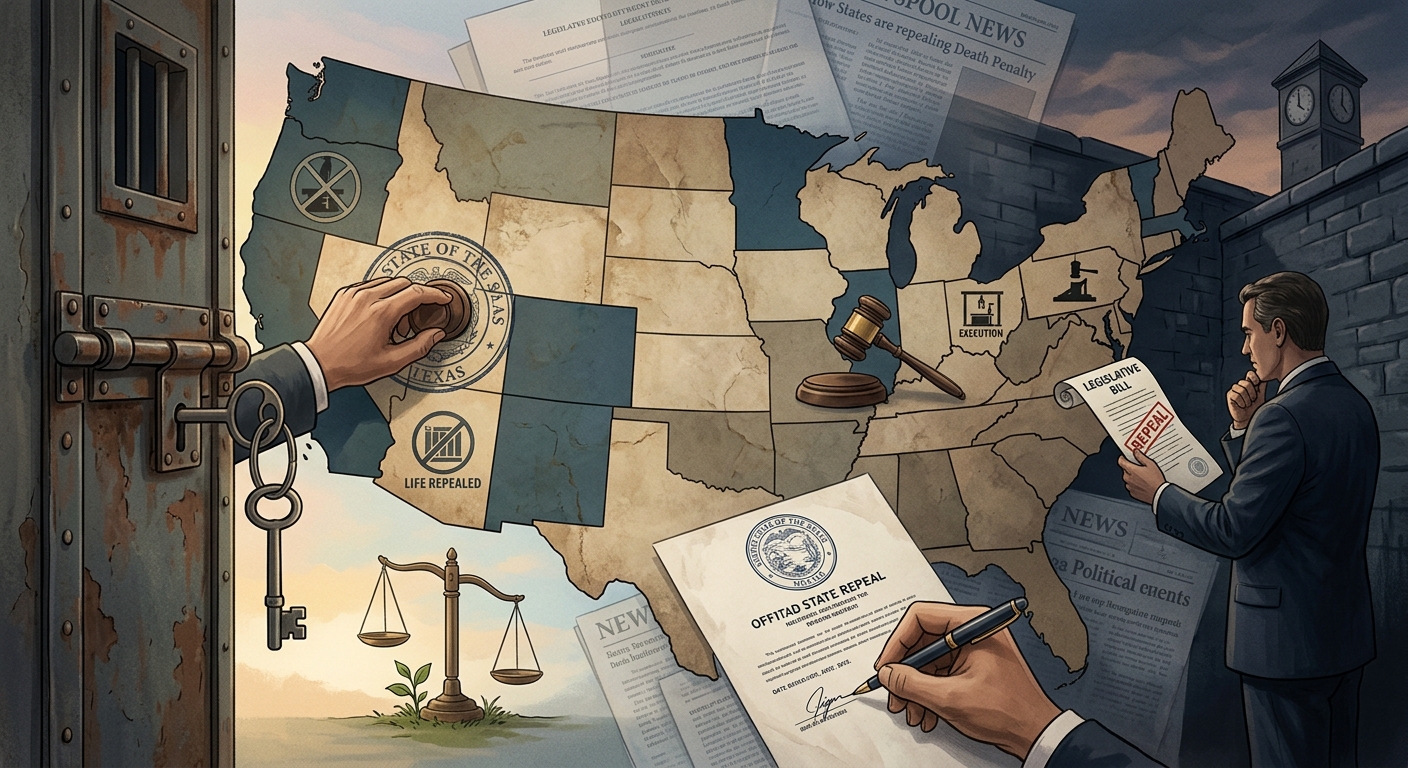
Rethinking the Ultimate Consequence: The End of Capital Punishment in the West
For the better part of American history, the death penalty has served as a seemingly immutable fixture within the nation’s criminal justice framework. Designed ostensibly as the ultimate deterrent against the most heinous offenses, it was long accepted as a necessary, albeit grim, tool for maintaining law and order. However, a profound transformation is sweeping across the country, particularly within the political landscapes of the American West. The decision by state lawmakers to dismantle state-sanctioned executions represents a monumental shift in penal philosophy and legal ethics.
When a state officially removes the death penalty from its legal statutes, it does more than simply alter a sentencing guideline; it fundamentally redefines its entire relationship with justice, the concept of rehabilitation, and the intrinsic sanctity of human life. States that have recently navigated this complex transition serve as crucial blueprints for understanding how deeply entrenched legal practices can be systematically dismantled. This dismantling occurs through persistent grassroots advocacy, rigorous legislative debate, and a growing public consensus against retributive violence. Over the past fifty years, empirical evidence has consistently debunked the theory that capital punishment deters violent crime, prompting policymakers to reevaluate the efficacy of the practice. The move away from the execution chamber is not merely a legal anomaly but a reflection of a society grappling with the practical and moral failures of an irreversible punishment.
The Power of Grieving Voices: Shifting the Narrative
Historically, proponents of capital punishment have leaned heavily on the concept of closure, arguing that the ultimate penalty is a necessary legal mechanism to bring peace to the grieving families of murder victims. This narrative, however, has been increasingly and powerfully challenged by the very individuals it claims to champion. In recent years, a formidable movement of surviving family members has emerged across the United States, publicly demanding that the state refrain from committing further violence in their names. This profound philosophical paradigm has fundamentally altered the political discourse surrounding the death penalty, replacing a demand for vengeance with a plea for restorative justice.
These courageous advocates articulate a powerful counter-narrative: state-sanctioned executions do not magically heal the deep wounds of loss; rather, they perpetuate a continuous, exhausting cycle of trauma. The legal mechanics of a capital case require a protracted appellate process that is constitutionally mandated and can stretch on for decades. For victims’ families, this means being permanently tethered to the criminal court system. They are repeatedly forced to relive the most harrowing moments of their lives through endless evidentiary hearings, intense media coverage, and seemingly infinite legal appeals. By advocating for alternative sentences, such as life imprisonment without the possibility of parole, these families champion a path that offers immediate finality. It allows survivors to focus their energy on emotional healing and community building rather than enduring a drawn-out, high-stakes legal spectacle that keeps their trauma in the public eye.
Systemic Disparities: The Geographic and Demographic Lotteries
The dismantling of capital punishment has also been significantly accelerated by the undeniable presence of systemic bias within the courts. The application of the death penalty has rarely been an objective reflection of the severity of the crime; instead, it frequently mirrors the deep-seated systemic inequities woven into the broader criminal justice system.
The Geography of Justice
One of the most glaring indictments of capital punishment is its arbitrary geographic application. Legal scholars and civil rights advocates have long pointed out that a defendant’s likelihood of receiving a death sentence is overwhelmingly dictated by the county in which the crime occurred, rather than the objective facts of the case itself. This phenomenon is driven by the vast discretionary power wielded by local district attorneys. In a state that retains capital punishment, one county prosecutor might aggressively pursue executions for specific homicides, while a neighboring county prosecutor might routinely seek life sentences for identical offenses. In some striking instances, an entire state’s death row population has been traced back to a single judicial district or even a specific local neighborhood, exposing the death penalty not as a uniform standard of statewide justice, but as a fatal lottery heavily influenced by local politics, underfunded public defender offices, and individual prosecutorial zeal.
Demographic and Racial Inequities
Equally troubling is the pervasive racial and demographic bias that infects capital sentencing proceedings. Decades of comprehensive legal analysis have demonstrated that the death penalty is disproportionately applied to marginalized communities, particularly Black and Hispanic defendants. Furthermore, the race of the victim plays a statistically significant role in determining who is sentenced to die, with crimes involving white victims historically resulting in harsher penalties than similar crimes involving minority victims. Beyond race, the system frequently ensnares individuals suffering from severe mental illness, intellectual disabilities, and histories of profound childhood trauma. Recognizing these profound demographic disparities has forced lawmakers and the public to confront an uncomfortable truth: a justice system vulnerable to human prejudice and systemic racism cannot be trusted to administer an irreversible punishment.
The Legislative Journey: From Bills to Signatures
Repealing the death penalty is rarely a swift or straightforward process. The legislative journey is often a grueling labyrinth, requiring years of strategic coalition-building, public education, and intricate political maneuvering. For a repeal bill to successfully navigate the complex chambers of a state legislature, it must garner support not just from progressive reformers, but also from conservative lawmakers who approach the issue from entirely different ideological standpoints.
In recent years, the abolition movement has seen a remarkable surge in conservative support. This alliance is driven by libertarian concerns regarding government overreach, the inherent and terrifying risk of the state executing innocent people, and the exorbitant fiscal waste associated with capital trials. This bipartisan synergy has been crucial in pushing abolition bills across the finish line. When a state legislature finally passes a repeal measure, the transition is often solidified by executive action. Governors signing these bills frequently exercise their constitutional clemency powers to commute the sentences of those already languishing on death row, effectively transforming their punishments to life in prison without the possibility of parole. This dual approach—legislative repeal coupled with executive clemency—ensures a clean, decisive break from the practice, emptying death row and closing the execution chambers permanently.
The Economics of Executions
While the moral and ethical arguments against the death penalty are profound and moving, the sheer financial burden of maintaining a capital punishment system has proven to be a decisive, pragmatic factor for many policymakers. A common societal misconception is that executing a prisoner is a cost-effective alternative to housing them for the duration of their natural life. However, rigorous economic analyses have repeatedly shattered this myth, revealing the staggering fiscal reality of the machinery of death.
According to data compiled by the Death Penalty Information Center, pursuing a capital case is astronomically more expensive than a non-capital prosecution. These cases often cost taxpayers 2.5 to 5 times more than trials resulting in life imprisonment. These bloated costs are incurred at every single stage of the legal process. Capital trials require specialized, highly trained legal counsel, extensive pre-trial investigations, numerous paid expert witnesses, and bifurcated legal proceedings—meaning there is one full trial to determine guilt and a completely separate trial to determine sentencing. Furthermore, defendants facing execution are legally entitled to a complex, mandatory appeals process designed to prevent wrongful state killings. For state governments grappling with significant budget deficits, the millions of dollars funneled into a broken death penalty system represent vital funds diverted from effective public safety initiatives, cold case investigations, victim assistance programs, and community policing.
The Broader National Landscape
The momentum generated by individual states repealing the death penalty has profoundly reshaped the national landscape of criminal justice reform. As of recent data from 2025 and 2026, the statistics reflect a nation steadily turning its back on the execution chamber. According to comprehensive reports tracking capital punishment across the United States, 23 states, along with the District of Columbia, have officially abolished the death penalty. An additional group of states currently operates under formal gubernatorial moratoriums, effectively pausing the practice indefinitely.
Even in jurisdictions where capital punishment remains legally permissible on the books, its actual application has plummeted drastically. Modern juries are increasingly reluctant to hand down death sentences, and prosecuting attorneys are pursuing capital charges far less frequently due to the associated costs and lengthy appeals. This de facto abandonment of the practice in many regions underscores a broader, undeniable cultural shift. The United States is gradually aligning itself with the vast majority of the democratic world, recognizing that a modern, effective justice system can protect society, deter crime, and hold offenders strictly accountable without resorting to state-sponsored lethality.
Frequently Asked Questions (FAQs)
- What happens to inmates currently on death row when a state repeals capital punishment?
When a state legislature abolishes the death penalty, the new legislation is typically prospective, meaning it prevents prosecutors from seeking future death sentences. However, to address the legal status of inmates already residing on death row, state governors frequently utilize their executive clemency powers to commute existing death sentences to life imprisonment without the possibility of parole. - Is life without parole a cheaper alternative to the death penalty?
Yes. Comprehensive economic studies have consistently demonstrated that sentencing an offender to life without parole is significantly less expensive than pursuing a death sentence. The astronomically high costs of the death penalty stem from extended pre-trial preparations, specialized legal representation, bifurcated trials, mandatory decades-long appeals, and the requirements of housing inmates in specialized high-security solitary confinement. - How many states have abolished the death penalty?
Based on recent nationwide tracking data from 2025 and 2026, 23 states and the District of Columbia have entirely abolished the death penalty. Additionally, several other states have paused all executions through official executive moratoriums, leaving only a fraction of states that actively pursue and carry out executions. - Does the death penalty act as an effective deterrent to violent crime?
No. Decades of criminological research and statistical data repeatedly show no correlation between the existence of the death penalty and lower murder rates. In fact, many states that have abolished the death penalty consistently report lower rates of violent crime compared to states that frequently conduct executions.
Conclusion: Charting a New Course for Restorative Justice
The systematic eradication of the death penalty in states across the nation represents far more than the simple conclusion of an outdated legal practice; it marks the beginning of a more restorative, logical, and equitable approach to criminal justice. By genuinely listening to the powerful voices of victims’ families, acknowledging the undeniable presence of racial and geographic bias, and confronting the extraordinary financial drain of the execution apparatus, states are choosing a more humane and pragmatic path. This legislative and cultural evolution deeply acknowledges that true, lasting justice cannot be achieved through irreversible violence. As the national consensus continues to build against capital punishment, the ultimate penalty is increasingly being relegated to the annals of history. In its place, society is making way for a legal system that prioritizes rigorous accountability, systemic fairness, and the intrinsic value of human life.
References
- State by State Data — Death Penalty Information Center. 2025. https://deathpenaltyinfo.org/state-and-federal-info/state-by-state
- What to Know: Costs and the Death Penalty — Death Penalty Information Center. 2026-03-09. https://deathpenaltyinfo.org/policy-issues/costs
- Capital Punishment, 2022 – Statistical Tables — U.S. Department of Justice, Bureau of Justice Statistics. 2024. https://bjs.ojp.gov/library/publications/capital-punishment-2022-statistical-tables
Similar Articles








Read full bio of medha deb




