
How Judges Decide Objections In Court: Practical Guide
Understand how trial judges evaluate, rule on, and record objections to questions, testimony, and exhibits during court proceedings.
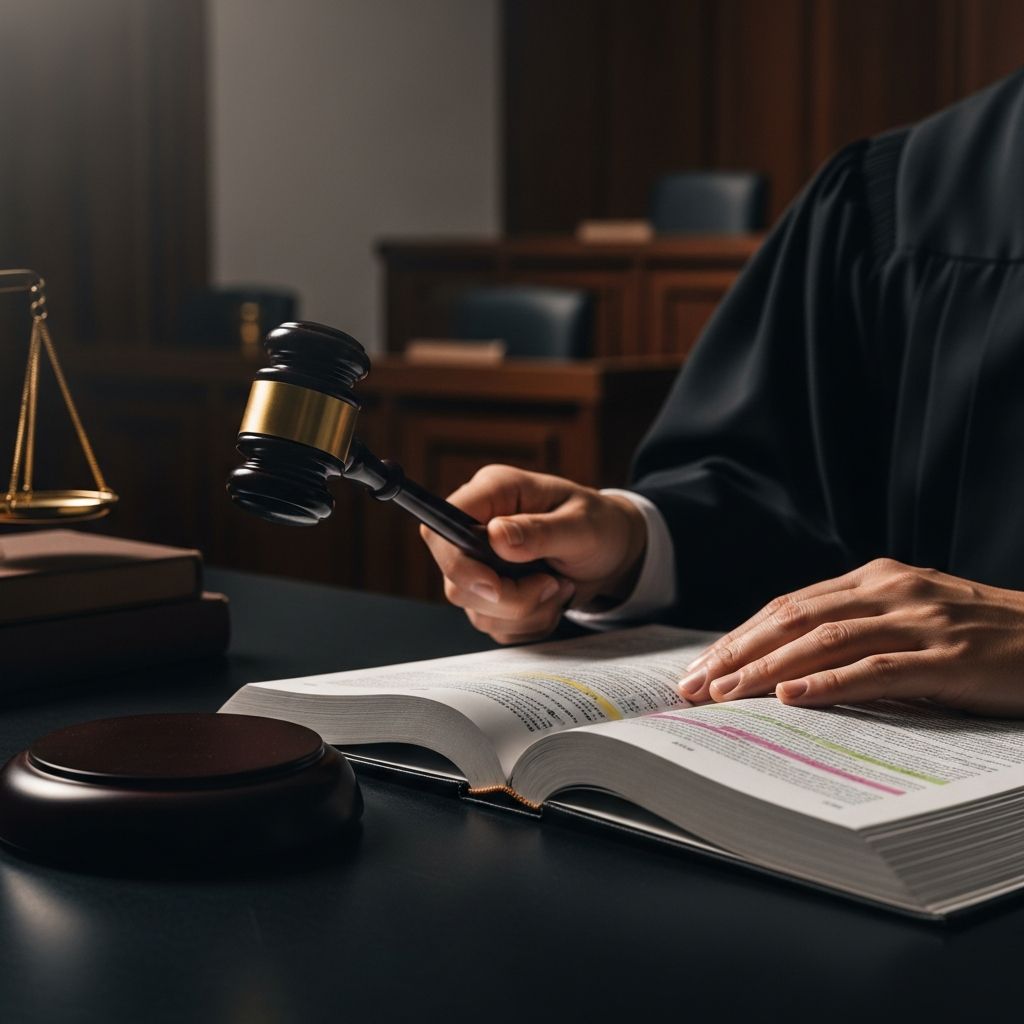
Objections are one of the most visible parts of any trial. They interrupt questioning, redirect lawyers, and shape what jurors are allowed to hear. To understand courtroom dynamics, it is essential to know how a judge evaluates an objection and decides whether to allow or block a question, answer, or exhibit.
This guide explains, in practical terms, how judges think about objections, the legal standards they apply, and what their rulings mean for the parties, witnesses, and any later appeal.
What an Objection Really Is
In simple terms, an objection is a lawyer’s request that the court enforce the rules of evidence or procedure at a specific moment during a hearing or trial.
- Purpose: To prevent the jury or judge from hearing improper evidence or argument.
- Target: Usually a question, a particular answer, a document or other exhibit, or a statement in argument.
- Decision-maker: The trial judge rules on the objection, typically in real time.
Under the Federal Rules of Civil Procedure, a party preserves an issue for review by clearly stating the action it wants the court to take or the action it opposes and briefly explaining why. A separate, old-fashioned “formal exception” is no longer required.
Key Outcomes: Sustained vs. Overruled
When an objection is made, the judge almost always responds with one of two short rulings: “sustained” or “overruled.”
| Ruling | What It Means | Effect on Evidence | Next Steps for Lawyers |
|---|---|---|---|
| Sustained | The judge agrees with the objection. | The question, answer, or exhibit is not allowed as presented. The court may strike testimony and tell the jury to disregard it. | The questioning lawyer must rephrase, lay more foundation, change topics, or abandon that line of questioning. |
| Overruled | The judge rejects the objection. | The question stands. The witness may answer, or the exhibit is admitted. | The examining lawyer may continue as planned; the objecting lawyer has preserved the issue but must move on. |
In either case, the ruling becomes part of the record, which is critical if a party wants to argue later that the judge made a legal error.
How Judges Analyze an Objection
Judges do not rule on objections randomly. They apply a series of questions and legal tests, usually very quickly, often in a matter of seconds.
1. Was the Objection Timely?
Objections must be raised as soon as it is reasonably clear that there is a problem with the question or evidence.
- If an attorney waits too long, the judge may find the objection waived.
- Timeliness matters because once an improper statement is fully before the jury, it is harder to erase its effect.
Federal Rule of Civil Procedure 46 and similar state rules emphasize that the objection must be made at the time the ruling is requested or made.
2. Is the Objection Specific Enough?
The judge next considers whether the objecting lawyer has clearly stated the legal ground for the objection.
- Rules governing objections to evidence in federal court (such as Federal Rule of Evidence 103) require the objecting party to state the specific ground, unless it is obvious from context.
- Vague protests like “this is unfair” generally are not enough; the lawyer must say, for example, “objection, hearsay” or “objection, relevance.”
A precise objection helps the judge apply the correct evidentiary rule and also helps an appellate court see what issue was preserved for review.
3. Does the Evidence Violate an Evidentiary Rule?
Once timing and specificity are satisfied, the judge turns to substance—the heart of the ruling. Common categories include:
- Relevance: Does the question or evidence tend to make a fact of consequence more or less probable? If not, or if its modest value is outweighed by risk of unfair prejudice, confusion, or delay, the judge may exclude it.
- Hearsay: Is the statement an out-of-court assertion offered to prove the truth of what it says, without fitting an exception?
- Foundation: Has the lawyer laid a proper basis to show that the witness has personal knowledge or that the exhibit is authentic?
- Form of the Question: Is the question leading, compound, argumentative, assuming facts not in evidence, or otherwise improper in form?
Judges compare the objection to the relevant rules of evidence—state or federal—often from memory and long trial experience.
4. Are There Policy or Fairness Concerns?
Evidence rules serve policy goals such as fairness and efficiency. Judges keep those goals in mind when ruling. For example:
- They may exclude technically relevant evidence that would mislead or inflame the jury.
- They may limit repetitive questioning that wastes time, even if the evidence is admissible in theory.
This discretionary balancing is part of why appellate courts usually review evidentiary rulings only for abuse of discretion—a very deferential standard.
Common Grounds for Objections and Judicial Responses
Although every case is unique, certain objections arise so frequently that judges develop standard ways of handling them.
Relevance and Undue Prejudice
Relevance is often the first gatekeeper. If evidence does not help prove or disprove an issue in dispute, judges will generally prevent the jury from hearing it.
- If evidence has no logical connection to the claims or defenses, the objection is likely to be sustained.
- Even relevant evidence may be excluded if its main effect would be to unfairly prejudice a party, confuse the issues, or waste time.
Hearsay and Its Exceptions
Hearsay rules restrict out-of-court statements used to prove the truth of what they say. Judges often must decide quickly whether:
- The statement is hearsay at all.
- An exception or exclusion applies (such as a party’s own statement, business records, or excited utterance).
If no exception fits, judges will generally sustain a hearsay objection and bar the statement, or limit how it can be used.
Foundation and Authentication
Judges also insist that lawyers first show that a witness or exhibit is properly connected to the case.
- Foundation for testimony: The judge asks whether the witness has personal knowledge of the facts being described.
- Foundation for documents or objects: The judge checks whether the proponent has offered enough proof that the item is what it is claimed to be (for example, an original contract or an accurate photo).
A lack-of-foundation objection is often cured by a few additional questions that clarify how the witness knows what they are talking about or how the exhibit was created or kept.
Form-of-Question Objections
Even when evidence is substantively admissible, the way a lawyer asks for it can trigger an objection. Common form objections include:
- Leading on direct examination (suggesting the answer in the question).
- Compound questions that ask more than one thing at once.
- Argumentative questions that are really speeches, not inquiries.
- Questions that assume facts not yet established in the record.
Judges usually sustain form objections but often allow the lawyer to ask a corrected version of the question immediately.
The Judge’s Options After Sustaining an Objection
When a judge sustains an objection, the response may be more complex than a simple “no.” Judges have several tools to manage the impact of improper material:
- Striking testimony: If the witness already answered, the judge can order that the answer be stricken from the record.
- Curative instruction: The judge may tell jurors to disregard what they heard and not consider it in deliberations.
- Limiting instruction: The judge can allow the evidence for a narrow purpose but instruct the jury not to use it for other purposes, such as judging a party’s character.
- Sidebars or recesses: For complex issues, the judge may excuse the jury while hearing argument at the bench or in chambers.
These measures aim to keep the trial fair and focused while minimizing interruptions.
Recording Objections for the Appeal Record
Judges also think about how their rulings will appear in the written transcript that appellate courts review. Both the Federal Rules of Civil Procedure and the Federal Rules of Evidence emphasize the importance of creating a clear record.
- The transcript should show the objection, the ground, and the ruling.
- If the judge reserves ruling, lawyers may need to renew the objection and request a decision later.
- If evidence is excluded, the offering party can make an offer of proof outside the jury’s presence, describing what the evidence would have shown; judges often permit this specifically to aid appellate review.
This record allows an appeals court to decide whether an error occurred and, if so, whether it matters enough to justify a new trial.
Standards of Review on Appeal
When a case goes up on appeal, most decisions about objections are reviewed under a forgiving standard known as abuse of discretion.
- If the trial judge’s ruling fell within a reasonable range of choices, the appellate court will not disturb it.
- Even if the ruling was wrong, the appellate court may treat it as harmless error if it did not affect the outcome.
- When no timely objection was made, appellate review is usually limited to plain error—a clear and obvious mistake that likely changed the result.
This framework reinforces how important it is for trial lawyers to object promptly and specifically, and for judges to create a clear record of each ruling.
Practical Tips for Understanding Judicial Rulings
Observers and self-represented parties often find objection rulings hard to interpret in real time. The following cues can help:
- If the judge rules quickly without argument, the issue is likely routine and covered by well-known rules.
- If the judge calls for a sidebar or sends the jury out, the question may involve complex legal issues or sensitive information.
- Repeated sustains on the same ground can signal that a particular line of questioning is improper and likely to remain off-limits.
- Judges may occasionally explain their rulings briefly in front of the jury, but more detailed reasoning often happens on the record outside the jury’s hearing.
Frequently Asked Questions (FAQs)
Q: Why do judges sometimes decide objections without letting lawyers argue?
Many objections involve straightforward application of familiar rules, so judges can rule instantly to keep the trial moving. More nuanced or disputed issues are the ones that prompt sidebars or longer explanations.
Q: Can a judge change a ruling on an objection later in the trial?
Yes. A judge may reconsider an earlier ruling if new information emerges, if additional foundation is laid, or if the legal context changes. Lawyers can renew objections or requests to admit evidence when circumstances evolve.
Q: What happens if no one objects to improper evidence?
If lawyers do not object, the judge will often allow the evidence, and any error may be difficult to challenge on appeal. Appellate courts usually require a timely objection to review the issue, except in rare cases of plain error.
Q: Do judges rule on objections differently in bench trials without a jury?
The same evidence rules generally apply, but judges in bench trials may admit more material and simply give improper evidence little or no weight. Because there is no jury to protect, concerns about prejudice are less pressing.
Q: How should a witness respond when an objection is made?
Witnesses should stop talking immediately and wait for the judge’s ruling. If the objection is overruled, they may answer the question; if it is sustained, they should not answer and should wait for the next question.
References
- Rule 46. Objecting to a Ruling or Order — Legal Information Institute, Cornell Law School. 2018-12-01. https://www.law.cornell.edu/rules/frcp/rule_46
- The Busy Lawyer’s Guide to Objections — Valladares, National Association of Criminal Defense Lawyers. 2023-02-01. https://www.nacdl.org/getattachment/00e51f71-1405-419c-9eb9-c3c3217fd14e/valladares-objections-feb-2023.pdf
- Objection (United States law) — Wikimedia Foundation (summary article; underlying rules derived from official sources). 2023-07-10. https://en.wikipedia.org/wiki/Objection_(United_States_law)
- Overruled vs. Sustained: How Objections Work in U.S. Trials — PastPaperHero Legal Resources. 2022-11-15. https://www.pastpaperhero.com/resources/us-legal-terms-evidence-overrule-an-objection
- Rule 46. Objecting to a Ruling or Order — Federal Rules of Civil Procedure (Unofficial text). 2020-01-01. https://www.federalrulesofcivilprocedure.org/frcp/title-vi-trials/rule-46-objecting-to-a-ruling-or-order/
- Five Common Criminal Court Objections: What Do They Mean? — Versus Texas Law Firm. 2021-06-01. https://versustexas.com/court-objections/
- At the Hearing: What are some common objections? — WomensLaw.org, National Network to End Domestic Violence. 2022-03-01. https://www.womenslaw.org/laws/preparing-court-yourself/hearing/objecting-evidence/what-are-some-common-objections
Similar Articles








Read full bio of medha deb


