
Racial Disparities In Policing: A Historical Guide To Reform
How history shapes today's racial disparities in American law enforcement.
Introduction: The Weight of History on Modern Policing
The institution of law enforcement in the United States does not exist in a vacuum. It is a complex, multifaceted entity that has evolved over centuries, deeply shaped by the socio-political climates and racial dynamics of various historical eras. To comprehend the current landscape of racial disparities within the criminal justice system, one must embark on a rigorous examination of history. The controversies, protests, and debates surrounding police encounters with minority communities today are not isolated anomalies or modern inventions; rather, they are the persistent echoes of a long, deeply entrenched legacy of control and marginalization. By tracing the historical roots of policing—from the early days of antebellum control and post-Civil War subjugation, to the aggressive, militarized tactics of the modern “War on Drugs”—we can better understand how systemic bias became woven into the very fabric of public safety. Confronting these uncomfortable truths is crucial for charting a meaningful course toward equitable reform in the 21st century.
The Genesis: Antebellum Control and Slave Patrols
In the southern regions of the United States, the origins of formal policing were distinctly different from the community-watch models adopted in some northern cities. The earliest iterations of centralized law enforcement in the South were “slave patrols,” established in the early 18th century . These patrols were primarily designed to protect the economic interests of plantation owners by controlling the enslaved Black population. Their mandates were explicit: deter uprisings, capture individuals attempting to escape to freedom, and violently discipline any infractions against plantation rules.
Operating with sweeping legal authority, members of these patrols could enter dwellings without cause and deploy brutal force with impunity. This foundational model of policing did not prioritize the protection of all citizens; instead, it established a framework where law enforcement acted as a mechanism of suppression against a specific demographic. The psychological and institutional normalization of surveying and controlling Black bodies established a dangerous, adversarial dynamic that would persist long after the abolition of chattel slavery.
Post-Civil War and Reconstruction: Criminalizing Freedom
Following the conclusion of the Civil War and the passage of the 13th Amendment, slavery was formally abolished—except as a punishment for a crime. This critical constitutional caveat paved the way for the creation of the “Black Codes” across Southern states. These restrictive laws were engineered to maintain the racial hierarchy and secure a steady stream of involuntary labor to replace the lost enslaved workforce. Under these codes, newly freed Black Americans could be arrested for vaguely defined offenses such as vagrancy, loitering, breach of contract, or simply walking without a demonstrable purpose.
Law enforcement officers became the primary enforcers of these codes. By aggressively targeting the Black population, police helped funnel thousands of individuals into the brutal convict leasing system. Through this system, prisoners were leased out to private companies for arduous, often lethal labor in coal mines, railroads, and agricultural plantations. The conditions were notoriously inhumane, with mortality rates rivaling those of the deadliest historical eras. The criminalization of everyday Black life successfully bypassed the promises of emancipation, effectively transforming the justice system into an economic engine that relied heavily on the subjugation and exploitation of minority populations.
The Jim Crow Era: Enforcing Segregation and Racial Terror
As the 19th century transitioned into the 20th, the Black Codes evolved into the more formalized Jim Crow laws, which legally mandated racial segregation across the South and influenced discriminatory practices nationwide. During this era, police officers were not just impartial enforcers of the law; they were the frontline defenders of a legally sanctioned racial caste system. They ensured that Black Americans remained confined to separate, vastly inferior public facilities and aggressively dismantled attempts to exercise voting rights or attain economic independence.
Furthermore, this period was characterized by horrific campaigns of racial terror, including thousands of extrajudicial lynchings. In many documented instances, local law enforcement officers were either willfully blind to these atrocities, providing tacit approval by refusing to intervene, or actively participated in them as members of white supremacist organizations. The failure of the state to protect Black citizens from lynch mobs cemented a profound, generational distrust between minority communities and the police. Law enforcement was widely perceived not as a protective shield, but as an active threat to Black survival, dignity, and civil rights.
The Civil Rights Era: Social Upheaval and the Escalation of Force
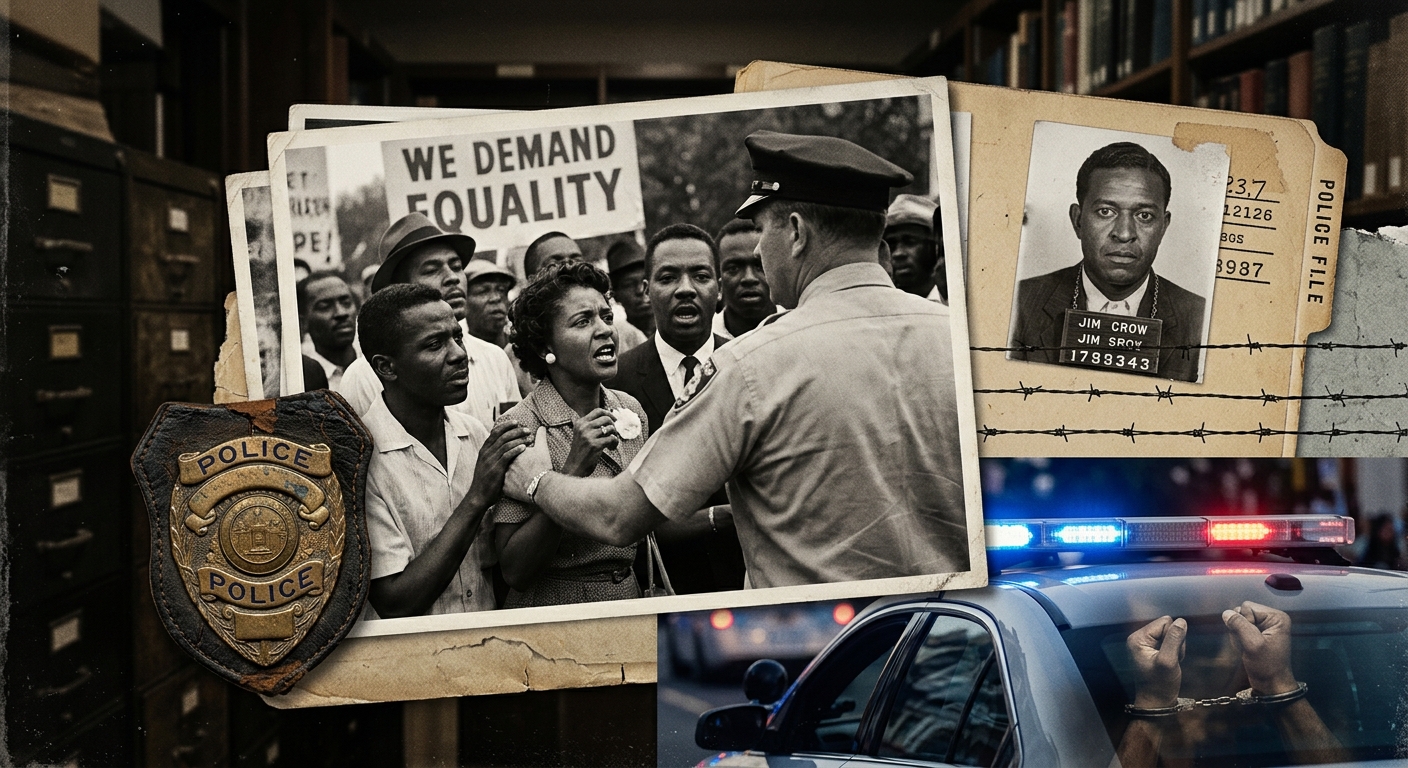
The mid-20th century brought about the Civil Rights Movement, a period of intense social upheaval and organized resistance against systemic racism. As Black Americans and their allies took to the streets to demand equality, they were frequently met with fierce, state-sanctioned violence. The clashes were broadcast globally, featuring indelible images of police officers deploying high-pressure fire hoses, attack dogs, and tear gas against peaceful demonstrators.
Beyond the physical violence, this era also marked a critical shift in the physical operational tactics of domestic law enforcement. In response to urban uprisings and widespread protests, police departments began to adopt more militarized approaches. The federal government initiated programs that supplied local police forces with surplus military equipment, originally intended for foreign conflicts. This militarization fostered a “warrior” mentality within police ranks, framing officers as soldiers in hostile territory and further alienating the minority communities they were purportedly assigned to protect.
The “War on Drugs”: A Catalyst for Mass Incarceration
In the 1970s, the political landscape shifted with the declaration of the “War on Drugs,” a campaign that would radically alter the trajectory of the American criminal justice system. While public rhetoric framed the initiative as a crusade against narcotics, the practical application heavily targeted Black and Latino communities. Legislation such as the Anti-Drug Abuse Act of 1986 established severe mandatory minimum sentences and introduced egregious sentencing disparities, most notably the 100-to-1 ratio between crack cocaine and powder cocaine.
Law enforcement tactics became increasingly aggressive to enforce these mandates . Programs emphasizing “stop-and-frisk,” zero-tolerance policing, and no-knock warrants were deployed disproportionately in urban centers. Entire neighborhoods were treated as occupied zones. Despite consistent data showing that drug usage and sales occurred at roughly similar rates across racial lines, people of color were arrested, convicted, and incarcerated at exponentially higher rates. The War on Drugs served as the primary catalyst for the era of mass incarceration, decimating families, devastating neighborhood economies, and creating millions of lifelong criminal records.
21st Century Policing: Systemic Bias and the Data
While overt, racially explicit laws have been struck from the books, the legacy of this history manifests today as systemic bias. Modern policing is heavily scrutinized through the lens of empirical data, which consistently highlights stark racial disparities . According to large-scale analyses of millions of traffic stops across various states, Black and Latino drivers are significantly more likely to be pulled over, searched, and arrested than their white counterparts, even though searches of white drivers frequently yield higher rates of contraband discovery .
The advent of modern technology has, in many cases, exacerbated these disparities. For example, the deployment of facial recognition software and predictive policing algorithms has been shown to encode historical biases, leading to the disproportionate surveillance of minority neighborhoods. Moreover, the deployment of use-of-force remains starkly disproportionate. High-profile tragedies involving unarmed Black individuals have ignited global movements demanding accountability and transparency. Institutional mechanisms, such as the legal doctrine of qualified immunity, often shield law enforcement officers from civil liability, creating a perception of an impenetrable wall of silence.
Rethinking Public Safety: Moving Toward Equitable Reform
Addressing the deep-rooted racial disparities in policing requires more than superficial changes; it demands a profound reimagining of public safety. While initiatives like implicit bias training, community policing models, and the deployment of body-worn cameras are steps in the right direction, many advocates and sociologists argue they are insufficient to dismantle over a century of systemic inequity.
True reform necessitates a holistic, society-wide approach. This includes critically reevaluating the massive footprints of municipal police budgets and considering the reallocation of funds toward essential community resources—such as mental health services, affordable housing, substance abuse clinics, and youth development programs. By reducing the societal reliance on armed law enforcement to handle non-violent crises, communities can begin to break the cycle of over-policing and mass incarceration. Acknowledging the historical weight of systemic racism is the prerequisite for building a justice system that genuinely embodies the principle of equal protection under the law for every citizen.
Frequently Asked Questions (FAQs)
- What were the “Black Codes”?
The Black Codes were restrictive laws enacted in Southern states immediately following the Civil War. They aimed to limit the freedom of newly emancipated Black Americans and ensure their availability as a cheap labor force. These laws criminalized basic activities like unemployment and vagrancy, allowing law enforcement to arrest Black individuals and force them into the convict leasing system.
- How did the “War on Drugs” impact minority communities?
Initiated in the 1970s and escalated in the 1980s, the War on Drugs disproportionately targeted Black and Latino neighborhoods through aggressive policing tactics and severe sentencing disparities, such as the crack versus powder cocaine sentencing gap . This resulted in skyrocketing arrest and incarceration rates for people of color, despite similar rates of drug use across different racial groups.
- What is systemic bias in law enforcement?
Systemic bias refers to the inherent, structural inequalities within institutions that disadvantage certain groups. In policing, this means that even if individual officers do not harbor conscious racial prejudices, the policies, practices, and historical foundations of the department result in unequal treatment—such as higher rates of stops, searches, and use of force against minority populations.
References
- Abolishing Racist Policing With the Thirteenth Amendment — Washington and Lee University School of Law Scholarly Commons. 2020-01-01. https://scholarlycommons.law.wlu.edu/wlulr/vol78/iss3/5/
- Racial Disparities and the Drug War — Office of Justice Programs, U.S. Department of Justice. 2009-01-01. https://www.ojp.gov/ncjrs/virtual-library/abstracts/racial-disparities-and-drug-war
- A large-scale analysis of racial disparities in police stops across the United States — Nature Human Behaviour. 2020-05-04. https://doi.org/10.1038/s41562-020-0858-1
- One in Five: Disparities in Crime and Policing — The Sentencing Project. 2023-11-02. https://www.sentencingproject.org/reports/one-in-five-disparities-in-crime-and-policing/
Similar Articles








Read full bio of medha deb




