
Shattering the Myth: The Hidden History of Slavery in California
Uncovering the hidden history of slavery and exploitation in the Golden State.
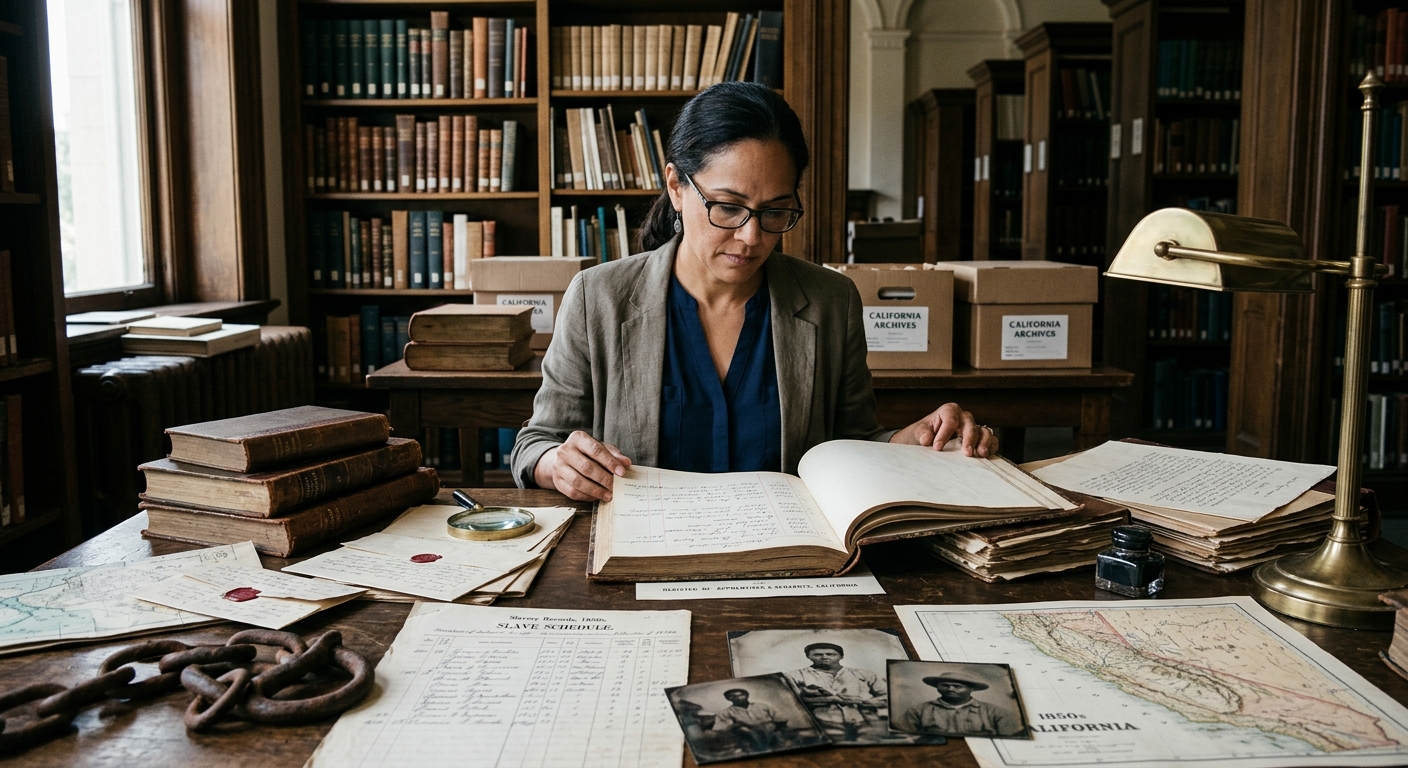
Shattering the Myth of a Free State: The Hidden Reality of Slavery in California
When considering the history of American slavery, the public imagination typically gravitates toward the expansive cotton plantations of the Deep South. California, on the other hand, is frequently romanticized as the ultimate destination of freedom and boundless opportunity—the terminus of the Underground Railroad of the West. It entered the federal Union in 1850 explicitly as a “free state” under the Compromise of 1850, a political maneuver ostensibly designed to halt the westward expansion of chattel slavery. However, the prevailing narrative of California as an unblemished beacon of liberty is a sanitized version of history.
Beneath the folklore of the rugged, independent forty-niner lies a dark, deliberately obscured reality: the Golden State was built, in significant part, upon the coerced labor and outright enslavement of African Americans and Indigenous peoples. The myth of the free state served as a convenient political facade, masking a brutal system of exploitation that fueled the economic explosion of the Gold Rush and laid the foundation for enduring racial disparities that continue to shape the state today.
The Gold Rush and the Importation of Enslaved Labor
The discovery of gold at Sutter’s Mill in 1848 triggered one of the largest and most rapid mass migrations in human history. Prospectors, opportunists, and entrepreneurs from across the globe descended upon the California territory, desperate to claim their share of the unimaginable wealth hidden in the Sierra Nevada foothills. Among this massive influx of fortune-seekers were hundreds of white Southerners who brought their enslaved African American laborers with them across the treacherous overland trails.
Although the newly drafted California Constitution of 1849 expressly forbade slavery and involuntary servitude, the reality on the ground was starkly different. The state’s foundational laws were selectively enforced, and the political establishment was heavily influenced by Southern sympathizers—often referred to as the “Chivs” or Chivalry Democrats—who were deeply invested in maintaining the status quo of white supremacy and unfree labor. Enslavers utilized various legal loopholes and extralegal intimidation to maintain control over their human property. They often forced enslaved individuals to sign deceptive “indenture contracts” before crossing into California, legally binding them to years of unpaid labor in exchange for a theoretical future freedom.
Others simply ignored the state constitution entirely, operating lucrative mining claims with captive labor in remote areas where the rule of law was dictated by whoever held the most firepower and political sway. The exact number of enslaved Black people forced to toil in the California gold fields is difficult to ascertain due to deliberately poor record-keeping and the clandestine nature of the practice. However, historical estimates and modern census analyses suggest that anywhere from 500 to 1,500 enslaved African Americans were living in California during the early 1850s, generating immense wealth for their captors while being violently denied the very freedoms the state supposedly guaranteed.
The California Fugitive Slave Act of 1852
The hypocrisy of California’s “free state” status was fully institutionalized with the passage of the California Fugitive Slave Act of 1852. Driven by the immense political pressure of pro-slavery politicians and wealthy Southern expatriates seeking to protect their assets, the California legislature enacted a law that was, in many operational ways, more draconian than its federal counterpart. The 1852 state law declared that any enslaved person who had been brought into California prior to its official statehood in 1850 remained the lawful property of their enslaver, fundamentally denying the freedom claims of Black individuals who had lived on legally free soil for years.
This aggressive legislation provided state-sanctioned mechanisms for enslavers to violently recapture Black individuals. It empowered local law enforcement to arrest suspected fugitives based merely on the sworn testimony of a white claimant. Furthermore, the law imposed severe penalties, including steep financial fines and lengthy imprisonment, on any white citizen who attempted to harbor or assist an escaping enslaved person. This legislation created an atmosphere of pervasive terror for all Black Californians.
Free people of color lived under the constant, terrifying threat of being kidnapped, falsely identified as runaways, and illegally deported to the brutal slave markets of the Deep South. High-profile legal battles, such as the 1858 case of Archy Lee—a young enslaved man brought from Mississippi who fought a protracted, highly publicized legal war for his emancipation—highlighted the extreme lengths to which the state judiciary would go to protect the property rights of enslavers over the basic human rights of Black residents.
The Indenture and Exploitation of Indigenous Californians
While African Americans faced the constant threat of chattel slavery and illegal deportation, the Indigenous populations of California were subjected to a systemic campaign of genocide and state-sponsored enslavement. In 1850, during its very first legislative session, the California government passed the deceptively named “Act for the Government and Protection of Indians.” This piece of legislation was, in reality, a comprehensive legal framework for the subjugation, displacement, and forced labor of Native Americans, codifying the exploitation that had begun under the Spanish mission system and amplifying it for the booming Gold Rush economy.
The 1850 Act facilitated the enslavement of Indigenous people through several brutal mechanisms:
- Weaponized Vagrancy Laws: The law allowed any white citizen to declare a Native American who was not visibly employed by a white person to be a “vagrant.” Law enforcement could then arrest the individual and auction off their labor to the highest bidder for a period of up to four months, essentially creating a revolving door of involuntary servitude.
- Child Indenture and Kidnapping: Perhaps the most insidious provision of the act allowed white settlers to obtain legal custody of Native American children. Under the thin guise of “apprenticeship,” these children were legally bound to work for white households until adulthood. This provision directly incentivized rampant kidnapping and the organized massacre of Native parents, fueling a lucrative and horrific slave trade in Indigenous youth.
- Convict Leasing: Native Americans who were convicted of minor infractions—often based on entirely fabricated charges—could be bailed out by white landowners who then forced them to work off their judicial debt under the constant threat of physical violence.
The devastating impact of this law, combined with the catastrophic ecological destruction of the Gold Rush and state-funded militia massacres, led to an unprecedented decline in the Indigenous population. Thousands of Native Americans were forced into unfree labor under this system, literally building the agricultural and ranching infrastructure of early California with their blood and sweat.
A Legal System Designed for Suppression
The continuation of unfree labor in a supposedly free state was only made possible by a judicial and legal system that was explicitly designed to disempower people of color. The cornerstone of this systemic oppression was the strict legal prohibition against non-white individuals testifying against white citizens in a court of law. In 1850, the state legislature passed a law stipulating that “no Black, or Mulatto person, or Indian shall be allowed to give evidence in favor of, or against a white man.” This prohibition was later expanded by the California Supreme Court in 1854 to explicitly include Chinese immigrants.
This evidentiary ban was an incredibly powerful tool of racial subjugation. It effectively granted white Californians total impunity to commit heinous crimes against Black, Indigenous, and Asian residents without any fear of legal reprisal. An enslaver could openly beat an enslaved person, a trafficker could boldly steal a Native child from their family, or a white miner could murder a Black prospector in broad daylight. As long as no white witnesses were willing to testify against the perpetrator, the criminal would walk completely free. This legal disenfranchisement stripped marginalized communities of their ability to defend their property, their liberty, and their lives, cementing an ironclad racial caste system that directly contradicted the foundational myths of the American West.
Rising Up: Resistance and the Fight for Emancipation
Despite the overwhelming legal, political, and physical violence directed against them, enslaved and free people of color in California did not passively accept their subjugation. They forged powerful networks of resistance, utilizing every available resource to fight for their emancipation and civil rights. The Black community in California, though relatively small in total numbers, was highly organized, financially strategic, and fiercely determined. They established independent newspapers, such as The Mirror of the Times, to expose the hypocrisies of the state government, document abuses, and boldly advocate for abolition and equal protection under the law.
Activists organized the Colored Conventions movement in California, gathering delegates from across the state to strategize political campaigns, aggressively petition the legislature for the repeal of discriminatory laws, and demand the fundamental right to testify in court. Furthermore, the Black community pooled their hard-earned resources to mount formidable legal defenses for those fighting fugitive slave claims. They successfully purchased the freedom of enslaved individuals and established vigilance committees to protect vulnerable residents from roaming kidnappers.
Courageous individuals like Bridget “Biddy” Mason, an enslaved woman who was brought to California from Mississippi, took monumental risks. Mason successfully sued for her freedom and the freedom of her extended family in a Los Angeles court in 1856. Winning her case against incredible odds, Mason went on to become a prominent real estate entrepreneur, a generous philanthropist, and one of the wealthiest Black women in early Los Angeles. Her life stands as a powerful testament to the resilience, brilliance, and agency of those who fought against California’s hidden slave regime.
The Enduring Legacy of Unfree Labor in the Golden State
The hidden history of slavery and unfree labor in California is not merely a forgotten academic footnote; it is the foundational bedrock upon which much of the state’s early wealth and infrastructure were built. The vast, generation-defining fortunes generated during the Gold Rush and the subsequent agricultural boom were inextricably linked to the brutal exploitation of Black and Indigenous bodies. White settlers were granted the exclusive political and legal tools to accumulate land, extract pristine resources, and build intergenerational wealth, while marginalized communities were systematically robbed of their labor, their freedom, and their lives.
Understanding this dark chapter of history is absolutely essential for contextualizing the profound racial and economic disparities that continue to plague California today. The direct legacy of the 1850 Act for the Government and Protection of Indians, the California Fugitive Slave Act, and the discriminatory legal codes can be clearly traced to the historical redlining of neighborhoods, the persistent and widening racial wealth gap, and the ongoing, modern struggles for Indigenous sovereignty.
As contemporary movements for racial justice and state-level reparations gain crucial momentum, they demand a rigorous and unflinching confrontation with the past. Dispelling the myth of California as an untarnished promised land is the critical first step toward acknowledging the deep, systemic roots of inequality. Only by dragging these hidden histories into the light can society undertake the difficult, necessary work of restorative justice and build a future that finally honors the state’s promise of true equality.
Frequently Asked Questions (FAQ)
When did California officially ban slavery?
California’s original 1849 Constitution prohibited slavery as it prepared for statehood in 1850. However, this ban was widely ignored, and laws like the 1852 Fugitive Slave Act actively protected the rights of enslavers over Black residents for years.
What was the Act for the Government and Protection of Indians?
Passed in 1850, this California law legalized the indentured servitude of Native Americans. It allowed white citizens to arrest Native people for “vagrancy” and lease their labor, and permitted the legal kidnapping and “apprenticeship” of Native children.
How many enslaved people were brought to California during the Gold Rush?
Due to the illicit nature of the practice and poor record-keeping, exact numbers are unknown. However, historians estimate that between 500 and 1,500 enslaved African Americans were brought to California by Southern prospectors during the Gold Rush era.
References
- Compromise of 1850 (1850) — National Archives. 2022-05-10. https://www.archives.gov/milestone-documents/compromise-of-1850
- California’s Role in the Civil War — Golden Gate National Recreation Area (U.S. National Park Service). 2020-05-13. https://www.nps.gov/goga/learn/historyculture/california-in-the-civil-war.htm
- Witness Statement – Stacey L. Smith, Ph.D — California Department of Justice. 2021-09-23. https://oag.ca.gov/ab3121/reports
- Laws of the State of California: An act for the government and protection of Indians. — Library of Congress. 1850. https://www.loc.gov/item/2019665971/
- Litigating Slavery’s Reach: A Story of Race, Rights, and the Law During the California Gold Rush — Jason A. Gillmer, Gonzaga University. 2023-05-17. https://law.scu.edu/wp-content/uploads/56.2_GILLMER_V10.pdf
Similar Articles








Read full bio of Sneha Tete


