The Rise of Elite Tactical Squads
In the complex landscape of modern American law enforcement, municipal police departments face intense, continuous pressure from politicians and the public to rapidly reduce violent crime and maintain order in urban centers. Over the past several decades, this intense pressure has fueled the rapid proliferation of specialized tactical squads. Often branded with aggressive, militaristic acronyms, these units are marketed to the general public as highly trained, elite forces necessary for dismantling violent criminal networks and removing illegal firearms from the streets.
However, beneath the veneer of specialized expertise and high-level training lies a deeply flawed, systemic policing model. As extensive federal investigations and tragic community outcomes have repeatedly and painfully demonstrated, these unaccountable police units often prioritize aggression over constitutional rights. By emphasizing forceful intervention over community collaboration, these squads fundamentally compromise civil liberties while consistently failing to deliver on their central promise of improved long-term community safety.
The Architecture of Aggression
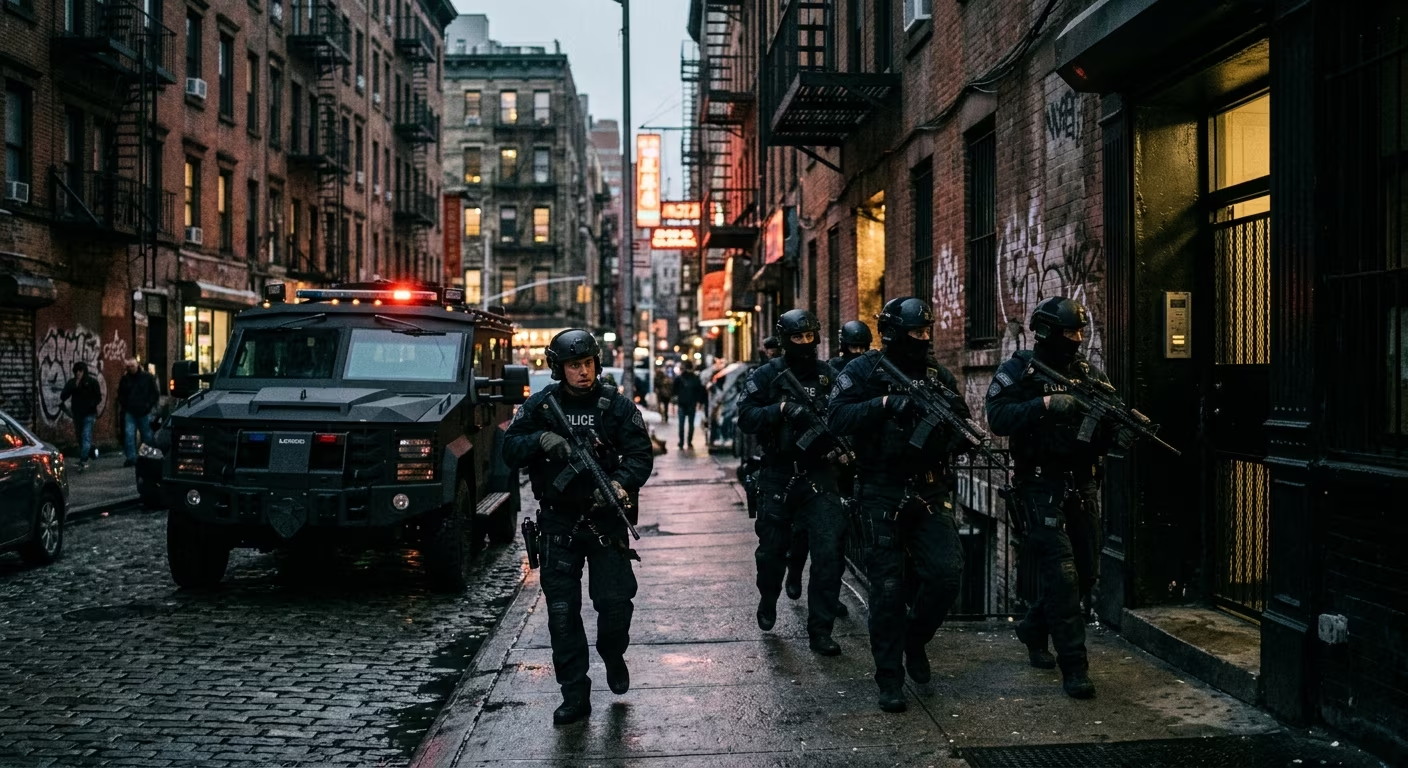
To understand why these tactical groups frequently run afoul of civil rights, one must examine their structural and cultural foundations. Unlike traditional patrol officers, who are theoretically meant to operate under a “guardian” model focused on community engagement, conflict de-escalation, and visible deterrence, specialized squads are frequently built upon a rigid “warrior” paradigm. They typically deploy in plainclothes or heavily tinted, unmarked vehicles, moving rapidly through residential neighborhoods with a pronounced emphasis on speed, surprise, and sheer numerical superiority.
This structural detachment inherently isolates squad members from the very communities they are sworn to protect. Because their operational mandate is broadly defined as “crime suppression” or “violence reduction,” these specialized units measure their success strictly in raw statistics: the sheer volume of pedestrian stops conducted, citations issued, and arrests made. This hyper-focus on metrics fosters an insular, high-stress culture where aggressive tactics are not only normalized but actively rewarded by higher-level command staff. The relentless pressure to produce numerical results often leads officers to view constitutional boundaries—such as the Fourth Amendment requirement for reasonable suspicion or probable cause—as inconvenient hurdles rather than fundamental, inviolable rights. Consequently, the architecture of these units is practically designed to facilitate constitutional overreach.
To highlight the structural differences, consider the typical contrast between traditional patrol units and specialized tactical squads:
| Characteristic | Traditional Patrol Units | Specialized Tactical Squads |
|---|---|---|
| Primary Focus | Responding to 911 calls, community engagement, visible deterrence. | Proactive crime suppression, weapons seizure, high-volume stops. |
| Operational Style | “Guardian” mentality, easily identifiable uniforms, marked vehicles. | “Warrior” mentality, plainclothes, unmarked vehicles, rapid deployment. |
| Metrics of Success | Call resolution, community trust, lowering neighborhood crime rates. | Number of stops, citations issued, contraband seized, raw arrest totals. |
The “Numbers Game” and the Myth of Public Safety
The tactical cornerstone of most specialized police units is the pretextual stop. A pretextual stop occurs when law enforcement officers use a minor, often negligible traffic or pedestrian violation—such as a broken taillight, slightly tinted windows, an expired registration tag, or jaywalking—as a legal justification to detain and investigate an individual for an entirely different, unrelated crime for which the officers have absolutely no initial evidence. In practice, this strategy involves overwhelming specific neighborhoods with highly visible, aggressive enforcement, creating thousands of unnecessary friction points between citizens and armed law enforcement officers.
Proponents of specialized squads argue that these broad dragnets are essential for seizing illegal weapons and intercepting narcotics before they enter the community. However, empirical data and extensive legal research paint a starkly different picture. According to comprehensive data published by the American Bar Association, less than two percent of pretextual traffic stops actually yield illicit contraband, and an even smaller fraction leads to meaningful felony arrests . Instead of effectively disrupting violent criminal enterprises, these units dedicate the vast majority of their taxpayer-funded resources to low-level harassment that primarily targets marginalized citizens.
This operational “numbers game” does not demonstrably reduce systemic, long-term violence. Instead, it continuously subjects thousands of innocent, law-abiding residents to the deep humiliation, psychological fear, and tangible physical danger of an unwarranted police encounter. When police chiefs, mayors, and city leaders evaluate the overall efficacy of these specialized squads, they often erroneously point to the sheer volume of stops and petty citations as definitive proof of proactive activity. Yet, pure activity does not equate to genuine public safety. The minimal operational gains achieved through these arbitrary searches are vastly outweighed by the escalation of violence and communal trauma that these stops frequently provoke.
Systemic Harms and the Erosion of Civil Rights
The profound human cost of specialized, metrics-driven policing is overwhelmingly borne by marginalized communities. Tactical units are disproportionately deployed to so-called “hot spots,” which are almost exclusively lower-income neighborhoods and communities of color. Because these tactical squads rely heavily on broad dragnets rather than targeted, intelligence-led investigations, their blunt-force tactics inevitably result in severe racial disparities across all policing outcomes.
The United States Supreme Court’s 1996 ruling in Whren v. United States established that an individual officer’s subjective intent does not render a traffic stop unconstitutional, provided there is a technically objective violation of the local traffic code. This landmark legal decision inadvertently provided a nearly impenetrable legal shield for systemic racial profiling. Research published in the Stanford Law Review explicitly emphasizes that the broad latitude granted by the Whren doctrine directly contributes to the severe amplification of racial disparities in nationwide stop-and-search rates . Officers operating in specialized units can follow virtually any driver long enough to observe a minor, inevitable infraction, granting them the ultimate legal cover to initiate a stop based entirely on conscious or unconscious racial bias.
For Black and Brown residents residing in heavily policed urban areas, this paradigm means living under constant, suffocating surveillance and the persistent threat of unjustified detention. The cumulative, generational trauma inflicted by these repetitive, hostile encounters fundamentally ruptures public trust in civic institutions. When local residents view law enforcement not as designated protectors, but rather as an occupying force intent on harassment, they become vastly less likely to report local crimes, participate as vital witnesses, or cooperate with necessary investigations. Ironically, the very units deployed to solve community violence end up actively chilling the precise community cooperation necessary for achieving actual public safety.
The Shield of Unaccountability
A defining and deeply troubling characteristic of these tactical squads is their unique ability to operate with minimal, if any, substantial administrative oversight. Within many large metropolitan police departments, these tactical units are treated as the untouchable “golden children” because they generate massive volumes of arrests. Department administrators consistently use these inflated metrics to publicly justify inflated budgets and demonstrate proactive law enforcement initiatives to fearful voting blocs. This favored organizational status frequently insulates unit members from standard accountability mechanisms and disciplinary actions.
Commanders and internal affairs divisions often turn a blind eye to mounting citizen complaints regarding excessive use of force, persistent verbal abuse, or blatant unconstitutional searches. The insular, secretive nature of these squads breeds a hyper-loyal subculture—a potent, highly distilled manifestation of the “blue wall of silence”—where unwavering loyalty to the unit strictly supersedes fidelity to the law, the constitution, or official departmental policy. In numerous documented instances, specialized units have been found to actively and deliberately circumvent transparency tools, such as by intentionally muting or powering off body-worn cameras, or by coordinating fabricated narratives on official incident reports following a violent encounter.
This distinct lack of rigorous, independent supervision creates a highly fertile breeding ground for unchecked abuse. It is absolutely not a coincidence that some of the most high-profile and tragic incidents of extreme police brutality in recent years have prominently involved members of elite crime-suppression units. The U.S. Department of Justice has repeatedly investigated and identified catastrophic, systemic failures in the direct supervision of such squads . For example, a sweeping DOJ investigation into the Memphis Police Department found that the department, heavily reliant on autonomous specialized units, engaged in a deeply entrenched pattern of constitutional violations, including routine excessive force and discriminatory policing against Black residents . When well-armed units operate without strict legal boundaries and definitive oversight, the highly predictable outcome is the tragic violation of fundamental human rights.
Reimagining Urban Safety Beyond the Squad Car
The consistent, undeniable failure of unaccountable tactical units to foster genuine, lasting safety demands a fundamental, paradigm-shifting change in how American cities approach crime reduction. The legitimate answer to systemic, generational violence is not hyper-aggressive policing, but rather holistic, community-based interventions that aggressively address the foundational root causes of local crime. Cities must prioritize the dismantling of toxic, loosely supervised specialized units and boldly redirect those massive financial resources toward programs with proven, long-term efficacy.
True public safety necessitates robust investments completely outside the traditional law enforcement apparatus. Critical steps forward include:
- Civilian Crisis Response Teams: Deploying unarmed, highly trained medical and social professionals to handle behavioral health emergencies, homelessness issues, and substance use crises without the immediate threat of armed, potentially lethal escalation.
- Violence Interruption Initiatives: Utilizing trained community members and social workers with lived experience to actively mediate neighborhood conflicts and prevent retaliatory violence before it occurs.
- Social Infrastructure Investment: Addressing the true root causes of crime by heavily funding affordable housing initiatives, robust educational opportunities, and after-school youth development programs.
By continuing to fund elite police squads that rely entirely on suppression, intimidation, and fear, municipalities stubbornly double down on a failed, costly strategy that actively degrades civil liberties. True safety is defined by the thriving presence of community resources, widespread well-being, and genuine economic opportunity, not merely by the overwhelming, intimidating presence of armed authority.
Frequently Asked Questions (FAQs)
What exactly is a specialized police unit?
A specialized police unit (frequently referred to as a tactical squad, crime-suppression unit, or strike force) is a designated, distinct group of officers within a larger police department assigned to a specific, proactive mission. This typically includes mandates like rapidly reducing violent crime, seizing illegal weapons, or conducting heavy narcotics interdictions. Unlike regular patrol officers who primarily respond to public 911 calls, these units proactively target specific geographic areas or demographic profiles, often utilizing highly aggressive, rapid-deployment tactics.
What is a pretextual stop and why is it considered highly controversial?
A pretextual stop occurs when police utilize a minor, often trivial traffic or pedestrian violation (like a broken taillight, an improper lane change, or walking in the roadway) as an official legal excuse to pull someone over in order to investigate a hunch about a much more serious crime. These stops are highly controversial because empirical data shows they are frequently utilized in a racially discriminatory manner, disproportionately targeting drivers of color. Furthermore, they rarely result in the actual discovery of illegal weapons or dangerous drugs.
Why do criminologists and legal experts argue these units do not actually improve public safety?
Experts and academic researchers point to decades of data demonstrating that the broad, highly aggressive tactics used by these units—such as intentionally flooding specific neighborhoods with stops and frisks—yield extremely low rates of contraband recovery. Instead of definitively reducing systemic violence, these unaccountable units frequently escalate otherwise minor, peaceful encounters into violent, sometimes deadly clashes. This severely erodes vital community trust, thereby making it significantly harder for traditional police to solve actual, serious crimes.
What specifically happens when these specialized units lack proper accountability?
When specialized units operate without strict, independent oversight, they rapidly develop insular, highly toxic subcultures that reward aggression and willfully ignore civil rights. This distinct lack of accountability invariably leads to systemic constitutional violations, including unwarranted excessive force, illegal and humiliating public searches, and widespread racial discrimination. These unchecked behaviors frequently culminate in tragic, highly publicized fatalities and result in massively costly federal civil rights investigations.
Conclusion
The national debate over the continued utility of elite, specialized police squads is no longer a purely theoretical exercise. Decades of concrete data, profound community trauma, and extensive federal oversight reports have conclusively demonstrated that attempting to aggressively police our way out of complex social issues via unaccountable tactical units is a fundamentally flawed premise. The necessary path forward requires municipal leaders to bravely divest from aggressive suppression tactics and invest deeply in the very communities that have historically borne the brunt of these harmful policies. Only then can our cities successfully cultivate a lasting standard of public safety that inherently respects human dignity and consistently upholds the constitutional rights of all citizens.
References
- Justice Department Finds Civil Rights Violations by Memphis Police Department and City of Memphis — U.S. Department of Justice. 2024-12-04. https://www.justice.gov/opa/pr/justice-department-finds-civil-rights-violations-memphis-police-department-and-city-memphis
- High Risk, Low Return: The Case Against Non-Public Safety Traffic Stops — American Bar Association. 2025-11-20. https://www.americanbar.org/groups/criminal_justice/resources/magazine/2025-fall/case-against-nonpublic-safety-traffic-stops-high-risk/
- An Empirical Assessment of Pretextual Stops and Racial Profiling — Stanford Law Review. 2021-02-04. https://www.stanfordlawreview.org/print/article/an-empirical-assessment-of-pretextual-stops-and-racial-profiling/
- Department of Justice will review specialized police units in the wake of Tyre Nichols beating — CBS News. 2023-03-08. https://www.cbsnews.com/news/tyre-nichols-doj-review-memphis-police-specialized-units/