
Hawaii Car Accident Laws: 2026 Updates & Essential Guide
Comprehensive overview of Hawaii's no-fault insurance, liability rules, and accident claim processes for drivers and victims.
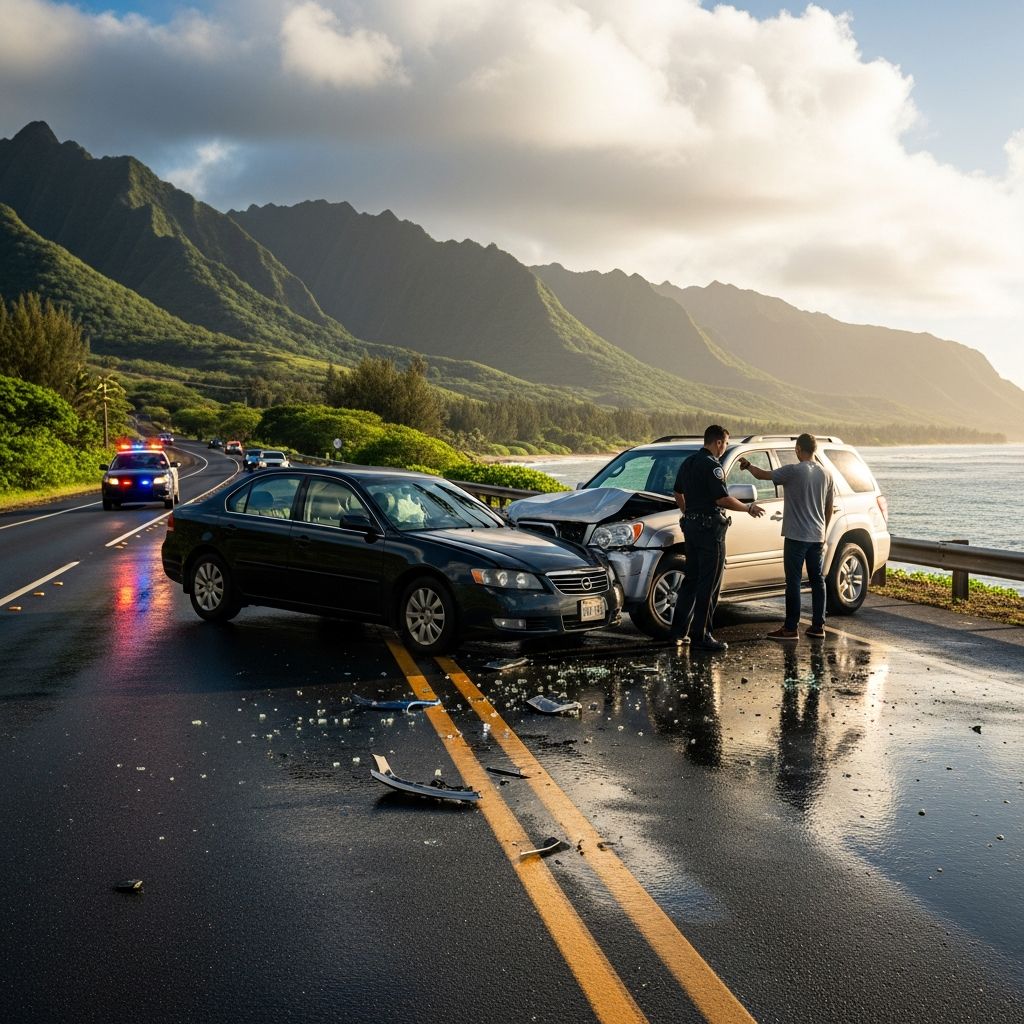
Hawaii’s car accident laws operate under a no-fault insurance framework, requiring all drivers to carry Personal Injury Protection (PIP) and liability coverage to handle injuries and damages from collisions. Recent updates effective January 1, 2026, raised minimum liability limits to 40/80/20, enhancing financial protection for accident participants.
Mandatory Insurance Requirements in Hawaii
Every vehicle registered in Hawaii must maintain specific auto insurance coverages to legally operate on public roads. This no-fault system prioritizes quick access to medical and wage benefits through your own policy before determining fault.
- Personal Injury Protection (PIP): Minimum $10,000 per person for medical expenses, rehabilitation, lost wages, and essential services, payable regardless of who caused the accident.
- Bodily Injury Liability: As of 2026, $40,000 per person / $80,000 per accident to cover injuries you cause to others.
- Property Damage Liability: Minimum $20,000 per accident for damages to vehicles or structures.
These requirements stem from Hawaii Revised Statutes (HRS) Chapter 431, Article 10C, mandating PIP under HRS § 431:10C-301 and defining benefits in HRS § 431:10C-103.5. Drivers without proof of insurance face fines up to $3,000, license suspension, registration revocation, and possible jail time for repeat offenses.
How No-Fault Insurance Functions After a Crash
In Hawaii’s no-fault environment, your PIP coverage serves as the first payer for accident-related costs. This means injured parties contact their own insurer promptly after a collision, submitting medical bills, wage statements, and proof of essential service needs.
PIP reimburses:
- Reasonable medical and rehabilitative treatments up to the policy limit.
- Up to 80% of lost income, capped by statute.
- Costs for household services if injuries prevent daily tasks.
Claims must follow HRS § 431:10C-308 procedures, including timely notification and documentation. Insurers review for necessity and eligibility, potentially denying improper submissions.
When Can You Sue for Additional Damages?
While PIP covers initial costs, Hawaii allows lawsuits for pain and suffering or excess damages if injuries meet ‘serious injury’ thresholds under HRS § 431:10C-306. Qualifying conditions include significant disfigurement, fractures, or permanent impairment that substantially limits life activities.
Below the threshold, no-fault rules bar non-economic damage claims, promoting settlements through insurance rather than courts. This balances rapid payouts with litigation control.
Filing Deadlines and Claim Procedures
Timely action is critical in Hawaii car accident cases. PIP claims require notification within 30 days of the accident, with benefits payable within 30 days of proof submission.
| Claim Type | Deadline | Key Statute |
|---|---|---|
| PIP Notification | 30 days from accident | HRS § 431:10C-308 |
| Liability/Personal Injury Lawsuit | 2 years from accident | HRS § 657-7 |
| Property Damage Claim | 2 years from accident | HRS § 657-7 |
Exceeding these limits generally forfeits rights to compensation. Victims should document the scene, seek medical attention, and notify insurers immediately.
Determining Fault in Hawaii Collisions
Hawaii applies modified comparative negligence, where fault percentages determine payout shares. If you’re 51% or more at fault, you recover nothing from the other party; otherwise, awards reduce by your fault share.
Factors influencing fault include traffic signals, speed, yielding, and road conditions. Police reports, witness accounts, and expert reconstructions aid determinations.
Steps to Take Immediately After a Hawaii Car Accident
- Ensure safety: Move vehicles if possible and activate hazard lights.
- Call 911 for injuries or major damage.
- Exchange information: Names, contacts, insurance details, and vehicle info with others involved.
- Document: Photos of scene, vehicles, injuries, and road conditions.
- Notify your insurer: File PIP claim promptly.
Avoid admitting fault or signing documents without legal review. Consult professionals for complex cases.
Compensation Available Beyond PIP
Once PIP exhausts, pursue liability claims against at-fault drivers for uncovered medical bills, lost earning capacity, pain, and property repairs. Uninsured/underinsured motorist coverage protects against inadequate opposing policies.
Optional add-ons like collision and comprehensive safeguard your vehicle, recommended for full protection despite not being mandatory.
Dispute Resolution for Denied Claims
Insurer denials trigger options under HRS Chapter 431: PIP disputes often go to arbitration, faster and cheaper than court. For liability matters, small claims court handles disputes under $5,000; higher amounts require circuit court.
Appeals follow insurer internal reviews, with hearings before the Insurance Commissioner if needed.
Recent Changes Impacting Hawaii Drivers
2026 legislation boosted minimum liability to 40/80/20 from prior 20/40/10 levels, addressing rising repair and medical costs. All policies renewing or starting post-January 1, 2026, comply.
Additionally, SB2026 mandates drivers slow and shift lanes when approaching stopped emergency vehicles on shoulders, reducing secondary crash risks.
Penalties for Non-Compliance
Driving uninsured incurs:
- Fines: Up to $3,000.
- License/registration suspension.
- Impoundment and reinstatement fees.
- Jail for repeats.
SR-22 filings prove future compliance for high-risk drivers.
Frequently Asked Questions About Hawaii Car Accident Laws
Is Hawaii a no-fault state?
Yes, Hawaii requires PIP coverage for your injuries regardless of fault, but allows lawsuits for serious injuries exceeding thresholds.
What are the new 2026 auto insurance minimums?
40/80/20 for liability plus $10,000 PIP, applying to all new/renewal policies from January 1, 2026.
Can I sue if my medical bills exceed PIP?
Yes, if injuries meet the serious injury threshold under HRS § 431:10C-306.
How long do I have to file a car accident lawsuit in Hawaii?
Two years for personal injury and property damage claims.
What happens if the at-fault driver is uninsured?
Your uninsured motorist coverage may apply if you carry it; otherwise, pursue the driver personally.
References
- Personal Injury Protection (PIP) Law in Hawaii – Complete Guide 2026 — HazenTech. 2026. https://hazentech.com/blogs/pip-law-in-hawaii/
- Hawaii car insurance laws and requirements: What is changing in 2026 — Insurance.com. 2026. https://www.insurance.com/auto-insurance/hawaii-car-insurance-laws/
- FAQ: AUTO INSURANCE MINIMUM LIMITS — Hawaii Insurance Division, cca.hawaii.gov. 2026-01. https://cca.hawaii.gov/ins/files/2026/01/Auto-Minimum-Limits-FAQs.pdf
- Bill Text: HI SB2026 | 2026 | Regular Session | Introduced — Hawaii State Legislature via LegiScan. 2026. https://legiscan.com/HI/text/SB2026/2026
- HI SB2026 | 2026 | Regular Session — Hawaii State Legislature via LegiScan. 2026. https://legiscan.com/HI/bill/SB2026/2026
Similar Articles








Read full bio of Sneha Tete


