
Handling Returned Checks: Legal Steps and Protections
Navigate the complexities of bounced checks with proven strategies for recovery, fees, and avoiding legal pitfalls across U.S. states.
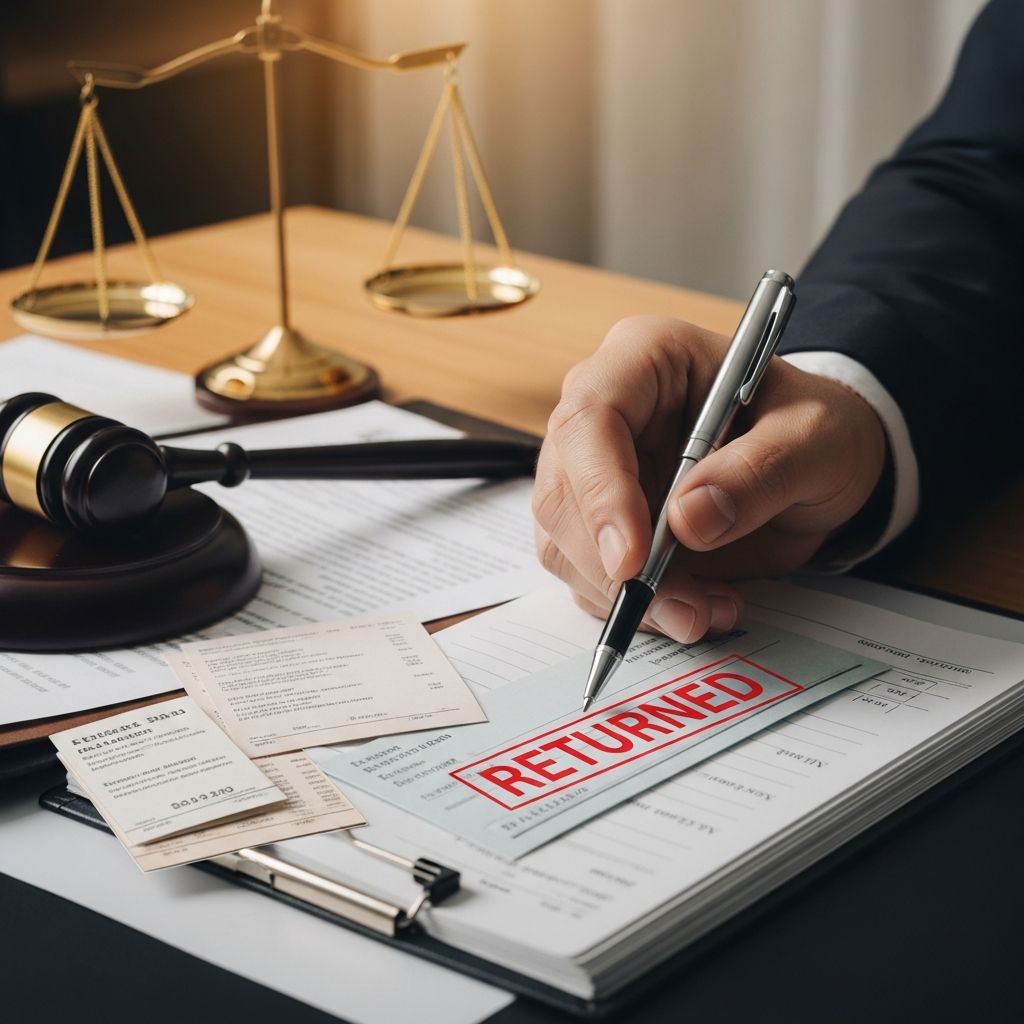
Returned checks, commonly known as bounced or NSF (non-sufficient funds) checks, pose significant challenges for businesses and individuals alike. When a check fails to clear due to inadequate account balance, it triggers a cascade of fees, potential legal actions, and strained relationships. This comprehensive guide explores the mechanics of bounced checks, immediate recovery actions, state-specific regulations, and preventive measures to safeguard your financial interests.
Understanding What Causes a Check to Bounce
A check bounces when the issuing bank declines payment because the drawer’s account lacks sufficient funds, has been closed, or due to other restrictions like a stop payment order. Unlike electronic transfers, paper checks rely on the payer’s bank balance at processing time, often 1-2 business days after deposit. According to banking standards, this delay can lead to unexpected shortfalls if the payer misjudges their balance.
- Common Triggers: Overdraft without coverage, account freezes, or forgotten transactions.
- Immediate Effects: Banks charge NSF fees typically ranging from $25 to $35 per incident, while merchants may add returned item fees of $20-$40.
These penalties compound quickly, making swift resolution critical for all parties involved.
Financial Consequences for Payers and Payees
For the payee (recipient), a bounced check means delayed payment, bank fees, and administrative hassle. Payees often absorb an NSF fee from their bank plus a merchant fee if applicable. In contrast, the payer (writer) faces their bank’s overdraft charge, potential account closure, and entry into shared databases like ChexSystems that flag bad check writers to future banks.
| Party | Typical Fees | Additional Risks |
|---|---|---|
| Payee | $25-$35 NSF + $20-$40 merchant fee | Delayed funds, collection efforts |
| Payer | $25-$35 overdraft/NSF | Account closure, credit impact if debt escalates, legal charges |
Bounced checks do not directly report to credit bureaus, but unpaid debts from them can if sent to collections. Repeated incidents may lead banks to restrict check-writing privileges or close accounts entirely.
Step-by-Step Recovery Process for Recipients
Act promptly upon notification of a bounced check—banks typically return it within days. Follow these structured steps to maximize recovery chances:
- Review Bank Notice: Confirm the reason (NSF, account closed) and note any fees deducted from your account.
- Contact the Payer: Send a formal demand letter via certified mail requesting payment within 10-30 days, including the original check copy, bank notice, and calculated fees. Specify total due: check amount + your fees + reasonable admin costs.
- Resubmit if Appropriate: For smaller amounts, redeposit once if you suspect a temporary issue, but verify funds first to avoid repeat fees.
- Engage Collections: If no response, forward to a collection agency specializing in bad checks; they often work on contingency.
Document every communication to build a case for escalation. In many states, written notice creates a presumption of intent if unpaid.
State Variations in Bad Check Regulations
Laws governing bounced checks differ significantly by state, blending civil remedies with criminal penalties. While not all bounced checks qualify as crimes—requiring proof of knowledge and no legitimate account—many offer enhanced civil recovery.
- Maryland: Criminal bad check suits require immediate goods/services exchange (e.g., not rent/utilities). Otherwise, pursue civil claims in District Court.
- Ohio: Civil actions under ORC 2307.61 allow triple damages (max $200 or 3x check value), admin fees, attorney costs, and court expenses if payer ignores 30-day notice.
- Florida: Chapter 832.05 criminalizes knowing issuance; misdemeanor under $150, third-degree felony at $150+. Penalties include fines up to $5,000 and jail time.
Always consult state statutes or local courts, as some cap fees (e.g., $40 max merchant fee) or mandate pre-suit notices.
Criminal vs. Civil Pathways: When to Escalate
Not every bounced check warrants police involvement; many resolve civilly. Criminal charges apply when intent to defraud is evident—knowingly writing without funds and ignoring dishonor notice.
- Criminal Threshold: Varies; e.g., Florida felonies for $150+, misdemeanors below. Prosecutors prioritize patterns or large sums.
- Civil Advantages: Faster, recoverable multiples (Ohio’s 3x), no proof of intent needed beyond notice failure. File in small claims for efficiency.
- Defenses for Payers: Accidental overdraft, prompt repayment post-notice, or bank errors. Courts may dismiss if paid within statutory windows.
Businesses often use civil suits for deterrence, recovering far beyond principal via statutes like Ohio’s.
Preventing Bounced Checks in Business Operations
Proactive policies minimize risks for merchants and professionals accepting checks:
- Implement check verification services (e.g., TeleCheck) pre-acceptance.
- Require ID, phone verification, or limit check amounts.
- Post clear policies: “$35 fee for returned checks; prosecution possible.”
- Shift to digital: Promote ACH, cards, or apps like Venmo for instant verification.
Monitoring tools and overdraft alerts help payers avoid pitfalls. Banks increasingly offer free overdraft protection transfers from savings.
Impact on Credit, Accounts, and Long-Term Finances
While isolated bounces skip credit reports, escalation to collections or judgments damages scores. Account closures via ChexSystems block new openings for 5 years. Legal convictions appear on criminal records, affecting employment. Payers should prioritize repayment plans offered in notices to halt penalties.
Frequently Asked Questions
Can a cashier’s check bounce?
No, legitimate cashier’s checks draw from bank funds, not the purchaser’s, if from insured institutions.
Is bouncing a check always illegal?
No—accidental NSF is civil; knowing issuance with no repayment intent is criminal (misdemeanor/felony by state/amount).
How long to sue for a bad check?
Statutes of limitations vary (2-6 years); send demand notice first to preserve triple damages claims.
Do bounced checks affect credit?
Not directly, but unpaid debts to collections do; prevent by resolving quickly.
What if the check writer disputes fees?
Courts award reasonable admin/attorney fees if statutes allow and notice complied with.
Best Practices for Resolution and Dispute Avoidance
Mediation or payment plans often succeed pre-court. Payers: Update balances via apps, enable alerts. Payees: Invoice digitally, verify large checks. In disputes, gather bank statements proving dishonor timing. These steps preserve relationships while enforcing rights.
(Word count: 1678)
References
- Bad Checks – Maryland Courts — Maryland Courts. Accessed 2026. http://www.mdcourts.gov/legalhelp/badchecks
- A Primer on Bounced Check Penalties Available Under Ohio Civil Law — Weltman. Accessed 2026. https://www.weltman.com/publication-a-primer-on-bounced-check-penalties-available-under-ohio-civil-law
- What Is a Bounced Check? — Citi. Accessed 2026. https://www.citi.com/banking/personal-banking-guide/basic-finance/what-is-a-bounced-check
- Bounced Checks and Legal Defense — The Hoffman Firm. Accessed 2026. https://www.thehoffmanfirm.net/blog/bounced-checks-and-legal-defense
- Bounced Check: The True Costs and What You Can Do — NerdWallet. 2023-10-01. https://www.nerdwallet.com/banking/learn/true-cost-of-a-bounced-check
- What is a Bounced Check — PNC Insights. Accessed 2026. https://www.pnc.com/insights/personal-finance/spend/what-is-a-bounced-check.html
Similar Articles








Read full bio of Sneha Tete


