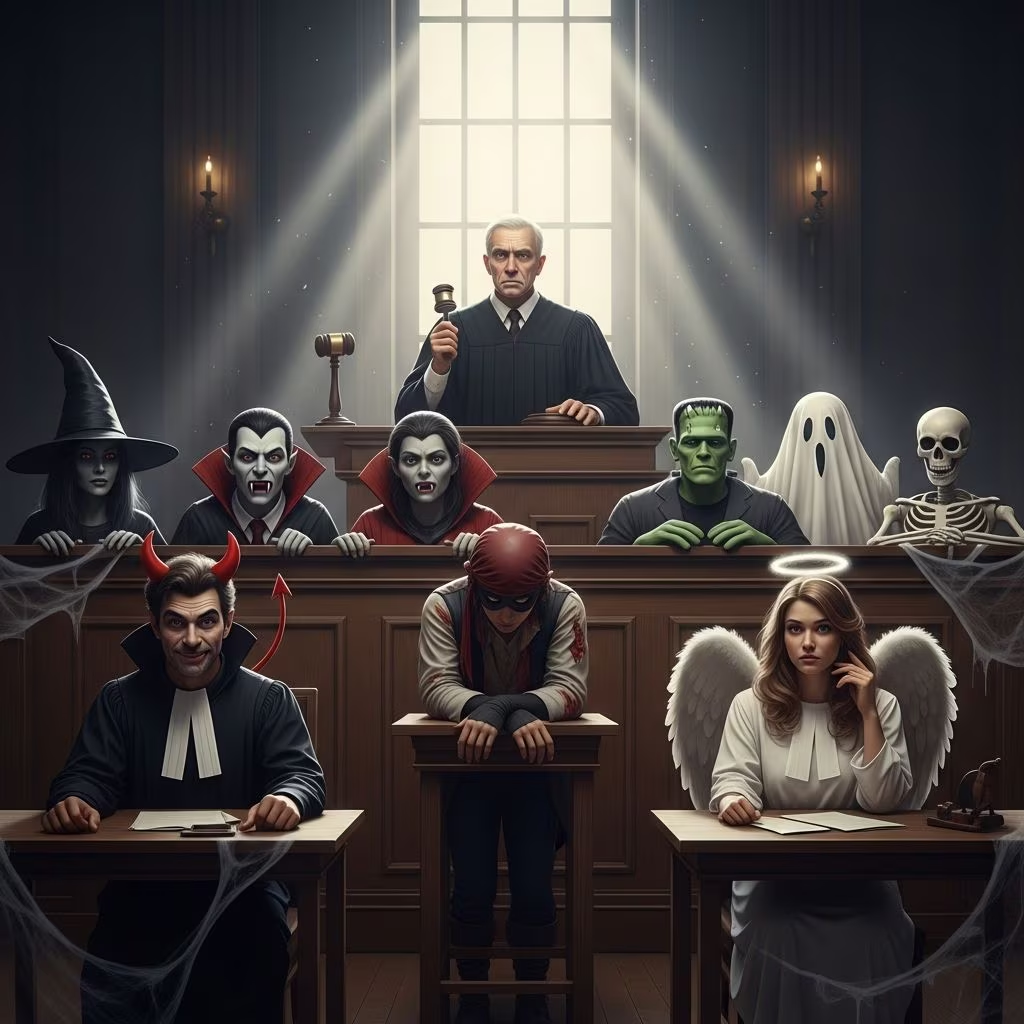
When Halloween Entertainment Becomes a Legal Nightmare
Halloween represents one of America’s most anticipated celebrations, a time when families gather, children dress in costumes, and communities host elaborate events designed to entertain and frighten. However, beneath the surface of fun and festivity lie several cautionary tales where Halloween activities resulted in serious legal consequences. These cases reveal how entertainment venues, manufacturers, and individuals can face substantial liability when safety precautions are inadequate or products fail to perform as expected. The intersection of holiday celebration and legal accountability has produced some of the most unusual and thought-provoking courtroom battles in American legal history.
The Dangerous Intersection of Homemade Costumes and Flammability
One of the most notable cases in Halloween litigation history involves a couple whose creative costume choice led to severe physical injury and a multi-year legal battle. Frank and Susan Ferlito attended a Halloween costume party in 1984, with Frank dressed as a lamb to complement his wife’s Mary costume. Rather than purchasing a ready-made costume, Susan constructed the lamb outfit using cotton balls manufactured by Johnson & Johnson Products, affixing them to long underwear with glue. During the festivities, Frank lit a cigarette, and the cotton balls immediately ignited, engulfing his costume in flames and causing severe burns to approximately one-third of his body.
The Ferlitos pursued a lawsuit against Johnson & Johnson, claiming the manufacturer failed to provide adequate warnings about the flammability of their cotton products. The case hinged on product liability and whether consumers could reasonably expect cotton to be flammable when used in clothing applications. A jury initially sided with the plaintiffs, awarding Frank $555,000 and Susan $70,000 in damages. However, this decision did not represent the final resolution of the dispute.
The manufacturer appealed the verdict, and in 1991, Johnson & Johnson successfully petitioned for a new trial. The appeals process revealed critical complications in the plaintiffs’ case. Both Frank and Susan admitted knowing that cotton burns when exposed to flames, undermining their argument that the product lacked adequate warnings. Furthermore, Frank acknowledged ignoring warning labels on cigarette packages, suggesting that additional warnings would not have altered his behavior during the party. The Court of Appeals for the Sixth Circuit ultimately ruled in favor of Johnson & Johnson in 1992, fundamentally changing the trajectory of the litigation.
This case established important precedents regarding consumer responsibility and the limits of manufacturer liability. It demonstrated that courts would not hold companies entirely accountable for injuries resulting from consumer misuse of products, even when those products were used in unconventional ways for costume creation.
The Frightening Reality of Inadequately Safe Haunted Houses
Haunted houses represent a staple of Halloween entertainment, designed to deliver controlled scares and atmospheric terror to willing participants. However, the line between appropriate fright and dangerous negligence became the central question in a case that fundamentally challenged how venues manage attraction safety. In October 1999, Deborah Mays entered a haunted house attraction operated by Gretna Athletic Boosters Inc. in Louisiana, expecting the typical thrills associated with such venues. The experience proved far more injurious than anticipated.
During her journey through the darkened corridors and frightening scenarios, Mays sustained a broken nose, an injury that raised significant questions about the venue’s responsibility to patrons. Her legal team pursued negligence charges, asserting that the haunted house operators failed to implement adequate safety measures or proper crowd management protocols that could have prevented her injury. The case forced courts to examine where venues draw the boundary between exciting entertainment and reckless endangerment.
This lawsuit highlighted ongoing tensions in the entertainment industry regarding liability for injuries occurring at attractions explicitly designed to frighten and disorient visitors. Haunted house operators must balance creating compelling entertainment experiences with implementing reasonable safety protocols. The case raised important questions about whether patrons who knowingly enter such venues assume certain risks, and whether operators bear responsibility for injuries that occur despite the inherent nature of the attraction.
Intellectual Property Disputes in the Costume Manufacturing Industry
Beyond physical injuries, Halloween has spawned unexpected litigation in the realm of intellectual property and trademark protection. Rasta Imposta, a costume manufacturer, engaged in a multi-year copyright battle with Kangaroo Manufacturing over a distinctive banana costume design. The dispute, which reached federal court in Camden, New Jersey, illustrates how even seemingly whimsical products can generate serious legal questions regarding design originality and trademark rights.
In 2017, Rasta Imposta sued Kangaroo Manufacturing, alleging that the competitor was producing and distributing banana costumes that directly infringed upon their existing design. The lawsuit centered on specific design elements, including the distinctive color palette and particular shape characteristics that Rasta Imposta claimed made their banana costume uniquely recognizable in the marketplace. As the case progressed through the federal courts, judges examined whether these design features constituted protectable intellectual property or merely represented obvious design choices that any costume manufacturer might reach independently.
The 3rd U.S. Circuit Court of Appeals in Philadelphia ultimately sided with Rasta Imposta, affirming in 2019 that their banana costume design possessed sufficient distinctive characteristics to merit copyright protection. The court’s decision included notably colorful language, observing that the company was “entitled to the veritable fruits of its intellectual labor.” This ruling established important precedent regarding how design-based intellectual property receives protection in the costume manufacturing industry, even when the products themselves appear simple or obvious to casual observers.
Additional Notable Halloween-Related Legal Disputes
Beyond these three prominent cases, the landscape of Halloween litigation includes several other fascinating examples that demonstrate the diverse ways in which holiday celebrations can generate legal conflict.
The Tombstone Expression Case
Property owners occasionally use Halloween as an opportunity to create elaborate yard displays featuring tombstones with humorous or satirical inscriptions. This creative impulse led to legal troubles when one homeowner’s tombstone messages referenced actual neighbors in negative or insulting ways. The inscriptions included statements such as “Here Lies Jimmy, the Olde Towne idiot, mean as sin even without his gin, no longer does he wear that stupid old grin . . . Oh no, not where they’ve sent him! -1690-” Neighbors who recognized themselves in these inscriptions filed complaints with local law enforcement.
When police ordered the property owner to remove the offensive tombstones, he initially refused, citing First Amendment protections for personal expression. The case ultimately required the homeowner to compromise by covering the identifying names with duct tape, illustrating the tension between creative expression rights and community standards regarding respectful conduct.
Corn Maze Mishap Litigation
Gracie Gail Durmon experienced a frightening incident while navigating a scary corn maze attraction when a performer dressed as Jason Voorhees from the horror film “Friday the 13th” approached her with a chainsaw prop. Startled by the encounter, Durmon attempted to flee but slipped on muddy ground, sustaining a broken leg. She subsequently sued the maze operators for negligence regarding the muddy conditions.
The court ruled against Durmon, determining that muddy conditions at an outdoor corn maze attraction represent an obvious and expected environmental factor. Judges noted that visitors who enter attractions specifically designed to frighten participants assume certain inherent risks associated with those experiences. This decision reinforced the principle that operators of fear-based attractions cannot be held liable for injuries resulting from conditions obviously associated with the attraction’s nature.
Key Lessons From Halloween Legal Disputes
The collection of Halloween-related lawsuits provides valuable insights for multiple constituencies, including manufacturers, entertainment venue operators, and consumers themselves.
- Product Safety Responsibility: Manufacturers cannot be held entirely responsible for injuries resulting from misuse of products, but they must provide reasonable warnings about foreseeable risks and ensure products meet basic safety standards for their intended use.
- Assumption of Risk: Patrons who voluntarily enter attractions explicitly designed to frighten them assume certain inherent risks, limiting operator liability for injuries directly resulting from those frightening experiences.
- Design Protection: Even seemingly simple costume designs can receive intellectual property protection if they possess distinctive characteristics that differentiate them from standard alternatives in the marketplace.
- Free Expression Boundaries: While individuals possess First Amendment rights to creative expression, those rights do not extend to personally insulting neighbors through public displays, even during Halloween celebrations.
- Environmental Conditions: Attractions that occur in outdoor or naturally hazardous environments may not be liable for injuries resulting from foreseeable environmental conditions when visitors knowingly enter such spaces.
The Evolution of Halloween Safety Standards
As Halloween celebrations have become increasingly elaborate and commercialized, legal standards surrounding participant safety have evolved accordingly. Courts have gradually developed clearer frameworks for determining when operators bear responsibility for injuries and when patrons assume inherent risks. These evolving standards attempt to balance the entertainment industry’s need to create compelling, frightening experiences with reasonable expectations that venues will implement basic safety protocols.
Modern haunted house operators, corn maze attractions, and other Halloween venues increasingly implement comprehensive liability waivers, staff training programs, and safety inspections to reduce legal exposure. Costume manufacturers have become more attentive to flammability standards and appropriate warning labels. These developments reflect how litigation outcomes have influenced industry practices, gradually raising baseline safety expectations across the Halloween entertainment sector.
Insurance and Risk Management in Halloween Entertainment
The litigation surrounding Halloween activities has significantly impacted how entertainment venues approach insurance and risk management. Operators now routinely obtain comprehensive liability coverage, implement thorough participant screening processes, and require liability waivers before allowing entry to attractions. Insurance companies have developed specialized policies for Halloween entertainers that account for the unique risks associated with fear-based entertainment.
These risk management approaches have created a more standardized, cautious approach to Halloween entertainment. While some argue this reduces spontaneity and creative freedom, others contend it represents a necessary evolution toward more responsible entertainment practices. The balance between thrilling entertainment and participant safety continues to evolve as legal precedents accumulate.
Frequently Asked Questions About Halloween Lawsuits
Q: Can haunted house operators be held liable for all injuries occurring at their attractions?
A: No. Courts have consistently ruled that participants who knowingly enter fear-based attractions assume certain inherent risks. Operators are typically not liable for injuries resulting from environmental conditions or frightening scenarios that are essential to the attraction’s purpose, but they must implement reasonable safety protocols and warn of unusual hazards.
Q: What warnings must product manufacturers provide regarding flammability?
A: Manufacturers must provide warnings appropriate to foreseeable uses of their products. For items like cotton balls that might reasonably be used in costumes, manufacturers should include flammability warnings. However, manufacturers are not responsible if consumers misuse products contrary to provided warnings.
Q: Can costume designs be protected by copyright?
A: Yes. If costume designs possess distinctive characteristics that differentiate them from standard alternatives, they can receive copyright protection. Courts examine the specific design elements to determine whether sufficient originality exists to warrant protection.
Q: Are liability waivers enforceable at Halloween attractions?
A: Generally, yes, provided they are clearly written, conspicuously displayed, and do not attempt to waive liability for gross negligence or intentional harm. Courts recognize that participants voluntarily entering fear-based attractions can reasonably assume risks inherent to those experiences.
Q: What recourse exists if someone is injured at a Halloween event?
A: Injured parties can pursue negligence claims if they can demonstrate that the operator or manufacturer failed to exercise reasonable care, resulting in their injury. However, courts will consider whether the injured party assumed inherent risks by voluntarily participating in the activity.
References
- The Top 5 Halloween Lawsuits — Mintz and Geftic Law Firm. Accessed January 2026. https://mintzandgeftic.com/top-halloween-lawsuits/
- 6 Bizarre Halloween-Related Lawsuits — Mental Floss. 2020. https://www.mentalfloss.com/article/629869/bizarre-halloween-lawsuits
- Four Bizarre but Real Halloween Lawsuits — PA Legal Advice. Accessed January 2026. https://www.palegaladvice.com/blog/halloween-lawsuits/