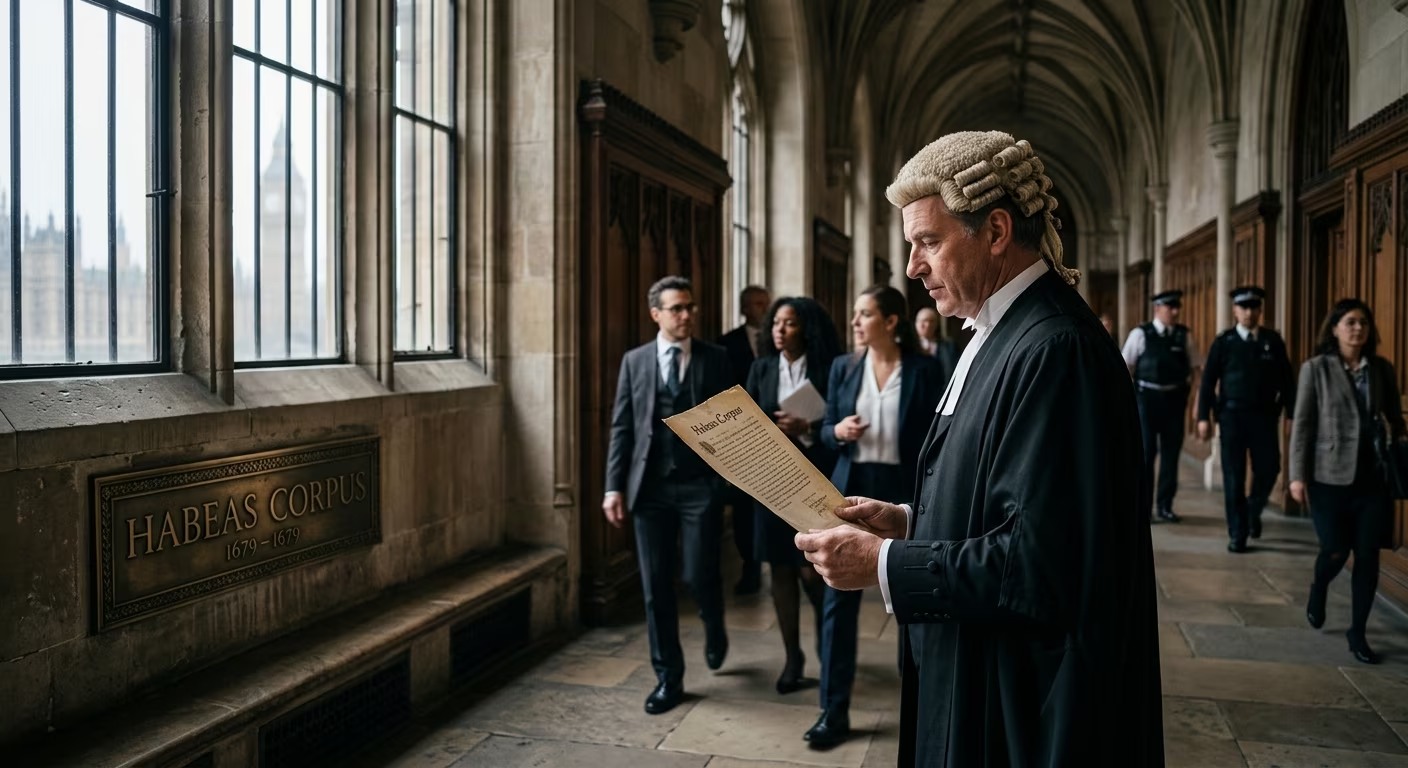
Few legal concepts resonate with the same profound historical weight and contemporary urgency as the writ of habeas corpus. Translated from Latin as “that you have the body,” this ancient legal doctrine serves as the ultimate safeguard against arbitrary state power and unlawful imprisonment. At its core, habeas corpus is a judicial mandate demanding that a prisoner be brought before a court so a judge can determine whether the government has the lawful authority to detain them. Without this mechanism, the fundamental right to liberty would be little more than a theoretical promise, easily discarded by overreaching executives or unchecked security apparatuses. As nations grapple with international terrorism and border security, the relevance of the “Great Writ” has never been more pronounced. This article explores the historical evolution of habeas corpus, its fundamental mechanics, its collision with modern national security policies, and its indispensable role globally.
From the Meadows of Runnymede to the Constitution
The story of habeas corpus begins on the marshy plains of Runnymede, England, in 1215. Facing a fierce rebellion from his barons, King John was forced to affix his seal to the Magna Carta, a document that inadvertently became the cornerstone of constitutional governance. While the original Magna Carta was largely a pragmatic peace treaty, its 39th clause introduced a revolutionary principle. It declared that no free man could be seized, imprisoned, stripped of his rights, outlawed, or exiled except by the lawful judgment of his equals or by the law of the land.
Over subsequent centuries, this broad principle of due process evolved within English common law into the specific procedural writ of habeas corpus. It transformed gradually from a royal prerogative—used by the monarch to compel the presence of subjects—into a weapon wielded by subjects to challenge the crown’s authority. The English Habeas Corpus Act of 1679 formally codified these procedures, cementing the writ as an indispensable check on the monarchy.
When the framers of the United States Constitution convened in Philadelphia in 1787, they were acutely aware of the dangers of unchecked executive power. Recognizing the Great Writ’s importance, they enshrined it directly into the new republic’s foundational document. Article I, Section 9, Clause 2, known as the Suspension Clause, explicitly states: “The Privilege of the Writ of Habeas Corpus shall not be suspended, unless when in Cases of Rebellion or Invasion the public Safety may require it.” By restricting its suspension to the most extreme threats, the framers ensured habeas corpus would remain a permanent fixture of American jurisprudence.
The Mechanics of the Great Writ
Understanding exactly how habeas corpus functions is crucial to appreciating its power. A habeas corpus proceeding is not a trial to determine a defendant’s guilt or innocence regarding a specific crime. Instead, it operates as an independent civil action filed against the state agent—usually a prison warden or military commander—who holds the petitioner in custody.
When a petition is formally filed, the court evaluates the legal and constitutional basis for the detention. The burden shifts to the state to justify the imprisonment. If the government cannot demonstrate a valid legal justification, the judge must order the prisoner’s immediate release. This process acts as an emergency brake on state overreach, allowing individuals to bypass the protracted appellate system when their fundamental liberty is at stake.
Comparing Habeas Corpus and Direct Appeals
| Feature | Habeas Corpus Petition | Direct Legal Appeal |
|---|---|---|
| Primary Purpose | To challenge the fundamental legality of the detention itself. | To correct procedural or legal errors made during a trial. |
| Nature of the Case | An independent civil lawsuit against the detaining authority. | A continuation of the original criminal trial process. |
| Timing of Filing | Can be filed after direct appeals are exhausted, or immediately for uncharged detentions. | Must be filed within strict timeframes immediately following a conviction. |
| Scope of Evidence | Can introduce new evidence not presented during the original trial. | Strictly limited to the established record and transcripts of the trial. |
The National Security Stress Test
The true test of any legal principle is how it withstands the pressures of national crisis. The September 11, 2001, terrorist attacks precipitated one of the most severe crises in modern American history, prompting a radical reevaluation of national security policies and shifting the balance between civil liberties and public safety.
In the aftermath of the attacks, the United States government implemented aggressive counterterrorism strategies worldwide. This included the capture and indefinite detention of suspected terrorists without formal charge or trial. The centerpiece of this extrajudicial strategy was the establishment of the detention facility at the Guantanamo Bay Naval Base in Cuba. The executive branch argued that because Guantanamo Bay was technically under Cuban sovereignty, the detainees held there were entirely outside the jurisdiction of U.S. federal courts. Consequently, the government asserted, these individuals possessed no legal right to file habeas corpus petitions.
This legal maneuvering attempted to create a “law-free zone,” where individuals could be held in perpetuity based purely on executive fiat. The legislative branch initially supported this controversial approach. In 2006, Congress passed the Military Commissions Act, which explicitly stripped federal courts of the statutory jurisdiction to hear habeas applications from alien detainees designated as “enemy combatants.”
A Watershed Ruling: Boumediene v. Bush
The coordinated legislative and executive efforts to bypass the Great Writ culminated in one of the most legally significant Supreme Court cases of the modern era: Boumediene v. Bush (2008). The case involved Lakhdar Boumediene and several other Algerian natives who had been seized by local police in Bosnia and subsequently handed over to U.S. forces, eventually being transported to Guantanamo Bay based on suspicion of plotting against the U.S. embassy.
The monumental question before the Court was whether the Military Commissions Act of 2006 unconstitutionally suspended the writ of habeas corpus for these detainees. In a divided 5-4 decision, the Supreme Court ruled in favor of the detainees, striking a major blow against unchecked executive authority. Justice Anthony Kennedy, writing the majority opinion, delivered a forceful defense of the constitutional separation of powers and the indispensable role of an independent judiciary.
The Court held that despite Cuba’s formal sovereignty over the territory, the United States exercised complete jurisdiction and control over the Guantanamo Bay naval base. Therefore, the constitutional privilege of habeas corpus extended fully to the non-citizen detainees held there. Furthermore, the Court firmly ruled that the alternative procedures established by the Military Commissions Act were inadequate substitutes for a traditional habeas corpus hearing. Boumediene served as a resounding reaffirmation that constitutional protections do not simply vanish when the government operates beyond the nation’s immediate borders.
International Perspectives on Arbitrary Detention
While habeas corpus is deeply rooted in Anglo-American legal tradition, the underlying right to challenge arbitrary detention is universally recognized. The international community, reeling from the horrific atrocities of the Second World War, prioritized the codification of this right in its foundational global treaties.
The cornerstone of this framework is the International Covenant on Civil and Political Rights (ICCPR), a pivotal multilateral treaty adopted by the United Nations General Assembly in 1966. Article 9 explicitly guarantees the right to liberty and security of person, forcefully stating: “No one shall be subjected to arbitrary arrest or detention. No one shall be deprived of his liberty except on such grounds and in accordance with such procedure as are established by law.”
Crucially, Article 9(4) of the ICCPR perfectly mirrors the functional mechanics of habeas corpus on a global scale. It dictates that anyone deprived of liberty by arrest or detention shall be entitled to take proceedings before a court, ensuring that the court may decide without delay on the lawfulness of the detention and order a release if the detention is deemed unlawful.
Despite binding international commitments, arbitrary detention remains a pervasive issue globally. Authoritarian regimes frequently utilize vague national security laws and administrative confinement to violently silence political dissidents and vulnerable minority groups. In these oppressive contexts, the absence of an independent judiciary renders the promise of Article 9 hollow, underscoring that legal texts are only as powerful as the institutions enforcing them.
The Ongoing Struggle to Preserve Liberty
The legacy of the Great Writ is not a static relic of a bygone era, but a living legal doctrine requiring constant defense. Governments are perpetually tempted to circumvent judicial oversight in the name of political expediency or perceived national security threats. The inherent tension between a state’s duty to protect its citizens and its moral obligation to respect individual liberties remains a defining feature of democratic governance.
Today, complex battles over habeas corpus continue in various modern arenas. We see the doctrine invoked in debates regarding the conditions of overcrowded immigration detention centers, the rights of individuals held under involuntary psychiatric commitment laws, and the extent of executive emergency powers during unprecedented public health crises. In each scenario, the writ serves as the ultimate tool for marginalized groups to demand visibility, fairness, and accountability.
Safeguarding habeas corpus for future generations demands rigorous civic education, an uncompromising commitment to judicial independence, and a vigilant legal community prepared to aggressively challenge state overreach. The core principle that no individual can be locked away in darkness without having their day in court is the bedrock upon which all other civil rights rest.
Frequently Asked Questions (FAQ)
What is the literal translation of “habeas corpus”?
The phrase is Latin for “that you have the body.” In a formal legal context, it refers to a specific writ requiring a person under arrest to be physically brought before a judge or into a courtroom. This ensures that the individual’s imprisonment or detention is lawful and justified by the state, rather than being an arbitrary exercise of power.
Can the United States government legally suspend the writ of habeas corpus?
Yes, but only under highly specific and extraordinarily rare circumstances. The Suspension Clause of the U.S. Constitution (Article I, Section 9, Clause 2) dictates that the writ shall not be suspended “unless when in Cases of Rebellion or Invasion the public Safety may require it.” A famous historical instance of its suspension occurred during the American Civil War, authorized by President Abraham Lincoln.
Does habeas corpus only apply to standard criminal cases?
No. While it is most frequently utilized by prison inmates challenging the legality of their criminal convictions or the conditions of their confinement, it is fundamentally a civil remedy. It can be utilized in situations involving the deprivation of personal liberty, such as challenging prolonged immigration detention, contesting involuntary civil commitment, and questioning the legality of military detentions.
How did the Boumediene v. Bush decision impact national security policy?
The 2008 Supreme Court ruling in Boumediene v. Bush significantly curbed unchecked executive power by ruling that non-citizen terrorism suspects held at the Guantanamo Bay facility have a constitutional right to challenge their detention in U.S. federal courts. It firmly established that the executive branch cannot deliberately create geographic zones devoid of constitutional protections to avoid judicial scrutiny.
How does international law view the concept of habeas corpus?
While international law may not always employ the precise Latin terminology, the underlying right to challenge arbitrary detention is universally recognized as a cornerstone of human rights. Treaties like the International Covenant on Civil and Political Rights (ICCPR) mandate that anyone deprived of their liberty has the absolute right to prompt, fair judicial review of their detention status.
References
- Magna Carta Translation — National Archives and Records Administration. https://www.archives.gov/exhibits/featured-documents/magna-carta/translation.html
- Boumediene v. Bush — Oyez, Chicago-Kent College of Law at Illinois Tech. https://www.oyez.org/cases/2007/06-1195
- International Covenant on Civil and Political Rights — Office of the United Nations High Commissioner for Human Rights (OHCHR). 1966-12-16. https://www.ohchr.org/en/instruments-mechanisms/instruments/international-covenant-civil-and-political-rights