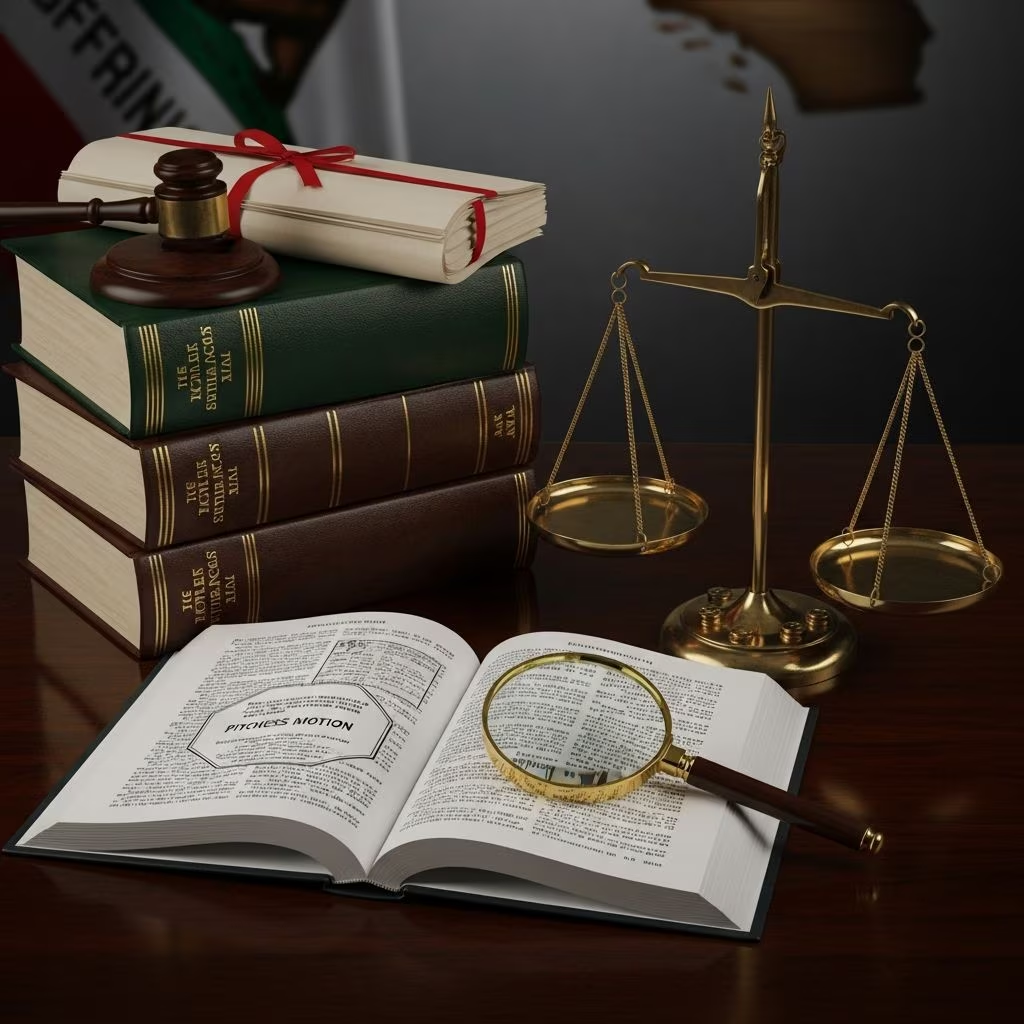
A Pitchess motion is a discovery tool that allows a California criminal defendant to ask a court for access to certain confidential law enforcement personnel records when those records may contain evidence of misconduct relevant to the defense. These requests are governed primarily by California Evidence Code sections 1043–1047 and are rooted in the California Supreme Court case Pitchess v. Superior Court (1974). Evidence Code provisions codified the judicial doctrine created in that case, balancing officer privacy rights with a defendant’s right to obtain exculpatory and impeachment evidence.
1. Why Pitchess Motions Exist
Law enforcement personnel files are generally confidential under California law, especially records relating to internal investigations, discipline, and citizen complaints. At the same time, due process requires that defendants have a meaningful opportunity to challenge the credibility of officers whose testimony is used against them, and to obtain evidence that could support defenses such as self-defense, mistaken identity, or fabrication.
The Pitchess procedure is designed to balance these interests by:
- Protecting privacy of peace officers and sensitive government information.
- Allowing limited access to information that is specifically relevant to the case and supported by a factual showing.
- Having a judge first review the records in camera (privately) before any information is disclosed to the defense.
2. What a Pitchess Motion Can Reveal
A successful Pitchess motion does not open an officer’s file completely. Instead, it typically leads to disclosure of narrowly tailored information that could help the defense. Common categories include:
- Prior findings or credible complaints of excessive force during arrests or detentions.
- Allegations of dishonesty, such as falsifying reports, fabricating evidence, or lying under oath.
- Evidence of bias, including racial, ethnic, religious, or other discriminatory conduct in policing.
- Other misconduct involving moral turpitude that could affect credibility.
These records are often used to:
- Impeach an officer’s credibility at trial.
- Support a motion to suppress evidence (for example, by showing a pattern of unlawful searches or coercive tactics).
- Corroborate the defendant’s version of events, such as claims of excessive force or fabrication of charges.
3. Legal Foundation: Evidence Code 1043–1047
California Evidence Code sections 1043–1047 describe how parties may seek discovery of peace officer personnel records and the standards courts must apply.
| Evidence Code Section | Core Function in Pitchess Process |
|---|---|
| § 1043 | Sets out the formal requirements for a written motion, notice to the agency, and the need for an affidavit showing good cause and materiality. |
| § 1044 | Recognizes the court’s authority to issue protective orders to limit disclosure and protect statutory privileges. |
| § 1045 | Governs the in camera review process, time limits on discoverable records, and categories of information that must or may be disclosed. |
| § 1047 | Addresses when records of officers who were not present during the incident may be shielded from discovery. |
The statute gives courts discretion but also directs them to exclude certain sensitive information—such as conclusions of officers investigating complaints—and limit disclosure to material that is relevant and reasonably necessary to the case.
4. Step-by-Step: How a Pitchess Motion Works
4.1 When to File
A Pitchess motion is a pretrial motion. It may be filed any time after charges are brought and before trial, though many defense attorneys file early to allow time for follow-up investigation if the motion is granted.
4.2 Required Contents of the Motion
Under Evidence Code section 1043, the written motion generally must include:
- The name of the officer whose records are requested and the agency that holds the records.
- The time and place of the hearing on the motion.
- A description of the kinds of records sought (e.g., complaints of excessive force, dishonesty, bias).
- A statement made on reasonable belief that the agency has the information requested.
- An affidavit or declaration showing:
- How the requested records are material to the case, and
- Why there is good cause to believe the records may contain relevant misconduct.
The supporting declaration often lays out a specific defense theory (for example, unlawful arrest or fabrication of charges) and ties that theory to alleged conduct by the officer that may be reflected in prior complaints or discipline.
4.3 Notice and Service Requirements
The moving party must serve the law enforcement agency that maintains the records at least 10 court days before the scheduled hearing. The agency, usually represented by a city or county attorney, may file a written opposition and is typically required to respond at least five court days before the hearing.
4.4 The Good-Cause Standard
Courts use the “good cause” test to decide whether to proceed to in camera review. This requires more than speculation. The declaration should:
- Present a plausible factual scenario that supports the defense theory.
- Link that scenario to specific types of officer misconduct (for example, excessive force or dishonesty).
- Explain why the requested records could reasonably be expected to contain information bearing on that issue.
If the defendant’s factual showing is internally consistent and connected to the alleged misconduct, many courts will find good cause to conduct in camera review, even if the defendant cannot prove those allegations at the motion stage.
4.5 In Camera Review by the Judge
If good cause is established, the court moves to an in camera review under Evidence Code section 1045. During this closed hearing:
- The judge meets with the custodian of records from the agency and, often, counsel for the agency.
- Defense counsel and the prosecutor are excluded from viewing the raw personnel file.
- The judge examines records that fall within the categories requested (and within statutory time limits, often focusing on the prior five years of complaints).
After reviewing the file, the court determines which (if any) complaints or materials are relevant and discoverable. Typically, the judge orders disclosure of limited information such as:
- Names and contact information of prior complainants or witnesses.
- Dates and brief descriptions of prior incidents that resemble the alleged misconduct in the current case.
4.6 Protective Orders and Scope of Use
Any disclosure is usually subject to a protective order, which can restrict how the defense may use or further disseminate the information. Courts often limit use to the pending criminal case and prohibit public disclosure of underlying documents.
5. Impact of SB 1421 and Related Transparency Laws
California’s public records law historically exempted most police personnel records from disclosure to the public. Senate Bill 1421, which amended Penal Code section 832.7, created broad public access to certain categories of serious police misconduct and critical incidents, such as officer-involved shootings, some uses of force causing death or serious injury, sustained findings of sexual assault, and sustained findings of dishonesty related to the reporting, investigation, or prosecution of crimes.
These changes mean that:
- Some records that once required a Pitchess motion may now be obtained through public records requests if they fall into SB 1421’s categories.
- Defense attorneys often use both tools: they may pursue a public records request for SB 1421-covered documents and still file a Pitchess motion for other types of complaints or older incidents that remain confidential.
Importantly, SB 1421 did not repeal or replace the Pitchess framework. For records outside the specific statutory categories of public disclosure, the Pitchess motion remains the required route to gain access in a criminal case.
6. Strategic Uses in Criminal Defense
Defense counsel often consider a Pitchess motion when the case hinges on the officer’s credibility or when the defendant alleges misconduct in the encounter leading to the charges. Common scenarios include:
- Conflicting accounts of whether the defendant resisted arrest or whether the officer used unnecessary force.
- Disputed probable cause for a stop, search, or arrest.
- Cases where the only direct evidence of the defendant’s guilt comes from the testifying officer, with little or no corroboration.
- Allegations that evidence was planted or that statements were coerced.
When successful, information revealed through Pitchess discovery may support:
- A motion to suppress evidence based on violations of the Fourth or Fifth Amendments.
- Cross-examination designed to impeach the officer’s honesty or recollection.
- Negotiations with prosecutors, potentially leading to charge reductions or dismissals.
7. Practical Considerations and Limitations
7.1 Narrowly Tailoring the Request
Overly broad requests—such as demands for “all personnel records” without specifying types of misconduct—are more likely to be rejected. Successful motions typically:
- Limit the request to particular categories of complaints (e.g., excessive force, false reporting).
- Identify a specific time frame, often within several years of the incident.
- Explain how those categories bear directly on the facts of the case.
7.2 Time Limits and Relevance
Evidence Code section 1045 directs courts to consider the age of records when determining relevance. Many courts focus on complaints within the five years preceding the incident, though this is not an absolute rule and may vary based on circumstances and the nature of the alleged misconduct.
7.3 Denied Motions and Appellate Review
If a trial court denies a Pitchess motion, the defense may seek review on appeal after conviction. California appellate courts generally review for abuse of discretion, and in some cases may order a new in camera review if the trial court applied the wrong standard or failed to examine potentially relevant records.
8. Sample Issues a Pitchess Motion Might Address
Although every case is unique, the table below gives examples of how a Pitchess motion may relate to specific defense issues:
| Defense Issue | Requested Pitchess Category | Potential Use at Trial |
|---|---|---|
| Claim of unlawful excessive force during arrest | Prior citizen complaints or discipline for excessive or unnecessary force | Support defendant’s version of events; impeach officer’s description of the encounter |
| Dispute over what was said during a stop | Prior sustained findings of dishonesty or false reporting | Challenge officer’s credibility; argue that reports or testimony are unreliable |
| Alleged racially biased stop | Complaints involving racial profiling or discriminatory enforcement | Show pattern of bias; support motions to suppress or dismiss based on selective enforcement |
9. Frequently Asked Questions (FAQs)
Q1: Does a Pitchess motion give the defense the entire personnel file?
No. Even when a Pitchess motion is granted, the judge reviews the file privately and orders disclosure only of specific, relevant information such as prior similar complaints or the names of witnesses. Sensitive or irrelevant material remains confidential, and disclosure is often limited by protective orders.
Q2: Can a defendant file a Pitchess motion without a lawyer?
In theory, a self-represented defendant can file a Pitchess motion, but in practice these motions are highly technical. They must comply with Evidence Code section 1043, include a properly drafted declaration, and be tailored to the facts of the case. Many defendants rely on appointed or retained counsel to prepare and argue the motion.
Q3: Are Pitchess motions used only in criminal cases?
Pitchess procedures originated in criminal cases and are most commonly used there, but courts have recognized that similar mechanisms may apply in certain civil actions that involve law enforcement conduct, subject to the same statutory protections and good-cause requirements.
Q4: How does a Pitchess motion relate to Brady obligations?
Under Brady v. Maryland, prosecutors must disclose exculpatory and impeachment evidence in their possession. Many California agencies maintain systems to flag officers with credibility issues so prosecutors can meet these obligations. However, where information is held in confidential personnel files, the Pitchess process provides a structured way for courts to decide what must be disclosed in a particular case.
Q5: What happens if the in camera review finds nothing relevant?
If the judge finds no complaints or incidents that meet the legal standard for disclosure, the court will deny the request. Typically, the details of the in camera review remain sealed, but the defense retains the right to challenge the denial on appeal after trial.
References
- California Evidence Code §§ 1043–1047 — California Legislature. 2024-01-01. https://leginfo.legislature.ca.gov/faces/codes_displayText.xhtml?lawCode=EVID&division=8.&title=&part=3.&chapter=4.&article=
- Penal Code § 832.7 — California Legislature. 2024-01-01. https://leginfo.legislature.ca.gov/faces/codes_displaySection.xhtml?sectionNum=832.7.&lawCode=PEN
- Pitchess v. Superior Court, 11 Cal.3d 531 — California Supreme Court. 1974-06-21. https://scocal.stanford.edu/opinion/pitchess-v-superior-court-30318
- Pitchess Motion – How to Get a Cop’s Personnel Record — Shouse Law Group. 2024-03-01. https://www.shouselaw.com/ca/civil-rights/police-misconduct/pitchess-motion/
- What You Need to Know About Pitchess Motions in California — Wallin & Klarich. 2023-09-15. https://www.wklaw.com/what-you-need-to-know-about-pitchess-motions-in-california/
- How to Win a Pitchess Motion — Criminal Appeals Advocates, P.C. 2022-11-10. https://www.spolinlaw.com/criminal-defense/how-to-win-a-pitchess-motion/
- 14-30 – Brady Issues and the Pitchess Process — Los Angeles County Sheriff’s Department (PARS Manual). 2021-05-01. https://pars.lasd.org/Viewer/Manuals/15183/Content/17019