
Business Structure Options Guide For 2025: Expert Comparison
Discover the best ways to structure your business for liability protection, taxes, and growth potential.
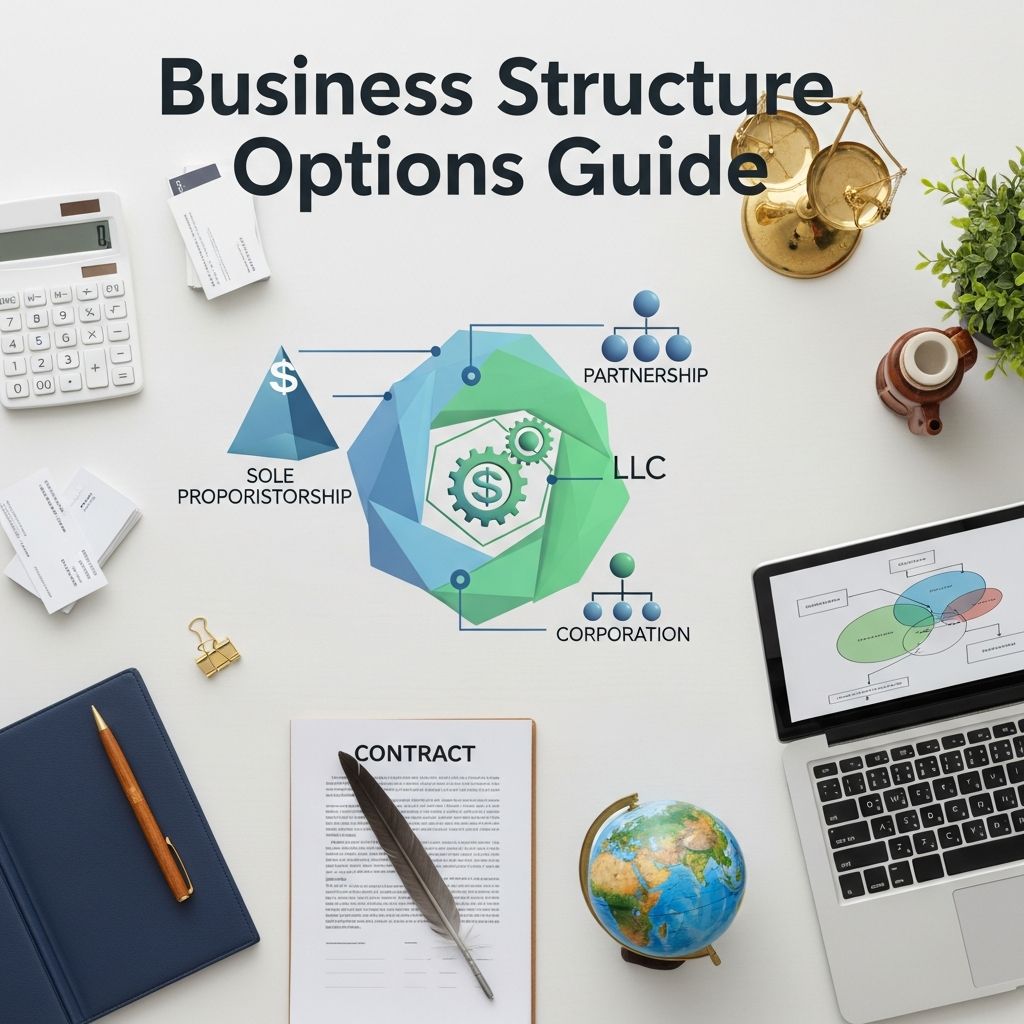
Selecting the appropriate legal structure for your business is a foundational decision that influences liability exposure, taxation obligations, management flexibility, and opportunities for expansion. Entrepreneurs must weigh factors such as personal asset protection, operational complexity, and compliance requirements when choosing among common forms like sole proprietorships, partnerships, limited liability companies (LLCs), and corporations. This guide provides an in-depth analysis of each option, highlighting their unique characteristics, advantages, and potential drawbacks to empower informed decision-making.
Understanding the Fundamentals of Business Organization
Every business begins with a vision, but its legal framework determines how it operates within the economic and regulatory landscape. The primary goal of business structuring is to balance risk management with efficiency. For instance, structures that offer limited liability shield owners’ personal assets from business debts and lawsuits, while simpler forms allow for quick setup and minimal paperwork.
Key considerations include the number of owners, desired level of control, funding needs, and long-term plans. According to the U.S. Small Business Administration, over 30 million small businesses operate in the United States, with sole proprietorships comprising the majority due to their ease of formation. However, as businesses scale, more robust structures become essential.
Sole Proprietorship: The Simplest Entry Point
A sole proprietorship represents the most straightforward business form, where a single individual owns and manages the entire operation. No formal registration is required beyond local business licenses, making it ideal for freelancers, consultants, and small-scale ventures.
- Setup Process: Minimal; file a DBA (Doing Business As) if using a trade name.
- Liability: Unlimited personal liability—owners are personally responsible for all debts and legal claims.
- Taxation: Pass-through; business income reported on personal tax return (Schedule C).
- Management: Complete owner control with no board or partners.
While this structure avoids double taxation and offers full decision-making autonomy, the lack of liability protection poses significant risks. For example, a lawsuit from a customer injury could jeopardize personal savings or home equity. Sole proprietorships suit low-risk, solo operations but falter in capital-intensive fields.
General Partnerships: Collaborative Foundations
General partnerships involve two or more individuals sharing ownership, profits, and responsibilities. Governed by state laws or a partnership agreement, this form fosters collaboration without the formalities of incorporation.
- Formation: Simple; draft a partnership agreement outlining profit-sharing, duties, and dispute resolution.
- Liability: Joint and several—each partner is fully liable for partnership debts, even those caused by others.
- Taxes: Pass-through; partners report shares on personal returns (Schedule K-1).
- Control: Shared equally unless specified otherwise.
Partnerships excel in professional services like law firms or accounting practices, where trust and combined expertise drive success. However, interpersonal conflicts and unlimited liability often lead owners to transition to limited partnerships or LLCs for better protection.
Limited Liability Company (LLC): Versatile Protection
LLCs combine corporate liability shields with partnership tax benefits, offering flexibility for single or multiple owners (members). Popular since the 1990s, they now represent about 20% of new business formations per IRS data.
| Aspect | Details |
|---|---|
| Formation | File Articles of Organization with state; operating agreement recommended. |
| Liability | Limited—personal assets protected except in cases of fraud. |
| Taxation | Default pass-through; elect corporate taxation if beneficial. |
| Management | Member-managed or manager-managed structures. |
LLCs provide operational freedom, such as customizable profit distributions independent of ownership percentages. They are suitable for real estate investors, e-commerce sellers, and growing startups seeking investor appeal without corporate rigidity.
C Corporations: Built for Scale and Investors
C corporations are separate legal entities owned by shareholders, designed for businesses anticipating significant growth, public offerings, or venture capital. They feature a board of directors and officers for governance.
- Incorporation: File Articles of Incorporation; issue stock; adopt bylaws.
- Liability: Strong limited protection for shareholders.
- Taxation: Double taxation—corporate income taxed, then dividends to shareholders.
- Ownership: Unlimited shareholders; easy stock transfer.
Tech giants like Apple started as C corps to attract funding. Despite tax drawbacks, their ability to raise capital through stock sales makes them indispensable for ambitious enterprises.
S Corporations: Tax-Efficient Corporate Alternative
S corporations mirror C corps in liability and structure but elect pass-through taxation under IRS Subchapter S, avoiding double taxation. Eligibility requires under 100 U.S.-based shareholders and one stock class.
- Benefits: Liability protection with personal tax rates on income.
- Restrictions: No foreign owners; equal profit/loss allocation per share.
- Best For: Family-owned businesses or those with steady profits under $10 million.
This hybrid appeals to owners prioritizing tax savings while maintaining corporate formalities like annual meetings and records.
Other Specialized Structures
Beyond basics, options like limited partnerships (LPs) and limited liability partnerships (LLPs) cater to niche needs. LPs feature general partners with unlimited liability and limited partners protected as investors. LLPs, common among professionals, limit partners’ liability for others’ negligence.
Nonprofits (501(c)(3)) pursue missions over profits, qualifying for tax exemptions via IRS approval. Cooperatives emphasize member ownership and democratic control, thriving in agriculture or retail.
Comparative Analysis of Business Structures
| Structure | Liability | Taxes | Setup Cost | Complexity |
|---|---|---|---|---|
| Sole Proprietorship | Unlimited | Pass-through | Low | Low |
| Partnership | Unlimited | Pass-through | Low | Medium |
| LLC | Limited | Flexible | Medium | Medium |
| C Corp | Limited | Double | High | High |
| S Corp | Limited | Pass-through | High | High |
This table illustrates trade-offs: simplicity versus protection. LLCs often emerge as a sweet spot for most small businesses.
Factors Influencing Your Choice
Assess your risk profile—high-liability industries like construction favor LLCs or corporations. Tax implications vary by income level; consult IRS Publication 334 for details. Growth plans matter: corporations facilitate equity financing. State fees differ, e.g., California LLCs cost $800 annually.
Steps to Form Your Business Structure
- Research state requirements via Secretary of State websites.
- Draft foundational documents (articles, agreements).
- Obtain EIN from IRS for banking/taxes.
- Register for state taxes and licenses.
- Open business bank account; secure insurance.
Professional advice from attorneys or CPAs is crucial to avoid pitfalls like piercing the corporate veil.
Frequently Asked Questions
Can I change my business structure later?
Yes, conversions like sole prop to LLC are common via state filings, though tax implications require planning.
What are ongoing compliance requirements for corporations?
Annual reports, meetings, and minutes; failure risks dissolution.
Do all structures need an operating agreement?
Not legally required for all, but recommended for LLCs and partnerships to clarify operations.
How do structures affect funding access?
Corporations attract investors via stock; LLCs use membership interests.
Is an LLC better than a sole proprietorship?
For liability protection, yes; otherwise, proprietorships are simpler.
Trends in Business Structuring
Recent shifts show LLCs dominating new formations due to flexibility amid economic uncertainty. Remote work and gig economies boost single-member LLCs. Blockchain-enabled DAOs challenge traditional forms, though legal recognition varies by state.
In conclusion, align your structure with business goals for optimal protection and efficiency. Regularly review as circumstances evolve.
References
- Choose a Business Structure — U.S. Small Business Administration. 2024-10-15. https://www.sba.gov/business-guide/launch-your-business/choose-business-structure
- Publication 334: Tax Guide for Small Business — Internal Revenue Service. 2025-01-10. https://www.irs.gov/publications/p334
- Business Entity Types — California Secretary of State. 2025-03-20. https://www.sos.ca.gov/business-programs/business-entities/types
- Organizational Chart Examples — Venngage. 2026-01-01. https://venngage.com/blog/organizational-chart-examples/
- Types of Organizational Structures — Lucidchart. 2024-11-05. https://www.lucidchart.com/blog/types-of-organizational-structures
Similar Articles








Read full bio of medha deb


