
Supreme Court Ruling: Grants Pass and the Homelessness Law
How the Grants Pass Supreme Court ruling reshapes public camping laws.
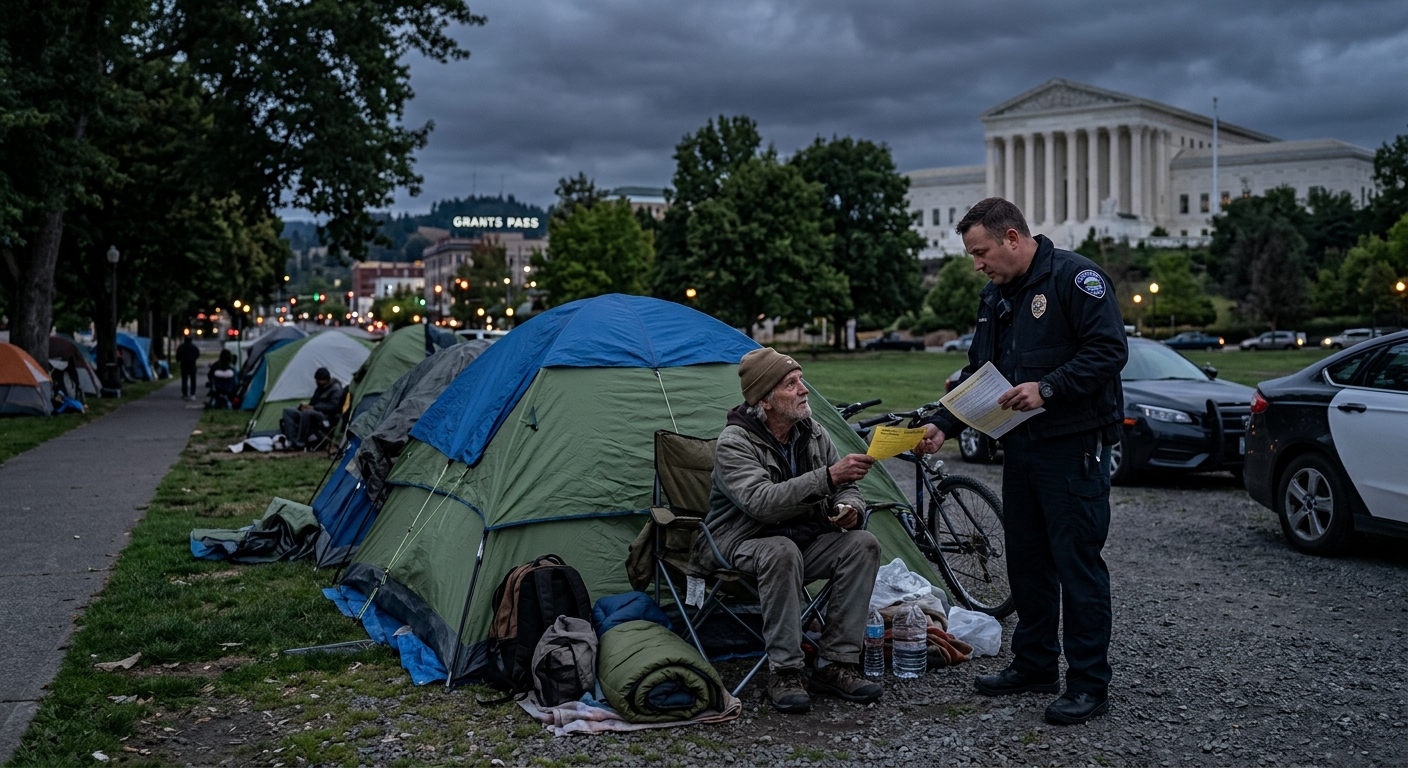
Homelessness in the United States remains one of the most pressing, complex, and emotionally charged public policy challenges of our modern era. As the cost of living continues to skyrocket and affordable housing shortages plague both urban and rural communities across the nation, the number of individuals forced to reside on the streets has visibly and dramatically increased. This undeniable, highly visible crisis has sparked intense legal and moral debates regarding how local governments should manage shared public spaces while respecting human dignity. At the absolute center of this debate lies a profound constitutional question: Can a municipality legally punish a person for sleeping outside on public property if that individual has literally nowhere else to go? This pivotal question finally reached the highest court in the nation, culminating in the landmark 2024 Supreme Court case, City of Grants Pass v. Johnson. The outcome of this case has fundamentally rewritten the legal framework surrounding unhoused populations, municipal authority, and the constitutional limits of the Eighth Amendment.
The Escalating Crisis of Unsheltered Populations
To fully comprehend the gravity of the legal battles surrounding public camping bans, one must first look at the stark data illustrating the scale of the emergency. According to the U.S. Department of Housing and Urban Development (HUD), official estimates revealed that on any given night in January 2023, over 650,000 people slept in a shelter or in conditions deemed unfit for human habitation. Alarmingly, approximately four in ten of these individuals were entirely unsheltered, meaning they were residing in places not meant for human habitation, such as city sidewalks, public parks, underpasses, or vehicles.
This represents a significant upward trend in the unhoused population, driven by complex socio-economic factors including systemic poverty, a severe lack of affordable permanent housing, untreated mental health conditions, and substance use disorders. Local governments, particularly in West Coast states, have found themselves overwhelmed. City councils face immense pressure from housed residents and business owners to clear public encampments and maintain clean, accessible public spaces. Simultaneously, human rights advocates and legal aid organizations fiercely argue that without providing alternative indoor shelter beds, penalizing people for performing the biologically necessary act of sleeping is both cruel and entirely ineffective at solving the underlying crisis.
The Constitutional Bedrock: Interpreting the Eighth Amendment
At the heart of the legal resistance against municipal public camping bans is the Eighth Amendment to the United States Constitution. Ratified in 1791 as part of the Bill of Rights, the amendment’s text explicitly states: “Excessive bail shall not be required, nor excessive fines imposed, nor cruel and unusual punishments inflicted”. Historically, the Cruel and Unusual Punishments Clause was specifically designed to prevent the government from employing barbaric methods of penalization, such as torture, drawing and quartering, or disproportionately extreme sentences that do not match the severity of the committed crime.
Over the decades, the Supreme Court’s interpretation of what constitutes “cruel and unusual” has gradually evolved. A crucial aspect of this evolution is the legal distinction between punishing an individual’s “conduct” and punishing their “status.” In the historical 1962 case Robinson v. California, the Supreme Court famously ruled that a state could not criminalize the mere status of being addicted to narcotics. Punishing someone for an illness or a fundamental state of being, the Court reasoned, inherently violated the Eighth Amendment. Decades later, advocates for the unhoused leveraged this powerful precedent to argue that when a community lacks sufficient shelter beds, homelessness becomes an inescapable, involuntary status. Therefore, they argued, punishing the unavoidable byproduct of that status—sleeping outside to survive—amounted to an unconstitutional penalization of their very existence.
The Origins of Grants Pass v. Johnson
The direct catalyst for the Supreme Court’s monumental intervention originated in a small municipality in southwestern Oregon. Grants Pass, a city with a population of nearly 38,000 residents, found itself grappling with a steadily growing unhoused population, estimated at roughly 600 individuals. Faced with increasing community complaints regarding public safety, public health, and sanitation related to encampments, the city council enacted a series of strict local ordinances designed to forcefully regulate public property.
These specific laws prohibited individuals from sleeping on public sidewalks, streets, or alleys, and enacted a total, comprehensive ban on camping or overnight parking in all city parks. The ordinances were aggressively enforced with escalating penalties. First-time offenders received hefty civil citations and fines. Repeat violators faced exclusion orders banning them from accessing city parks entirely, and further violations could quickly result in criminal trespass charges carrying potential jail time. Crucially, at the time these strict ordinances were enforced, Grants Pass had zero low-barrier, public homeless shelters available to accommodate the displaced population. Two unhoused plaintiffs filed a class-action lawsuit against the city on behalf of the homeless community, arguing that enforcing these anti-camping bans when individuals had absolutely no indoor alternatives constituted cruel and unusual punishment.
Conduct Versus Status: The Crux of the Legal Debate
The legal showdown in Grants Pass v. Johnson centered almost entirely on the philosophical and legal dividing line between “status” and “conduct.” To understand how the courts evaluated this complex dynamic, it is helpful to look at the historical timeline of relevant constitutional precedents that shaped the arguments.
| Case Name | Year | Key Constitutional Finding |
|---|---|---|
| Robinson v. California | 1962 | Criminalizing the inherent status of being a drug addict violates the 8th Amendment’s prohibition on cruel and unusual punishment. |
| Powell v. Texas | 1968 | Criminalizing the physical conduct of public intoxication is permissible, distinguishing between an alcoholic’s status and their public behavior. |
| Martin v. City of Boise | 2018 | The 9th Circuit ruled that punishing public sleeping when no shelter beds are available is unconstitutional, viewing it as an extension of the homeless status. |
| City of Grants Pass v. Johnson | 2024 | The Supreme Court overturned Martin, ruling that the 8th Amendment does not prohibit local governments from enforcing broadly applicable public camping bans. |
The plaintiffs in the Grants Pass case heavily relied on the logic established by the Ninth Circuit Court of Appeals in its 2018 ruling, Martin v. City of Boise. In that case, the Ninth Circuit explicitly held that municipalities could not constitutionally enforce public camping ordinances against homeless individuals when the number of unhoused people vastly exceeded the number of available shelter beds. The underlying reasoning was that if sleeping is an unavoidable biological necessity, and indoor sleeping is rendered impossible by a lack of beds, outdoor sleeping is an involuntary, unavoidable consequence of the homeless status.
The City of Grants Pass vehemently pushed back against this logic during their appeal to the Supreme Court. The city’s legal counsel argued that their ordinances did not criminalize the “status” of being homeless, but rather the specific, prohibited “conduct” of occupying public land with bedding materials and tents. They leaned heavily on the 1968 precedent Powell v. Texas, which determined that while alcoholism is a recognized status, the act of being intoxicated in public is a conduct that the state retains the absolute authority to criminalize in the interest of public order.
The Supreme Court’s 2024 Landmark Ruling
On June 28, 2024, the United States Supreme Court delivered a decisive and landscape-altering 6-3 ruling in City of Grants Pass v. Johnson. In a sweeping majority opinion authored by Justice Neil Gorsuch, the Court fundamentally rejected the legal framework established by the Ninth Circuit, determining that the Eighth Amendment’s Cruel and Unusual Punishments Clause does not restrict a government from enforcing laws prohibiting camping or sleeping in public against homeless individuals.
The majority opinion emphasized that the Eighth Amendment is strictly designed to regulate the specific method or kind of punishment that a state may impose after a criminal conviction—ensuring punishments are not designed to cause unnecessary terror, pain, or disgrace. It does not, according to the Court, place substantive limits on what specific behaviors a local government can choose to classify as a criminal act. Justice Gorsuch reasoned that the penalties utilized by Grants Pass—modest monetary fines and brief periods of incarceration for repeat offenses—were standard, commonplace punishments utilized across the country and did not qualify as “cruel” or “unusual” in the constitutional sense. The Court formally decoupled the availability of shelter beds from a city’s constitutional authority to enforce public order, effectively ruling that the enforcement of public camping bans does not illegally criminalize a person’s status.
The Voice of the Dissent
Justice Sonia Sotomayor authored a passionate and deeply critical dissenting opinion, joined by Justices Elena Kagan and Ketanji Brown Jackson. Sotomayor sharply criticized the majority’s logic, arguing that sleep is a fundamental biological necessity, not a voluntary criminal act. The dissent emphasized that for individuals with absolutely no access to alternative shelter, penalizing them for sleeping outside effectively and unconstitutionally criminalizes their very existence. By punishing an involuntary state of being, Sotomayor argued, the city’s ordinances cross the legal threshold into cruel and unusual punishment. The dissenting justices warned that this ruling would inevitably lead to a highly fragmented, deeply punitive approach to public health, where vulnerable populations are subjected to endless cycles of fines, arrests, and forced displacement rather than being offered meaningful social support or pathways to stable housing.
The Ripple Effect: Municipal Policies and the Unhoused
The immediate ramifications of the Grants Pass decision reverberated rapidly across municipalities nationwide. By completely dismantling the constitutional constraints previously imposed by the Martin v. Boise precedent, the Supreme Court handed a definitive, far-reaching victory to local governments seeking greater autonomy in managing their public spaces. City officials, mayors, and law enforcement agencies now possess the unencumbered legal authority to enact and enforce criminal penalties for acts like public camping or sleeping, even in jurisdictions where local shelter space is vastly insufficient or entirely non-existent.
For the unhoused population, however, the ruling paints a remarkably bleak and precarious picture. Criminalizing the act of sleeping on public property essentially forces highly vulnerable individuals into a relentless, punitive cycle of justice system involvement. When an unhoused person receives a civil citation for sleeping outside that they cannot afford to pay, the unpaid ticket inevitably escalates into a criminal warrant. Subsequent arrests lead to incarceration, which in turn results in a permanent criminal record. This criminal history acts as a massive, often insurmountable barrier to securing future employment, receiving essential government assistance, or passing background checks for rental housing. Rather than effectively addressing the root causes of the crisis, civil rights advocates argue that these aggressive enforcement strategies merely shuffle displaced, impoverished individuals from one jurisdiction to another, exacerbating their deep instability and further cementing their cycle of poverty.
Charting a New Path: Solutions Beyond Criminalization
While the Supreme Court has officially clarified what municipalities are legally permitted to do, it does not dictate what they should do to actually resolve the crisis. The Grants Pass ruling effectively shifts the massive burden of solving the homelessness epidemic away from the federal judiciary and places it squarely back onto the shoulders of local policymakers, urban planners, and state legislatures. Relying solely on punitive enforcement is widely considered by sociologists, housing experts, and economists to be a highly costly and ultimately ineffective long-term strategy. Arresting, jailing, and processing unhoused individuals places an enormous, unsustainable financial burden on local criminal justice systems without meaningfully reducing the overall rate of homelessness.
Moving forward, cities dedicated to enacting lasting, structural change are increasingly turning toward evidence-based “Housing First” models. This highly effective approach prioritizes providing individuals with unconditional, permanent supportive housing before addressing other complex challenges such as behavioral health issues or substance abuse disorders. By pairing stable, low-barrier housing with comprehensive, wrap-around social services, communities can actively break the relentless cycle of chronic homelessness. Furthermore, significant local and federal investments in affordable housing development, robust eviction prevention programs, and expanded mental health care access remain the most structurally sound, compassionate methods for preventing individuals from ever having to face the profound desperation of sleeping on the street in the first place.
Frequently Asked Questions
- What did the Supreme Court decide in Grants Pass v. Johnson?
The Supreme Court ruled in a 6-3 decision that local governments are legally permitted to enforce bans on sleeping or camping in public places, even if there is no alternative indoor shelter available. The Court determined that such enforcement does not violate the Eighth Amendment. - What exactly does the Eighth Amendment protect against?
The Eighth Amendment of the U.S. Constitution strictly protects citizens against the federal and state governments requiring excessive bail, imposing excessive fines, and inflicting cruel and unusual punishments. The Court ruled this applies to the method of punishment, not what conduct is criminalized. - Does this landmark ruling mean being homeless is now illegal?
No, being homeless is not a crime. The Supreme Court drew a sharp legal distinction between the unavoidable “status” of being homeless (which cannot be criminalized) and the specific “conduct” of camping or using bedding on public property (which can be criminalized). - What are the recommended alternatives to criminalizing homelessness?
Housing and policy experts strongly advocate for “Housing First” initiatives, significantly increasing the supply of affordable rental housing, and providing robust mental health and substance abuse services rather than relying on the costly cycle of arrests and fines.
References
- City of Grants Pass, Oregon v. Johnson, 603 U.S. ___ — Supreme Court of the United States. 2024-06-28. https://www.supremecourt.gov/opinions/23pdf/23-175_19m2.pdf
- The 2023 Annual Homelessness Assessment Report (AHAR) to Congress — U.S. Department of Housing and Urban Development (HUD). 2023-12-15. https://www.huduser.gov/portal/datasets/ahar/2023-ahar-part-1-pit-estimates-of-homelessness-in-the-us.html
- Amdt8.1 Overview of Eighth Amendment, Cruel and Unusual Punishment — Constitution Annotated, Congress.gov. 2024-01-01. https://constitution.congress.gov/browse/essay/amdt8-1/ALDE_00013219/
- City of Grants Pass v. Johnson Case Summary — Justia Supreme Court Center. 2024-06-28. https://supreme.justia.com/cases/federal/us/603/23-175/
Similar Articles








Read full bio of medha deb


