
Gifting Firearms: Complete Legal Roadmap For 2026
Navigate federal and state laws to safely gift a firearm without legal risks or violations.
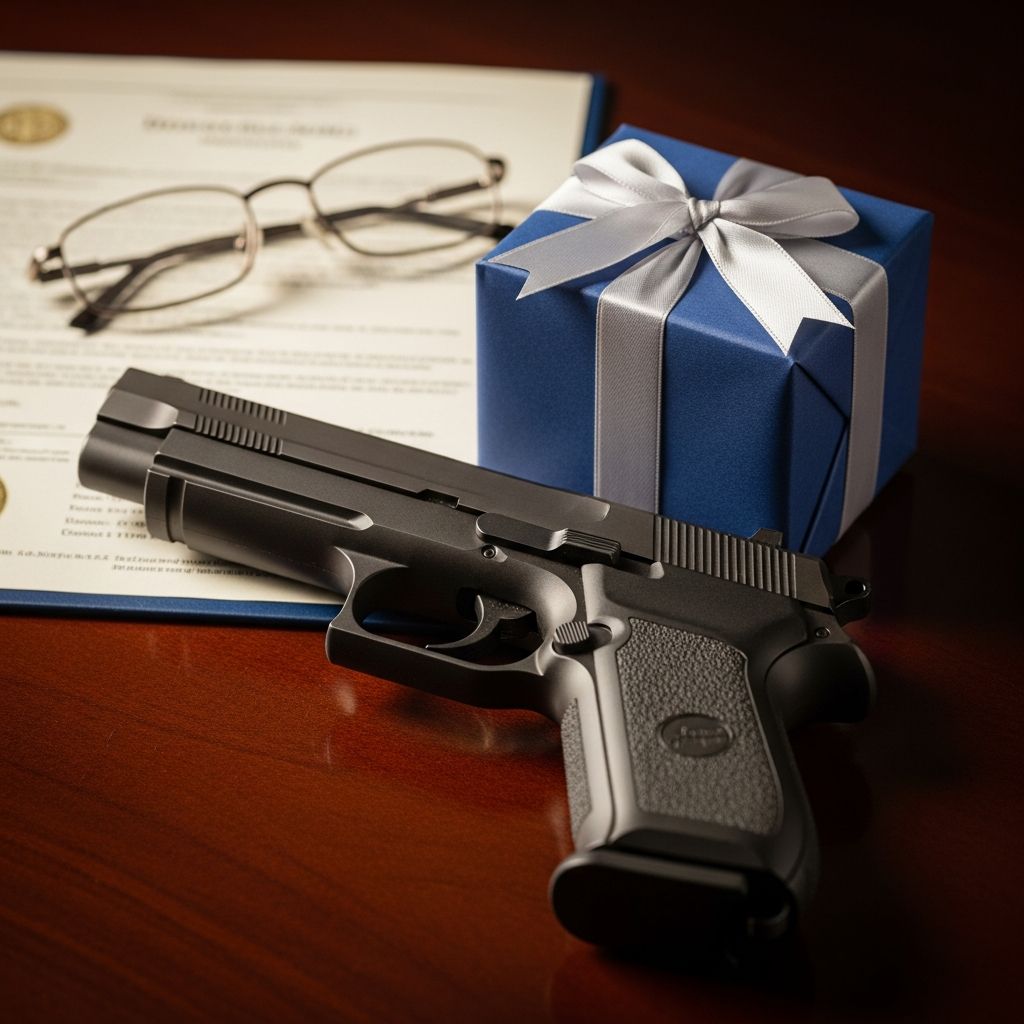
Presenting a firearm as a gift can be a meaningful gesture for holidays, milestones, or family traditions. However, U.S. firearm laws demand careful adherence to avoid serious penalties. Federal regulations establish baseline requirements, while states impose additional restrictions on transfers, background checks, and possession. This guide outlines key steps to gift responsibly, drawing from authoritative sources like the ATF and industry experts.
Understanding Core Federal Firearm Regulations
Federal law permits purchasing a firearm intended as a bona fide gift, provided the recipient qualifies to possess it. The ATF clarifies that buyers acting in good faith—using their own funds without reimbursement—may acquire guns for gifting. However, 18 U.S.C. § 922(d) prohibits transfers to known prohibited persons, including felons, those with domestic violence convictions, fugitives, unlawful drug users, or individuals adjudicated as mentally defective. Violating this constitutes a felony punishable by up to 10 years imprisonment.
Prohibited categories extend to undocumented immigrants, dishonorably discharged military personnel, and those under certain restraining orders. Gifters bear responsibility to confirm eligibility through reasonable inquiry, as ignorance offers no defense.
Recipient Eligibility: The First Critical Check
Before any purchase, verify the recipient meets federal age minimums: 18 for long guns (rifles, shotguns) and 21 for handguns from licensed dealers. Private gifts follow similar guidelines, but exceptions apply for parental gifts to minors under 18 for specific uses like hunting or target practice, requiring written permission.
- Age verification: Confirm via ID; minors need documented parental consent for handguns.
- Criminal history: No felonies, misdemeanors with 2+ year sentences, or domestic violence offenses.
- Mental health: No involuntary commitments or adjudications.
- Substance issues: Avoid gifting to active addicts or unlawful users.
Table of Federal Prohibited Persons:
| Category | Description | Legal Reference |
|---|---|---|
| Felons | Convicted of crimes punishable by >1 year | 18 U.S.C. § 922(g) |
| Domestic Violence | Misdemeanor convictions involving partners | 18 U.S.C. § 922(g)(9) |
| Mental Health | Adjudicated defective or committed | 18 U.S.C. § 922(g)(4) |
| Drug Users | Unlawful users/addicts | 18 U.S.C. § 922(g)(3) |
| Illegal Aliens | Non-citizens without status | 18 U.S.C. § 922(g)(5) |
If doubt exists, request the recipient undergo a NICS background check or consult an FFL dealer.
Intrastate Gifting: Same-State Transfers
Within the same state, private gifts between eligible individuals often require no FFL involvement under federal law. However, states like California, Colorado, New York, and others mandate universal background checks via FFL for all transfers, including gifts. The National Shooting Sports Foundation (NSSF) lists states such as Connecticut, Delaware, Illinois, Nevada, New Jersey, Oregon, Rhode Island, and Washington as requiring FFL-mediated private transfers.
Some jurisdictions demand permits: Maryland, Minnesota, and Pennsylvania require checks for handguns. Always cross-check local ordinances, as cities may add magazine or feature bans.
Interstate Gifting: Mandatory FFL Routing
Gifting across state lines strictly requires shipping the firearm to an FFL in the recipient’s state. The recipient then completes Form 4473 and passes a NICS check (plus state steps) before taking possession. Direct handovers are illegal federally, even for family.
Process Overview:
- Purchase or select the firearm.
- Ship via FFL to recipient’s state FFL (overnight carriers ban firearms; use USPS for long guns with restrictions).
- Notify recipient to complete transfer paperwork.
- Ensure compliance with recipient state’s assault weapon, capacity, or feature laws.
This method preserves the gift’s intent while minimizing liability.
Avoiding Straw Purchases: A Common Pitfall
Straw purchasing—buying for a prohibited person—is a federal felony. Even reimbursements or partial payments transform a gift into a straw purchase. ATF Form 4473 explicitly questions if you’re the ‘actual transferee’; answering yes for a true gift is proper, as you’re the buyer.
Industry advice discourages direct gifting due to risks, recommending gift certificates for recipient-led purchases. For family, confirm no hidden disqualifiers.
Special Cases: Family, Minors, and Inheritance
Parents/guardians may gift firearms to children 18+, treating them as adults legally. For under-18s, handguns need written permission for limited purposes. Inheritance follows probate: executors must be eligible possessors; heirs cannot receive if prohibited.
Inheritance table:
| Scenario | Requirements |
|---|---|
| Eligible Heir | Legal possessor; standard transfer rules apply |
| Prohibited Heir | Cannot inherit; must sell via FFL or forfeit |
| Executor Issues | Court appoints eligible administrator if needed |
State-Specific Compliance Checklist
Laws evolve; as of 2026, consult state AG sites or FFLs. Key high-regulation states:
- California: All transfers via FFL; 10-day wait; roster restrictions.
- New York: Permits, checks, safe storage mandates.
- Florida/Texas: Minimal private transfer rules.
Use ATF’s state-by-state resources or NSSF tools for updates.
Best Practices for Risk-Free Gifting
To maximize safety:
- Document eligibility discussions.
- Opt for gift cards to gun shops.
- Include safety training resources.
- Engrave or tag as ‘gift’ for records.
- Consult local FFL pre-purchase.
Pair the gift with a safe, lockbox, or training course to promote responsibility.
Frequently Asked Questions
Can I gift a gun to my adult child in another state?
Yes, ship to their state’s FFL for background check and transfer.
Is a background check needed for same-state gifts?
Federal no, but states like CA, NY require it for all transfers.
What if the recipient is a felon?
Illegal federally; do not transfer—federal felony.
Can I gift ammo with the gun?
Yes, same rules apply; minors need permission.
How do I handle a gifted gun inheritance?
Executor verifies heir eligibility; use FFL if prohibited.
Final Thoughts on Responsible Gifting
Gifting firearms legally hinges on due diligence. Prioritize compliance to protect yourself and recipients. For personalized advice, contact an attorney or FFL. Safe gifting builds lasting traditions without legal entanglements.
References
- How to Legally Gift a Gun: A Practical Holiday Guide — A Girl & A Gun. 2023. https://www.agirlandagun.org/how-to-legally-gift-a-gun-a-practical-holiday-guide/
- Can You Legally Buy a Gun for Someone Out of State? — FastBound. 2024. https://www.fastbound.com/ffl-blog/can-you-legally-buy-a-gun-for-someone-else/
- Giving a Firearm as a Gift? Some Reminders from NSSF — National Shooting Sports Foundation. 2023. https://www.nssf.org/articles/giving-a-firearm-as-a-gift-some-reminders-from-nssf/
- CAN I GIFT A GUN? — Stock & Barrel Gun Club. 2024. https://stockandbarrel.com/can-i-gift-a-gun/
- May a parent or guardian purchase firearms or ammunition as a gift to a juvenile less than 18 years of age? — Bureau of Alcohol, Tobacco, Firearms and Explosives (ATF). 2024. https://www.atf.gov/firearms/qa/may-parent-or-guardian-purchase-firearms-or-ammunition-gift-juvenile-less-18-years-age
- Gifts & Inheritance – Gun Laws — Texas State Law Library. 2025. https://guides.sll.texas.gov/gun-laws/gifts-inheritance
Similar Articles








Read full bio of Sneha Tete


