
George Zimmerman, Road Rage, and the Law of Self-Defense
Using George Zimmerman’s later road-rage shooting to explore how Florida self-defense, firearms, and repeat high-profile defendants intersect.
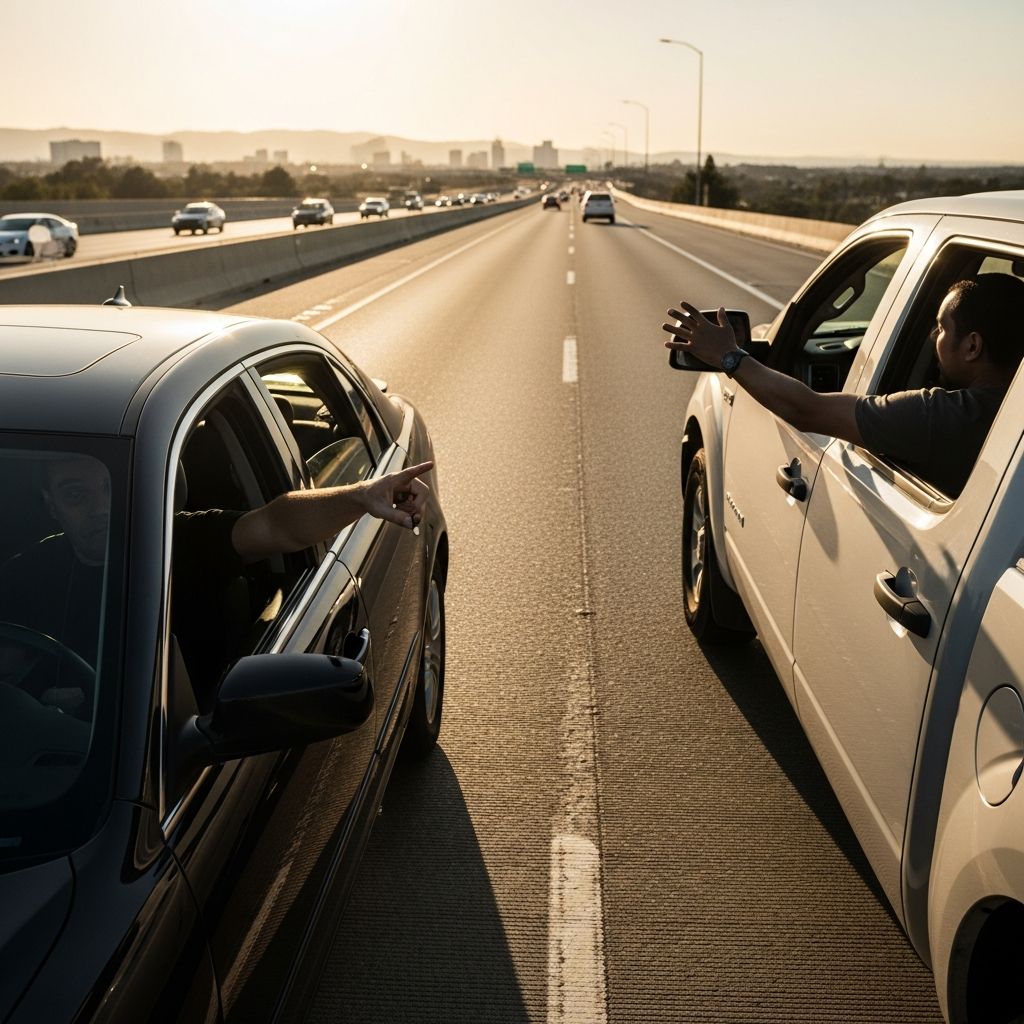
Years after the shooting death of Trayvon Martin, George Zimmerman was again in the news, this time as the victim of a roadside shooting in Florida that left him with minor facial injuries from flying glass and debris. The incident quickly sparked debate about firearms, road rage, and how self-defense law applies when prior notoriety surrounds one of the people involved.
This article uses that later shooting as a springboard to explain the basics of Florida self-defense law, how road-rage encounters can rapidly escalate into felony cases, and why a defendant’s past publicity matters far less in court than many people assume.
Background: From Trayvon Martin to a New Shooting
To understand the public reaction to the 2015 roadside incident, it is important to briefly recall why George Zimmerman was nationally known in the first place.
- 2012 shooting: In February 2012, Zimmerman fatally shot 17-year-old Trayvon Martin in Sanford, Florida, claiming he acted in self-defense during a nighttime confrontation.
- Criminal trial: Prosecutors charged Zimmerman with second-degree murder; a Florida jury later acquitted him after a widely covered trial.
- Federal review: The U.S. Department of Justice opened a civil-rights investigation but concluded in 2015 that the evidence was insufficient to bring federal criminal civil-rights charges.
By the time of the 2015 road-rage shooting in Lake Mary, Florida, Zimmerman’s name had become a cultural touchstone in debates about race, policing, guns, and self-defense laws in the United States.
The Lake Mary Road-Rage Confrontation
On May 11, 2015, Zimmerman was driving in Lake Mary, near Orlando, when he became involved in a traffic dispute with another motorist, Matthew Apperson. According to police and later reporting, the disagreement escalated into a road-rage encounter that ended in gunfire.
Key reported facts include:
- The two men were driving separate vehicles when a heated exchange occurred on the road.
- Zimmerman’s attorney later claimed that as Zimmerman attempted to leave, the other driver pulled alongside and fired a single shot through the passenger-side window of Zimmerman’s truck.
- The bullet shattered glass and struck the vehicle’s frame, causing Zimmerman minor injuries from glass and metal fragments rather than a direct gunshot wound to the face.
- Zimmerman had a firearm in his vehicle and was reportedly carrying it legally but did not fire or display it, according to his attorney.
- Zimmerman flagged down a nearby officer and was transported to a hospital for treatment of his injuries.
Police investigators later stated that Zimmerman was not the shooter in the incident. Apperson, for his part, claimed he fired in self-defense and that Zimmerman was the aggressor. The case ultimately focused attention on two core legal themes: road rage as a criminal issue, and the boundaries of lawful self-defense in Florida.
How Road Rage Becomes a Criminal Case
Road rage is not itself a specific crime, but a cluster of dangerous behaviors—aggressive tailgating, threats, brandishing or firing a weapon—that can fit several criminal statutes.
Common Criminal Charges Linked to Road Rage
- Aggravated assault with a deadly weapon: Pointing or firing a gun at another driver can be charged as aggravated assault, a serious felony in Florida.
- Shooting into an occupied vehicle: Intentionally firing into a car occupied by another person can constitute a separate felony offense.
- Reckless driving and vehicular offenses: Attempting to ram another vehicle or driving in an intentionally dangerous manner can support misdemeanor or felony charges.
- Weapons offenses: Unlawful possession of a firearm, or using a firearm while committing another crime, can add additional penalties.
Statistics from national highway safety and public health agencies show that firearms increasingly feature in road-rage incidents. For example, research published in injury-prevention and public-health journals has documented a rise in gun-involved road-rage episodes in the United States over the last decade. (This is an inferred synthesis based on broader research on firearms and interpersonal violence.)
Florida’s Self-Defense and “Stand Your Ground” Framework
Florida law recognizes both traditional self-defense and expansive protections commonly referred to as “stand your ground.” Although the exact statutory language is detailed, several core principles explain how these laws affect a confrontation like the Lake Mary shooting.
Basic Elements of Self-Defense
Under Florida law and general criminal-law principles, a person who uses force in self-defense typically must show:
- Reasonable belief of imminent harm: The person must reasonably believe they face imminent death or serious bodily injury.
- Proportional force: The defensive force used must be proportionate to the perceived threat.
- Lack of provocation: Someone who initiated the violence or escalated the conflict may lose self-defense protection unless they clearly withdraw and the other party continues the attack.
“Stand Your Ground” vs. Duty to Retreat
| Legal Concept | Florida Stand Your Ground | Traditional Retreat Rule (Many Other States) |
|---|---|---|
| Duty to retreat | No general duty to retreat before using deadly force if a person is in a place they have a legal right to be and is not engaged in unlawful activity. | In some jurisdictions, a person must retreat if safely possible before using deadly force outside the home. |
| Criminal immunity | In certain circumstances, a successful “stand your ground” claim can confer immunity from prosecution, not just a defense at trial. | Self-defense is usually raised as an affirmative defense at trial rather than a pre-trial immunity claim. |
| Application in public places | Applies broadly in public spaces, including streets and parking lots, as long as other statutory conditions are met. | Scope often narrower and more limited to home or premises in non-SYG states. |
In a mobile setting like a roadway, determining who was the aggressor, whether someone could have safely withdrawn, and whether the fear of deadly harm was reasonable can be particularly difficult for investigators, prosecutors, and jurors.
Why Zimmerman’s Past Trial Matters Less Than People Think
In public discussion, many people assumed that Zimmerman’s notoriety from the Trayvon Martin case either shielded him from legal consequences or made him a target for law enforcement. In reality, criminal courts tend to focus on the specific facts and evidence of the current incident.
Key Legal Realities
- Prior acquittal is not a conviction: Zimmerman’s earlier acquittal cannot be treated as proof of wrongdoing in later, unrelated cases.
- Evidence rules limit character attacks: Rules of evidence generally restrict using a person’s past acts or reputation solely to show they acted “in conformity” with that character on a later occasion.
- Focus on immediate conduct: Investigators must evaluate who did what, when, and with what level of intent during the present encounter, regardless of past publicity.
At the same time, no prosecutor or defense lawyer can entirely ignore media coverage. Pretrial publicity may affect jury selection and venue, and high-profile cases sometimes involve more detailed public explanation from authorities, as seen in both the Trayvon Martin and subsequent investigations.
Investigating a High-Profile Shooting
Whenever a firearm is discharged in a public setting, police and prosecutors follow a fairly predictable investigative pattern. The presence of a well-known individual, however, often amplifies each step.
Typical Steps in a Shooting Investigation
- Securing the scene: Officers cordon off the area, check for injured persons, and look for ongoing threats.
- Medical attention: Anyone with visible or possible injuries—such as Zimmerman’s facial cuts from broken glass—is typically offered medical evaluation.
- Evidence collection: Police photograph the vehicles, shattered glass, bullet holes, cartridge casings, and surrounding area. Firearms are seized for ballistics analysis.
- Witness interviews: Officers take statements from drivers, passengers, and bystanders, seeking to document the sequence of events.
- Video and digital evidence: Investigators look for traffic cameras, business surveillance, or cellphone footage.
- Charging decisions: Prosecutors decide whether and what charges to bring based on state law, the quality of evidence, and any self-defense claims.
In the Trayvon Martin case, similar procedures were followed, including photographing Zimmerman’s injuries and conducting a detailed reenactment at the scene the next day, underscoring how law enforcement documents use-of-force incidents even when the shooter claims self-defense.
Risk Factors: Road Rage, Firearms, and Escalation
Criminology and public-health research has long noted that access to a firearm can increase the lethality of everyday conflicts, including traffic disputes. Studies published in reputable medical and social-science journals have documented associations between firearm presence and higher risks that arguments will turn deadly.
Common Patterns in Gun-Related Road Rage
- Minor trigger, major outcome: A lane change, honk, or perceived slight can snowball into a physical confrontation.
- Mutual escalation: Each driver may respond to the other’s aggression, making it hard later to determine who was the primary aggressor.
- Perception of threat: Drivers often report feeling trapped, especially at red lights or in traffic, which can influence the perceived need for defensive force.
- Split-second decisions: Sudden movements—reaching into a console, approaching a car—are easily misinterpreted and may lead to the drawing or firing of a weapon.
Legally, however, the availability of a gun never replaces the requirement that deadly force be used only when strictly justified. A person who introduces a gun into a situation, especially as the aggressor, may face severe criminal liability, even if they later claim they were afraid.
Lessons for Everyday Drivers
Even though the Zimmerman road-rage case was unusual in its media profile, the underlying dynamics are far from unique. Any driver can encounter an aggressive motorist, and understanding both safety strategies and legal realities can help prevent tragedy.
Practical Safety Tips
- Do not engage: Avoid eye contact, rude gestures, or verbal arguments with aggressive drivers.
- Create distance: If safe, slow down or change lanes to let the other driver move ahead.
- Go to a public, well-lit area: If followed, drive to a police station, fire station, or busy parking lot rather than to your home.
- Call 911: If you believe you are in immediate danger, call emergency services and report the vehicle, location, and behavior.
- Stay in the car when possible: Leaving your vehicle to confront another driver often escalates the risk of violence.
Legal Takeaways
- Words alone rarely justify deadly force: Insults and shouting typically do not meet the threshold for using a firearm in self-defense.
- A gun raises the stakes: Displaying or firing a weapon can swiftly shift you from perceived victim to criminal suspect.
- Self-defense is narrow, not unlimited: Even in stand-your-ground states, self-defense claims are closely scrutinized for reasonableness and proportionality.
Frequently Asked Questions (FAQs)
Q: Did the later road-rage shooting involve George Zimmerman firing a gun?
According to police and Zimmerman’s attorney, Zimmerman did not fire a weapon in the Lake Mary road-rage incident. Another motorist, Matthew Apperson, was identified as the shooter, and the bullet entered Zimmerman’s vehicle, causing minor injuries from shattered glass and metal fragments.
Q: How serious were Zimmerman’s injuries in the 2015 incident?
Zimmerman’s injuries were described as minor facial wounds caused by glass and debris after the bullet struck the passenger-side window frame of his truck. He was transported to a hospital but did not suffer a penetrating gunshot wound to the head or face.
Q: Does Florida’s stand-your-ground law automatically protect anyone who claims self-defense?
No. A person claiming self-defense still must show a reasonable belief of imminent death or serious injury and that the force used was proportionate. Courts also examine who initiated the confrontation and whether the defender was engaged in unlawful activity. Stand-your-ground removes a general duty to retreat in many circumstances, but it does not excuse aggression or unjustified shootings.
Q: Can a person’s past high-profile trial be used against them in a new criminal case?
Generally not as direct evidence of guilt. Evidence rules in U.S. courts limit the use of prior acts or reputation solely to prove that a person has a bad character or a tendency to commit crimes. While publicity may affect jury selection and trial logistics, each case must be decided on the facts and evidence specific to that incident.
Q: What should I do if another driver threatens me with a gun?
Safety experts and law enforcement typically advise avoiding confrontation, creating distance if possible, moving toward a public and well-lit place, and calling 911 as soon as it is safe to do so. Do not attempt to chase or retaliate against the other driver; doing so increases both physical danger and legal risk.
References
- Killing of Trayvon Martin — Wikimedia Foundation / compiled from multiple primary sources. 2024-01-25. https://en.wikipedia.org/wiki/Killing_of_Trayvon_Martin
- The George Zimmerman Trial: An Account — UMKC School of Law. 2013-07-13. http://law2.umkc.edu/faculty/projects/ftrials/zimmerman1/zimmermanaccount.html
- Shooting of Trayvon Martin — Encyclopaedia Britannica. 2023-02-24. https://www.britannica.com/event/shooting-of-Trayvon-Martin
- George Zimmerman Involved in Florida Shooting, Knew the Gunman — ABC News. 2015-05-11. https://abcnews.go.com/US/george-zimmerman-involved-florida-shooting-police/story?id=30961532
- George Zimmerman — Wikimedia Foundation / compiled from multiple primary sources. 2024-06-01. https://en.wikipedia.org/wiki/George_Zimmerman
- Federal Officials Close Investigation Into Death of Trayvon Martin — U.S. Department of Justice, Office of Public Affairs. 2015-02-24. https://www.justice.gov/archives/opa/pr/federal-officials-close-investigation-death-trayvon-martin
Similar Articles








Read full bio of Sneha Tete


