
Beyond the Binary: The Safety and Rights of Gender-Neutral IDs
Exploring how gender-neutral identification documents provide essential safety, legal recognition, and mental health benefits for non-binary people.
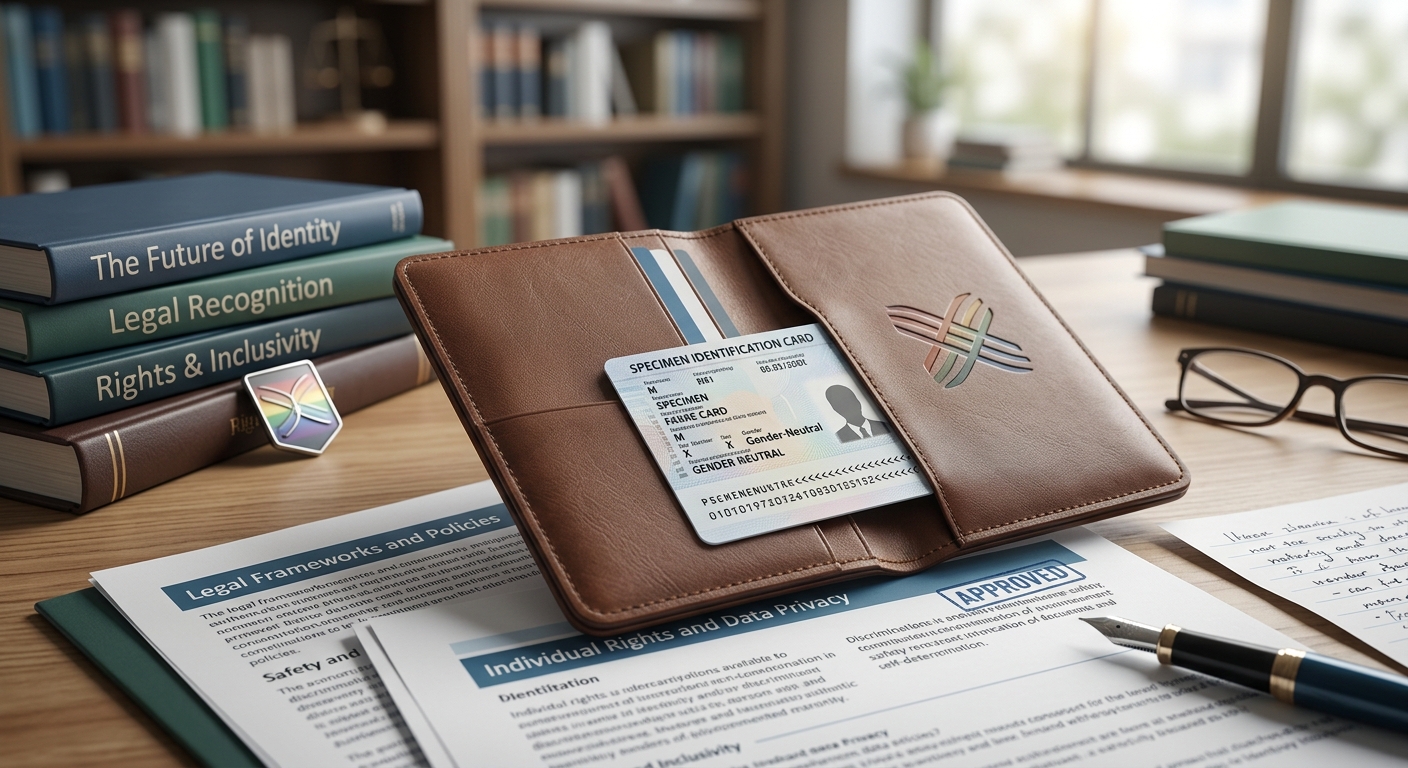
The Fundamental Need for Accurate Identification
In an increasingly documented society, the simple act of pulling a plastic card out of a wallet is a prerequisite for participating in modern civic life. We are required to present our identification to open bank accounts, secure housing, board commercial flights, pick up prescriptions, and exercise our fundamental right to vote. For the majority of the population, this exchange is entirely frictionless—a mundane administrative routine scarcely given a second thought. However, for transgender, non-binary, agender, and intersex individuals, presenting a government-issued identification document can be a moment fraught with profound anxiety, potential humiliation, and tangible danger. The incongruence between a person’s lived reality and the strictly binary “M” or “F” stamped on their card creates a dangerous friction point between marginalized individuals and the state.
In recent years, the introduction of the “X” gender marker—representing an unspecified or non-binary gender identity—has emerged as a vital structural remedy to this growing crisis. Access to gender-neutral identification is fundamentally a matter of personal safety, human dignity, and equal protection under the law. It enables individuals to navigate public and private spaces without being forcibly misgendered or unexpectedly outed by the very documents meant to protect and legitimize them.
For those whose gender identity falls outside the traditional binary, an accurate ID is not a luxury; it is a critical tool for survival. By examining the safety implications, the complex legal landscape, and the profound mental health benefits, we can begin to grasp why the push for the “X” marker is one of the most critical civil rights battles of our time.
The Safety Implications of Inaccurate Documents
To truly comprehend the necessity of genderless or gender-neutral identification, one must first examine the severe and often immediate consequences of carrying an inaccurate ID. When a person’s physical appearance, gender expression, or chosen name does not seamlessly align with the sex assigned at birth listed on their driver’s license or passport, routine identity verifications become perilous endeavors.
This discrepancy routinely triggers suspicion from retail clerks, security personnel, and law enforcement officers. What should be a brief verification process can escalate into invasive questioning about a person’s anatomy and personal life. In the most severe cases, this forced outing leads to outright discrimination, verbal harassment, or physical violence. Transgender and non-binary people frequently report being denied essential services, turned away from banking establishments, or subjected to heightened, invasive scrutiny by the Transportation Security Administration (TSA) simply because their documents do not match the evaluator’s subjective expectations of gender presentation.
Furthermore, inaccurate identification documents severely and negatively impact the democratic process. According to comprehensive research published by the Williams Institute at the UCLA School of Law, strict voter ID laws disproportionately and adversely affect transgender voters . Researchers found that tens of thousands of voting-eligible transgender citizens lack accurate identification documents. In states with rigid voter ID requirements, this missing documentation can result in disenfranchisement. A gender marker mismatch not only creates an intimidating voting environment but can prevent a citizen from casting their ballot.
This systemic failure to provide accurate documentation constitutes a form of administrative violence. By forcing individuals to carry documents that contradict their identity, the state actively participates in their marginalization, making them highly vulnerable to institutional and interpersonal harm. The “X” marker serves as a crucial, government-backed shield against this vulnerability, providing a legally recognized alternative that respects the individual’s identity and clearly signals to authorities that their non-binary presentation is legitimate and state-sanctioned.
Navigating the Fractured Legal Landscape
The ongoing fight for accurate identification has yielded significant, albeit highly uneven, victories across different levels of government. Historically, changing a gender marker on any government ID required individuals to successfully navigate a labyrinthine process of medical gatekeeping. This restrictive process often included obtaining costly court orders, undergoing extensive psychiatric evaluations, and securing letters from surgeons verifying that irreversible clinical transition steps had been taken. These archaic requirements placed an insurmountable financial and medical burden on marginalized individuals, effectively barring the vast majority of the transgender community from obtaining accurate IDs.
A monumental paradigm shift occurred at the federal level when the U.S. Department of State drastically modernized its passport policies. The State Department now officially allows all U.S. citizens to self-select their gender marker—choosing between male, female, or X—without requiring any medical certification, surgical proof, or doctor’s note . This progressive policy recognizes that individuals are the authorities on their own identity, providing a universally recognized travel document that honors non-binary and intersex individuals.
However, the legal landscape at the state level remains deeply fractured and highly contentious. Because driver’s licenses and birth certificates are issued by individual state governments, the availability of an “X” marker depends entirely on geographic location. The Movement Advancement Project (MAP), an independent think tank meticulously tracking identity document laws, highlights a stark national divide . While a rapidly growing coalition of progressive states and the District of Columbia have implemented straightforward self-attestation policies allowing for the easy adoption of an “X” marker on driver’s licenses, other jurisdictions have moved aggressively in the opposite direction. Meanwhile, some states have passed legislation banning gender-neutral markers or restricting updates to align solely with the sex assigned at birth.
This legal patchwork creates a chaotic, confusing environment for non-binary and transgender Americans. A person might legally possess a federally issued U.S. passport correctly displaying an “X” marker, yet be legally barred from having that exact same marker on their state-issued driver’s license. This glaring inconsistency not only causes logistical nightmares but also forcibly segments individuals into different classes of citizenship based purely on their zip code.
Comparing Identity Document Policies by Jurisdiction
To illustrate the stark disparities in how gender markers are handled across different jurisdictions, the following table outlines the general processes for obtaining a gender-neutral ID at the federal level compared to progressive and restrictive state environments.
| Jurisdiction Level | Availability of “X” Marker | Documentation Required for Update |
|---|---|---|
| Federal (U.S. Passports) | Yes | Self-attestation (no medical proof required). |
| Progressive States (e.g., CA, NY, WA) | Yes | Self-attestation via a simple application form. |
| Restrictive States | No | Only binary options allowed; often requires proof of surgery or an amended birth certificate to change between M and F. |
Mental Health and the Power of State Affirmation
Beyond the undeniable physical safety and robust legal protections afforded by gender-neutral identifications, the psychological and emotional benefits of state recognition are profound. Human beings harbor a fundamental, intrinsic need to be seen, understood, and recognized accurately by their communities and governing institutions. When the state issues an identification card that authentically aligns with a person’s true self, it sends a powerful, stabilizing message of societal validation and inclusion.
For years, non-binary and transgender individuals have endured the chronic, grinding stress of carrying official documents that actively invalidate their existence. This phenomenon, known as minority stress, contributes significantly to higher rates of anxiety and depression within the LGBTQ+ community. Erasing this specific stressor by providing an “X” marker option yields measurable improvements in overall mental health.
Having an accurate ID empowers individuals to participate freely in public life with confidence rather than perpetual fear. It means handing over a driver’s license at a routine traffic stop without bracing for a discriminatory, transphobic reaction. It means applying for a new job, signing a lease, or registering for classes without the preemptive dread of explaining a mismatched gender marker to a prospective employer or landlord. The profound sense of safety derived from these accurate IDs is as much emotional as it is physical; it is the enduring safety of knowing that the government officially acknowledges your right to exist exactly as you are.
The Path Forward: Reevaluating Identification
While the growing proliferation of the “X” marker is undeniably a massive step forward for civil rights, legal advocates, scholars, and LGBTQ+ organizations continue to push for deeper, more systemic changes. The ultimate, long-term goal for many activists is not just the piecemeal addition of a third gender category, but a critical, foundational reevaluation of why gender markers are required on public-facing identification documents in the first place.
Historically, physical descriptors like height, eye color, and sex assisted law enforcement in identifying individuals. However, with advances in biometric data and digital records, the practical utility of a gender marker has significantly diminished. Many advocates forcefully argue that removing gender markers entirely from public-facing documents while keeping them securely stored only in private demographic databases would effectively eliminate the risk of bias and discrimination altogether.
Until such a sweeping paradigm shift occurs, the immediate legislative battle remains heavily focused on expanding unrestricted access to the “X” marker across all fifty states. Furthermore, advocates are working to ensure that vital federal systems, such as the REAL ID program and the Social Security Administration, seamlessly integrate these non-binary classifications without creating additional bureaucratic hurdles. True equality and justice require that the government continually adapt its systems to reflect the diverse, complex reality of its citizens, rather than forcing those citizens to contort themselves to fit into rigid, outdated bureaucratic categories.
Frequently Asked Questions (FAQs)
What exactly does an “X” gender marker signify on a government ID?
An “X” gender marker is a federally and state-recognized designation used on identification documents to indicate a gender that is not exclusively male or female. It is utilized by non-binary, intersex, agender, and gender-nonconforming individuals. The “X” serves as a legally valid alternative to the traditional “M” (Male) or “F” (Female) options, providing an accurate reflection of the individual’s true identity.
How many U.S. states currently offer an “X” marker on driver’s licenses?
The availability of gender-neutral markers changes frequently due to ongoing legislative sessions. Currently, over twenty states and the District of Columbia allow individuals to select an “X” marker on their driver’s licenses. However, several states have actively banned the use of non-binary markers. For the most up-to-date information, organizations like the Movement Advancement Project (MAP) track identity document laws state by state.
Does traveling internationally with an “X” marker on a U.S. passport cause issues?
While the U.S. issues passports with an “X” marker, international travel requires navigating foreign laws. Some countries maintain strict binary systems or hostile policies toward LGBTQ+ individuals, potentially leading to scrutiny or entry denial. Travelers are strongly advised to research their destination’s specific laws and human rights record before traveling.
Do I need a doctor’s note to get an “X” marker on my U.S. passport?
No. As of recent policy updates, the U.S. Department of State no longer requires any medical certification, letters from physicians, or proof of clinical transition to select an “X” marker. The process is entirely based on self-attestation, meaning the applicant simply selects their preferred gender marker on the passport application form.
References
- Change of Sex Marker — U.S. Department of State, Bureau of Consular Affairs. https://travel.state.gov/content/travel/en/passports/need-passport/change-of-sex-marker.html
- The Potential Impact of Voter Identification Laws on Transgender Voters in the 2024 General Election — Herman, J.L. et al., Williams Institute, UCLA School of Law. 2024-09-15. https://williamsinstitute.law.ucla.edu/publications/trans-voter-id-impact/
- Identity Document Laws and Policies — Movement Advancement Project. 2026-04-02. https://www.mapresearch.org/equality-maps/identity_document_laws
Similar Articles








Read full bio of medha deb


