
Understanding the GAP Good Rewards Mastercard
Learn how the GAP Good Rewards Mastercard works, what it costs, and how to decide if it fits your spending habits.
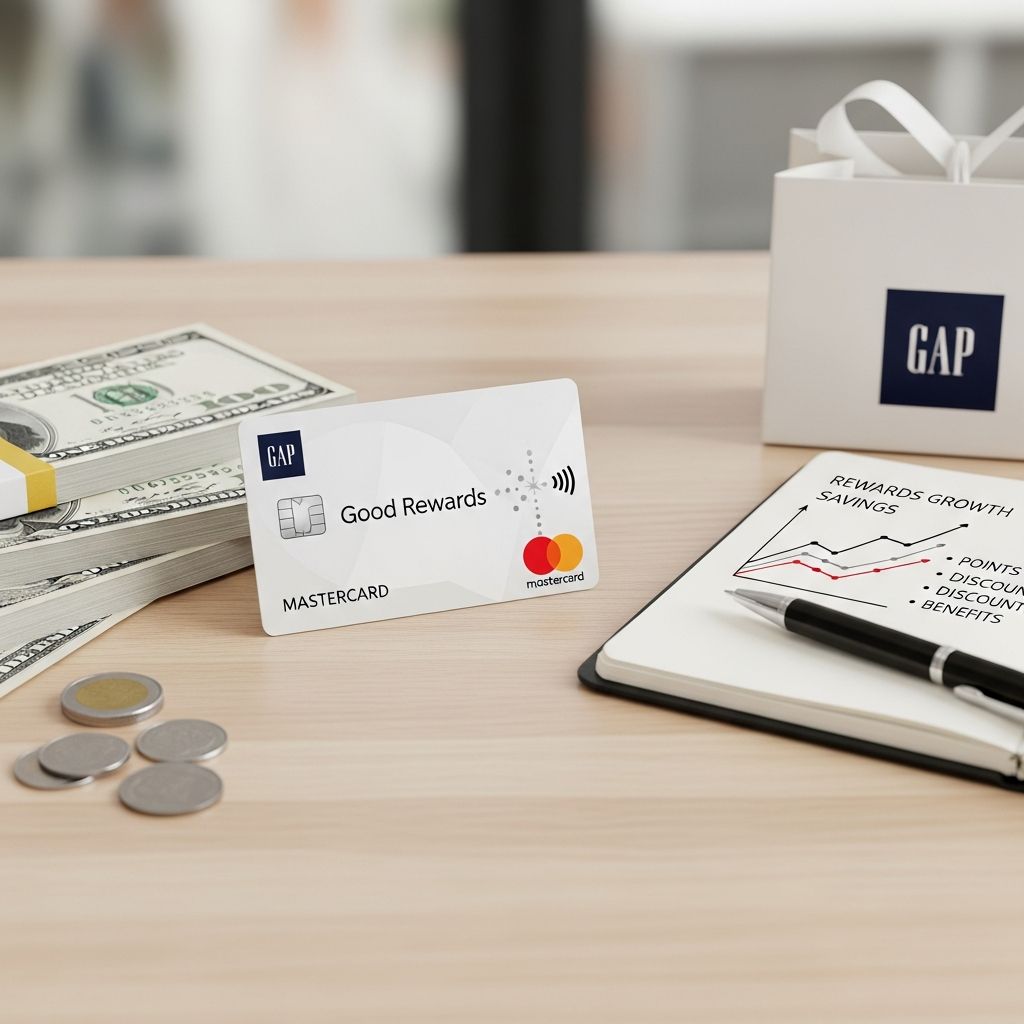
The GAP Good Rewards Mastercard is a store-branded rewards credit card designed for frequent shoppers at GAP and its affiliated brands. It offers brand-focused perks, but like most retail cards, it also comes with tradeoffs in fees, interest costs, and limited flexibility compared with general-purpose rewards cards.
This guide explains how the card generally functions, the kinds of rewards and costs you can expect, and how to decide whether a store-branded Mastercard like this is the right choice for you.
1. What Is the GAP Good Rewards Mastercard?
A store-branded Mastercard is a credit card issued by a bank but co-branded with a specific retailer. You can typically use it everywhere Mastercard is accepted, but its best features are tied to the partner store.
With a card like the GAP Good Rewards Mastercard, you can:
- Make purchases at GAP and related brands to earn enhanced rewards.
- Use the card at non-GAP merchants where Mastercard is accepted, often earning a lower base rate of rewards.
- Access cardholder-only discounts and promotional offers targeted to store customers.
However, rewards are usually optimized for brand loyalists, not for people who want flexible cash back or travel points.
2. How Rewards on Retail Credit Cards Typically Work
While exact numbers vary by product and over time, store credit cards and co-branded Mastercards tend to share some common reward structures.
2.1 Reward Types You May See
- Store points: Points that can be redeemed toward future purchases at the retailer or its partner brands.
- Tiered earnings: Higher rewards on in-brand purchases (for example, at GAP) and a lower flat rate on purchases elsewhere.
- Occasional bonuses: Extra points or discounts during special events, card anniversaries, or targeted promotions.
According to major issuers, many rewards cards offer bonus rates in specific categories (like dining, groceries, or travel) and a smaller rate on other spending. Retail cards simply swap in-store purchases for those bonus categories.
2.2 Typical Redemption Options
Most retail cards keep redemption options simple and store-centered:
- Reward certificates or coupons usable at the brand’s stores or website.
- Statement credits applied against recent store purchases (less common but possible).
- Occasional options like gift cards, but often still tied to the same family of brands.
Unlike many general rewards cards, you rarely see travel transfer partners or broad cash-back options with store-focused cards.
3. Advantages of a GAP-Branded Mastercard
For shoppers who already spend heavily with GAP and its partner brands, a co-branded card can deliver real value when used carefully.
3.1 Extra Value for Brand Loyalists
- Elevated in-store rewards: Higher reward rates on purchases across the GAP family of brands than you would earn at those stores with a typical flat-rate card.
- Cardholder-only deals: Access to special sales, early access events, or exclusive promo codes that non-cardholders cannot use.
- Synergy with loyalty programs: Store cards often stack on top of free loyalty memberships, accelerating your points or status level.
3.2 Building a Credit Profile (When Used Responsibly)
Because co-branded Mastercards are reported to the major credit bureaus like other bank cards, they can help you build credit if you:
- Pay at least the statement balance on time every month.
- Keep your credit utilization ratio relatively low (for example, using well under 30% of your total limit).
- Avoid carrying large balances across multiple cards.
Responsible card use can positively affect your payment history and utilization, two of the most influential factors in common credit scoring models.
4. Key Costs and Risks to Watch
Store-branded cards are often easier to get than premium rewards cards, but they usually come with higher interest rates and a narrow rewards focus.
4.1 Interest Rates and Carrying a Balance
Rewards credit cards in general—and store cards in particular—frequently charge above-average interest rates. The result is that any interest you pay can quickly outweigh the value of the rewards you earn.
To limit interest costs:
- Plan to pay your statement balance in full every billing cycle whenever possible.
- If you must carry a balance, aim to pay more than the minimum to reduce interest over time.
- Avoid using the card for large purchases you cannot repay quickly.
4.2 Fees and Penalties
Depending on the exact card configuration and your account behavior, you may face:
- Late payment fees if you miss your due date.
- Returned payment fees if your bank transfer fails.
- Foreign transaction fees if the card is used outside your home country (common on many non-travel cards).
Always read the card’s official pricing and terms disclosure; it sets out the full fee schedule and rate details using standardized language required by federal regulations.
4.3 Rewards Limitations
Compared with broad-based rewards cards, co-branded retail cards are usually more restrictive:
- Points may only be redeemable at a narrow group of brands.
- Reward certificates may expire if not used by a certain date.
- Promotional earning rates can be changed, reduced, or discontinued with appropriate notice.
These factors can make the rewards less valuable if your shopping habits change or you move away from the brand.
5. Comparing a Store Mastercard with General Rewards Cards
Before you apply for any new card, it helps to compare it against common alternatives, such as a flat-rate cash-back card or a general travel rewards card.
| Feature | Store-Branded Mastercard | Flat-Rate Cash-Back Card |
|---|---|---|
| Best earning category | Purchases at the specific retailer or its brands | All purchases earn the same percentage |
| Redemption flexibility | Mostly limited to store purchases or store-linked rewards | Cash back as statement credit, bank deposit, or similar |
| Typical APR level | Often high compared with mainstream cards | Varies, but sometimes lower than store cards |
| Ideal user | Frequent shopper with consistent brand loyalty | Consumer seeking simple, flexible rewards |
If you rarely shop at GAP, a general cash-back card that rewards all spending categories may be more useful than a narrowly focused store card.
6. How Credit Card Rewards Programs Generally Operate
Understanding the mechanics of rewards cards can help you decide whether any specific product fits your financial strategy.
6.1 How You Earn Rewards
Rewards cards typically grant points, miles, or cash back for each dollar you spend:
- Flat-rate structure: The same rate on every purchase (e.g., 1.5% back on all spending).
- Tiered categories: A higher rate in some categories, such as supermarkets or gas, and a lower base rate elsewhere.
- Rotating categories: Certain cards provide bonus rewards that change every quarter in specified spending areas.
Retail co-branded cards position store purchases as the primary “bonus” category, functioning much like a tiered card with a high in-brand rate and a lower general rate.
6.2 Common Redemption Paths
Across the market, you will see several broad redemption options:
- Statement credits: Apply rewards against your card balance.
- Direct deposits or checks: Convert points to cash in a bank account (for some issuers).
- Travel bookings: Use points or miles for flights, hotels, or rental cars via a travel portal.
- Gift cards and merchandise: Redeem points for gift cards or goods, sometimes at slightly lower value.
Store-centric cards often streamline this list and concentrate on coupons, store certificates, or statement credits specifically tied to the co-branded retailer.
7. How a GAP Store Card Could Affect Your Credit
Any new credit line, including a co-branded Mastercard, can change your credit profile in several ways.
7.1 Short-Term Effects
- Hard inquiry: When you apply, the issuer typically runs a hard inquiry, which may cause a small, short-lived drop in your credit scores.
- New account: Adding a new tradeline can reduce the average age of your accounts, another factor considered by many scoring models.
7.2 Long-Term Outcomes
Over time, responsible use can offset those short-term impacts:
- On-time payments build a positive payment history.
- Increased overall credit limits can help lower your utilization ratio if you avoid running up large balances.
- Maintaining the account for several years can gradually improve the age-related components of your score.
Conversely, missed payments or consistently high utilization can have the opposite effect and harm your scores.
8. When a GAP Good Rewards Mastercard May Be a Good Fit
The card may make sense in the following situations:
- You buy clothing or accessories from GAP and its partner brands regularly.
- You intend to pay balances in full each month, avoiding interest charges.
- You want to concentrate rewards on a small number of brands rather than spread them across categories.
- You already have a basic cash-back card and want a specialized card for your favorite store.
9. When You Might Want to Skip It
On the other hand, you may want to look for alternatives if:
- You rarely shop at GAP or could easily switch to alternative retailers.
- You are working to pay down existing balances and prefer not to open new credit lines.
- You want simple, flexible rewards that can be used for any category of spending.
- You anticipate carrying a balance and would prefer a card with a lower interest rate.
10. Practical Strategies for Using Retail Credit Cards Wisely
Regardless of the exact card details, the same good habits apply to almost every rewards credit card.
10.1 Maximize Benefits Without Overspending
- Treat rewards as a bonus for spending you would make anyway, not a reason to buy more.
- Use the card primarily where it offers the highest value (for example, at the co-branded retailer) and rely on broader cards for other purchases.
- Track reward expirations and redemption thresholds so you do not lose points.
10.2 Protect Your Budget and Credit Health
- Create and follow a realistic monthly budget so card spending does not outpace your income.
- Set up automatic payments for at least the statement balance or, at minimum, the required payment to avoid late fees.
- Review your statements monthly for errors, unauthorized charges, or fee changes.
11. Frequently Asked Questions (FAQs)
Q1: Does a store-branded Mastercard work everywhere?
Yes. Unlike a closed-loop store card that works only at a specific retailer, a co-branded Mastercard can generally be used at any merchant that accepts Mastercard. However, the most generous rewards typically apply only at the partner store and its affiliates.
Q2: Are retail credit cards harder or easier to qualify for?
Retail credit cards are often marketed to a wide range of consumers and may have more accessible approval criteria than premium travel or cash-back cards. However, approval still depends on your credit profile and the bank’s underwriting standards.
Q3: Can the rewards structure on my card change over time?
Yes. Issuers can modify reward rates, bonus categories, or promotional offers, provided they give any notices required by law and the cardholder agreement. It is a good idea to review updates that arrive with your monthly statement or via email.
Q4: What happens to my points if I close the card?
In many programs, unused points or store certificates may be forfeited when your account is closed, whether by you or by the issuer. Always check the rewards program terms before closing a card, and consider redeeming points first.
Q5: Should I apply at checkout when offered an instant discount?
Instant savings at the register can be appealing, but you should still consider long-term factors like interest rates, fees, and your overall credit strategy. Taking time to review the full terms and compare alternatives is usually wiser than making a decision based solely on a one-time discount.
References
- How Do Credit Card Points Work? Tips to Calculate & Redeem — Ramp. 2023-06-15. https://ramp.com/blog/how-do-credit-card-rewards-work
- Discover the Top Credit Card Benefits & Rewards to Look For — College Ave Student Loans. 2023-04-05. https://www.collegeave.com/articles/credit-card-benefits-rewards-explained/
- How Do Credit Card Rewards Work? — Capital One. 2023-09-12. https://www.capitalone.com/learn-grow/money-management/how-do-credit-card-rewards-work/
- What Are Credit Card Reward Points and How Do They Work? — Citi. 2023-03-01. https://www.citi.com/credit-cards/credit-card-rewards/what-are-credit-card-reward-points
- A Beginner’s Guide to Credit Card Points — Bankrate. 2022-11-21. https://www.bankrate.com/credit-cards/rewards/how-do-credit-card-points-work/
- What Is a Rewards Credit Card? — Experian. 2023-07-18. https://www.experian.com/blogs/ask-experian/what-is-a-rewards-credit-card/
- How Does a Rewards Credit Card Work? — HSBC Bank USA. 2022-10-10. https://www.us.hsbc.com/credit-cards/rewards-credit-card-explained/
Similar Articles








Read full bio of Sneha Tete


