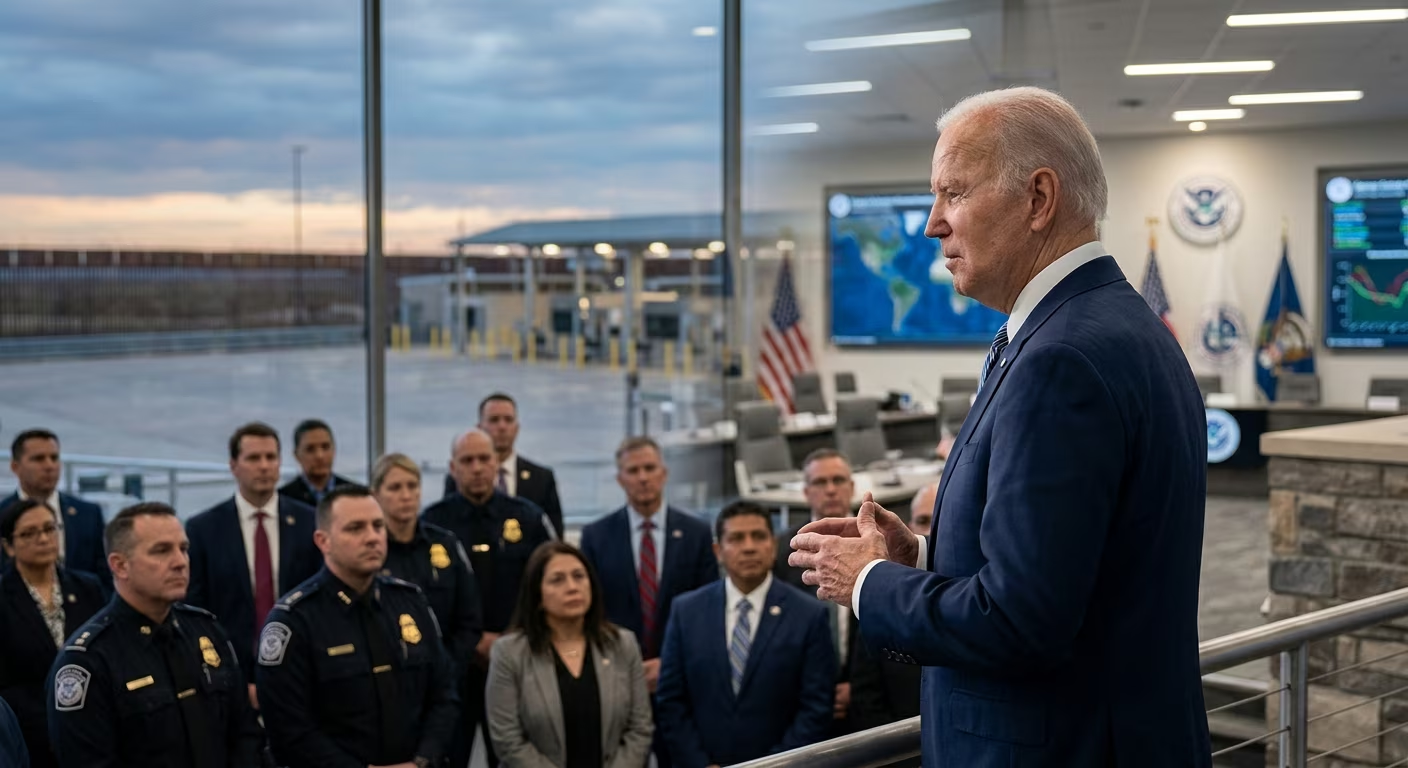
On his very first day in office, President Joe Biden signaled a dramatic shift in the United States’ approach to immigration enforcement. Moving away from the preceding administration’s zero-tolerance frameworks, the incoming administration sought to recalibrate how federal agencies handled undocumented immigrants. A cornerstone of this immediate, day-one agenda was a proposed 100-day pause on most deportations. This executive maneuver was not merely a symbolic gesture but a strategic pause designed to give the Department of Homeland Security (DHS) the necessary time to review its enforcement policies, reallocate finite resources, and implement a more targeted approach to civil immigration enforcement.
However, the sweeping nature of executive actions often collides with the complex realities of the federal judiciary. The deportation moratorium was swiftly met with a fierce legal challenge from the State of Texas, culminating in a federal judge blocking the initiative. This early confrontation set the stage for a prolonged legal tug-of-war that has defined the Biden administration’s tenure regarding immigration policy. Understanding the mechanics of the blocked moratorium, the subsequent pivot to prosecutorial discretion, and the broader implications for the American immigration system is essential for comprehending what comes next for federal immigration enforcement.
The Genesis of the 100-Day Deportation Moratorium
The January 2021 deportation moratorium was introduced via a memorandum from the acting Secretary of Homeland Security. The directive outlined a 100-day pause on the removal of certain noncitizens whose deportations had already been ordered. The core objective was straightforward: the U.S. immigration system was grappling with overwhelming backlogs, and DHS needed breathing room to conduct a comprehensive review of its enforcement priorities and operational protocols.
Importantly, the moratorium was not an absolute, blanket ban on all deportations. The directive contained specific, notable exceptions. For example, individuals who were deemed to pose a threat to national security or were suspected of terrorism or espionage were explicitly excluded from the pause. Furthermore, the moratorium did not protect recent unauthorized entrants; noncitizens who were not physically present in the United States before November 1, 2020, were still subject to standard removal proceedings. By carving out these exceptions, the administration attempted to strike a balance between securing the border against new, immediate threats and providing a temporary reprieve for individuals who had been living in the country for longer periods without committing serious crimes.
Immediate Backlash: The Texas Lawsuit and Judicial Intervention
The administration’s attempt to pause deportations was almost immediately derailed by aggressive litigation. Within days of the memorandum’s publication, Texas Attorney General Ken Paxton filed a lawsuit in federal court seeking to halt the policy. The legal argument presented by Texas was multi-faceted. First, the state claimed that the moratorium violated the Administrative Procedure Act (APA) by failing to provide an adequate rationale for such an abrupt policy reversal. Second, Texas invoked a highly controversial agreement signed with the outgoing Trump administration during its final days, which purportedly required the federal government to consult with the state before making significant changes to immigration enforcement.
The case was heard by U.S. District Judge Drew Tipton, who ultimately sided with Texas. Judge Tipton issued a temporary restraining order, subsequently extended, that effectively blocked the enforcement of the 100-day moratorium on a nationwide scale. In his ruling, Tipton agreed with the state’s argument that Texas would suffer irreparable financial harm if the moratorium proceeded. The core of this argument relied on the premise that releasing undocumented immigrants or halting their removals would inherently increase the state’s expenditures on public services, primarily in the sectors of public education and state-funded healthcare.
This ruling was a watershed moment. It highlighted an increasingly common legal strategy where individual states utilize specific federal district courts to secure nationwide injunctions against federal policies. This phenomenon effectively allows a single judge to dictate, or at least significantly delay, the national security and foreign policy agendas of the executive branch.
Recalibrating Enforcement: The Shift to Prosecutorial Discretion
With the 100-day moratorium permanently stalled by the judicial system, the Biden administration was forced to pivot. If DHS could not temporarily halt all deportations, it would instead strictly define who should be targeted for removal. This led to the formalization of new ICE enforcement priorities, primarily encapsulated in a comprehensive September 2021 memorandum issued by DHS Secretary Alejandro Mayorkas.
The Mayorkas guidelines directed ICE agents to prioritize their enforcement and removal efforts on three distinct categories of noncitizens:
- Threats to National Security: Individuals engaged in or suspected of terrorism, espionage, or related activities.
- Threats to Public Safety: Individuals who had been convicted of serious criminal offenses, particularly violent crimes or gang-related activities, and who were deemed to pose an ongoing danger to the community.
- Threats to Border Security: Individuals who were apprehended at the border or ports of entry while attempting to enter the country unlawfully, or who were not physically present in the U.S. before November 1, 2020.
This framework represented a return to the concept of prosecutorial discretion, heavily utilized during the Obama administration but largely abandoned during the Trump administration, which had effectively declared all undocumented immigrants as equal priorities for enforcement. However, like the moratorium, these priorities also faced intense legal scrutiny. In 2022, a federal court ruling temporarily forced the Biden administration to halt these specific limits on ICE arrests, throwing the agency’s operational guidelines back into uncertainty.
The Deep Dive: Understanding Prosecutorial Discretion in Immigration
To fully grasp the ongoing battles over ICE priorities, one must understand the fundamental necessity of prosecutorial discretion within immigration law. The United States is home to an estimated 11 million undocumented immigrants. Meanwhile, Congress only appropriates enough funding to deport a small fraction of this population annually. ICE faces finite resources, limited detention bed space, and an immigration court system that is buckling under a backlog of millions of pending cases.
Prosecutorial discretion is the legal authority that allows law enforcement agencies to decide where to focus these limited resources. In the criminal justice system, police and prosecutors routinely use discretion to prioritize solving murders over prosecuting jaywalking. Similarly, in immigration enforcement, discretion allows ICE to prioritize the removal of a convicted violent felon over a peaceful, undocumented parent who has lived in the U.S. for twenty years and pays taxes.
Critics of broad prosecutorial discretion argue that it effectively creates a shadow amnesty, allowing individuals who have violated federal immigration laws to remain in the country indefinitely without consequence. They assert that the executive branch has a constitutional mandate to faithfully execute the laws passed by Congress, meaning that categorical exemptions from deportation are a gross overreach of presidential power. Conversely, proponents argue that discretion is a fundamental, inescapable aspect of all law enforcement operations. By forcing ICE to concentrate on removing violent criminals and recent border crossers, the government can legitimately enhance national security metrics while avoiding the humanitarian catastrophe of tearing integrated families apart over minor civil infractions.
When the courts intervene to block priority guidelines, they effectively dilute this discretion. If ICE is forbidden from systematically prioritizing public safety threats, agents are left to operate without centralized, strategic direction, often resulting in arbitrary enforcement that instills widespread fear within immigrant communities without tangibly improving national security.
The Broader Impacts on Immigrant Communities
The whiplash of immigration policy between 2021 and the present has taken a profound toll on immigrant communities across the nation. The initial announcement of the 100-day moratorium offered a brief window of profound hope for mixed-status families who feared the sudden separation that deportation brings. The rapid judicial reversal of that policy, however, replaced that hope with an enduring, pervasive anxiety.
When federal guidelines are constantly shifting due to overlapping court injunctions and administrative appeals, the individuals caught in the crossfire suffer the most. Legal service providers and immigration advocates have reported massive confusion among their clients, many of whom do not understand if they are considered high-priority targets or if they qualify for affirmative relief. The chilling effect is palpable; undocumented individuals often become hesitant to interact with local law enforcement, report workplace abuses, or seek medical care, fearing that any interaction with government entities could lead to their detention and removal.
Moreover, the socio-economic ramifications extend beyond immediate families. Local economies that heavily rely on immigrant labor face disruptions when enforcement policies become erratic. Workers who are afraid of unexpected workplace raids are less likely to participate actively in the formal economy, suppressing wages and diminishing local tax revenues. Furthermore, educators and school administrators have observed heightened anxiety among students from immigrant families, which directly correlates with lower academic performance and increased absenteeism during periods of heightened ICE activity. The lack of a stable, predictable federal policy creates a ripple effect that damages community cohesion at the neighborhood level.
Looking Ahead: Executive Action vs. Legislative Reform
As the administration navigates the complex realities of immigration policy, the fundamental question remains: what comes next? The history of the blocked deportation moratorium perfectly illustrates the inherent fragility of attempting to overhaul immigration policy solely through executive action. Whatever one president enacts with a pen, a federal judge can enjoin, and the next president can immediately revoke.
The Biden administration has continued to utilize its executive authority to manage the border, including sweeping actions in 2024 to restrict asylum access for migrants who cross the Southern border unlawfully during periods of high encounter volumes. Yet, these measures are generally reactive, designed to manage crises rather than fix the underlying, systemic flaws in the U.S. immigration code.
Ultimately, a sustainable, long-term solution requires congressional action. Bipartisan efforts to update the Immigration and Nationality Act have repeatedly stalled due to intense partisan polarization. Until Congress can successfully pass comprehensive immigration reform that modernizes the legal immigration system, addresses the status of the undocumented population, and properly funds border security infrastructure, the U.S. will remain locked in a cycle of executive mandates and judicial blockades.
Comparative Analysis of Enforcement Priorities
The shifting landscape of immigration enforcement can be better understood by contrasting the approaches of recent presidential administrations. The table below highlights the core differences in how executive power has been wielded to direct ICE operations over the past decade.
| Administration | Primary Approach to Enforcement | Key Targets for Removal | Use of Prosecutorial Discretion |
|---|---|---|---|
| Obama | Targeted Enforcement | Convicted criminals, recent border crossers, national security threats. | High; formally codified to protect families and long-term residents. |
| Trump | Zero-Tolerance / Universal | Virtually all undocumented immigrants; criminal history not required. | Low; specific guidelines were rescinded to maximize enforcement. |
| Biden | Recalibrated & Prioritized | Public safety threats, terrorists, recent unauthorized entrants. | High; heavily emphasized, though frequently challenged in federal courts. |
Frequently Asked Questions (FAQs)
What exactly was the 100-day deportation moratorium?
The 100-day moratorium was an executive action issued by the Department of Homeland Security on January 20, 2021. It directed a temporary pause on the deportation of certain noncitizens who had already received removal orders, providing the government time to review and update its broader immigration enforcement policies. Exceptions were made for national security threats and recent arrivals.
Why did Judge Drew Tipton block the moratorium?
Judge Tipton issued a temporary restraining order blocking the moratorium primarily based on a lawsuit filed by the State of Texas. He agreed with Texas’s argument that pausing deportations would cause the state “irreparable financial harm” by increasing costs associated with public education and healthcare for undocumented immigrants. He also cited potential violations of the Administrative Procedure Act.
What does “prosecutorial discretion” mean in immigration?
Prosecutorial discretion refers to the authority of law enforcement agencies, like ICE, to decide where to focus their limited resources. Because Congress does not provide enough funding to deport every undocumented immigrant in the country, DHS uses discretion to prioritize the removal of individuals who pose a serious threat to public safety or national security over those who do not.
Did the blocked moratorium mean all deportations resumed immediately?
While the blanket pause was blocked, the Biden administration still implemented interim and final enforcement guidelines that directed ICE officers to prioritize specific groups (criminals, security threats, recent border crossers). Therefore, while deportations did not stop entirely, the strategic focus of who was being deported shifted significantly compared to the prior administration.
Can the President fix the immigration system without Congress?
No. While the President has broad executive authority to manage border enforcement and direct agency resources, these actions are temporary and highly vulnerable to federal court injunctions. Permanent, systemic changes to the legal immigration framework, visa quotas, and paths to citizenship require legislation passed by Congress.
Conclusion
The rise and rapid fall of the 100-day deportation moratorium serves as a defining microcosm of the contemporary American immigration debate. It underscores the immense challenges the executive branch faces when attempting to reshape entrenched enforcement paradigms. As legal battles over ICE priorities and border security measures continue to unfold, it is overwhelmingly clear that executive discretion alone cannot cure the systemic deficiencies of the U.S. immigration system. Moving forward, the true test for the nation will be whether lawmakers can bridge partisan divides to craft a durable, legislative framework that balances national security with humanitarian obligations.
References
- Judge bars Biden from enforcing 100-day deportation ban — PBS News. 2021-01-26. https://www.pbs.org/newshour/politics/judge-bars-biden-from-enforcing-100-day-deportation-ban
- Biden administration halts limits on ICE arrests following court ruling — CBS News. 2022-06-25. https://www.cbsnews.com/news/biden-administration-halts-limits-on-ice-arrests-following-court-ruling/
- Immigration Enforcement Actions: 2021 — Congressional Research Service. 2021-06-01. https://crsreports.congress.gov/
- FACT SHEET: President Biden Announces New Actions to Secure the Border — The White House. 2024-06-04. https://www.whitehouse.gov/briefing-room/statements-releases/2024/06/04/fact-sheet-president-biden-announces-new-actions-to-secure-the-border/