
Free Speech Zones vs. The Right to Protest
How 'free speech zones' silence dissent and threaten First Amendment rights.
The Illusion of Visibility: Protest in the Modern Era
The intersection of global spectacle and fundamental civil liberties frequently produces intense friction, particularly when the eyes of the world are watching. In the theater of modern democracy, the right to dissent is not merely about the freedom to harbor contrary opinions in private; it is fundamentally about the right to project those opinions into the public sphere. Dissent requires an audience. Yet, over the past few decades, municipal governments and law enforcement agencies have increasingly employed creative logistical maneuvers to sanitize public spaces during major events. Through the deployment of physical barricades, sudden route changes, and the establishment of restrictive designated areas, authorities often attempt to prioritize visual harmony over constitutional rights.
This dynamic effectively quarantines the First Amendment, transforming vibrant public spaces into highly controlled television sets where dissent is either hidden or heavily diluted. The practice of moving protests out of sight fundamentally misunderstands the purpose of free expression. When individuals take to the streets to voice their grievances, they are not simply speaking into the void; they are demanding to be seen by those in power and by the public at large. Stripping a protest of its visibility neutralizes its primary mechanism for inspiring social and political change.
A Case Study in Censorship: The 2008 Torch Relay
The collision between international pageantry and the right to public assembly was starkly illuminated during the spring of 2008. As the Olympic flame made its way toward Beijing, its international relay became a lightning rod for global demonstrations. The 2008 Beijing Olympics were highly controversial due to the host government’s human rights abuses, particularly regarding its policies in Tibet and its international political alignments. Global activists viewed the international torch relay as a rare, highly televised opportunity to draw media attention to these atrocities. When the torch arrived in San Francisco—the only North American stop on its global tour—the anticipation of massive, visible demonstrations was at an all-time high.
Thousands of individuals, draped in flags and holding banners demanding justice, lined the Embarcadero, expecting the relay to pass directly in front of them along the officially publicized route. However, instead of managing the protests through standard, constitutional crowd-control measures, city officials executed a series of sudden, unannounced logistical maneuvers. The planned route was abruptly abandoned. Authorities secretly shuttled the torch onto a bus and rerouted it to a vastly different, heavily guarded path far away from the waiting crowds.
This bait-and-switch tactic successfully prevented any televised visual conflict between the Olympic procession and human rights demonstrators. From a purely administrative standpoint, the city avoided a public relations disaster and maintained physical order. But from a constitutional perspective, the maneuver was deeply problematic. The government effectively shielded a foreign political symbol from domestic dissent, denying protesters their intended audience. The thousands of individuals who had peacefully assembled to exercise their First Amendment rights were left shouting at empty streets. This incident serves as a powerful historical case study of how government entities can utilize logistical secrecy to circumvent the spirit of the First Amendment without explicitly arresting anyone for speaking.
The Architecture of a “Free Speech Zone”
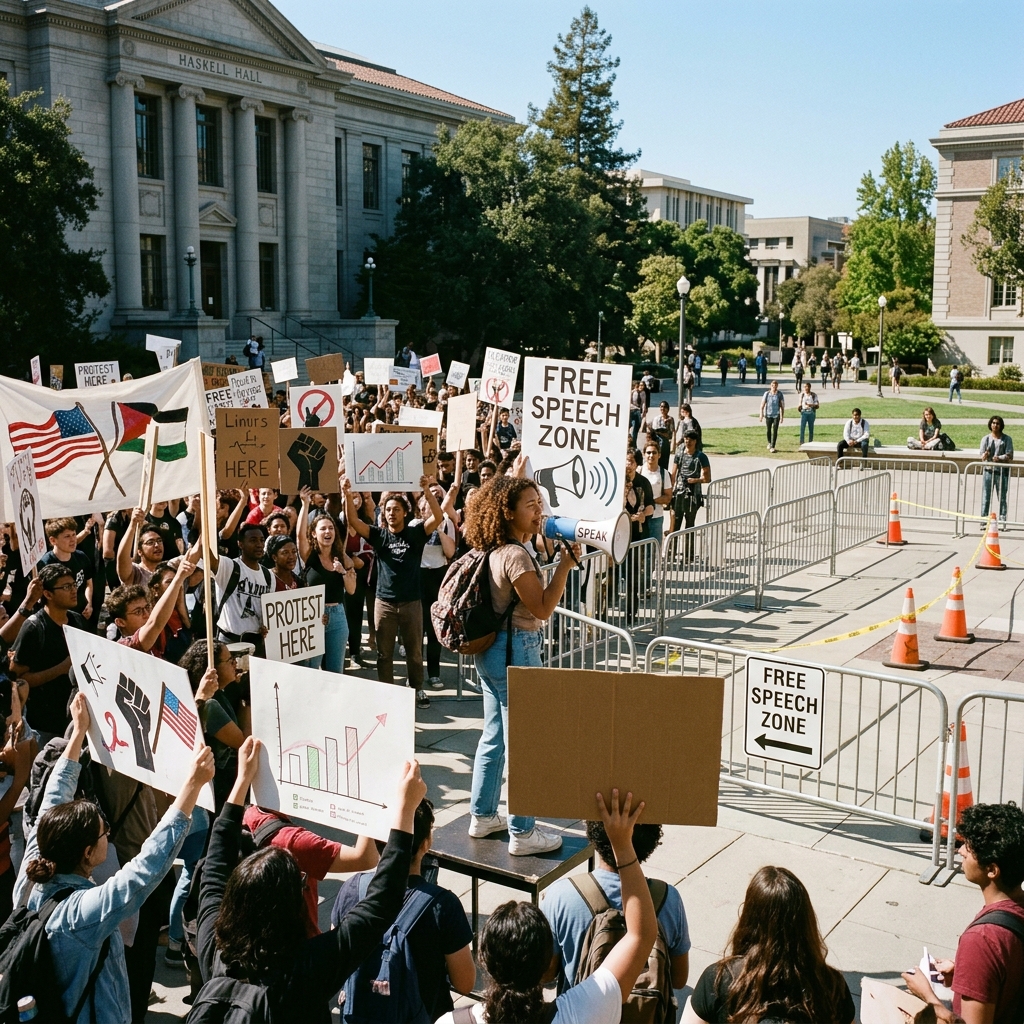
The events in San Francisco were a high-profile manifestation of a broader, increasingly common tactic in crowd control: the creation of “free speech zones.” Often deployed during national political conventions, international summits, and major sporting events, these zones are geographically designated areas where protesters are explicitly permitted to gather. Ostensibly, they are designed to balance the right to expression with the government’s interest in maintaining public safety, ensuring smooth traffic flow, and protecting dignitaries from potential harm.
In practice, however, these zones frequently act as a quarantine for the First Amendment. They are routinely positioned blocks, or even miles, away from the main event location. Protesters are often corralled behind chain-link fences, surrounded by an overwhelming police presence, and kept entirely out of the sightlines of both the event attendees and the media cameras. By isolating dissent geographically, authorities effectively neuter the communicative power of the demonstration.
The fundamental flaw in the concept of a free speech zone is the assumption that speech is merely about the act of vocalizing words, regardless of who is listening. If an environmental advocacy group wishes to protest a summit of oil executives, placing them in a fenced-in parking lot a mile away from the convention center defeats the entire purpose of the demonstration. The protest is intended to confront the executives and the media covering them. When the government dictates that dissent can only occur in a space where it cannot be seen or heard by its target audience, it is not accommodating speech; it is suppressing it through geographical exile.
The Public Forum Doctrine and Constitutional Limits
To understand the legal friction surrounding free speech zones and bait-and-switch routing tactics, one must examine the foundational principles of the Public Forum Doctrine. Under United States constitutional law, traditional public forums—such as streets, sidewalks, and public parks—are spaces that have historically been dedicated to public assembly and debate. In these areas, the government’s ability to restrict speech is severely limited, recognizing the vital role these spaces play in democratic participation.
While First Amendment protections are robust, they are not absolute. The Supreme Court has established that the government may impose reasonable “time, place, and manner” restrictions on speech in public forums to maintain order. The landmark Supreme Court case Ward v. Rock Against Racism (1989) formally solidified this framework, noting that while the government can regulate certain logistical aspects of expression to preserve public order, it cannot fundamentally suppress the communication. For these restrictions to be considered legally valid, they must strictly adhere to three core criteria:
- Content and Viewpoint Neutrality: The restriction must apply equally to all groups, regardless of their message. A city cannot ban a protest because its message is unpopular or offensive, nor can it force critics into a free speech zone while allowing supporters to line the streets unimpeded.
- Narrow Tailoring to a Significant Government Interest: The restriction must serve a legitimate, important government purpose, such as ensuring pedestrian safety, preventing violence, or preventing the total obstruction of vital emergency roadways. Furthermore, the regulation must not burden substantially more speech than is necessary to achieve that specific interest.
- Ample Alternative Channels of Communication: This is the most critical factor in the context of free speech zones. The restriction must leave the speaker with a viable alternative way to reach their intended audience effectively.
It is on this third prong that extreme free speech zones and deceptive routing tactics frequently fail constitutional scrutiny. If a demonstration is sequestered to an area where the target audience cannot possibly see the signs or hear the chants, the alternative channel of communication is not “ample”; it is effectively non-existent.
Evaluating Legitimate Safety vs. Unconstitutional Censorship
A crucial part of maintaining a healthy democracy involves distinguishing between genuine security protocols and thinly veiled censorship tactics. Authorities frequently cite “security concerns” as a blanket justification for severely restricting protest access. The table below outlines the differences between legally permissible crowd management and unconstitutional suppression tactics:
| Feature | Legitimate Safety Measure (Constitutional) | Suppression Tactic (Unconstitutional) |
|---|---|---|
| Buffer Zones | Establishing a narrow, reasonable distance between opposing groups to prevent imminent physical violence. | Creating massively expansive zones that make protesters entirely invisible to the event attendees and media. |
| Event Routing | Keeping specific emergency lanes clear while maintaining a highly publicized parade or event route. | Secretly changing the route at the last minute to intentionally evade all demonstrators and hide dissent. |
| Viewpoint Application | Applying identical security rules and proximity limits to both protesters and supporters alike. | Allowing supporters near the event cameras while moving critics to a distant, heavily fenced “zone.” |
| Media Access | Allowing journalists to freely document all public areas, including both the event and the surrounding protests. | Restricting the press from accessing, interviewing, or filming the individuals confined within protest areas. |
The Critical Nature of Visibility in Public Dissent
Protest is inherently a performative act; it is an exercise in visual and auditory communication. The history of meaningful social change is inextricably linked to the visibility of dissent. The American Civil Rights Movement relied heavily on the stark visual contrast between peaceful marchers and aggressive law enforcement to awaken the conscience of a nation. If those historic marches had been legally confined to remote, fenced-in “free speech zones” far away from public thoroughfares and television cameras, their societal impact would have been profoundly diminished.
When authorities utilize logistical tactics to separate the speaker from their target audience, they artificially sanitize the event for public consumption. This sanitization creates a false, manufactured illusion of universal consensus. If a global athletic event or a major political convention is broadcast without any visible opposition, the resulting media narrative incorrectly suggests unanimous public support. The government should never act as a visual director, manipulating the optics of a public event to protect foreign dignitaries or political candidates from the mere discomfort of public criticism.
The First Amendment protects the right to make the powerful uncomfortable. It protects the right to disrupt the visual harmony of a carefully orchestrated public relations event with dissenting signs, vocal chants, and peaceful assembly. When police forces push dissenters out of sight to ensure a flawless television broadcast, they are prioritizing the aesthetic preferences of event organizers over the foundational constitutional rights of the citizens.
Modern Implications for Democratic Engagement
The tactics utilized during the 2008 Olympic torch relay laid the administrative groundwork for contemporary struggles over the freedom of assembly. Today, we see similar, highly restrictive strategies deployed across various civic arenas. For example, the Foundation for Individual Rights and Expression (FIRE) has extensively documented and litigated against public university policies that attempt to restrict student leafleting and demonstrations to tiny, highly regulated patches of campus grass.
Similarly, the use of massive “National Special Security Events” (NSSE) designations by the federal government for events like political conventions or international summits often results in the suspension of standard First Amendment protections across vast urban centers. Entire downtown grids are transformed into fortress-like environments where unscripted public expression is aggressively marginalized.
These restrictive practices have a profound and deeply concerning chilling effect on democratic participation. When citizens realize that their intense efforts to organize, mobilize, and peacefully protest will be met with geographical marginalization and forced invisibility, the incentive to participate in public discourse drops dramatically. Why spend weeks organizing a demonstration if municipal authorities will simply reroute the target of your protest at the last minute, or lock your organization behind a distant barricade?
Protecting the fundamental right to protest inherently requires a society to tolerate a certain degree of public inconvenience. True free expression is messy, loud, and often disruptive to the normal, quiet flow of daily life. Attempting to neatly package and contain it within designated zones is fundamentally incompatible with the principles of a free and open society. Dissent must be allowed to breathe in the open air, visible and audible to all who pass by.
Frequently Asked Questions
What is a Free Speech Zone?
A free speech zone is a specific, government-designated geographic area in a public space where individuals are permitted to protest, hold signs, or distribute literature. They are frequently established during major political conventions, international summits, or sporting events, usually under the official justification of maintaining public order and safety.
Are Free Speech Zones Constitutional?
Their constitutionality depends entirely on their specific implementation. While the government can legally impose reasonable “time, place, and manner” restrictions on speech, these regulations must leave open ample alternative channels for communication. If a free speech zone completely isolates protesters from their intended audience and the media, courts frequently strike them down as unconstitutional violations of the First Amendment.
What is the Public Forum Doctrine?
The Public Forum Doctrine is a crucial legal framework used by U.S. courts to evaluate the constitutionality of government restrictions on speech in public property. It dictates that traditional public spaces, like streets, sidewalks, and parks, possess the highest level of First Amendment protection, severely limiting the government’s ability to ban or heavily restrict peaceful assembly in these areas.
Can the Government Secretly Change an Event Route to Avoid Protests?
While the government has broad administrative authority to manage traffic and ensure public safety, purposely and secretly changing an event’s route solely to hide the event from peaceful protesters can be viewed as an unconstitutional infringement. It denies the assembled individuals their right to be seen and heard by their target audience, violating the requirement to leave ample alternative channels of communication open.
Conclusion
Ultimately, the right to free speech is rendered effectively meaningless if the government possesses the unchecked authority to dictate that no one is allowed to see or hear it. As society navigates an era of increasingly sophisticated event management and heightened security protocols, citizens and courts alike must remain hyper-vigilant against administrative tactics that quietly erode civil liberties under the guise of public safety. The streets and sidewalks belong to the public, and the vital voices of dissent deserve to be heard directly, not hidden away in the carefully managed shadows.
References
- Ward v. Rock Against Racism, 491 U.S. 781 — United States Supreme Court. 1989-06-22. https://supreme.justia.com/cases/federal/us/491/781/
- Free Speech Zones — The First Amendment Encyclopedia, Middle Tennessee State University. 2023-08-07. https://firstamendment.mtsu.edu/article/free-speech-zones/
- Assessing Constitutional Challenges to University Free Speech Zones Under Public Forum Doctrine — Indiana Law Journal. 2004-01-01. https://www.repository.law.indiana.edu/ilj/vol79/iss1/13/
- Free Speech Zones — The Foundation for Individual Rights and Expression (FIRE). 2024-01-01. https://www.thefire.org/research-learn/free-speech-zones
Similar Articles








Read full bio of medha deb


