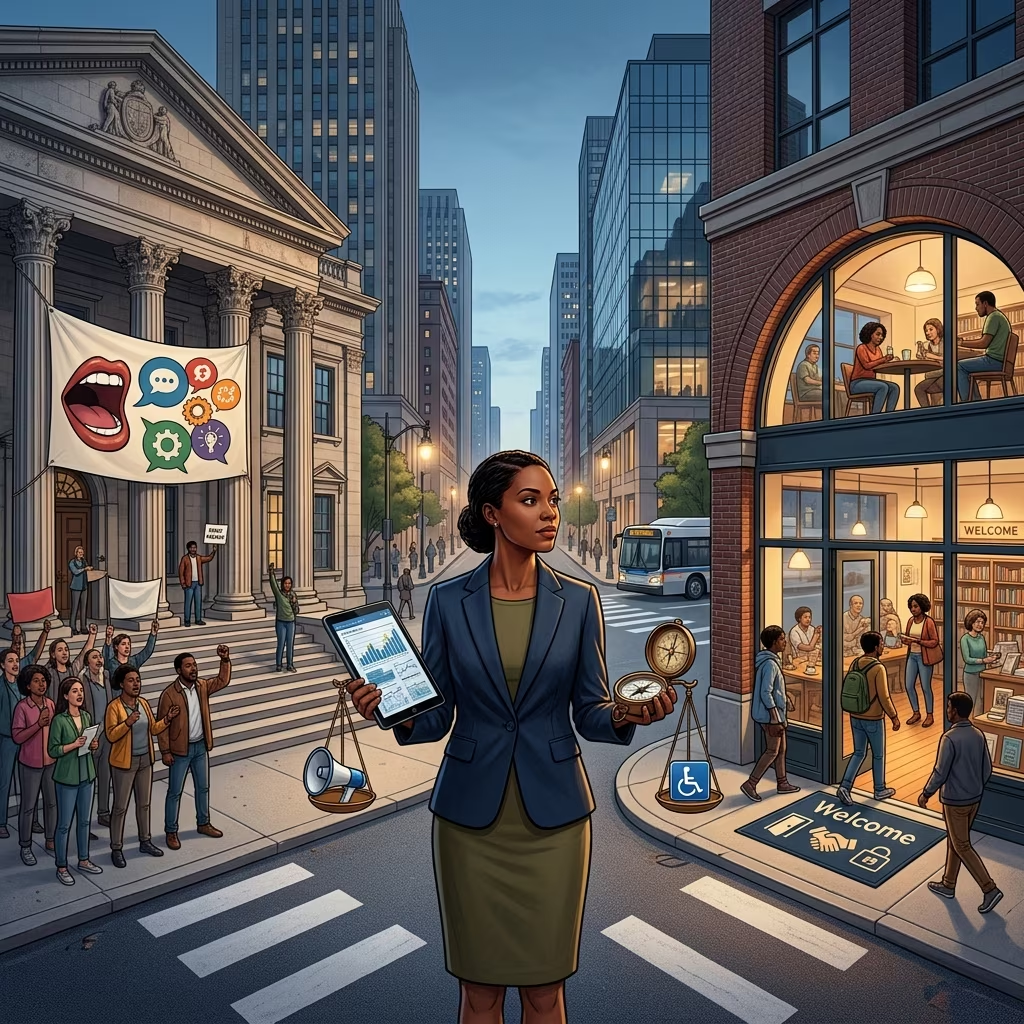
The landscape of civil rights in the United States is frequently defined by the complex, sometimes contentious intersection of competing constitutional principles. One of the most fiercely debated arenas in modern jurisprudence is the friction between state-mandated non-discrimination laws and the First Amendment’s protection of free speech. For decades, legal scholars, civil rights advocates, and business owners have grappled with a fundamental question: when does a legal requirement to serve the public cross the line into unconstitutional government-compelled speech?
Recent judicial developments, particularly at the highest levels of the federal court system, have brought this debate to the forefront of national discourse . By drawing a line between standard commercial transactions and services that involve customized, expressive messaging, the courts have introduced new nuances into how anti-discrimination protections are applied. Understanding these nuances is critical for marginalized groups, particularly the LGBTQ+ community, as well as for business owners seeking to navigate their legal obligations without compromising their deeply held beliefs or expressive freedoms.
The Judicial Context: Balancing Expression and Equality
To fully grasp the current legal landscape, one must first understand the doctrine of compelled speech. The First Amendment does not merely protect an individual’s right to speak their mind; it equally protects their right to remain silent. The government cannot force a citizen to articulate, endorse, or promote a message with which they fundamentally disagree. This principle is relatively straightforward when applied to private individuals but becomes intensely complicated when applied to commercial enterprises operating in the public sphere.
When a business opens its doors to the public, it becomes subject to various state and federal regulations, including public accommodation laws. These statutes are designed to ensure that all citizens have equal access to the marketplace, free from discrimination based on race, religion, national origin, and, in many jurisdictions, sexual orientation and gender identity . However, a conflict arises when the service being sold is not a mere commodity, but a form of original, creative expression.
Distinguishing Between Conduct and Expression
The pivotal legal test hinges on whether the goods or services in question are fundamentally “expressive.” If a commercial service requires the creator to generate a customized messagendndash;such as writing a tailored speech, painting a commissioned portrait, or designing a bespoke websitendndash;the courts are increasingly likely to view that service as protected speech . In these highly specific scenarios, forcing a creator to produce content that violates their personal convictions is viewed by the judiciary as an unconstitutional mandate.
Conversely, if a business sells standardized, non-expressive goods or services, the First Amendment does not provide a shield against anti-discrimination laws. A restaurant cannot refuse to serve a meal, a hotel cannot refuse to rent a room, and a retail store cannot refuse to sell a pair of shoes based on the customer’s identity. In these cases, the transaction is considered standard commercial conduct, not protected expression.
The Scope of Anti-Discrimination Statutes in Modern Commerce
Public accommodation laws form the bedrock of consumer civil rights in the United States. Federal protections, most notably Title II of the Civil Rights Act of 1964, prohibit discrimination in places of public accommodation on the basis of race, color, religion, or national origin . However, federal law does not explicitly cover sexual orientation or gender identity in public accommodations, leaving a significant gap that state legislatures have had to fill.
Currently, numerous states have enacted their own comprehensive anti-discrimination statutes. These state-level laws stretch further than federal mandates, expressly forbidding businesses that serve the public from discriminating against LGBTQ+ individuals . These statutes are vital tools for ensuring that all citizens can participate fully and equally in the economic and social life of their communities. The tension arises only when these broad statutory mandates collide with the narrow, constitutionally protected realm of customized artistic expression.
Routine Retail versus Bespoke Services
To clarify the distinction between what is regulated by anti-discrimination laws and what is protected by the First Amendment, it is helpful to look at specific examples of commercial activity. The table below illustrates how different types of businesses and services are generally categorized under current legal frameworks.
| Type of Business / Service | Nature of the Transaction | Subject to Public Accommodation Laws? |
|---|---|---|
| Grocery Store or Supermarket | Sale of pre-packaged, standardized goods. | Yes. Cannot refuse service based on protected characteristics. |
| Hotel or Lodging Facility | Providing standard room accommodations to the general public. | Yes. Bound by strict non-discrimination mandates. |
| Custom Speechwriter | Drafting unique, personalized textual content conveying a specific message. | No. Compelling a writer to draft a message they oppose violates the First Amendment. |
| Commercial Transit (Bus, Train) | Providing standard point-to-point transportation. | Yes. Must provide equal access to all paying passengers. |
| Bespoke Graphic Designer | Creating original artwork or digital media tailored to celebrate a specific event. | No. Generally protected as customized, expressive speech. |
Ramifications for Marginalized Communities and Consumer Rights
The delineation between expressive speech and standard commerce has profound implications for marginalized communities. For LGBTQ+ individuals, recent judicial rulings recognizing First Amendment exemptions have sparked understandable apprehension. The primary concern is that these exemptions might be weaponized or broadly interpreted by bad actors as a general license to discriminate in everyday commercial interactions.
However, legal experts emphasize that the carve-out for expressive services is exceptionally narrow. It does not dismantle the broader framework of civil rights protections. A business owner’s personal beliefs do not grant them immunity from public accommodation laws unless the specific service requested forces them to generate customized speech . For instance, a graphic designer who refuses to create a custom website celebrating a same-sex wedding cannot simultaneously refuse to sell a pre-designed, generic website template to an LGBTQ+ customer. The refusal must be tied strictly to the customized message, not to the identity of the buyer.
Guardrails Against Broad Exemptions
To prevent the erosion of civil rights, courts enforce strict guardrails around what qualifies as expressive conduct. A business cannot simply slap an “artist” label on its operations to bypass anti-discrimination laws. The service must inherently involve the creation of speech, and the government’s compulsion must actively force the individual to contradict their own messaging. These stringent requirements ensure that the vast majority of commercial establishmentsndndash;ranging from healthcare providers and mechanic shops to big-box retailers and restaurantsndndash;remain unequivocally bound by non-discrimination statutes .
Future Legal Battlegrounds
While the supreme judicial authorities have provided clarity on purely expressive professions like custom website design, the legal frontier remains fraught with gray areas. The coming years will likely see a surge in litigation as lower courts are tasked with determining exactly where the line of “expression” is drawn in less obvious industries.
Consider the culinary arts: Is the creation of a custom wedding cake a form of protected artistic expression, or is it merely the preparation of food? What about a florist arranging a bouquet, or a tailor crafting a bespoke suit? These professions involve skill, artistry, and customization, but whether they rise to the level of “speech” protected by the First Amendment is a question that remains heavily debated. As businesses attempt to test the boundaries of these exemptions, civil rights organizations will continue to litigate vigorously to ensure that public accommodation laws are not steadily chipped away by overly broad interpretations of artistic freedom.
Ultimately, the balance between free expression and equality is not static; it is an evolving dialogue. As society progresses and the nature of commerce shifts, the legal system will continually be forced to refine its definitions, ensuring that the First Amendment remains a shield for true expression rather than a sword for unwarranted discrimination.
Frequently Asked Questions (FAQs)
What is a public accommodation law?
Public accommodation laws are civil rights statutes that prohibit discrimination in businesses and spaces that are open to the general public. These include hotels, restaurants, retail stores, theaters, and transportation services. The goal of these laws is to ensure that all individuals, regardless of their race, religion, national origin, or other protected characteristics, have full and equal access to goods and services in the marketplace.
Does a First Amendment exemption mean any business can refuse service to LGBTQ+ people?
No. The First Amendment exemption recognized by courts is highly specific and narrowly tailored. It only applies to businesses providing customized, expressive servicesndndash;such as commissioned artwork, custom writing, or bespoke designndndash;where fulfilling the service would force the creator to express a message they fundamentally disagree with. Standard retail stores, hospitality venues, and non-expressive service providers cannot refuse service based on a customer’s sexual orientation or gender identity.
How do courts determine if a service is considered “speech”?
Courts look at whether the service involves original, creative input that conveys a specific message. They assess if the final product is customized to articulate a viewpoint and whether the creator is actively involved in generating that expression. Routine commercial transactions, even those requiring skill (like repairing a car or cooking a standard meal), do not meet this threshold.
What should I do if I experience discrimination at a standard retail or service business?
If you are denied service at a standard, non-expressive business (such as a grocery store, hotel, or restaurant) based on a protected characteristic, you should document the incident thoroughly. Note the date, time, location, and the individuals involved. You can file a complaint with your state’s civil rights commission or the appropriate federal agency, such as the Department of Justice, depending on the specific protections enacted in your jurisdiction.
References
- 21-476 303 Creative LLC v. Elenis (06/30/2023) ndndash; Supreme Court of the United States. 2023-06-30. https://www.supremecourt.gov/opinions/22pdf/21-476_c185.pdf
- Title II of the Civil Rights Act (Public Accommodations) ndndash; U.S. Department of Justice. 2024-06-07. https://www.justice.gov/crt/title-ii-civil-rights-act-public-accommodations
- State Public Accommodation Laws ndndash; National Conference of State Legislatures. 2025-05-16. https://www.ncsl.org/civil-and-criminal-justice/state-public-accommodation-laws