Introduction to a New Era of Literary Censorship
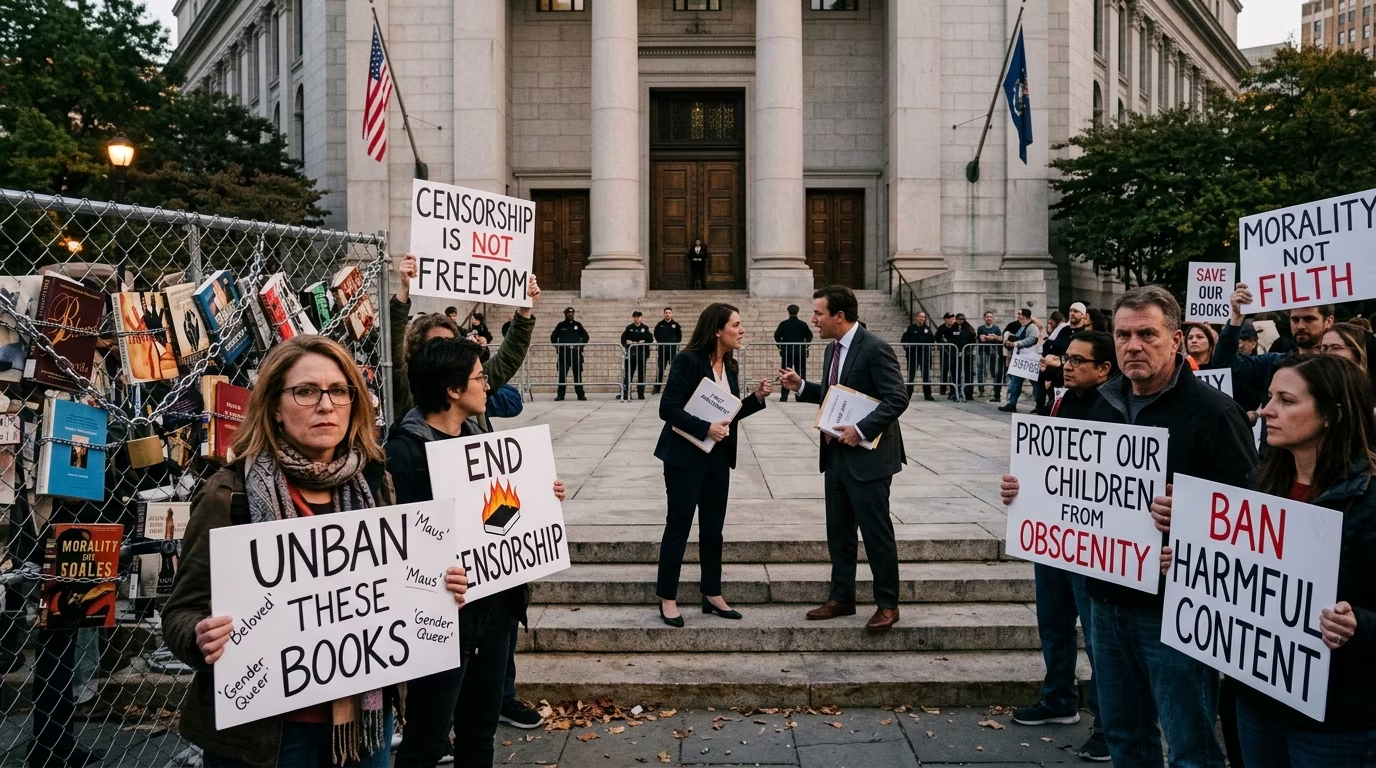
The United States is currently experiencing a profound and unprecedented wave of literary censorship. Unlike the scattered, isolated complaints of decades past, today’s efforts to restrict access to books in schools, public libraries, and independent bookstores are highly coordinated and frequently backed by state legislation. At the heart of this cultural and legal battleground is a constitutional clash between the First Amendment’s guarantee of free speech and the legal concept of obscenity. According to data released by the American Library Association, 2023 saw the highest number of titles targeted for censorship ever documented, with 4,240 unique book titles challenged. These numbers represent a dramatic escalation in efforts to police public access to information.
What makes this contemporary wave of censorship particularly notable is the legal rhetoric employed by proponents of book bans. Rather than merely arguing that certain texts are inappropriate for younger readers, advocates and lawmakers are increasingly classifying literature as “obscene,” a highly specific legal term that carries severe constitutional implications. By leveraging obscenity laws, these movements attempt to strip books of their First Amendment protections entirely, threatening educators and librarians with criminal liability for distributing them.
First Amendment Foundations: The Shield of Free Expression
To understand the gravity of labeling a book “obscene,” one must first examine the bedrock of American free speech jurisprudence. The First Amendment strictly prohibits the government from censoring speech, punishing publishers, or banning literature simply because the ideas contained within are controversial, unpopular, or uncomfortable. This robust protection applies to printed materials, digital content, and artistic expressions. The Supreme Court has long recognized that a free society depends on the unhindered exchange of ideas, and that literature serves as a critical vehicle for social commentary, personal exploration, and the challenging of societal norms.
However, First Amendment protections are not absolute. The courts have carved out very narrow categories of speech that fall outside the protective shield of the Constitution, such as incitement to violence, true threats, and obscenity. Because obscenity is an unprotected category of speech, government entities have the authority to ban it entirely and penalize those who distribute it. The danger arises when the legal definition of obscenity is deliberately conflated with broader, subjective concepts like “vulgarity,” “indecency,” or simply content that some parents find objectionable. When the line between protected literature and unprotected obscenity is blurred, the fundamental right to free expression is put in jeopardy.
The Legal Definition of Obscenity: Unpacking the Miller Test
The legal threshold for declaring a work “obscene” in the United States is intentionally high. It is not enough for a book to contain explicit language or descriptions of sexual intimacy. The definitive standard for obscenity was established by the Supreme Court in the landmark 1973 case, Miller v. California. In this ruling, the Court recognized the inherent danger of allowing local magistrates or angry citizens to arbitrarily ban books based on their personal sensibilities. To create a uniform and stringent standard, the Court formulated what is now known as the “Miller test.” For a piece of literature, film, or art to be legally classified as obscene, it must meet three highly specific, concurrent criteria. If a work fails to meet even one of these prongs, it is shielded by the First Amendment and cannot be banned as obscene.
The Three Pillars of the Miller Test
- The Prurient Interest Prong: The average person, applying contemporary community standards, must find that the work, taken as a whole, appeals to the prurient interest. In legal terms, “prurient” means a shameful or morbid interest in sex, rather than a normal, healthy, or educational interest.
- The Patently Offensive Prong: The work must depict or describe sexual conduct in a patently offensive way, as specifically defined by applicable state law. This means the depiction must be overwhelmingly explicit and shocking to the average member of the community.
- The Serious Value Prong: The work, when taken as a whole, must lack serious literary, artistic, political, or scientific value.
The SLAPS Test: The Ultimate Defense for Literature
The third prong of the Miller test, often referred to as the “SLAPS test” (Serious Literary, Artistic, Political, or Scientific value), serves as the ultimate safeguard for published books. This requirement demands that judges and juries evaluate a book in its entirety, rather than isolating a few controversial sentences or paragraphs out of context. A novel may contain intensely explicit descriptions of sexual trauma or intimacy, but if the broader narrative contributes to a serious literary or political theme, the book cannot be deemed legally obscene.
This holistic approach prevents censors from flipping through a novel, finding a handful of explicit words, and weaponizing those isolated passages to criminalize the entire work. It acknowledges that difficult, gritty, and even offensive content is often necessary to tell a compelling story, convey a political message, or reflect the harsh realities of human existence. In the context of the current censorship wave, many books targeted for bans are critically acclaimed novels, memoirs, and educational texts that have won prestigious literary awards. Because these works possess undisputed literary and educational value, they categorically fail the Miller test for obscenity, rendering efforts to ban them on those grounds constitutionally dubious.
Board of Education v. Pico: The School Library Battleground
While the Miller test governs the absolute banning of books in broader society, the rules surrounding public school libraries are slightly more nuanced. Schools act as both educators and guardians, giving them some leeway to curate library collections based on educational suitability. However, this power is not unlimited. The Supreme Court addressed the limits of school board authority over library books in the 1982 case, Board of Education v. Pico.
In a plurality opinion, the Court held that local school boards may not remove books from school library shelves simply because they dislike the ideas contained in those books. The Court drew a crucial distinction between prescribing a mandatory curriculum and curating a voluntary library collection. While school officials have broad discretion over what is taught in the classroom, the school library represents a unique environment of voluntary inquiry. The Pico decision established that removing books based on narrow partisan or political motivations violates students’ First Amendment right to receive information and ideas. While a school board might legally remove a book because it is “pervasively vulgar” or educationally unsuitable, they cannot use vulgarity as a pretext for viewpoint discrimination. This ruling remains a vital precedent today, as many modern challenges target books explicitly because they feature diverse characters or address systemic issues.
The Modern Strategy: Redefining Indecency to Bypass the Courts
Recognizing that almost no mainstream published book meets the strict legal definition of obscenity under the Miller test, modern censorship advocates have pivoted to a new strategy. They are increasingly lobbying state legislatures to pass laws that lower the standard for censorship in schools and public libraries. Instead of relying on the rigorous Miller test, these new laws often attempt to ban materials broadly deemed “harmful to minors” or “indecent.”
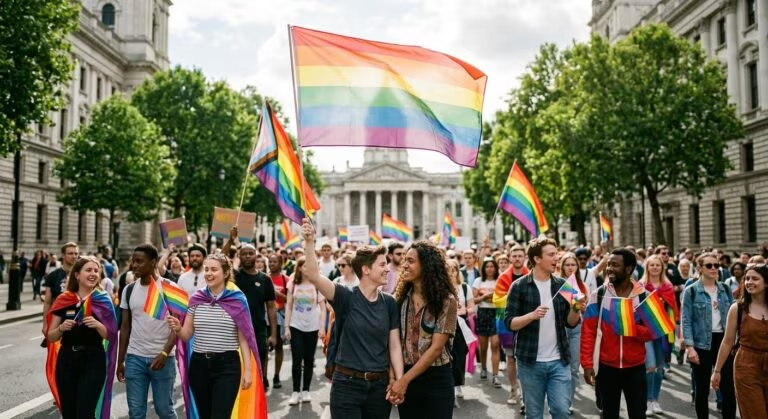
While the government does have a recognized interest in shielding children from certain explicit materials, the Supreme Court has consistently ruled that the government cannot reduce the adult population’s reading material to only what is fit for children. By attempting to expand the definition of what is legally unacceptable, legislators are creating a massive chilling effect. Librarians and educators, facing the threat of exorbitant fines or even felony charges, are frequently forced into preemptive censorship. They remove legally protected books from shelves simply to avoid the financial and professional ruin of a drawn-out legal battle. Furthermore, this legislative strategy disproportionately targets narratives exploring LGBTQ+ identities and the lived experiences of marginalized communities. When a memoir detailing a teenager’s coming-out experience is falsely equated with pornography, the law is being used not to protect children, but to erase specific identities from the public square.
The Societal Impact of Erasing Marginalized Voices
The collateral damage of this constitutional battle extends far beyond the courtroom. When books are pulled from shelves under the guise of obscenity laws, the message sent to the communities represented in those pages is one of exclusion and stigmatization. Removing these texts deprives young readers of the opportunity to see themselves reflected in literature, which is a critical component of healthy psychological development. Moreover, it denies all readers the chance to build empathy by experiencing the world through diverse perspectives.
The chilling effect also heavily impacts authors and publishers. Writers may self-censor, avoiding complex or controversial topics out of fear that their work will be banned, blacklisted, or subjected to legal scrutiny. Independent bookstores, which often serve as community hubs for free thought, find themselves under attack for stocking titles that local advocacy groups have arbitrarily labeled obscene. Ultimately, treating literature as contraband diminishes the intellectual vitality of the nation.
Conclusion: Safeguarding the Freedom to Read
The ongoing attempts to put books on trial for obscenity represent a profound manipulation of American free speech jurisprudence. The Supreme Court established the Miller test precisely to prevent the kind of moral panic and widespread censorship that is currently sweeping the nation. A society that values liberty must tolerate a wide array of expressions, including those that some citizens find offensive or uncomfortable. Defending the freedom to read requires a robust understanding of the First Amendment, active participation in local government, and an unwavering commitment to the idea that no single group should have the power to dictate what the rest of the public is permitted to read, learn, and explore.
Frequently Asked Questions (FAQs)
What is the difference between “indecency” and “obscenity”?
Obscenity is a narrow legal category of unprotected speech defined by the Supreme Court’s Miller test, which includes an assessment of a work’s literary or artistic value. Indecency, on the other hand, is a broader term for sexually explicit or vulgar material that may be restricted in certain broadcast contexts but remains heavily protected by the First Amendment in print literature.
Can a state ban a book solely because it contains sexual content?
No. Under the First Amendment, the presence of sexual content does not automatically make a book legally obscene. To be banned, the work as a whole must appeal to the prurient interest, be patently offensive, and completely lack serious literary, artistic, political, or scientific value.
How do school boards decide which books are appropriate for libraries?
School boards possess discretion to curate library collections based on educational suitability and age appropriateness. However, as established in Board of Education v. Pico, they cannot remove books simply because they disagree with the political or social viewpoints expressed in the text.
Does the First Amendment protect all books universally?
While the First Amendment protects the vast majority of published literature, it does not protect works that meet the stringent legal definition of obscenity, nor does it protect child pornography, incitement to violence, or true threats.
References
- Miller v. California, 413 U.S. 15 — Supreme Court of the United States. 1973-06-21. https://www.law.cornell.edu/supremecourt/text/413/15
- Board of Education, Island Trees Union Free School District No. 26 v. Pico by Pico, 457 U.S. 853 — Supreme Court of the United States. 1982-06-25. https://www.law.cornell.edu/supremecourt/text/457/853
- American Library Association reports record number of unique book titles challenged in 2023 — American Library Association. 2024-03-14. https://www.ala.org/news/press-releases/2024/03/american-library-association-reports-record-number-unique-book-titles