
Free Speech and Immigration: The 8 U.S.C. 1324 Debate
How a federal law sparked a major Supreme Court battle over free expression.
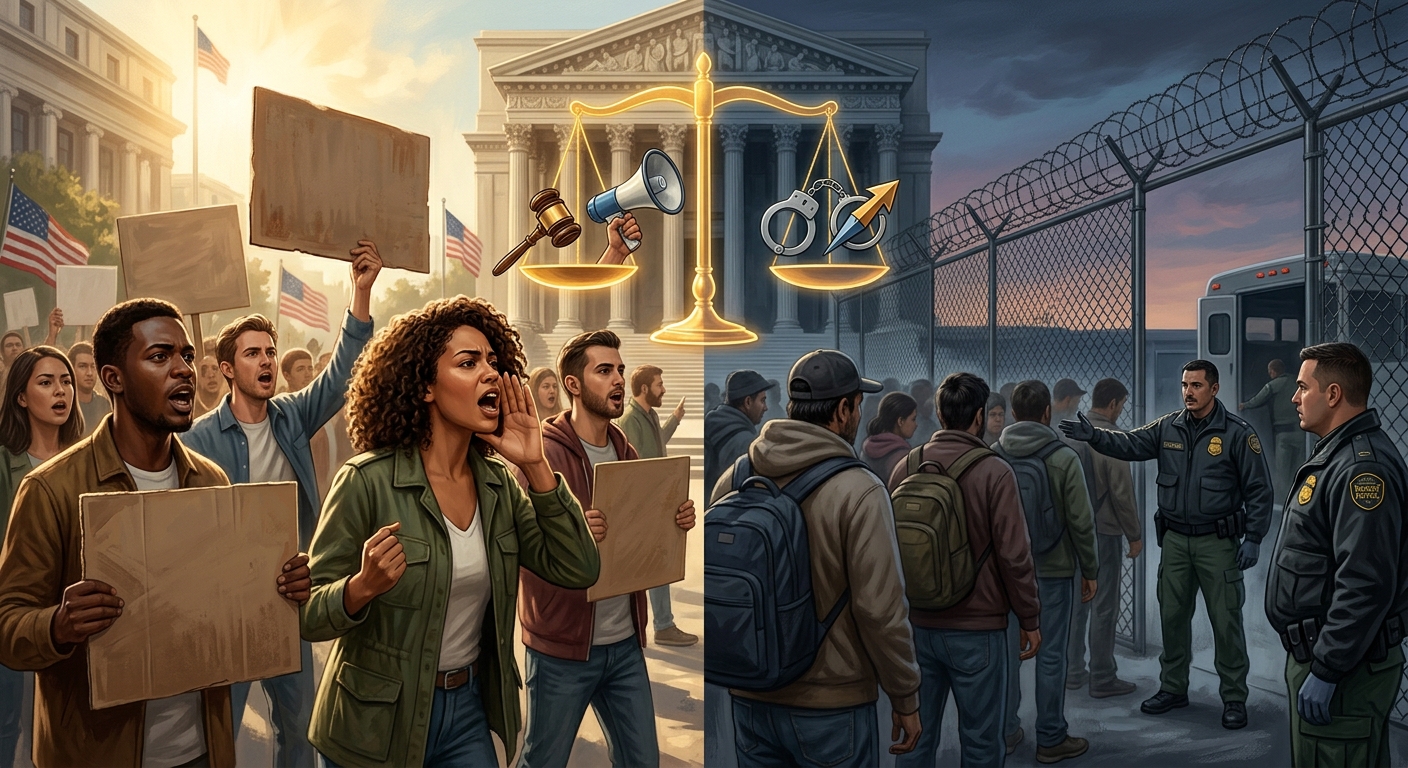
In the complex landscape of American constitutional law, few principles are guarded as fiercely as the freedom of expression. The First Amendment serves as a vital shield, ensuring that individuals can communicate ideas, advocate for policies, and offer advice without the looming threat of government retaliation. However, this foundational right frequently collides with other compelling state interests, most notably the enforcement of federal immigration policies. When the mechanisms designed to control national borders intersect with the policing of language, a profound constitutional debate arises.
At the epicenter of this modern legal controversy is a specific federal statute that seemingly blurred the line between criminal conspiracy and everyday conversation. By criminalizing the act of encouraging an undocumented individual to remain in the country, the government inadvertently sparked a fierce debate over the limits of the First Amendment. This article delves deeply into the mechanics of this law, the theoretical dangers it posed to ordinary citizens, and the landmark Supreme Court decision that ultimately sought to harmonize border enforcement with the preservation of free speech.
The Core of the Legal Debate: Decoding the Federal Harboring Statute
To understand the friction between free speech and border control, one must examine the specific language of the law in question. The federal immigration framework is heavily governed by Title 8 of the United States Code. Within this framework, 8 U.S.C. § 1324 outlines a series of severe criminal offenses related to the unauthorized entry and residence of noncitizens .
While the statute primarily targets human smuggling operations and those who physically harbor individuals evading immigration authorities, one specific clause has drawn intense scrutiny: Section 1324(a)(1)(A)(iv). This provision, often referred to as the “encouragement provision,” makes it a federal felony for any person to encourage or induce a noncitizen to come to, enter, or reside in the United States, knowing or in reckless disregard of the fact that such residence is in violation of the law .
The penalties for violating this statute are severe. A conviction can result in a fine and imprisonment for up to five years. If the offense is committed for the purpose of commercial advantage or private financial gain, the maximum prison sentence can skyrocket to ten years . On its face, the statute is a powerful tool for prosecutors targeting organized smuggling rings. However, the use of the broad verbs “encourage” and “induce” introduced a precarious ambiguity into the federal code, raising alarm bells among constitutional scholars and civil rights advocates.
The Danger of Criminalizing Everyday Conversations
The fundamental problem with the encouragement provision lay in its plain text. In everyday parlance, to “encourage” simply means to give support, confidence, or hope to someone. If interpreted through this standard, colloquial lens, the federal statute possessed the terrifying potential to transform benign, everyday conversations into federal felonies.
Consider the potential real-world applications of a broad interpretation of this law. The resulting legal environment would cast a shadow of criminality over countless innocent interactions. Examples of such endangered speech include:
- The Academic Advisor: A university counselor advising an international student whose student visa has unexpectedly lapsed to remain on campus for an extra week to complete their final exams rather than fleeing the country immediately.
- The Social Worker: A housing advocate counseling an undocumented victim of domestic violence to seek refuge in a local government-funded women’s shelter instead of attempting a dangerous border crossing back to their home country.
- The Good Samaritan Neighbor: A citizen offering a spare bedroom to a displaced, undocumented family while actively telling them they should stay in the community because it is safe and welcoming.
- The Political Activist: A journalist or activist publishing an editorial arguing that unauthorized immigrants should defy unjust deportation orders and participate in peaceful, public protests.
If the law were applied literally, all of these individuals could technically be prosecuted for “encouraging” a noncitizen to reside in the United States in violation of the law. This dynamic creates what legal scholars call a “chilling effect.” When a statute is overly broad or vague, citizens will preemptively self-censor, avoiding perfectly legal and constitutionally protected speech out of fear of prosecution. This chilling effect strikes at the very heart of the First Amendment.
The Overbreadth Doctrine and the First Amendment
To combat laws that threaten to chill free expression, the judicial system relies on a unique constitutional mechanism known as the Overbreadth Doctrine. Generally, an individual can only challenge a law if it directly violates their own constitutional rights. However, the First Amendment is treated with special reverence. Under the Overbreadth Doctrine, a court can strike down a law in its entirety if it prohibits a “substantial amount of protected speech” relative to its plainly legitimate sweep .
This doctrine acknowledges that the continuous existence of an overly broad law is a danger to a free society. Even if the government promises only to use the law against true criminals, the mere presence of the statute on the books acts as a lingering threat. Advocates argued that 8 U.S.C. § 1324(a)(1)(A)(iv) was a textbook example of an overbroad statute, as its plain text swept up massive amounts of protected advocacy, advice, and charitable speech.
The Catalyst: A Fraudulent Scheme Reaches the Supreme Court
The theoretical debates surrounding the encouragement provision transitioned into a tangible constitutional showdown through the criminal actions of a man named Helaman Hansen. Operating out of California, Hansen orchestrated a highly lucrative and predatory fraudulent scheme that targeted vulnerable undocumented immigrants .
Hansen falsely promised undocumented noncitizens that they could obtain lawful United States citizenship through a process he called “adult adoption.” He claimed that if an American citizen adopted them, they would automatically be granted legal status. In reality, no such legal pathway exists for adults. Despite this, Hansen convinced hundreds of individuals to pay exorbitant fees, ultimately defrauding his victims of nearly $2 million .
When federal authorities uncovered the scam, Hansen was indicted on multiple counts of fraud. Crucially, he was also charged under the encouragement provision of 8 U.S.C. § 1324, as he had actively induced undocumented immigrants to remain in the country unlawfully for his own financial gain. In his defense, Hansen’s legal team deployed the Overbreadth Doctrine. They argued that the encouragement provision was facially unconstitutional because it criminalized vast amounts of protected speech. Therefore, they claimed, Hansen could not be convicted under it, regardless of his fraudulent actions. The Ninth Circuit Court of Appeals agreed, striking down the statute and setting the stage for a dramatic Supreme Court review .
The Supreme Court’s Verdict: Intentional Solicitation vs. Protected Speech
In the summer of 2023, the Supreme Court of the United States issued its highly anticipated ruling in United States v. Hansen. In a 7-2 decision authored by Justice Amy Coney Barrett, the Court reversed the Ninth Circuit and salvaged the constitutionality of the federal statute. However, it did so by radically narrowing the acceptable interpretation of the law .
Justice Barrett’s majority opinion rejected the colloquial understanding of the words “encourage” and “induce.” Instead, the Court looked to the historical, specialized usage of these terms within the context of criminal law. In criminal jurisprudence, encouraging or inducing illegal acts refers specifically to the concepts of criminal solicitation and facilitation (aiding and abetting). These are specialized terms of art that require a specific mens rea—a guilty state of mind and a deliberate intent to bring about a specific unlawful act .
By interpreting the statute through this strict criminal law lens, the Supreme Court ruled that 8 U.S.C. § 1324 does not criminalize general advocacy, charitable advice, or expressions of support. It only criminalizes the purposeful solicitation and active facilitation of specific immigration violations. Because the statute, when interpreted correctly, only targets unprotected criminal speech, the Court determined it was not unconstitutionally overbroad.
The Dissenting Perspective: Lingering Ambiguities and Chilled Speech
While the majority believed their specialized interpretation saved the statute, the decision was not unanimous. Justice Ketanji Brown Jackson, joined by Justice Sonia Sotomayor, authored a vigorous dissent. The dissent argued that the Court was effectively rewriting the statute to save it, rather than reading the plain text as Congress had written it .
Justice Jackson warned that ordinary citizens do not consult historical legal treatises to understand the law; they read the words on the page. Because the plain text of the law remains incredibly broad, the dissent argued that the chilling effect would persist. Everyday Americans, fearful of stepping over an invisible legal line, might still hesitate to offer advice or charity to undocumented neighbors, leaving the First Amendment vulnerable to the discretionary power of federal prosecutors.
Key Differences in Interpreting the Law
To fully grasp the impact of the Supreme Court’s ruling, it is helpful to contrast the two differing interpretations of the statutory language that were at the heart of the litigation.
| Concept | Colloquial Meaning (Rejected by SCOTUS) | Criminal Law Meaning (Adopted by SCOTUS) |
|---|---|---|
| Definition of “Encourage” | To inspire with courage, spirit, or hope; to give advice or express support. | To intentionally solicit, command, or actively facilitate a specific criminal act. |
| First Amendment Impact | Highly restrictive; chills general advocacy, legal advice, and charitable outreach. | Protective; allows general speech while punishing only active participation in crime. |
| Requirement of Intent | Low; mere positive speech could trigger a violation regardless of criminal intent. | High; requires purposeful intent (mens rea) to aid and abet a violation of law. |
Broader Implications for Professionals and Advocates
The Supreme Court’s decision in United States v. Hansen carries profound implications for a wide array of professionals across the United States. For immigration attorneys, social workers, religious leaders, and humanitarian aid workers, the ruling provides a crucial sigh of relief. By officially narrowing the scope of the encouragement provision, the highest court in the land has insulated general advice and advocacy from federal prosecution.
Professionals can continue to inform undocumented individuals of their legal rights, provide them with humanitarian assistance, and advocate for policy changes without the fear of being labeled federal felons. However, the ruling also serves as a stark reminder of the boundaries of free speech. While advocacy is protected, actively conspiring to smuggle individuals across borders or purposely facilitating the evasion of law enforcement remains strictly prohibited under the narrowed definitions of criminal solicitation.
Frequently Asked Questions (FAQs)
What exactly does 8 U.S.C. § 1324 prohibit?
8 U.S.C. § 1324 is a comprehensive federal statute that criminalizes alien smuggling, domestic transportation of unauthorized aliens, concealing or harboring unauthorized aliens, and encouraging or inducing unauthorized aliens to enter or reside in the United States unlawfully.
Is it illegal to advise an undocumented immigrant to stay in the US?
Following the Supreme Court’s ruling in United States v. Hansen, merely advising, supporting, or expressing a desire for an undocumented immigrant to remain in the US is protected speech under the First Amendment. The law only criminalizes the intentional solicitation or active facilitation of an immigration violation.
What was the final decision in United States v. Hansen?
The Supreme Court ruled 7-2 that the federal law prohibiting the encouragement or inducement of illegal immigration is not unconstitutionally overbroad. The Court saved the law by interpreting “encourage” and “induce” strictly as terms of criminal solicitation and aiding and abetting, rather than general speech.
What is the First Amendment Overbreadth Doctrine?
The Overbreadth Doctrine is a principle in constitutional law that allows a court to invalidate a statute entirely if it prohibits a substantial amount of protected free speech in relation to its plainly legitimate applications, thereby preventing a “chilling effect” on the public’s freedom of expression.
References
- 8 USC 1324: Bringing in and harboring certain aliens — Office of the Law Revision Counsel. 2026-06-02. https://uscode.house.gov/view.xhtml?req=granuleid:USC-prelim-title8-section1324&num=0&edition=prelim
- United States v. Hansen, 599 U.S. 762 (2023) — Supreme Court of the United States. 2023-06-23. https://www.supremecourt.gov/opinions/22pdf/22-179_10n2.pdf
- Title 8, U.S.C. 1324(a) Offenses — United States Department of Justice. 2020-01-17. https://www.justice.gov/archives/jm/criminal-resource-manual-1907-title-8-usc-1324a-offenses
- United States v. Hansen (2023) — The First Amendment Encyclopedia. 2023-07-18. https://firstamendment.mtsu.edu/article/united-states-v-hansen/
Similar Articles








Read full bio of medha deb


