
Franchise Licenses: Legal Basics for Small Business Owners
Understand when a simple license becomes a regulated franchise and what that means for your small business.
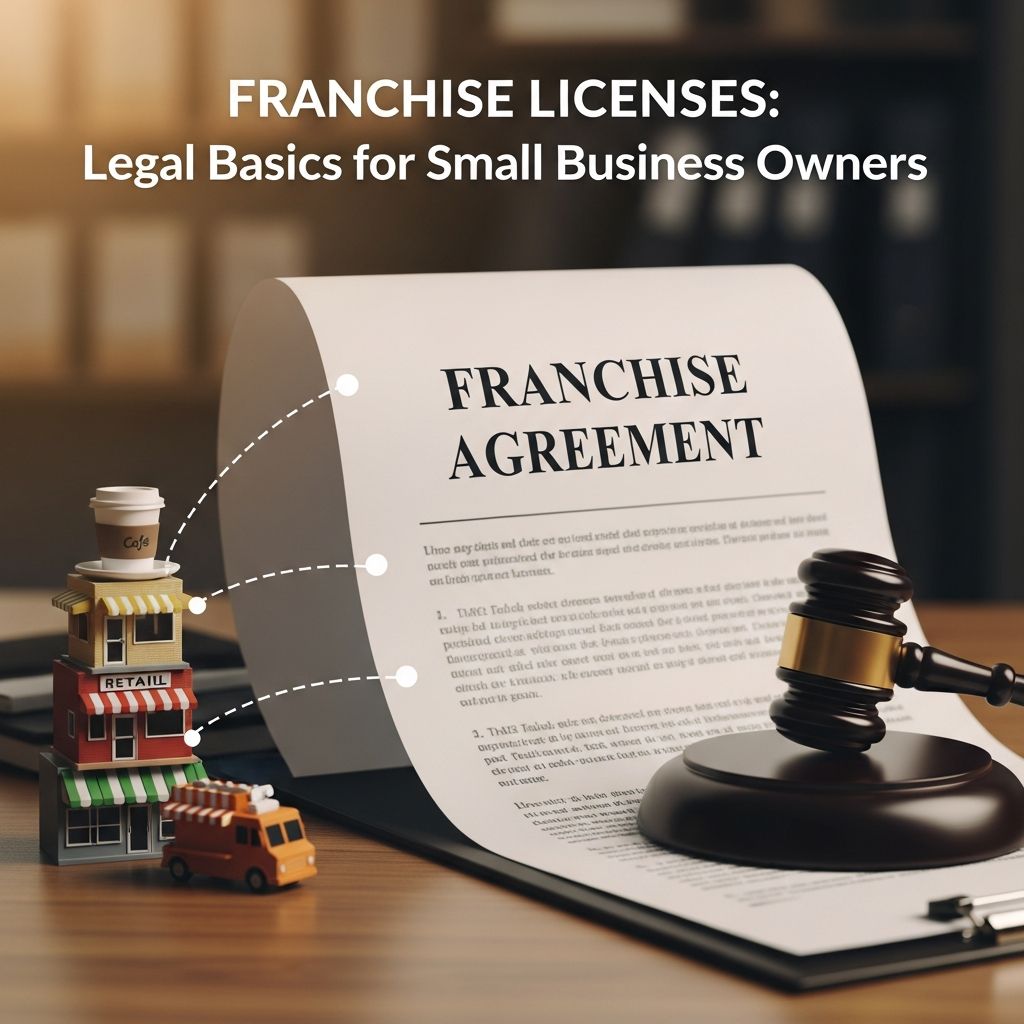
A growing business often reaches a crossroads: should it expand by selling licenses to use its brand, or by offering formal franchises? The label on the contract is not what controls. In U.S. law, a so-called “license” can be treated as a regulated franchise if it meets specific legal criteria, triggering disclosure and compliance obligations for the company that grants those rights.
This guide explains what a franchise license is, how it differs from a simple license, and why the distinction matters for entrepreneurs, brand owners, and prospective franchisees.
Franchising in Plain Language
At its core, a franchise is a continuing commercial relationship where one party (the franchisor) allows another (the franchisee) to operate a business using the franchisor’s brand and business system in exchange for fees and ongoing obligations.
Under the U.S. Federal Trade Commission (FTC) Franchise Rule, a relationship is generally a franchise if three key elements are present:
- The right to operate a business identified with the franchisor’s trademark or other commercial symbol.
- The franchisor’s significant control over, or significant assistance with, how the business is run.
- A required payment, above a minimum threshold, within a specified time after starting the business.
If these conditions are satisfied, the arrangement is treated as a franchise under federal law regardless of what the parties choose to call it.
What Is a Franchise License?
The term franchise license is not a formal legal category in federal law; rather, it is a practical description. A typical franchise involves granting a bundle of licenses to use the franchisor’s intellectual property and business methods. Those licenses are governed by franchise-specific rules when the legal definition of a franchise is met.
In practice, a franchise license usually includes:
- A license to use the franchisor’s trademark, trade name, logos, and branding in connection with the business.
- Permission to follow and implement the franchisor’s business format, such as operating procedures, marketing plans, and quality standards.
- Access to training, manuals, and ongoing operational support.
- Contractual obligations to pay initial fees, royalties, or other charges for the right to operate under the brand.
Because a franchise license involves both intellectual property rights and a broader business system, it is subject to the FTC Franchise Rule and, in many states, additional registration or disclosure requirements.
License vs. Franchise: Why the Label Does Not Decide
Many companies prefer to describe their arrangements as “licenses” to avoid the costs and formality of franchise regulation. However, U.S. regulators and courts focus on substance over form. If the relationship looks and functions like a franchise, it will generally be regulated as one, no matter what the contract is called.
Core Differences at a Glance
| Feature | Typical License | Regulated Franchise |
|---|---|---|
| Primary purpose | Use specific intellectual property (e.g., a logo on products) | Operate a full business under a brand and system |
| Trademark association | May or may not define overall business identity | Business is identified with franchisor’s trademark |
| Control & support | Limited; focused on brand quality standards | Significant control or assistance in daily operations |
| Regulatory overlay | General contract and IP law | FTC Franchise Rule and often state franchise laws |
| Disclosure requirements | None specific to licenses | Mandatory Franchise Disclosure Document (FDD) |
Three Legal Elements That Turn a License into a Franchise
The FTC Franchise Rule and related guidance identify three definitional elements. When all are present, the arrangement is treated as a franchise for federal disclosure purposes.
1. Trademark or Commercial Symbol
The first element is a promise that the other party can operate a business that is clearly connected with the brand owner’s trademark, service mark, trade name, or comparable symbol.
Indicators that this element is present include:
- The business uses the same name, logo, or signage as the brand owner.
- Advertising and customer-facing materials prominently feature the brand owner’s marks.
- Customers understand the business to be part of, or affiliated with, a broader branded network.
The definition is intentionally broad. It can encompass stylized logos, distinctive décor, or overall trade dress that signals a common brand identity.
2. Significant Control or Significant Assistance
The second element focuses on the degree of influence the brand owner exerts over the affiliated business. The more the owner shapes how the business is run, the more likely the relationship is a franchise.
Examples of significant control include:
- Requiring approval of the business site for new or relocating outlets.
- Mandating specific design, layout, or appearance standards.
- Setting fixed hours of operation.
- Specifying production or service delivery techniques.
- Imposing uniform accounting methods or software.
- Requiring adherence to detailed personnel policies.
- Restricting the customers or territories the business may serve.
Examples of significant assistance include:
- Formal training programs in sales, operations, or technical skills.
- Ongoing management, marketing, or staffing advice.
- Help in selecting the business location.
- Providing system-wide websites, IT platforms, or marketing networks.
- Supplying comprehensive operating manuals and business formats.
Some support is compatible with a simple license, especially when it is limited to protecting the integrity of a trademark. But as control or assistance becomes more detailed and continuous, the relationship increasingly resembles a franchise.
3. Required Payment
The third element is a required payment from the operator to the brand owner (or an affiliate) as a condition of starting or continuing the business. The Franchise Rule interprets this broadly to include many types of fees and charges.
Typical forms of required payment include:
- Initial franchise or access fees paid before opening.
- Ongoing royalties based on revenue or profits.
- Mandatory advertising or marketing fund contributions.
- Payments for required equipment, supplies, software, or inventory, particularly if the brand owner or its affiliate benefits financially.
- Training fees, technology fees, or other recurring charges connected to operating under the brand.
Federal guidance sets a minimum payment threshold over a defined initial period; if that threshold is not met, the arrangement may fall outside the federal franchise definition. Some state laws may use different thresholds or definitions.
Federal and State Regulation of Franchise Licenses
Once a relationship is classified as a franchise, a set of regulatory obligations applies, aimed at protecting prospective franchisees and promoting transparency.
The FTC Franchise Rule
The FTC’s Franchise Rule, codified at 16 C.F.R. parts 436 and 437, focuses on pre-sale disclosure.
Key federal requirements include:
- Preparing and providing a detailed Franchise Disclosure Document (FDD) that covers 23 specific items, such as litigation history, fees, financial performance representations (if made), and financial statements.
- Delivering the FDD to prospective franchisees at least a set number of days before they sign a contract or pay any money.
- Prohibiting certain unfair or deceptive practices in the offer or sale of franchises.
The Rule does not regulate the business terms of the franchise relationship itself; instead, it aims to ensure buyers receive enough information to make an informed decision.
State Franchise Laws
In addition to federal law, many states have their own franchise statutes and regulations. These may address:
- Registration or filing of the FDD with a state regulator before offering franchises in that state.
- Additional disclosure obligations specific to the state.
- Substantive protections, such as good-cause standards for termination, non-renewal rules, or limits on certain contract terms.
State definitions of a franchise can differ from the FTC definition. Some states use a two-part test based on a marketing plan and a community of interest, and do not always require the same payment threshold as the federal rule. Because of these variations, an arrangement might be a franchise under state law even if it narrowly avoids federal coverage, or vice versa.
Risks of Misclassifying a Franchise as a License
Calling an arrangement a “license agreement” will not prevent regulators or courts from finding that it is actually a franchise. Misclassification carries practical and legal risks for the brand owner and, in some cases, for investors and executives.
Potential consequences include:
- Regulatory enforcement by the FTC or state authorities for failing to provide required disclosures or for offering unregistered franchises where registration is required.
- Civil liability to franchisees who may seek rescission (unwinding) of the contract, damages, or attorneys’ fees based on disclosure or registration violations.
- Contract uncertainty if key provisions are deemed unenforceable because they conflict with mandatory franchise statutes.
- Reputational harm and business disruption if a network of “licensees” claims it should have been treated as franchisees.
For small businesses hoping to expand, these risks make it especially important to structure agreements with legal advice and a clear understanding of franchise law.
Designing a Compliant Franchise License Program
Entrepreneurs who decide to franchise should plan carefully. A well-designed franchise license program typically includes the following components:
- Documented business system – Written manuals, brand standards, and operating procedures that can be taught and consistently implemented.
- Clear intellectual property portfolio – Registered or protectable trademarks and trade dress that will be licensed to franchisees.
- Thoughtful fee structure – Transparent initial and ongoing fees linked to the support and benefits provided.
- Compliance with the Franchise Rule – Preparation of an FDD that meets the detailed form and content requirements.
- State law strategy – Registration or filing in applicable states before marketing or selling franchises there, where required.
- Training and support systems – Programs to deliver the promised significant assistance in a consistent, scalable way.
These elements help protect both sides: franchisees receive a more predictable package of rights and information, while franchisors reduce legal risk and build a stronger brand system.
Considerations for Prospective Franchisees
From the perspective of a prospective franchisee, understanding whether you are getting a true franchise or just a license is critical to evaluating risk and legal protections.
Questions to ask include:
- Is there an FDD, and have you had time to review it with an adviser before signing?
- How much operational control will the brand owner have over your daily business?
- What kinds of assistance and training are promised, and for how long?
- What fees will you pay initially and on an ongoing basis, including indirect payments through required suppliers?
- What are your rights to renew, transfer, or exit the relationship, and under what conditions can it be terminated?
If the business arrangement meets the hallmarks of a franchise but you are not receiving disclosures or protections that typically accompany franchising, that discrepancy may signal legal and financial risk.
Frequently Asked Questions (FAQs)
Q1: Is every license automatically a franchise?
No. A license becomes a franchise only when it includes the right to operate a business identified with the licensor’s trademark, the licensor’s significant control or assistance, and a required payment meeting the applicable threshold.
Q2: Can we avoid franchise rules by charging no upfront fee?
Not necessarily. Required payments can include many forms of direct or indirect compensation, such as equipment markups, mandatory training fees, or advertising contributions, so eliminating a single fee may not remove the relationship from franchise coverage.
Q3: Does using another company’s logo always create a franchise?
No. Using a logo under a limited trademark license, with minimal control or assistance and without the broader business format elements of a franchise, may remain a simple license. It is the combination of brand association, operational influence, and payment that triggers franchise status.
Q4: Who regulates franchises in the United States?
At the federal level, the FTC enforces the Franchise Rule, which mandates the Franchise Disclosure Document and prohibits certain unfair practices. Many states also regulate franchise offers and sales through their own securities or franchise agencies.
Q5: Should small businesses get legal advice before offering licenses?
Yes. Because the line between licensing and franchising can be subtle and because misclassification can lead to regulatory and civil liability, businesses considering expansion through license-like arrangements should consult counsel knowledgeable in franchise law.
References
- Franchise Rule — Federal Trade Commission. 2007-01-01 (as codified, with later amendments). https://www.ftc.gov/legal-library/browse/rules/franchise-rule
- 16 CFR Part 436 — Disclosure Requirements and Prohibitions Concerning Franchising — Electronic Code of Federal Regulations, U.S. Government Publishing Office. 2025-01-01 (current version). https://www.ecfr.gov/current/title-16/chapter-I/subchapter-D/part-436
- When Is a “License” Really a “Franchise”? — Cheng Cohen LLC. 2014-06-01. https://www.franchise-law.com/when-is-a-license-really-a-franchise.shtml
- Do I Have a License or Franchise Agreement? Understanding the Differences — Vail Garvin, PLLC. 2021-05-10. https://www.vailpllc.com/news/do-i-have-a-license-or-franchise-agreement-understanding-the-differences
- Franchise Definition — Wisconsin Department of Financial Institutions. 2020-03-01. https://dfi.wi.gov/Pages/Securities/Filings/FranchiseDefinition.aspx
- The Basics of Licensing in Franchising — Lusthaus Law P.C. 2022-02-15. https://lusthausfranchiselaw.com/blog/the-basics-of-licensing-in-franchising/
- Franchise vs. License: Which Business Model is Right for You? — Franchise Business Review. 2023-06-01. https://franchisebusinessreview.com/post/licensing-vs-franchising/
Similar Articles








Read full bio of medha deb


