
Forming an LLC in Alabama: A Practical Guide
Learn the key legal steps, filings, and decisions required to properly form and maintain a limited liability company in Alabama.
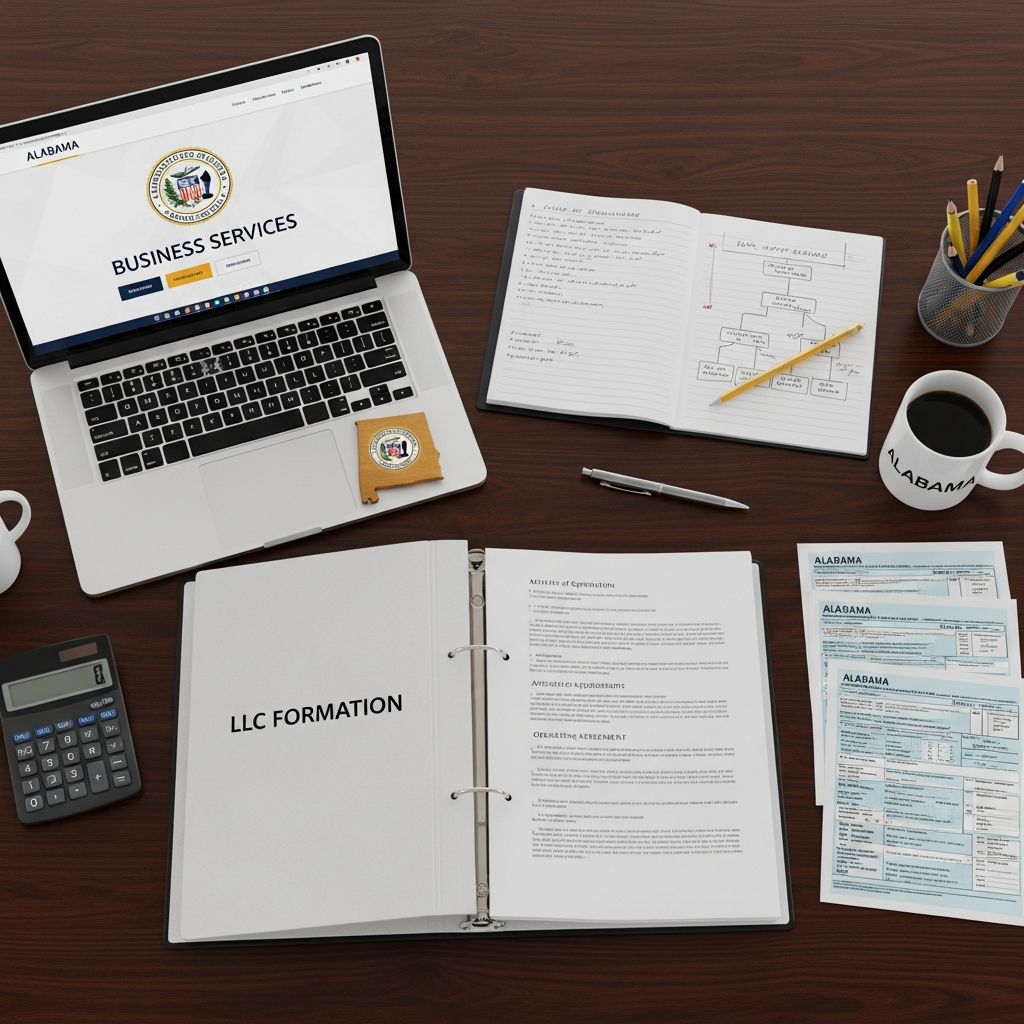
Creating a limited liability company (LLC) in Alabama is one of the most common ways for small and mid-sized business owners to protect their personal assets while keeping flexible management and tax options. This guide walks through the core legal steps, key decisions, and ongoing obligations for forming and maintaining an Alabama LLC.
Why Choose an Alabama LLC?
An LLC is a business structure created under state law that separates your personal assets from those of the business. In Alabama, LLCs are governed primarily by Title 10A of the Code of Alabama, which authorizes the formation of limited liability companies and defines their rights and obligations.
- Limited liability protection — Members are generally not personally liable for business debts and obligations, as long as the LLC is properly formed and maintained.
- Flexible taxation — An LLC can usually choose to be taxed as a sole proprietorship, partnership, S corporation, or C corporation for federal tax purposes.
- Customizable management — Members can manage the LLC directly or appoint managers, and the internal rules can be tailored through an operating agreement.
- Relatively simple compliance — Compared with corporations, LLCs often have fewer formalities but must still observe state filing and tax requirements.
Planning Your Alabama LLC Before You File
Before submitting any paperwork, it helps to clarify your core business decisions.
Define the LLC’s Purpose and Structure
- Business purpose — Identify the type of products or services your LLC will provide. Many Alabama filings allow a broad purpose, such as “any lawful business,” but a more specific internal description helps with licenses and tax classification.
- Ownership (members) — Decide who will own the LLC, their percentage interests, and what each person will contribute (cash, property, or services).
- Management style — Choose whether the LLC will be member-managed (all owners have authority) or manager-managed (one or more designated managers run day-to-day operations).
Check Name Availability and Alabama Requirements
Alabama law requires that your LLC name be distinguishable from other names on file and include specific wording indicating its status.
- Include one of the following designators in the name:
- “Limited Liability Company“
- “LLC“
- “L.L.C.“
- Ensure the name is not misleading about the type of services offered, particularly if the LLC is not authorized to provide regulated professional services.
- Confirm that the name is distinguishable from existing entities by searching the Alabama Secretary of State business entity database.
| Requirement | Summary |
|---|---|
| Name ending | Must contain “Limited Liability Company”, “LLC”, or “L.L.C.” |
| Uniqueness | Must be distinguishable from other names on file with the Alabama Secretary of State. |
| Non-misleading terms | Cannot imply you provide services not authorized in your filings or under Alabama law. |
Reserve Your LLC Name
Alabama is unusual in that it requires a name reservation before or with your LLC formation filing. You must obtain a Certificate of Name Reservation from the Alabama Secretary of State and reference it when you file the LLC’s formation document.
- File a name reservation request for domestic entities with the Secretary of State.
- Indicate the exact name you plan to use and your contact information.
- Once granted, the reservation holds the name for a period designated by the state (commonly up to 1 year), giving you time to file the formation document.
Choosing an Alabama Registered Agent
Every Alabama LLC must designate a registered agent and registered office. This person or company receives official legal documents, such as service of process and certain state notices.
- The registered agent must have a physical street address in Alabama (no P.O. boxes for the registered office).
- The agent can be an individual Alabama resident or a business authorized to act as a registered agent in the state.
- The agent must generally be available at the registered office during normal business hours to receive documents.
Because the registered agent’s name and address become public record, some business owners choose a professional registered agent service rather than listing their home address.
Preparing and Filing the Certificate of Formation
To officially create an Alabama LLC, you file a Certificate of Formation with the Alabama Secretary of State, along with the required filing fee.
Key Information Included in the Certificate of Formation
The state-approved Certificate of Formation form for a domestic LLC requires several specific details.
- LLC name (including the required designator).
- Registered agent’s name and street address in Alabama.
- Mailing address of the registered office (if different from the street address).
- Any additional provisions you wish to include, such as management structure or limitations, if allowed by Alabama law.
- A statement that the LLC has at least one member, as required by the form.
- The county of the registered office address.
How to File
- Submission — File the original Certificate of Formation and a copy with the Alabama Secretary of State.
- Method — The form must be typed; the Secretary of State does not accept handwritten or emailed filings.
- Filing fee — The standard fee for a domestic LLC filing is published by the Secretary of State (recent guidance shows a $200 filing fee for online or mail filings, but always verify current fees with the state).
- Processing — After review, the Secretary of State issues confirmation of formation, often in the form of a certificate or stamped copy, proving the LLC legally exists.
Drafting an Alabama LLC Operating Agreement
Although not filed with the state, an operating agreement is a foundational internal document that defines the rights and responsibilities of members and managers. Some guidance indicates that an operating agreement is expected or required as part of the LLC’s internal governance, even if it can be written or oral.
Core Topics to Address
- Ownership interests — Names of members, capital contributions, and percentage or unit interests.
- Management structure — Whether the LLC is member-managed or manager-managed, and the scope of authority of each.
- Voting rules — How votes are allocated (by membership interest or per capita) and what percentage is needed for major decisions.
- Profit and loss allocations — How income, losses, and distributions are allocated among members.
- Admission and exit of members — Procedures for adding new members, handling resignations, removals, or buyouts.
- Recordkeeping and banking — Who can sign contracts, open bank accounts, and manage financial records.
- Dissolution — Events that trigger winding up and how remaining assets will be distributed.
A carefully drafted operating agreement is one of the key tools for demonstrating that the LLC operates as a separate legal entity, which helps preserve limited liability protection.
Obtaining an EIN and Setting Up Business Finances
Most Alabama LLCs will need a federal Employer Identification Number (EIN), issued by the Internal Revenue Service (IRS). The EIN is used for tax filings, payroll, and many banking tasks.
- Apply for an EIN directly from the IRS, typically online, at no cost.
- Use the EIN, not your Social Security number, on business tax forms and many contracts to reduce personal exposure.
- Open a separate business bank account to keep business and personal finances distinct; this separation supports your liability protection.
Licenses, Permits, and Local Approvals
Forming an LLC with the Alabama Secretary of State does not by itself authorize you to operate every type of business. Depending on your industry and location, you may need additional approvals.
- State-level licenses — Certain professions (for example, health care providers, engineers, accountants, and other regulated occupations) require state licensure or specific entity forms.
- County and municipal licenses — Many local governments in Alabama require business licenses, zoning clearances, or home-occupation permits for businesses operating in their jurisdiction.
- Sales tax registration — If you sell taxable goods or services, you may need to register for sales and use tax with the state or local authorities.
Understanding Alabama LLC Taxes and the Business Privilege Tax
LLCs are typically pass-through entities for federal income tax purposes, meaning profits flow to members’ personal returns unless the LLC elects corporate taxation. However, Alabama also imposes a separate tax known as the Alabama Business Privilege Tax on entities doing business in the state.
Business Privilege Tax Overview
- Most LLCs that are organized or doing business in Alabama must file a Business Privilege Tax return each year with the state Department of Revenue.
- The tax is generally based on the entity’s net worth in Alabama, within a minimum and maximum range set by statute.
- Returns are usually due shortly after the beginning of the taxable year (commonly within 2.5 months for many entities), but deadlines can vary based on classification and tax year; always check current instructions from the Alabama Department of Revenue.
Federal and State Income Tax Choices
From a federal perspective, an Alabama LLC can normally choose among several tax classifications.
- Single-member LLC — Default classification is a disregarded entity (income reported on the owner’s individual return).
- Multi-member LLC — Default classification is a partnership, filing an informational return and issuing Schedule K-1s to members.
- Election as corporation — The LLC can elect C corporation or S corporation status by filing the appropriate forms with the IRS.
These federal choices may affect how Alabama income tax applies to your business and owners. Consulting a tax professional familiar with Alabama rules is usually advisable when choosing a tax classification.
Maintaining Your Alabama LLC in Good Standing
After formation, keeping your LLC in good standing requires consistent attention to filings, taxes, and internal recordkeeping.
Key Ongoing Responsibilities
- Registered agent updates — If your registered agent or registered office changes, you typically must file an update with the Alabama Secretary of State.
- Business Privilege Tax filings — File required returns and pay taxes on time each year to avoid penalties or loss of good standing.
- Local license renewals — Renew county or municipal business licenses, if applicable, according to local deadlines.
- Accurate records — Maintain financial records, contracts, minutes or consent resolutions for major decisions, and membership records.
- Separate finances — Keep business accounts separate from personal funds to help preserve limited liability.
Common Mistakes When Forming an Alabama LLC
Catching common errors early can save time and expense later.
- Skipping name reservation — Alabama specifically requires a name reservation before or with the Certificate of Formation filing; failing to include it can delay approval.
- Listing an invalid registered office — A P.O. box or out-of-state address cannot serve as the required registered office.
- No written operating agreement — Relying solely on verbal understandings can lead to disputes over ownership, profits, or control.
- Commingling funds — Mixing business and personal funds weakens liability protection and complicates tax reporting.
- Ignoring tax obligations — Overlooking the Business Privilege Tax or local license requirements can result in penalties and possible administrative dissolution.
Frequently Asked Questions About Alabama LLCs
Q: How long does it take to form an LLC in Alabama?
A: Processing times vary depending on how you file and current Secretary of State workloads. Mailed filings often take longer than online submissions. Always check the Alabama Secretary of State website for current processing estimates.
Q: Do I need a lawyer to form an Alabama LLC?
A: Alabama does not require you to hire an attorney to form an LLC. Many owners file on their own using state forms. However, legal advice is strongly recommended for complex ownership structures, multiple members, or businesses with significant liability or regulatory issues.
Q: Can I be my own registered agent in Alabama?
A: Yes, you may serve as your own registered agent if you are an Alabama resident with a physical street address in the state and are available during normal business hours. Some owners still choose professional services to maintain privacy and ensure consistent availability.
Q: What if I want to change my LLC’s name later?
A: Changing an LLC name generally requires filing appropriate amendment documents with the Alabama Secretary of State and, often, reserving the new name. You must also update tax agencies, banks, licenses, contracts, and marketing materials to reflect the change.
Q: Does Alabama require annual reports for LLCs?
A: Alabama’s primary recurring filing for many LLCs is the Business Privilege Tax return, which functions similarly to an annual report combined with a tax calculation. Always review current guidance from the Alabama Department of Revenue to confirm your specific obligations.
References
- Business Privilege Tax Overview — Alabama Department of Revenue. 2024-01-01. https://www.revenue.alabama.gov/business-tax/alabama-business-privilege-tax/
- Domestic Limited Liability Company Certificate of Formation (LLC) Form — Alabama Secretary of State. 2022-09-01. https://www.sos.alabama.gov/sites/default/files/2022-09/DomesticLLCFormation.pdf
- LLCs — Business Entities Division — Alabama Secretary of State. 2024-03-01. https://www.sos.alabama.gov/business-entities/llcs
- How to Start an LLC in Alabama — LegalZoom. 2024-05-01. https://www.legalzoom.com/articles/how-to-start-an-llc-in-alabama
- How to Start an LLC in Alabama (Step-by-Step Guide) — Chamber of Commerce. 2024-02-15. https://www.chamberofcommerce.org/how-to-start-an-llc-in-alabama
- How to Form an LLC in Alabama: Step-by-Step Guide (Video) — YouTube / business.gov resource links. 2023-08-01. https://www.youtube.com/watch?v=cK3vwrtqLkQ
Similar Articles








Read full bio of medha deb


